
Ultimate T-CLOCS Pre-Ride Inspection Guide: Check Your Bike in 10 Minutes
 Jake Miller
18 min read
Jake Miller
18 min read
I almost rode out of my driveway once with a rear tire that was sitting at 18 PSI. I didn’t notice. I would have been on the highway in under three minutes. What stopped me? A two-minute walkaround I’d built into a habit years earlier, courtesy of the MSF’s T-CLOCS framework.
That story doesn’t have a dramatic ending — and that’s exactly the point. When it comes to maintenance on a motorcycle, the best pre-ride checks are the ones that catch problems before they become emergencies. T-CLOCS is the system that has kept me and countless other riders from experiencing the kind of story that does have a dramatic ending.
Whether you’ve been riding for two months or twenty years, this guide will walk you through every letter of T-CLOCS in plain, no-fluff English — with a free downloadable checklist at the end you can print, laminate, and hang in your garage.
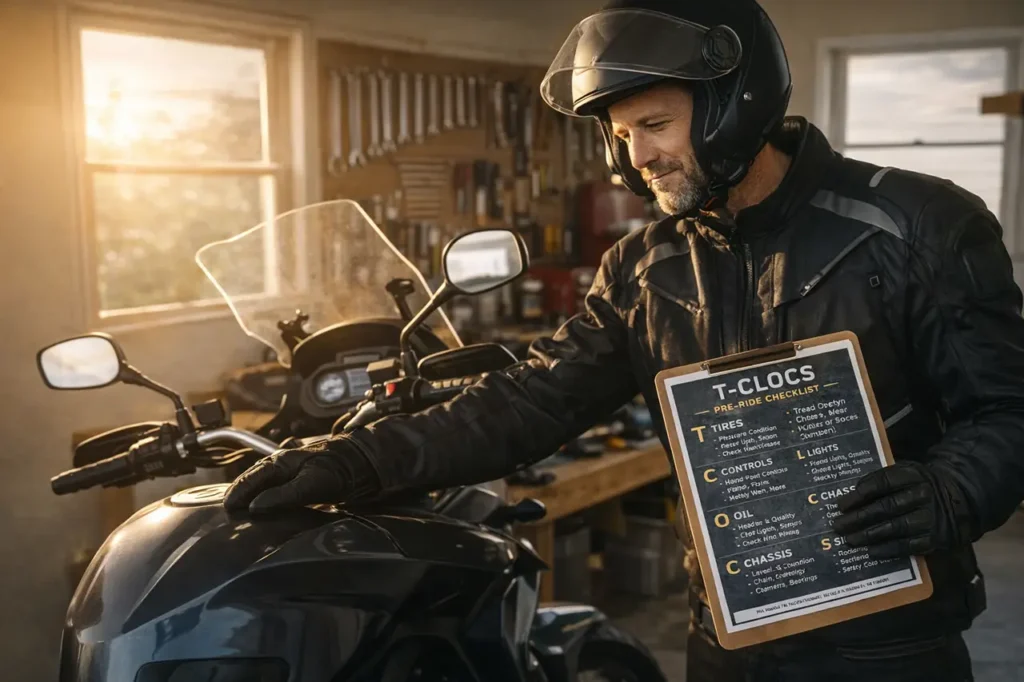
Rider doing pre-ride inspection in garage
If you’re short on time, here’s the quick version. But I really encourage you to read the full breakdown — the details are where the life-saving stuff lives.
⚡ TL;DR — T-CLOCS Pre-Ride Inspection
T-CLOCS stands for: Tires & Wheels, Controls, Lights & Electrics, Oil & Fluids, Chassis, and Stands.
- Takes 5–10 minutes and should be done before every single ride — yes, every one.
- T = Tires & Wheels: pressure, tread, sidewalls, spokes/rims, brake rotors.
- C = Controls: levers, cables, throttle, brake pedal, switches.
- L = Lights & Electrics: headlight, taillight, turn signals, horn, kill switch.
- O = Oil & Fluids: engine oil, coolant, brake fluid, clutch fluid.
- C = Chassis: frame, bodywork, chain/belt/shaft, suspension.
- S = Stands: sidestand, centerstand — check for cracks and that they retract properly.
⬇ Download the free printable checklist at the bottom of this post
Why T-CLOCS? And Why Does It Matter Every Single Ride?
T-CLOCS was developed by the Motorcycle Safety Foundation (MSF) and is the pre-ride inspection standard taught in their Basic RiderCourse. It’s not a bureaucratic checklist — it’s a memory aid built around six critical systems that determine whether your motorcycle is safe to ride.
I’ve met riders who say, ‘I check my bike when it feels wrong.’ That’s like only looking at the gas gauge when the engine starts sputtering. Motorcycles don’t always give you warning signs before something fails. A brake line that’s nearly empty, a tire that’s been losing a pound of pressure per week, a loose axle nut — none of these announce themselves until it’s too late.
The National Highway Traffic Safety Administration consistently lists tire and brake failures among the top mechanical causes of motorcycle crashes. A consistent pre-ride habit directly addresses both of those. Ten minutes. That’s the investment. Let’s break it down.
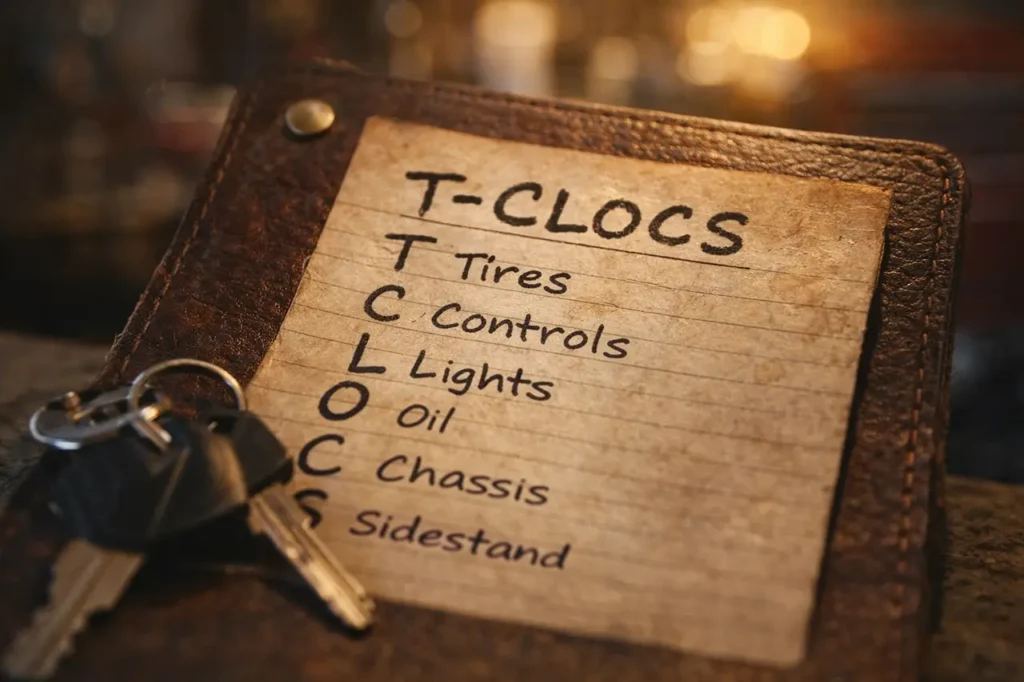
Calose-up of T-CLOCS acronym on a weathered garage wall or notepad
T — Tires & Wheels
If I had to pick one item on this list that matters more than all the others combined, it’s tires. Your tires are your bike’s only contact with the road — two palm-sized patches of rubber doing everything. They deserve serious respect.
Tire Pressure
Check cold tire pressure every single morning before you ride. Tires lose roughly 1 PSI per month naturally, and temperature drops can cause significant pressure loss overnight. A tire that was fine yesterday might be 3 PSI down after a cold night.
Find your correct pressures in the owner’s manual or on the sticker inside the swingarm — not on the tire sidewall (that’s the maximum, not the recommended). For most bikes it’s somewhere in the 32–42 PSI range front and rear, but this varies wildly, especially for sport bikes vs. cruisers vs. ADV bikes.
I keep a quality digital gauge in my jacket pocket at all times. The cheap pencil-style gauges are notoriously inaccurate. A $15 digital gauge is the easiest safety upgrade you can make.
Tread Depth & Wear
Most motorcycle tires have tread wear indicators — small rubber bridges in the grooves. When the tread wears down to those indicators, you’re at 1/32 of an inch, which is the legal and safety minimum. In wet conditions, I’d personally replace well before that.
Walk around the tire and look for: flat spots (from a burnout or long straight-line braking), cupping (scalloped wear from worn suspension), cracking in the sidewall, embedded objects like nails or screws, and bulges. A bulge means the tire’s internal structure is compromised — ride it to the shop immediately and get it replaced. Do not take a trip.
Wheels, Rims & Rotors
Grab the wheel at 9 and 3 o’clock and try to wobble it side to side. Any play usually means a worn wheel bearing. Also check:
- Spoked wheels: squeeze each spoke to feel for tension. A loose spoke pings differently than a tight one. Even two or three loose spokes can throw a wheel out of true over time.
- Cast wheels: look for cracks around the spokes or rim edge, especially after hitting a pothole.
- Brake rotors: check for scoring, warping (you’ll feel this as brake pulsation), and that the rotor retaining bolts are all present and tight.
- Axle nut: give it a visual check. It should have a cotter pin or castle nut. If either is missing, don’t ride.
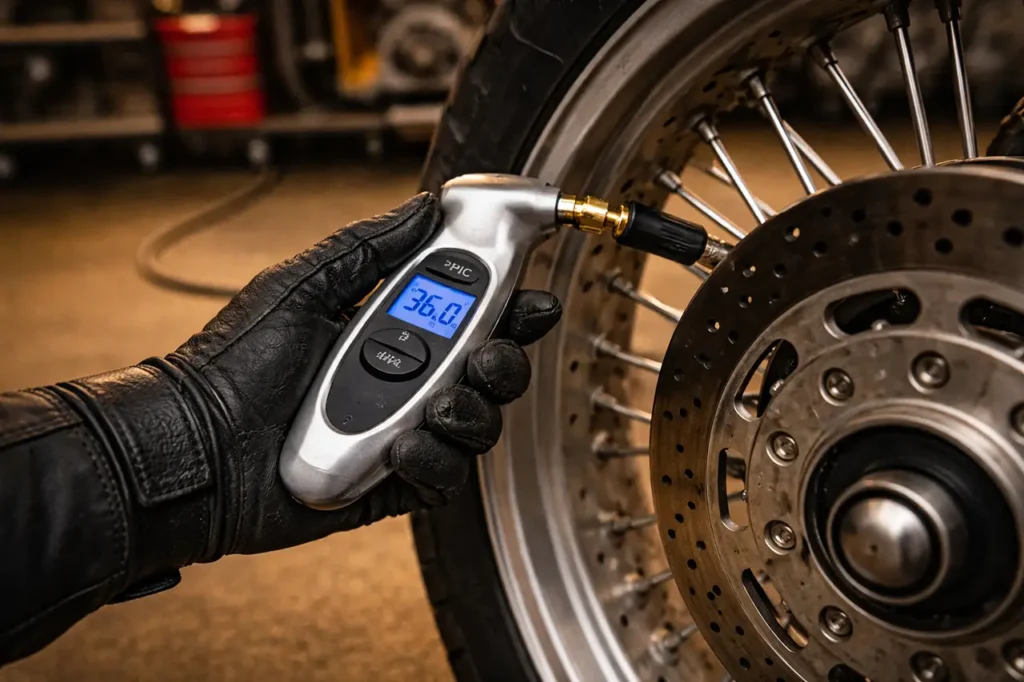
Motorcycle tire pressure being checked with digital gauge
C — Controls
Controls are everything you physically touch and operate. If any of these fail mid-ride, you’re in serious trouble.
Throttle
Roll the throttle open and release it. It should snap back fully and crisply. Then turn your handlebars lock-to-lock while the throttle is closed — if it sticks or binds at any steering angle, your cable routing might be pinching somewhere. This is a known issue on some bikes after handlebar swaps.
Also check throttle freeplay. You want a small amount (usually 2–3mm) but not zero — zero freeplay means the throttle could crack open slightly when you push the bars forward in a turn.
Brake Levers & Pedal
Squeeze the front brake lever firmly. It should feel solid within the first third of travel. If it feels spongy or pumps up after multiple squeezes, you likely have air in the hydraulic line or low brake fluid — both require attention before riding.
Press the rear brake pedal and check the pedal height. Most bikes let you adjust this, and it should feel natural under your heel-ball-toe positioning. Check brake light activation while you’re doing this — press each brake independently and confirm the brake light comes on.
Clutch Lever & Cable
For cable-operated clutches, check freeplay at the lever tip (typically 2–3mm). Too much freeplay means the clutch might not disengage fully; too little means you risk clutch slip. If you have a hydraulic clutch, squeeze it — it should feel similar to your brake lever (firm, progressive).
Run your eyes along the entire clutch cable if it’s a cable type. Look for kinks, fraying near the ferrules, or cracked housing. Cable failures tend to happen at the ends where they bend.
Handlebar & Switches
Give the handlebars a shake — they should feel rock solid with no movement in the clamps. Check that the bar end weights (if equipped) are tight. Then run through your handlebar switches: horn, turn signals, engine kill switch, high beam, and any mode buttons. Do this before you start the engine so you’re not surprised by a dead horn later.
L — Lights & Electrics
Being seen is staying alive. Lights are one of the few things that are simultaneously your safety system and the thing that makes you visible to everyone else. Check all of them.
Headlight
Turn the bike on and confirm the headlight illuminates in both low and high beam. Then push the bars left and right to make sure the headlight housing is secure and doesn’t wiggle. A loose headlight can vibrate off-aim over bumpy roads, meaning you’re underilluminating what’s ahead at night without realizing it.
If you have a projector-style LED headlight, also confirm the cutoff line is correct. Aftermarket LED retrofits sometimes project unevenly, which can blind oncoming traffic.
Tail Light & Brake Light
Walk to the rear of the bike. Confirm the taillight is on (always-on running light). Then squeeze each brake independently and confirm the brake light activates brighter. If you’re riding solo, prop a mirror behind the bike or press the brake and step back to check. This catches bulb failures that you’d otherwise only discover when someone rear-ends you.
Turn Signals & Horn
Activate both left and right turn signals and verify all four blinkers are working. A super-fast blink rate (hyper-flash) usually means one bulb is out. If you’ve switched to LED signals without a load equalizer, you’ll experience this regularly.
The horn gets overlooked every time. Hit it once. It costs you literally one second and could save your life the first time a car turns into you.
Dashboard Warning Lights
When you key on, your dash should light up with the standard warning indicators (check engine, oil pressure, ABS, etc.) and then most should extinguish once the bike starts. If any stay on after startup — especially ABS or traction control indicators — that’s a signal to investigate before your ride.
O — Oil & Fluids
Fluids are the lifeblood of your motorcycle. Low or contaminated fluids cause catastrophic failures — often without warning. The good news: checking them takes less than two minutes.
Engine Oil
Check engine oil when the bike is cold and on level ground (or on its centerstand if equipped). Most bikes have either a sight glass on the right side of the engine or a dipstick accessed from the same area. The oil level should be between the minimum and maximum marks.
While you’re looking at the sight glass, also check the color. Fresh oil is honey-amber. Dark brown oil is used but still fine. Black, milky, or foamy oil signals a problem — black could mean extended intervals, milky means coolant contamination (head gasket issue), and foamy means air intrusion.
Check for any oil spots under the bike from the night before. A few drops might just be a weeping gasket, but a puddle demands immediate investigation.
Brake Fluid
Front and rear brake fluid reservoirs are usually translucent plastic with MIN/MAX lines. Brake fluid level drops slowly as your brake pads wear (the caliper pistons extend), so a gradually lowering level is normal — until it hits the minimum, at which point you need new pads imminently.
A sudden significant drop in brake fluid level, however, means you have a leak. Don’t ride until you find it.
Also check the fluid color — it should be clear to slightly yellow. Dark brown or black brake fluid is old and hygroscopic (it’s absorbed moisture), which dramatically raises its boiling point and causes brake fade. Service it every two years regardless of level.
Coolant (Liquid-Cooled Bikes)
Check the coolant overflow reservoir — there’s a MIN line on the translucent tank, usually near the radiator. Don’t open the radiator cap cold to check (and especially not warm — pressurized coolant burns). The overflow tank level tells you everything you need during a pre-ride check.
If your coolant level is consistently dropping between rides without any obvious leaks, investigate further. It could be burning off through a compromised head gasket.
Clutch Fluid & Other Hydraulics
Bikes with hydraulic clutches have a separate reservoir on the left handlebar. Check it just like the brake fluid. Some bikes also have a hydraulic center stand actuator or other hydraulic systems — check your owner’s manual for their locations.
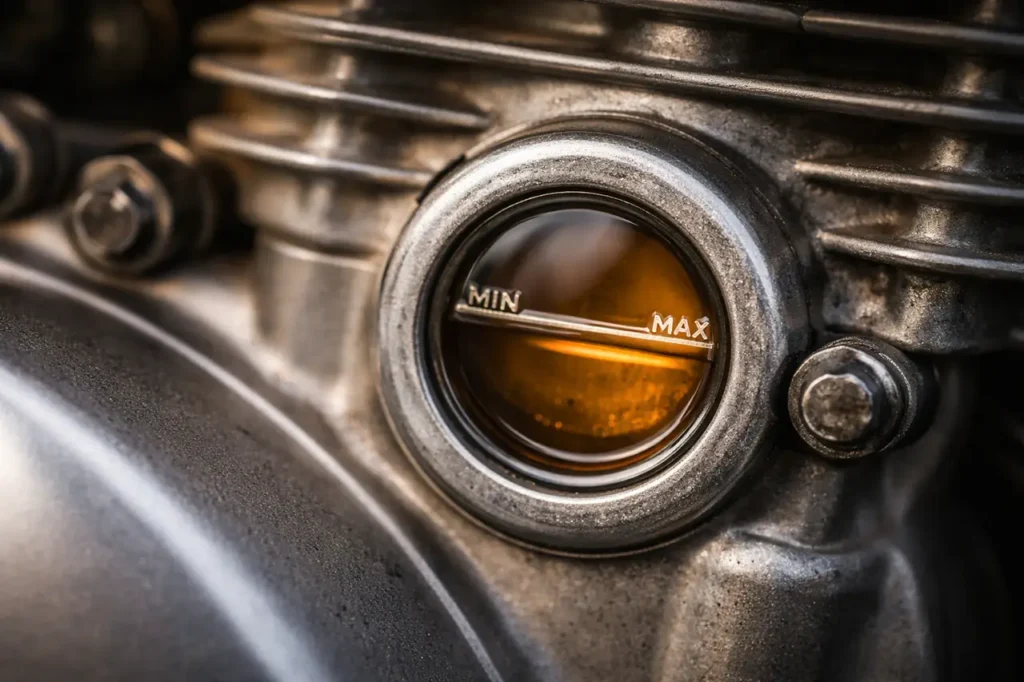
Motorcycle engine oil sight glass showing proper level
C — Chassis
Chassis covers the physical structure of your bike — frame, suspension, drive system, and bodywork. These items change slowly over time, which means problems creep up on you.
Chain, Belt, or Shaft Drive
For chain-driven bikes (most bikes), look for: proper slack (usually 25–35mm mid-chain, check your manual), rust or stiff links, stretched or kinked sections, and adequate lubrication. A dry chain is a noisy chain, and it’s rapidly wearing itself, your sprockets, and potentially your countershaft seal.
Belt drive (most Harleys and some BMWs): look for cracks, fraying, or missing teeth on the belt. Belt drives are essentially maintenance-free but they do fail eventually — a cracked belt can snap on the highway.
Shaft drive: check for any leaks at the final drive housing. Shaft drives are extremely low maintenance, but the fluid does need changing at manufacturer-specified intervals.
Suspension
With the bike on level ground, compress the front forks a few times. They should move smoothly through their travel with no binding and come back without excessive bouncing (more than one return oscillation usually means worn damping). Check the fork tubes for oil weeping — a fine ring of oil around the lower tube is a sign the fork seal is on its way out.
Similarly, bounce the rear of the bike. Most rear shocks last many years, but look for any wetness on the shock body or unusual clunking sounds through the linkage.
Check all suspension linkage pivot bolts you can visually access. These work loose over miles and most riders never check them.
Frame & Bodywork
You don’t need to crawl under the bike with a flashlight every morning, but do a quick visual of the frame at obvious stress points — around the steering head, swingarm pivot, and footpeg mounts. Any new cracks in painted frame sections deserve investigation.
Make sure fairings and bodywork panels are secure. A loose fairing at 70 mph is a hazard for you and cars behind you. Check the fuel tank cap is fully closed and locked.
S — Stands
The last letter in T-CLOCS gets overlooked most often, but sidestand failures cause a surprising number of bike drops — and occasionally rider injuries when the stand doesn’t retract fully.
Sidestand
Lower and raise the sidestand a couple of times. It should swing smoothly, not grind or require significant effort. Check the sidestand pivot bolt — these come loose, and a wobbly sidestand is unnerving when you’re parking on uneven ground.
Critically: confirm the sidestand return spring is intact and functional. This spring is what snaps the stand back up when you lift the bike. A broken spring means the stand can drag on the ground while riding — in a left-hand corner, that can lever the bike upright violently.
Most modern bikes have a sidestand interlock switch that cuts the engine if the stand is down when a gear is selected. Test it: put the bike in gear with the sidestand down and try to move forward — the engine should cut. If it doesn’t, your interlock is bypassed or failed. This is a safety item worth fixing.
Centerstand (If Equipped)
If your bike has a centerstand, check that it retracts fully with no sagging or dragging. Look at the mounting points for cracking in the frame tabs — centerstands put significant leverage on the frame when used repeatedly.
How Long Should a T-CLOCS Check Actually Take?
Honestly? Once you’ve done it 20 times, the whole walkaround takes five to seven minutes. The first few times it’ll take closer to fifteen because you’re building the muscle memory of where things are on your specific bike.
I follow the same physical path every single time: start at the front left (front tire), move clockwise around the bike (front right tire, right side, rear, left side), and end back at the front with a final look at the dash when I start the engine. The repetition is the point — it means I immediately notice when something is different.
You don’t need to pull out your phone or a clipboard every morning (though the first few months, a physical checklist helps enormously). The goal is to internalize the habit so thoroughly that not doing it feels wrong.
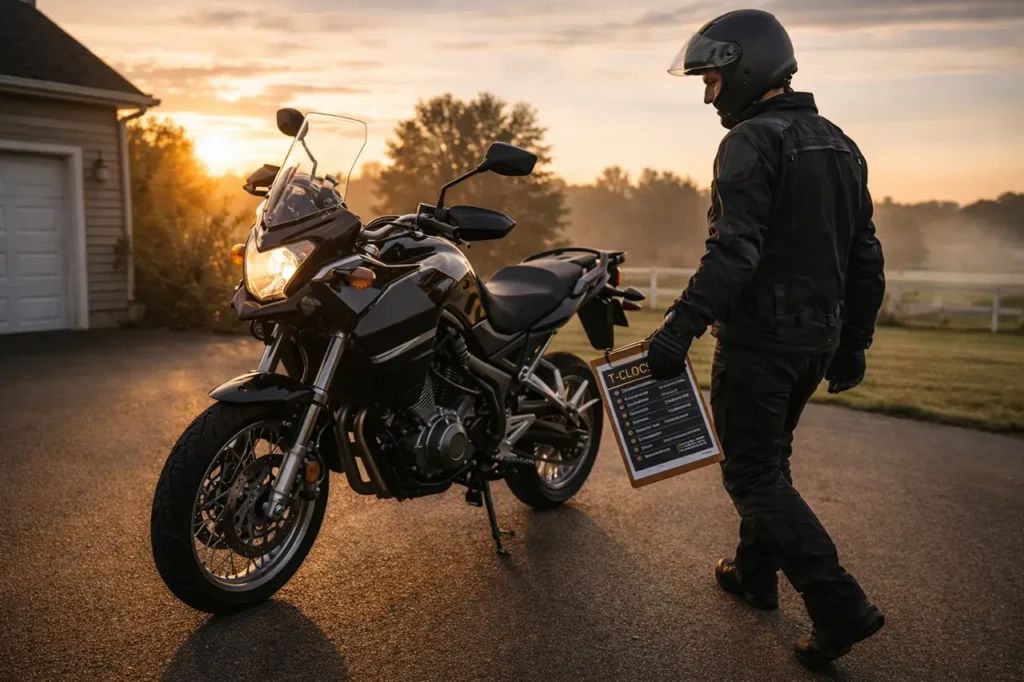
Rider walking around motorcycle doing systematic T-CLOCS inspection
Common Mistakes Riders Make With Pre-Ride Checks
In my years of riding and talking with other riders, I see the same shortcuts come up over and over. Here are the ones worth calling out:
- Checking tire pressure after a warm-up ride. Hot tires show higher pressure than the true cold reading. Always check cold.
- Only checking when something feels off. Most pre-failure states feel completely normal until they don’t.
- Skipping the check on short rides. The five-mile coffee run is where you’ll discover the kickstand spring failed — not the 300-mile weekend trip.
- Not knowing your baseline. You need to know what ‘normal’ looks, sounds, and feels like for your bike so you can spot deviations.
- Ignoring the stands section entirely. It sounds trivial until a dragging sidestand takes a bite out of a left-hand sweeper.
- Never actually downloading the checklist. Having it posted in your garage for the first few months genuinely accelerates habit formation.
Making T-CLOCS a Non-Negotiable Habit
The hardest part of T-CLOCS isn’t knowing what to check — it’s building the discipline to do it even when you’re excited to ride and the weather is perfect.
Here are a few things that helped me build the habit:
- Anchor it to gear-up time. I do my check while walking the gear from the house to the garage, finishing just as I’m ready to put my helmet on. It doesn’t feel like extra time.
- Keep a tire gauge visible. Mine hangs on a hook next to the garage door. Out of sight, out of mind — visible means it gets used.
- Use the printable checklist for the first 30 rides. After that, you’ll have the sequence memorized and can go without it.
- Ride with someone who checks their bike. Peer behavior is the most underrated habit tool. When your riding buddy does a walkaround every time, you will too.
T-CLOCS Printable Checklist
Print this checklist, laminate it, and hang it in your garage. Use a dry-erase marker to check off each item on your first rides, until the sequence becomes second nature.
T-CLOCS Printable Checklist PDF Download
| Inspection Item | Status (✓ / ✗) | Notes / Action Needed |
| T — TIRES & WHEELS | ||
| Front tire pressure (cold) | ☐ | |
| Rear tire pressure (cold) | ☐ | |
| Front tire tread depth | ☐ | |
| Rear tire tread depth | ☐ | |
| Tire sidewalls (no cracks/bulges) | ☐ | |
| Wheel bearings (no wobble) | ☐ | |
| Spokes or rim integrity | ☐ | |
| Brake rotors (no scoring/warping) | ☐ | |
| Axle nuts & cotter pins | ☐ | |
| C — CONTROLS | ||
| Throttle opens & snaps back | ☐ | |
| Throttle smooth lock-to-lock | ☐ | |
| Front brake lever (firm, no air) | ☐ | |
| Rear brake pedal height & function | ☐ | |
| Clutch lever & cable/hydraulic | ☐ | |
| Handlebar switches functional | ☐ | |
| Horn works | ☐ | |
| L — LIGHTS & ELECTRICS | ||
| Headlight low beam | ☐ | |
| Headlight high beam | ☐ | |
| Tail/running light | ☐ | |
| Brake light (front brake) | ☐ | |
| Brake light (rear brake) | ☐ | |
| Turn signals all 4 corners | ☐ | |
| No warning lights after startup | ☐ | |
| O — OIL & FLUIDS | ||
| Engine oil level & color | ☐ | |
| No oil spots/leaks under bike | ☐ | |
| Front brake fluid level | ☐ | |
| Rear brake fluid level | ☐ | |
| Coolant overflow level | ☐ | |
| Clutch fluid (if hydraulic) | ☐ | |
| C — CHASSIS | ||
| Chain slack & lubrication | ☐ | |
| No stiff/kinked chain links | ☐ | |
| Front fork smooth (no binding) | ☐ | |
| Fork tubes (no oil weeping) | ☐ | |
| Rear suspension (no clunks) | ☐ | |
| Frame / swingarm (no cracks) | ☐ | |
| Bodywork & tank cap secure | ☐ | |
| S — STANDS | ||
| Sidestand pivot bolt tight | ☐ | |
| Sidestand return spring intact | ☐ | |
| Sidestand interlock switch works | ☐ | |
| Centerstand retracts fully (if equipped) | ☐ |
Date: _____________ Bike: _____________ Mileage: _____________
Final Thoughts: Check It Before You Wreck It
I know it feels like overkill — especially on the ninth consecutive morning you’re checking tire pressure and everything is fine. But that’s the nature of a safety habit: most of the time it catches nothing. The value is in the rare times it catches everything.
My 18-PSI rear tire moment was a turning point. I’ve had exactly three serious findings in my riding life from pre-ride checks: the soft tire, a brake line that was nearly empty (slow leak at a banjo bolt), and a rear brake pad that was completely gone on one side (uneven wear I’d missed). Any one of those, discovered mid-ride instead of in the driveway, could have ended very differently.
Do the check. Every ride. Even the five-minute ones. Especially those.
If this guide helped you, bookmark it, share it with your riding group, and download the checklist below. Ride safe out there.
Disclaimer: Maintenance advice states here are general rules of thumb, readers should always refer to their specific motorcycle’s owner’s manual, as intervals can vary wildly between a Harley Davidson and a Honda sportbike.
📎 Related Posts on RevvRider:
→ How to Choose a Motorcycle Jacket by Riding Style
→ Ultimate Motorcycle Jackets Guide [Pillar Post]
→ How to Clean a Leather Motorcycle Jacket
Sources:
https://msf-usa.org/documents/library/t-clocs-pre-ride-inspection-checklist/

Related Articles

Rusty Bolt Rescue: How I Remove Rust from Motorcycle Bolts Without Snapping Them
Rusty motorcycle bolts? Here's how I remove rust from motorcycle bolts safely, from penetrating oil soaks to vinegar baths, plus…
Jake Miller
11 min read

How to Properly Tie Down a Motorcycle: A Rider’s Field Guide to Straps, Anchors, and Zero Regrets
Learn how to properly tie down a motorcycle from a rider who has done it hundreds of times. Straps, anchor…
Jake Miller
10 min read

Basic Motorcycle Maintenance: My Honest Daily, Weekly, and Monthly Routine
I've spent years wrenching in my own garage. Here's my honest, no-nonsense guide to basic motorcycle maintenance, from daily checks…
Jake Miller
8 min read