Brakes are the single most important safety system on your motorcycle, and brake pad wear is one of those things that sneaks up on you — until the day it absolutely does not.
If you want a full picture of keeping your bike running safe and reliable, start with the maintenance on a motorcycle pillar guide — it covers everything from fluids to chains to seasonal prep. But right now, let us go deep on the one component that stands between you and a very bad day.
⚡ TL;DR — Quick Answer
- Replace your motorcycle brake pads when friction material reaches 2mm or less — do not wait for metal-on-metal grinding.
- Key warning signs: squealing or grinding noise, pulsing or vibrating brake lever, reduced stopping power, visible wear past the groove indicator, and a spongy or pulling lever.
- Checking pad thickness visually takes under two minutes and should be part of your pre-ride T-CLOCS check.
- Replacing pads at home is achievable for most riders with basic tools — budget 45 to 90 minutes and follow the steps in this guide.
- After fitting new pads, bed them in properly before relying on full braking force. Skipping bedding is the number one mistake new pad installers make.
The Day My Brake Pads Almost Cost Me
I have been riding for over twelve years, and I will tell you something that still makes me uncomfortable to admit: I almost rode through a major intersection on completely glazed brake pads because I kept telling myself I would check them after this ride, and then the next one, and the one after that. The front lever was feeling a little wooden. Stopping distance had crept up. I had been blaming the cold weather.
When I finally pulled the wheel and looked at the pads, the friction material was down to almost nothing — maybe 1.5mm on one side and less on the other. The wear had been uneven because a caliper slider was sticking, something I also had not noticed. I got lucky. My commute route had not demanded an emergency stop during those rides. The next one might have been different.
Since that day, brake pad inspection has been one of the first things I do at every service interval, and a quick visual check has become part of my pre-ride routine. This guide is everything I know about identifying worn brake pads, reading the warning signs before they become emergencies, and replacing the pads yourself with confidence.
1. Why Motorcycle Brake Pads Matter More Than You Think
On a car, worn brake pads are urgent but you usually have some warning and a fair amount of redundancy — four wheels, a parking brake, an electronic assist system. On a motorcycle, you have two small contact patches and two separate brake circuits. If your front brake loses effectiveness, you lose the majority of your stopping power. That is not a situation you want to discover mid-corner.
Motorcycle brake pads are subject to enormous stress. Every hard stop generates significant heat, which cycles through the pads, rotors, and caliper hardware repeatedly. Over time, the friction compound wears down. The rate at which it wears depends on your riding style, your bike’s weight, the type of pads fitted, and how often and how hard you brake.
Most riders are surprised by how quickly sport riders can go through pads — a dedicated track day can use up a pad set that would last a road rider months. On the flip side, a casual commuter who mostly rolls to gentle stops might find their pads lasting two to three years without much drama.
The key point is this: there is no universal ‘replace at X miles’ rule. Pad inspection is visual and tactile, and it is the only reliable way to know where you stand.
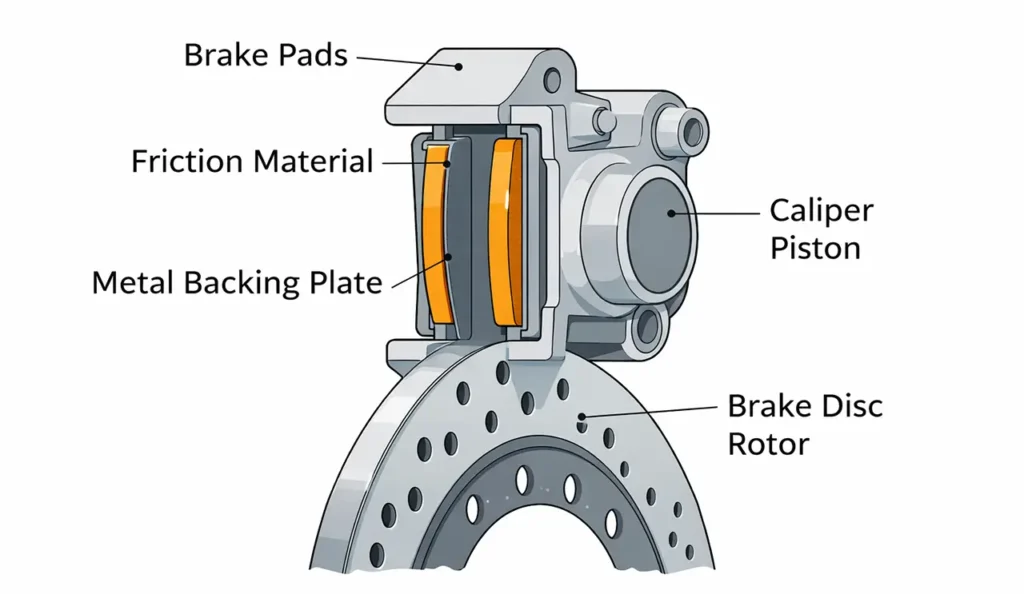
Cross-section diagram of motorcycle disc brake system showing pad thickness
2. How to Tell When Brake Pads Need Replacing: The Warning Signs
Before I get into the visual inspection process, let me walk through the warning signs that your pads are giving you. These are the signals that should make you stop and check immediately, not schedule a look for next weekend.
Squealing or Screeching Noise When Braking
This is the most common early warning sign, and a lot of riders dismiss it as heat, weather, or just ‘the bike being noisy.’ Do not dismiss it. Most quality brake pads have a small steel wear indicator tab built into the backing plate. When the friction material wears thin enough, this tab makes contact with the rotor and produces a high-pitched squeal. That is not an annoyance — it is an engineered warning system.
Not all pads have these tabs, especially performance aftermarket options, so squealing is a strong signal but not the only one to watch for. Some new pads will squeal briefly during bedding; that is normal and passes quickly. Persistent squealing on established pads is not normal.
Metal Grinding or Groaning
If squealing has moved into grinding or groaning, you have already gone past the warning and are now in the emergency zone. Grinding means the friction material is completely gone and the metal backing plate of the pad is contacting the rotor directly. This will damage the rotor rapidly — often requiring replacement of both the rotor and the pads — and it significantly compromises your braking performance right now.
I have seen riders try to get one more week out of grinding pads. Do not be that rider. The cost of replacing a rotor on top of pads is three to five times the cost of catching it at the squealing stage.
Pulsing or Vibration Through the Lever or Pedal
If you feel a rhythmic pulsing through the brake lever or rear pedal when you apply the brakes — a kind of throbbing sensation — that usually points to a warped or scored rotor rather than the pads themselves. However, pads that have worn unevenly, or pads with hot spots from glazing, can also create this sensation. Either way, pulsing is a signal to stop and inspect.
Reduced Stopping Power or Increased Lever Travel
If your bike is taking noticeably longer to stop than it used to, or if the lever is traveling further before you feel meaningful bite, pay attention. This can indicate several things — worn pads, air in the brake line, contaminated pads, or glazed pads — but worn friction material is high on the list. If your stopping distances have crept up and you cannot point to a specific other cause, check the pads.
Lever Pulling to One Side
If the bike pulls to one side when you apply the front brake, you likely have uneven pad wear — one side wearing faster than the other due to a sticking caliper slider or uneven caliper mounting. This is both a pad problem and a caliper maintenance problem. Address both at the same time.
⚠️ Do Not Ignore These Signs
Any of the above warning signs should be treated as a reason to inspect immediately — not to schedule an inspection. Brake failure does not give you a second chance. If in doubt, do not ride until you have checked.
3. How to Visually Inspect Your Brake Pads (The Right Way)
Knowing the warning signs is useful, but the honest approach to brake pad maintenance is not waiting for warning signs at all. It is building a visual inspection into your regular routine. Here is how to do it properly.
What You Are Looking For: Pad Thickness
Every brake pad has a friction material layer bonded to a metal backing plate. New pads typically have around 4mm to 7mm of friction material depending on the style and brand. The absolute minimum you should ride on is 2mm. Most manufacturers recommend replacement at or before 2mm, and I personally replace at 2.5mm because stopping distance on fresh pads versus worn-out pads is meaningful.
Some pads have a wear groove — a small channel molded into the friction surface. When that groove has disappeared, the pad is at or near its wear limit. This is your visual indicator, and it works whether or not your pads have the steel wear tab.
Checking Without Removing the Wheel
On most motorcycles, you can see the pads reasonably well without removing the wheel — which means you have no excuse not to check them regularly.
- Position yourself so you can see the caliper directly. On most bikes the front caliper is visible from the side of the wheel.
- Look through the gap between the caliper and the disc rotor. You should be able to see the friction material on at least one pad.
- Estimate the thickness. If you can see the wear groove is still present and there is visible friction material, you are likely above 2mm. If the groove is gone or the friction material is very thin, measure properly.
- Do both sides of the caliper — the inboard and outboard pads wear at different rates if a caliper slider is sticking.
- Repeat for the rear brake. Rear calipers are often slightly harder to see clearly but the principle is identical.
Measuring Properly With Calipers
If you want an accurate measurement — and I strongly recommend it over eyeballing — you need to either remove the wheel or at least partially release the caliper to access the pads. A digital vernier caliper (they cost around $15 and are enormously useful for general motorcycle maintenance) gives you an accurate reading in seconds. Anything below 2mm gets replaced that day.
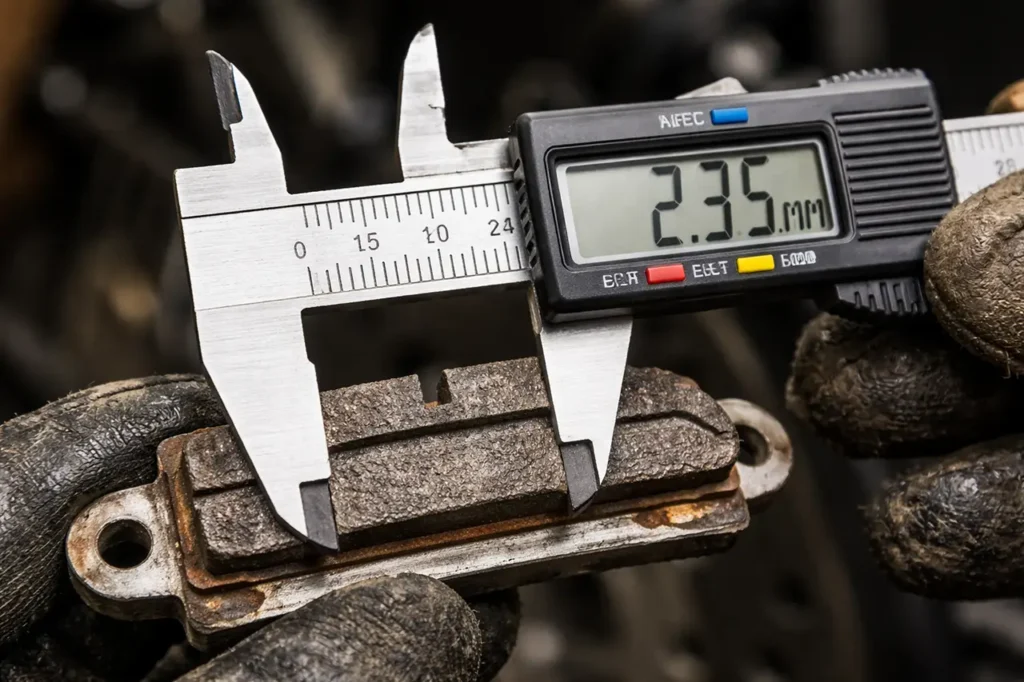
Close-up of motorcycle brake pad inspection showing wear groove and friction material thickness
Checking Rotor Condition While You Are There
Any time you are inspecting pads, spend thirty seconds on the rotor. Look for deep scoring grooves running around the rotor surface (caused by embedded pad material or debris), cracks, heat discoloration (a bluish tint indicates the rotor has been overheated), and visible thickness variation around the circumference. Rotors have a minimum thickness stamped on the hub — if the rotor is at or below that spec, replace it.
Running new pads on a heavily scored or warped rotor is money wasted. The new pads will embed rotor debris and wear faster and unevenly. If the rotor is in poor condition, replace both.
4. How Often Should You Inspect Brake Pads?
My schedule: I check pad thickness visually every time I do a full pre-ride T-CLOCS inspection — which for me is the start of every riding season, and any time I notice a change in brake feel. I do a quick caliper glance every 1,000 miles as part of my routine checks.
For a more formal inspection schedule tied to mileage:
| Riding Style | Check Interval | Typical Pad Life |
| Daily commuter (urban) | Every 3,000 miles | 8,000–12,000 miles |
| Weekend sport/twisty roads | Every 2,000 miles | 5,000–9,000 miles |
| Track days or aggressive sport riding | Every track day | 1–3 track days per set |
| Long-distance touring | Every 4,000–5,000 miles | 10,000–18,000 miles |
| Casual/occasional riding | Every 6 months minimum | Varies widely |
These are rough guides, not guarantees. Your riding style, bike weight, and braking habits matter enormously. The only reliable answer is what you see when you look.
5. Choosing the Right Replacement Brake Pads
Brake pads are not a one-size-fits-all component. The compound — the material that makes up the friction layer — affects feel, bite, modulation, heat resistance, and rotor wear. Getting this right matters.
Sintered vs Organic (Resin) Pads
These are the two main categories you will encounter.
- Sintered pads are made from metallic particles fused together under heat and pressure. They perform well from cold, handle heat well, and last longer. The trade-off is they are harder on rotors and can feel slightly wooden at low speeds until bedded in. My choice for road riding, especially in the wet.
- Organic (resin) pads use a softer compound of friction materials bound together. They offer better initial bite when cold, lighter rotor wear, and often better feel at moderate temperatures. They wear faster and can fade more quickly under sustained heavy braking. Good for lighter bikes and moderate riders.
There is also a semi-sintered or semi-metallic middle ground that tries to balance both. Brands like EBC, Brembo, Galfer, Ferodo, and Vesrah cover the full range. I have had good results with EBC sintered pads on road bikes and Brembo on sport-oriented setups.
OEM vs Aftermarket
OEM pads — the ones specified by your bike’s manufacturer — are a reliable baseline. They are what the braking system was designed and tested around. If you are happy with your braking feel and stopping power, OEM replacements are a perfectly sensible choice. They are not always the most cost-effective option, but they are the safest specification match.
Aftermarket pads from reputable brands can offer meaningful improvements in fade resistance, initial bite, or longevity. Just make sure you are buying the right compound for your riding style. A touring compound on a track-day bike is a mismatch; a race compound on a casual commuter will chew through your rotors faster than necessary.
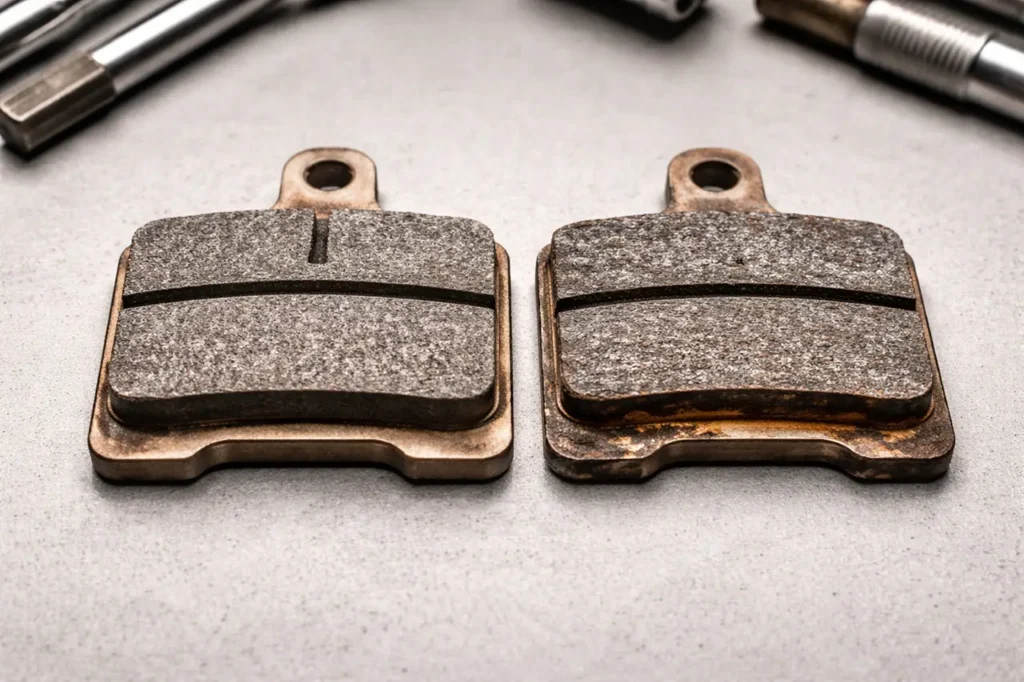
Comparison of new and worn motorcycle brake pads on a workbench
6. How to Replace Motorcycle Brake Pads — Step by Step
Replacing motorcycle brake pads is one of those jobs that sounds more intimidating than it is. The first time I did it, I spent forty-five minutes double-checking everything and consulting the service manual. Now it takes me about twenty minutes per caliper. If you have basic mechanical ability and a few tools, you can do this yourself.
Tools and Materials You Will Need
- New brake pads (correct specification for your bike)
- Socket set and combination spanners (metric)
- Allen key set
- Brake piston tool or large flathead screwdriver (to push pistons back)
- Brake cleaner spray
- Copper or ceramic anti-seize grease (for slider pins ONLY — never on friction surfaces)
- Clean lint-free rags
- Nitrile gloves
- Turkey baster or brake fluid syringe (for fluid overflow management)
- Your bike’s service manual
Step 1: Safety First — Prepare the Work Area
Put the bike on a paddock stand so the wheel is off the ground and can spin freely. Park on a flat, stable surface. Lay down a ground sheet or some cardboard — brake work gets messy. Put on your nitrile gloves before you touch anything. Brake dust contains compounds you do not want in your lungs or on your skin.
Open the front brake fluid reservoir cap and set it aside with a rag underneath it — fluid may overflow slightly when you push the pistons back in the next steps. Do not spill brake fluid on painted surfaces; it strips paint.
Step 2: Remove the Caliper
Locate the caliper mounting bolts — on most bikes these are two bolts attaching the caliper to the fork leg or caliper bracket. Remove these bolts and slide the caliper off the disc. Support it so the brake hose is not under tension; you can hang it from the fork leg with a zip tie or a wire hook rather than letting it dangle.
Do not squeeze the brake lever with the caliper removed and the wheel still in place, as this can push the pistons out too far and make reinsertion difficult. If someone accidentally squeezes the lever, you will need to carefully pry the pistons back using your tool before proceeding.
Step 3: Remove the Old Pads
With the caliper in hand, locate the pad retaining pin or bolt — usually a threaded pin that slides through the pad ears. Remove this, and the pads should slide out. Note which direction they came out and which way they were oriented. Take a photo before you remove them if this is your first time — it will save you confusion during reassembly.
Inspect the pad backing plates for corrosion and the pad springs for cracking or distortion. These small springs maintain consistent pad contact with the rotor and keep the pads from rattling. Replace them if they look tired — they are inexpensive and often come with a new pad kit.
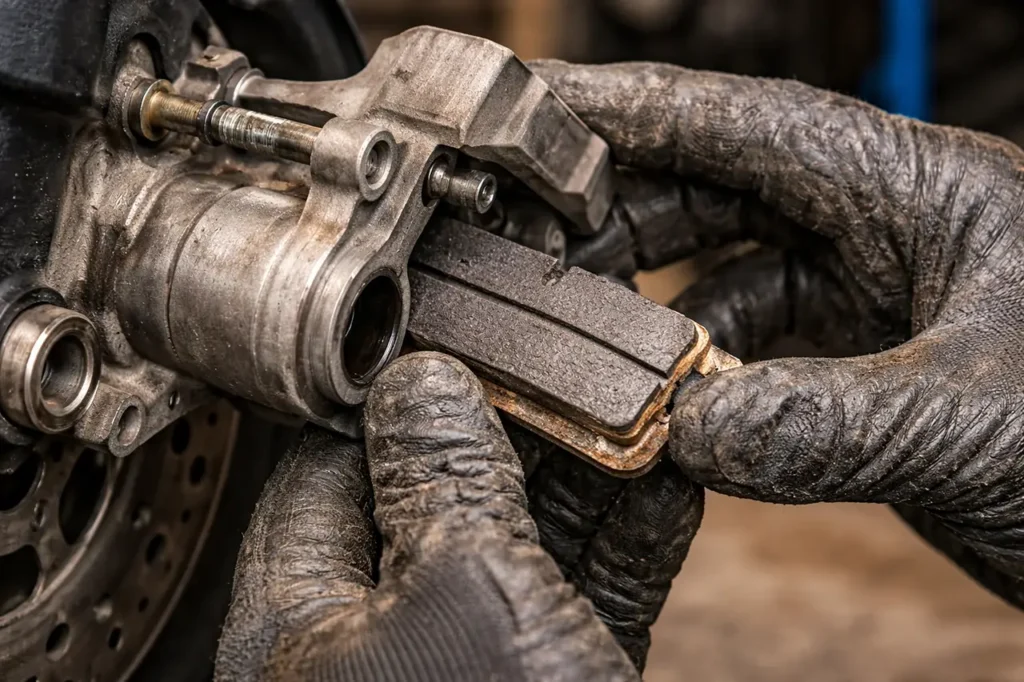
Mechanic removing brake pads from a motorcycle caliper with retaining pin visible
Step 4: Clean the Caliper
While the pads are out, this is your opportunity to clean the caliper properly. Spray brake cleaner into the caliper body, particularly around the pistons and the pad contact areas. Wipe out the loosened debris with a clean rag. Do not use any lubricant inside the caliper body or on the friction surfaces.
Check the caliper slider pins — these are the lubricated bolts that allow the caliper to float on its bracket and ensure both pads apply evenly. If they are dry, corroded, or stiff, clean them with brake cleaner and re-lubricate with fresh caliper grease or copper slip. Sticking sliders are one of the most common causes of uneven pad wear and pulling during braking.
Step 5: Push the Pistons Back
New pads are thicker than your worn ones. To fit them, you need to push the caliper pistons back into the caliper body. Use a brake piston tool (a ratcheting spreader designed for the job) or carefully use a large flathead screwdriver between the old pad and the piston face — slowly, evenly, without scoring the piston.
Push both pistons back evenly if you have a twin-piston caliper. Keep an eye on the brake fluid reservoir — as the pistons retract, fluid flows back up and the reservoir level will rise. If it looks like it is about to overflow, remove a small amount with a turkey baster before continuing. Do not let it overflow onto the fairing.
Important: Do Not Over-Push the Pistons
Pushing pistons all the way into the caliper body can damage the seals. You only need them retracted enough to accept the new, thicker pads. Push until you can fit the new pad into the space — then stop.
Step 6: Install the New Pads
Inspect the new pads before fitting. Make sure the friction material is firmly bonded to the backing plate and there are no cracks. Some pads come with a thin shim of anti-squeal material on the backing plate — fit these as directed by the pad manufacturer.
Slide the new pads into the caliper in the same orientation the old ones came out. Reinsert the retaining pin and tighten it to the torque specified in your service manual. Do not overtighten — these are often aluminium threads and they strip easily.
Reinstall any pad springs in the correct orientation.
Step 7: Reinstall the Caliper
Slide the caliper back over the disc rotor. It should slide on smoothly if the pistons are retracted correctly. If it is tight, do not force it — check that both pistons are evenly retracted.
Thread in the caliper mounting bolts by hand first, then torque them to specification. This is a safety-critical fastener. Use a torque wrench. Correct torque spec is in your service manual — do not guess.
Step 8: Pump the Lever to Reset the Pistons
With the caliper back on the bike, squeeze the brake lever slowly and repeatedly. The first few squeezes will go almost to the bar — the pistons need to re-extend from their retracted position out to contact the new pads. Keep pumping until the lever feels firm and the braking feel returns.
Do not get on the bike until the lever feels solid. A soft or travelling lever means the pistons are not properly extended, and you will have no effective braking until they are.
Check the brake fluid reservoir level. Top it up to the MAX line with fresh brake fluid of the correct specification (DOT 4 for most bikes — check your manual). Replace the reservoir cap.
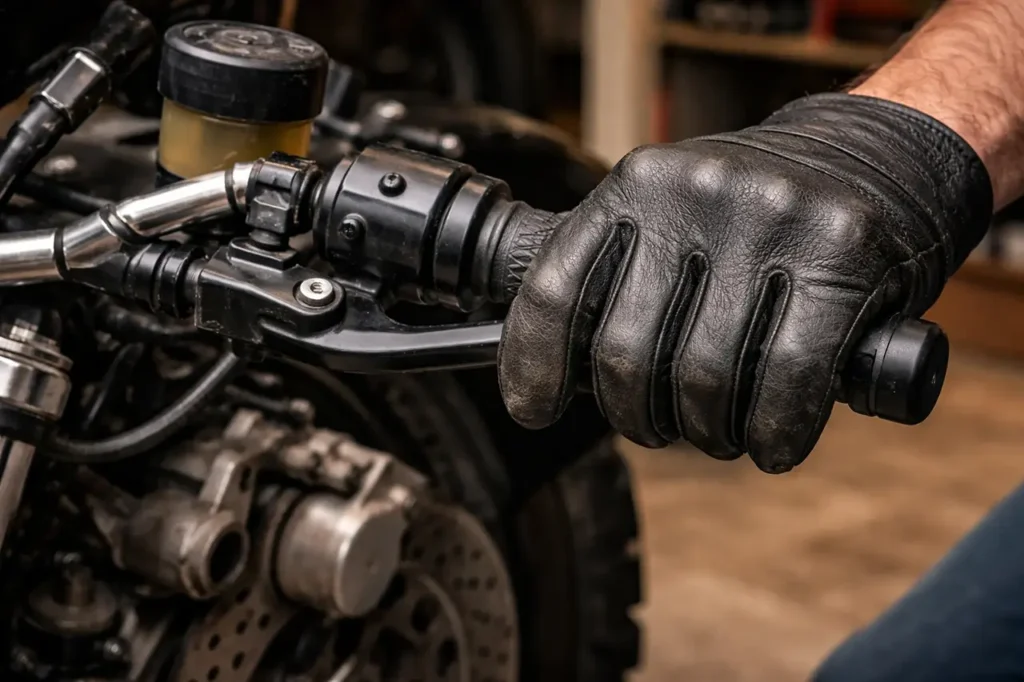
Pumping motorcycle brake lever to reset caliper pistons after pad replacement
Step 9: Do a Static and Roll-Forward Check
Before you ride anywhere, push the bike forward by hand and apply each brake firmly. Confirm the brake locks the wheel and releases cleanly without sticking. If the brake drags when you release, the pistons may not be retracting fully — a sign of a damaged seal or a sticking slider that needs further attention.
Look at the caliper and fluid reservoir one more time. No leaks, no drips, no staining. Everything is tight and secure. Now you can ride — but slowly at first.
7. Bedding In New Brake Pads — Do Not Skip This
This is the step that most first-time brake changers skip, and it is genuinely important. New brake pads need to be bedded in — a process of gradually transferring a thin, even layer of pad material onto the rotor surface so that the pad compound and rotor are properly mated.
Without bedding in, you risk glazing the pads (making the surface glassy and slippery rather than grabby), getting inconsistent braking feel, and not achieving the full stopping power the pads are capable of.
The Bedding-In Process
- Find a quiet road or empty car park with good visibility and no traffic pressure.
- Accelerate to approximately 30 mph, then apply the brake firmly but not aggressively to slow to about 5 mph. Do not come to a complete stop — keep moving slowly.
- Accelerate again and repeat. Do this six to eight times, allowing the brakes to cool between applications. You will notice the lever feel firming up and the bite improving with each cycle.
- After the first series, allow the brakes to cool for several minutes — do not park immediately and let heat soak into the pads. Keep moving slowly if possible.
- Do a second series at slightly higher speed if the first felt good.
- Avoid heavy emergency-stop-level braking for the first 100 to 200 miles. The pads are still fully bedding in during this period.
💡 Pro Tip: Avoid Coming to a Complete Stop During Bedding
Coming to a full stop mid-bedding cycle and holding the brake can transfer an uneven hot spot of pad material to the rotor, which you will feel as a pulsing sensation later. Keep rolling slowly between stops during the bedding sequence.
8. When to Take It to a Mechanic Instead
I am a firm believer in doing as much of your own maintenance as possible. But brake work has a zero-margin-for-error requirement that demands honest self-assessment.
Consider taking it to a professional if any of these apply:
- You have brake fluid leaking from the caliper body or banjo bolt — this indicates a seal failure requiring caliper rebuild or replacement.
- The caliper pistons are seized and will not move, even with the correct tool and steady pressure.
- The rotor is below minimum thickness, cracked, or badly warped — rotor replacement on some bikes requires wheel removal and specialist tools.
- You find air in the brake lines — bleeding is achievable at home but requires confidence and the right equipment.
- The brake hose is cracked, chafed, or swollen — replacement is non-negotiable and the correct torque on brake hose fittings is critical.
- This is your first time and you are not comfortable with the process after reading this guide. There is absolutely no shame in having a trusted mechanic do the first one while you watch. Learn from observation.
9. Post-Replacement Checklist Before Every Ride
Once you have replaced the pads, build these checks into your routine:
- Brake lever feels firm within the first third of travel
- No brake fluid leaks at the caliper or reservoir
- Brake activates the brake light correctly (both front and rear)
- Wheel spins freely with no dragging when brake is released
- Caliper mounting bolts are torqued to spec
- Brake fluid level is between MIN and MAX
- New pads are being bedded in gradually for the first 100 miles
Quick Reference: Brake Pad Warning Signs and Actions
| Warning Sign | Likely Cause | Action Required |
| Squealing when braking | Wear indicator tab contacting rotor | Inspect pads immediately — likely near end of life |
| Metal grinding or groaning | Friction material gone, metal-on-metal | Do not ride — replace pads (and possibly rotor) today |
| Pulsing through lever or pedal | Warped rotor or glazed/uneven pads | Inspect rotor and pads, measure rotor runout |
| Reduced stopping power | Worn pads, glazing, or fluid issue | Check pad thickness and brake fluid level |
| Lever pulling to one side | Uneven pad wear, sticking caliper slider | Inspect both pads, clean and lubricate slider pins |
| Spongy or soft lever | Air in brake line or very low fluid | Check fluid level, bleed brakes if needed |
| Pad material at 2mm or less | Normal wear at replacement threshold | Replace pads now — do not delay |
Final Thoughts From the Garage
There is something deeply satisfying about pulling a wheel, inspecting your own pads, and making a confident call about whether they have life left or need replacing. It is the kind of knowledge that makes you a better, more aware rider — not just a more capable mechanic.
Brakes are not glamorous. Nobody posts photos of their brake pads on Instagram. But every emergency stop you have ever made cleanly, every near-miss you threaded your way through, every corner you carried too much speed into and still got sorted — your brakes were doing their part every single time. They deserve your attention.
The signs are not subtle once you know what to look for. The squealing, the reduced feel, the visual wear at the groove — they are all there. And replacing pads yourself is genuinely achievable. The first time is the hardest. The second time, you wonder why you ever took it to a shop.
Check your pads. Replace them when they need it. Bed in the new ones properly. Then go enjoy the road they are going to help keep you on.
Ride safe out there.
Related Reading: