
10 Best GPS Nav Setups for Enduro Motorcycles (Rider Tested)
 Jake Miller
11 min read
Jake Miller
11 min read
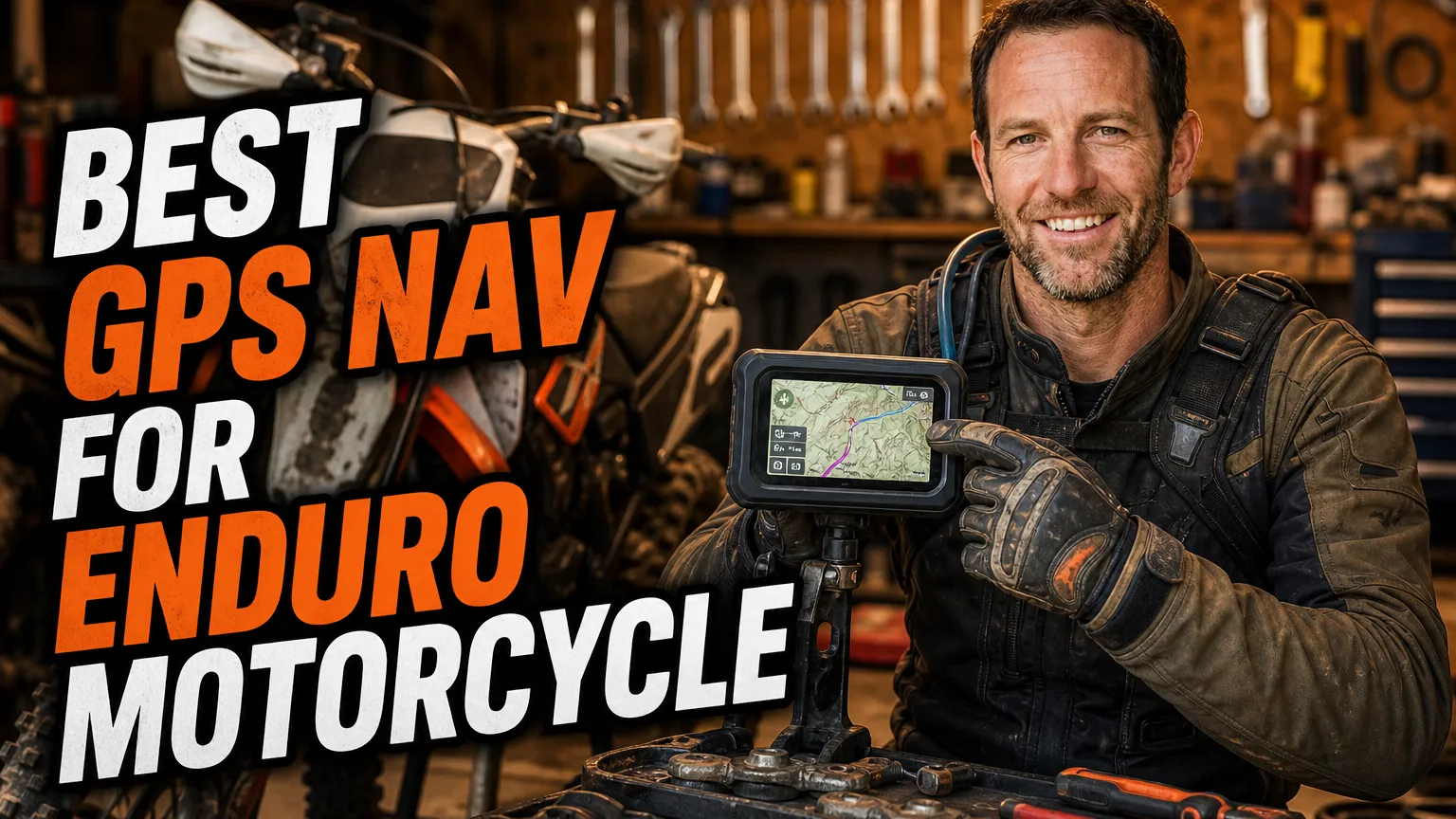
I have been bolting navigation gear to enduro bikes for the better part of a decade, and I have destroyed more than my fair share of screens along the way. Roots, roost, river crossings and the occasional unplanned get-off are brutal on electronics, and what works brilliantly on a touring bike often dies in the first twenty minutes of a muddy enduro loop.
So this list is not a spec-sheet copy and paste. Every unit below is something I have either run myself or watched a riding buddy run through a full season of trail abuse. I have focused on gear that survives vibration, reads clearly through dust, and actually helps you find the trail instead of distracting you from it.
If you ride tight woods, rocky climbs and rally-style routes, the right nav setup genuinely changes how confidently you ride. Here is what I would buy today.
- My overall pick is the Garmin Montana 700i for its 5-inch glove-friendly screen and satellite SOS.
- For a purpose-built enduro dash, the Trail Tech Voyager Pro is hard to beat on KTM and Husqvarna platforms.
- Budget riders should start with the DMD2 app on a rugged Android phone before spending big.
- Rally racers need a roadbook device like the Tripy II, not a standard trail GPS.
- Always hardwire power to the bike, and mount behind the bars so the unit survives a crash.
1. Garmin Montana 700i — My Overall Pick for Enduro Riding
If I could only own one navigation device for dirt bikes, it would be the Montana 700i. The 5-inch glove-friendly touchscreen is the key feature here, because I can zoom and pan with muddy winter gloves on without ever taking my hand off the bar.
The 700i is IPX7 rated and built to MIL-STD-810 standards for shock and vibration, which is exactly what a bike that spends half its life airborne needs. It also locks onto GPS, GLONASS and Galileo satellites, so I get a solid fix even in deep valleys and tight tree cover.
Why I Keep Coming Back to It
The inReach satellite messaging and SOS on the 700i is the feature that made me commit. Riding remote alpine singletrack alone is genuinely risky, and knowing I can trigger an SOS without cell signal is worth a lot to me.
Battery life sits at roughly 18 hours on the rechargeable pack, and I keep Garmin’s optional AA battery pack in my pack as a backup. That combination has saved a multi-day trip for me more than once.
Where It Falls Short
It is heavy and chunky compared to a phone, and it is not cheap at around $600. The touchscreen also gets sluggish in heavy rain, which is why I still carry paper notes for really nasty weather.
2. Trail Tech Voyager Pro — The Best Purpose-Built Enduro Dash GPS
The Voyager Pro is the only unit on this list that was designed from the ground up for dirt bikes rather than adapted from hiking or touring gear. Its 4-inch color touchscreen mounts straight onto the OEM dash bracket on most KTM, Husqvarna, GASGAS and Beta enduro models.
What I love most is that it is not just a navigator. It doubles as a full instrument cluster, showing speed, RPM, engine temperature, voltage and ambient temperature, all pulled from the bike itself.
The Navigation Side
You import GPX files through Trail Tech’s Tracks app, then follow breadcrumb trails on a moving map. It is genuinely good for following a pre-ridden loop or a race route you have uploaded the night before.
The buddy tracking feature is a nice touch when riding in a group, since you can see where the rest of your crew is on the map. That has saved me from a lot of waiting at trail junctions.
What Bugs Me
The basemap detail is nowhere near Garmin’s TopoActive maps, and the Tracks app feels clunky compared to modern phone software. The screen is also smaller than a Montana, so I have to glance a bit longer at speed.
At roughly $400 to $500 depending on the mount kit, though, it is excellent value if your bike already has the wiring loom for it.
3. Garmin Tread Overland Edition — Best Dedicated Off-Road Navigator
Garmin’s Tread line was built specifically for off-road vehicles, and the Overland Edition with its 8-inch display is a serious piece of kit. It comes preloaded with public land boundaries, Forest Service roads, BLM trails and TopoActive mapping, plus iOverlander campsites.
For enduro riders who also do long dual-sport trips and camp along the way, that land-access data is genuinely useful. I have used it to find legal trailheads that no other device in my kit showed.
Group Ride Radio
The built-in Group Ride Radio lets you track and talk to other riders in your group, which is brilliant on big adventure loops. It is overkill for a two-hour enduro blast, but on a multi-day ride it changes the whole dynamic.
The Honest Downsides
The 8-inch Overland Edition costs well over $1,000 and it is physically huge on a dirt bike. I would only run it on a proper rally tower or a big dual-sport. The smaller 5.5-inch Tread Base Edition around $600 is far more realistic for enduro use.
4. Carpe Iter Adventure Tablet + Control Pad — Best Big-Screen Android Setup
Carpe Iter is a Slovenian company making Android-based navigation hardware for adventure and enduro riders, and their Adventure Tablet is the setup I reach for on long navigation-heavy trips. It is a roughly 7-inch ruggedized Android tablet with a very bright display and glove-friendly touch.
The real magic is the Control Pad, a handlebar-mounted button pod that lets me zoom, scroll and switch screens without touching the screen at all. In tight woods with muddy gloves, that is a game changer.
Software Freedom
Because it runs Android, I can install DMD2, OsmAnd, Locus Map or Gaia GPS and pick whichever suits the ride. That flexibility means I am never locked into one map provider or one routing style.
What to Watch Out For
It is a bigger, heavier installation, and a big crash can be unkind to a tablet. Prices land around €500 for the tablet plus roughly €200 for the Control Pad, so it is a commitment.
5. Garmin GPSMAP 67i — Best for Remote Backcountry and SOS
When I am heading somewhere genuinely remote, the GPSMAP 67i is what goes on the bars. It uses buttons rather than a touchscreen, which sounds archaic until you realise buttons always work with thick gloves, in rain, and with mud on your hands.
It supports multi-band GNSS, meaning it locks onto multiple satellite frequencies for noticeably better accuracy under dense canopy and in canyons. That precision matters when you are trying to find a faint singletrack turn.
Satellite Comms and Battery
Like the Montana 700i, the 67i includes inReach satellite messaging and an SOS button. Battery life is measured in days rather than hours, which means it easily outlasts a full weekend of riding on one charge.
Where It Frustrates Me
The 3-inch screen is small, and panning a map with buttons is slow compared to a touchscreen. At around $600 it is also priced like a premium device despite the modest display.
6. Garmin Zumo XT2 — Best for Dual-Sport and Road-Biased Riders
If your enduro bike spends as much time on tarmac as it does on dirt, the Zumo XT2 is a strong compromise. Its 6-inch display is extremely bright, IPX7 sealed and glove-friendly, and it comes with both street maps and TopoActive off-road mapping.
Garmin’s Adventurous Routing is genuinely fun on backroads, and I have used the XT2 to string together gravel connectors between trail networks that I would never have found otherwise.
Group Riding Features
With the optional Group Ride Radio accessory, the XT2 lets you see and talk to other riders, which is a big plus on organised dual-sport events. Wi-Fi updates mean map refreshes happen at home rather than on your laptop.
Why It Is Not My Enduro First Choice
It is road-biased in both routing logic and physical size, and it is heavy for tight woods work. At roughly $600 it is also a big spend if you mostly ride dirt.
7. Garmin eTrex 32x — The Best Budget Dedicated Handheld
The eTrex 32x is the little device I recommend to riders who want a proper dedicated GPS but do not want to spend premium money. It has a 2.2-inch colour screen, button controls, IPX7 sealing and preloaded TopoActive maps with a microSD slot for more.
It also includes a three-axis compass and a barometric altimeter, which is genuinely useful for elevation-based route planning on mountain loops. Battery life is about 25 hours on a pair of AA batteries, which is easy to carry spares for.
Where It Wins
It is small, light, cheap at roughly $300, and it survives crashes that would kill a phone. I have used mine as a backup nav on rally-style rides and it has never let me down.
Where It Loses
The screen is tiny and the interface feels dated, so following a complex route at speed is hard work. It is a backup or a starter device, not a primary nav for fast enduro riding.
8. DMD2 on a Rugged Android Phone — Best Software-First Budget Route
Before you spend hundreds on hardware, I genuinely suggest trying the DMD2 app on a rugged Android phone in a waterproof cradle. It is a dual-sport mapping app built by riders, with offline vector maps, GPX import, waypoints, a trip computer and even a digital roadbook mode.
Combined with a cheap rugged handset, the whole setup costs less than a tank of fuel plus a phone you probably already own. I used this exact combination for a full season before buying dedicated hardware.
The Real Problems
Phone batteries drain fast with the screen on and GPS running, and heat is a genuine issue on slow technical trails. Vibration is the other killer, since it can destroy optical image stabilisation in camera modules.
Use a proper vibration-damping mount and a phone you do not care about, and this becomes a genuinely viable enduro nav setup.
9. Tripy II — Best Rally Roadbook Navigator
If you race rally or ride roadbook-style routes, a standard trail GPS will not cut it. The Tripy II is a digital roadbook that scrolls tulip diagrams as you ride, paired with a precise trip meter and cap heading so you can navigate at speed without stopping to read notes.
This is the style of navigation used in Dakar-style events, and once you learn it, it is far faster than staring at a map. The unit mounts on a rally tower, runs off bike power and is built for the abuse of racing.
Who It Is For
This is a specialist tool for rally racers and hardcore roadbook riders, not for casual trail riding. You need roadbook files to make it useful, and the learning curve is real.
Cost and Compromise
Expect to pay several hundred euros, and accept that it does not replace a mapping GPS for exploring. I run mine alongside a Montana rather than instead of it.
10. KTM Connectivity Unit Offroad — Best Factory-Integrated Option
If you ride a recent KTM enduro model, the factory Connectivity Unit Offroad is the cleanest navigation solution available. It plugs into the bike’s wiring and pairs with the KTMconnect app to put turn-by-turn navigation and uploaded GPX routes directly on the TFT dash.
There is no extra screen to mount, no cradle to break, and nothing hanging off your bars to snag on branches. For riders who mostly follow pre-planned routes, that minimalism is very appealing.
The Catch
It only works on compatible late-model bikes, and you are limited to the factory software rather than free choice of apps. The screen is also small compared to a dedicated GPS unit.
If it fits your bike, though, it is the tidiest enduro nav setup I have used, and it costs a fraction of a premium handheld.
How I Actually Mount and Power These Units
Whatever you buy, hardwire it to the bike. Internal batteries die at the worst possible moment, and swapping batteries on a muddy hillside is miserable.
I always mount behind the bars rather than above them, so the unit is protected in a crash. A vibration-damping mount is non-negotiable for anything with a camera or a lot of internal electronics.
Finally, download your maps for offline use before you leave home. Nothing ruins a ride faster than a blank screen at the trailhead.
My Bottom Line
If I had to pick one, it is the Garmin Montana 700i for its balance of screen size, ruggedness and satellite safety. Enduro riders on KTM-family bikes should seriously look at the Trail Tech Voyager Pro instead, since it doubles as a dash.
Budget riders, start with DMD2 on a phone you already own. Rally racers need a roadbook device like the Tripy II, and everyone else will be very happy with a Montana or a GPSMAP 67i.
Buy once, mount it properly, and go ride.
Frequently Asked Questions
What is the best GPS nav for enduro motorcycle riding?
For most enduro riders I recommend the Garmin Montana 700i. Its 5-inch glove-friendly screen, IPX7 sealing, multi-GNSS accuracy and optional inReach satellite SOS make it the most versatile single unit you can bolt to a dirt bike.
Can I use my phone instead of a dedicated GPS?
Yes. Apps like DMD2, OsmAnd and Locus Map running on a rugged Android phone in a waterproof cradle give you offline vector maps and GPX import for very little money. The trade-offs are battery life, heat and vibration damage to camera hardware.
Do I need satellite communication on an enduro GPS?
If you ride remote mountain singletrack alone, yes. Devices like the Garmin GPSMAP 67i and Montana 700i include inReach satellite messaging and SOS, which works far outside cell coverage.
What size screen works best on a dirt bike?
I find 4 to 5 inches is the sweet spot for enduro. Anything larger gets in the way when you are standing on the pegs in tight woods, and anything smaller is hard to read at speed with muddy goggles.

Related Articles

6 Best Motorcycle Phone Mounts That Keep Your Phone Charged on the Road
Compare six dependable motorcycle phone mounts with wireless or USB charging, including fit, power wiring, vibration protection, weather resistance, and…
Jake Miller
10 min read

5 Best Motorcycle Phone Mounts for Naked Bikes and Open-Cockpit Riding
I compare secure, vibration-conscious phone mounts for naked and touring bikes, with fit notes, real trade-offs, and setup tips for…
Jake Miller
11 min read

7 Best Phone Mounts for Sport Bikes: Secure, Vibration-Smart Picks
Compare secure phone mounts for sport bikes, including clip-on fit, vibration control, case systems, prices, and my practical picks for…
Jake Miller
12 min read