
8 Best Motorcycle Chocks for Harley Touring That Actually Hold a 900 lb Bagger
 Jake Miller
12 min read
Jake Miller
12 min read
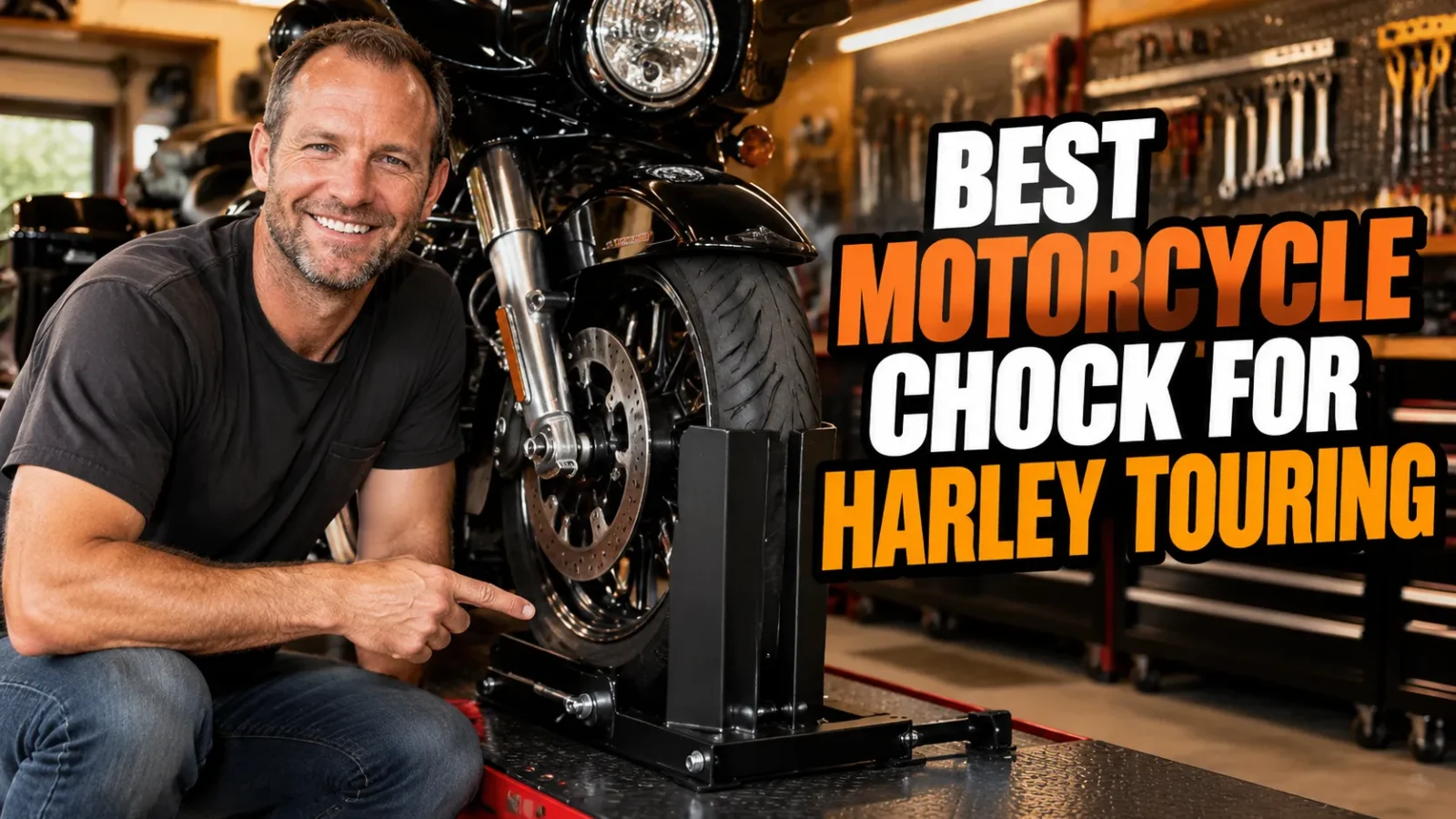
I have owned three Touring Harleys, and every single one of them has spent time sitting in a wheel chock in my garage. Not because it looks cool, but because a 900 lb bagger is a genuinely awkward thing to park, and I got tired of tip-toeing around a bike that wanted to lean on a kickstand in a space that was too tight.
So I went down the chock rabbit hole. I have bought cheap ones, returned two of them, and eventually settled on a setup I trust with a bike that costs more than my first car.
Here is what I learned, and the eight chocks I would actually recommend for a Harley Touring model.
- The Condor Pit-Stop SC-2000 is my overall pick. Adjustable, American made, and it swallows a Touring front wheel without drama.
- The Baxley LA Chock is the premium choice for baggers, but you pay for it.
- For a permanent trailer or garage mount, the WheelDock is the one I keep bolting down.
- A chock alone never secures a bike for transport. You still strap it.
- Watch front fender clearance, especially on 2024 and newer baggers with the 19 inch front wheel.
What Actually Matters on a Heavy Touring Bike
Before I get into the list, I want to explain why a chock that works fine on a sportbike can be borderline dangerous on a Road Glide.
Tire width and cradle depth
A Touring front tire is wide and heavy. Older baggers run a 130/90B16, most 2020 and newer models run a 130/80B17, and the 2024 and up Street Glide and Road Glide moved to a 19 inch front wheel with a 130/60B19 tire.
That last one matters. A 19 inch low profile tire sits differently in a cradle than a tall 16 inch sidewall. If the cradle is too shallow, the bike rocks. If the cradle is too tall, the arms can kiss the fender.
Fender clearance is the real killer
Harley front fenders on Touring models sit close to the tire, and the fender is expensive and painted. I have seen a cheap chock’s upright arms scuff a fender on the way in. That is a very expensive mistake for a part that costs less than a tank of fuel.
Look for a chock with rubber or plastic coated contact points and a cradle that grabs the tire low, not the fender high.
Freestanding versus bolt down
A freestanding chock is great for rolling a bike in and out. It is not great for holding a 900 lb bagger for months. If it lives on your garage floor, bolt it down. If it lives in a trailer, bolt it down.
And regardless of which one you buy, a chock does not replace straps. Not ever. I learned this the hard way with a bike that walked sideways in a trailer, and I now follow the same process every time, which I wrote up in this guide on how to properly tie down a motorcycle.
1. Condor Pit-Stop SC-2000 — My Overall Pick
If I had to buy one chock for a Harley Touring bike and never think about it again, this is the one. The Condor Pit-Stop SC-2000 is made in the USA, and it is the chock I see most often in the garages of riders who actually put miles on their baggers.
Why it suits a Touring Harley
The cradle is adjustable, which is the whole point. I can set the width and the depth to match a 130/80B17 front tire, roll the bike in, and the wheel locks into place with a satisfying clunk. The self-centering design means the bike does not fight me on the way in.
It is rated for heavy cruisers, and I have used mine with a fully loaded Road Glide with luggage and a passenger seat. No flex, no creaking, no drama.
The catch
It is not cheap. Expect to pay somewhere in the $250 to $300 range. It is also bulky, so it is not the thing you toss in a saddlebag. But it doubles as a maintenance stand, and honestly that alone justifies the price.
If you are doing your own oil changes and brake work, a chock like this makes basic motorcycle maintenance dramatically easier, because the bike stays upright and stable while you work.
2. Baxley LA Chock — The Premium Bagger Choice
Baxley Trailer Company builds chocks in Alabama, and their LA Chock is the one specifically aimed at cruisers and baggers. If you have ever walked through a well set up toy hauler at a rally, you have probably seen one.
Why it suits a Touring Harley
The LA Chock is designed around wide front tires, and it holds a Touring front wheel more securely than anything else I have used. The geometry is different from a generic rocker chock. Instead of just cradling the tire, it pins it.
I also like that it is a genuinely one person operation. I can roll my bagger in, step off, and it stays put while I grab straps.
The catch
Price. You are looking at roughly $300 to $350, sometimes more depending on the finish. It is also heavy and it wants to be bolted down to be at its best.
For a rider who trailers a Touring bike to Sturgis every year, it is worth every dollar. For someone who just wants the bike parked in the garage, it is more chock than you need.
3. WheelDock — Best Permanent Mount for Trailers and Garages
The WheelDock is the chock I keep coming back to for permanent installations. It bolts to the floor, and once it is down, it is down.
Why it suits a Touring Harley
The design is simple and brutally effective. You roll the front wheel in, and a spring loaded mechanism clamps the tire. The bike stays upright on its own, which makes loading a trailer a genuinely one person job.
It is rated well beyond the weight of a Touring model, and it handles wide cruiser tires without complaint. I have one bolted into my trailer and one in the corner of my garage, and neither has ever let me down.
The catch
It is a bolt down only proposition. There is no freestanding version that makes sense. You also need to get the mounting position right the first time, because moving it means drilling new holes.
Measure twice. I did not, the first time, and I now have two extra holes in my trailer floor as a permanent reminder.
4. Pingel Removable Wheel Chock — Best Quick Release Option
Pingel is best known for fuel valves, but their removable wheel chock is a legitimately good piece of kit for riders who need floor space back when the bike is out.
Why it suits a Touring Harley
The chock locks into a mounting plate or an E-track strip, and it pops out with a lever. That means I can have a chock in my garage when I need it and a flat floor when I do not.
It is aluminum, so it is light enough to move around one handed, and it handles a wide Touring front tire fine.
The catch
Because it is removable, it depends entirely on the mounting plate being installed correctly. Do that badly and you have a chock that moves under load, which is the last thing you want with a bagger on it.
Expect to pay around $200 to $250 for the chock and plate combination.
5. Acebikes SteadyStand — Best Upright Parking Stand
This one is a slightly different animal, and I want to be clear about that. The Acebikes SteadyStand is a German made front wheel stand that holds a bike upright without straps, and it is fantastic for parking and short term storage.
Why it suits a Touring Harley
It takes the lean out of the equation. Instead of the bike resting on a kickstand and eating up floor width, it stands straight up. In a narrow garage, that is a real win.
It also makes cleaning and detailing easier, because I can walk all the way around the bike without shuffling past a kickstand.
The catch
It is not a trailer chock. I would not transport a Touring bike in a SteadyStand, and I would not leave a 900 lb bagger in one for six months without straps as a backup.
Think of it as a parking and maintenance aid. It is excellent at that, and it costs roughly $150 to $200.
6. Extreme Max 5001.5060 — Best Value Aluminum Chock
If you want something light, aluminum, and cheap enough that you do not have to justify it, the Extreme Max 5001.5060 is the one I recommend to riders who are not sure they even want a chock yet.
Why it suits a Touring Harley
It is an adjustable cradle design with a wide opening, so a Touring front tire fits without modification. The aluminum construction keeps it light enough to move around, and the price sits in the $80 to $120 range.
For a garage parking chock, it does the job.
The catch
It is not in the same league as a Condor or a Baxley for trailer duty. The hardware is lighter, and the finish is not as durable. Mine has a few scratches after two seasons of use.
For occasional use, it is a great deal. For daily abuse, spend more.
7. Harbor Freight 1500 lb. Motorcycle Wheel Chock — Best Budget Pick
Yes, I am including the Harbor Freight chock. No, I am not going to pretend it is as good as a Condor. But at roughly $40 to $60, it is the cheapest way to get a Touring bike standing upright in a garage.
Why it suits a Touring Harley
The 1500 lb rating is more than enough for a bagger, and the rocker style cradle holds a wide front tire adequately when it is bolted down.
I bought one as a second chock for a project bike and it has done exactly what I asked of it.
The catch
Two things. First, the powder coat is thin and mine started showing rust within a year, so I would hit it with a coat of paint before it goes outside. Second, and more importantly, do not trust it freestanding with a 900 lb bagger.
Bolt it down. Always.
8. Titan Ramps Motorcycle Wheel Chock — Best Heavy Duty Steel Option
If you want steel, weight, and a chock that feels like it could hold up a small truck, the Titan Ramps motorcycle wheel chock is a solid middle ground between the Harbor Freight bargain and the premium American made options.
Why it suits a Touring Harley
The steel cradle is wide and deep, which is exactly what a Touring front tire wants. It has a low profile so fender clearance is not an issue, and the bolt down holes line up with a standard trailer floor layout.
I have used one in a friend’s enclosed trailer for hauling a Road King, and it held the front wheel firmly for a 600 mile trip.
The catch
It is steel, so it is heavy and it will rust if you leave it out in the weather. It also needs a decent set of straps to be genuinely safe, which brings me to the thing I want to repeat one more time.
The Rule I Never Break
A chock holds a wheel. It does not hold a motorcycle. Those are two different jobs, and confusing them is how people end up with a bagger lying on its side in a trailer.
Every time my Touring bike goes on a trailer, it goes into the chock and then it gets four straps. Two on the front, pulling forward and slightly down. Two on the rear, pulling back. Suspension partially compressed, never bottomed out.
That process is not optional, and it is worth learning properly. If you want the full breakdown, the guide I linked earlier on how to properly tie down a motorcycle is the one I hand to friends who are new to hauling.
How I Would Choose
If the chock is going in a trailer and the bike goes on it regularly, buy the WheelDock or the Baxley LA Chock and bolt it down properly.
If it is going in a garage and you want one chock that does everything well, get the Condor Pit-Stop SC-2000. That is my pick and it has been for years.
If you just want the bike standing up straight without spending real money, the Extreme Max or the Harbor Freight chock will do it, as long as you bolt it down and accept that it will not last forever.
Keeping the Chock (and the Bike) in Shape
A chock is a piece of steel sitting on a garage floor or in a trailer. It will collect grit, and that grit will eventually chew up the coating on your wheel.
I blow mine out with compressed air every couple of months and hit the pivot points with a light spray lubricant. That takes thirty seconds and it is exactly the kind of small habit that falls under basic motorcycle maintenance.
If the bike is going to sit in that chock for the winter, do not just walk away. A chock holds it upright, but it does nothing for a battery that is slowly dying or fuel that is going stale. Follow a proper winterizing routine before you park it for the season.
Final Thoughts
The best motorcycle chock for a Harley Touring bike is the one that fits your front tire properly, clears your fender, and is bolted to something solid.
Everything else is preference. I have spent more money on chocks than any reasonable person should, and the honest answer is that the Condor does 95 percent of what the Baxley does for a bit less money.
Buy once, bolt it down, strap the bike anyway, and your bagger will stay upright for as long as you own it.
Frequently Asked Questions
Will a standard wheel chock hold a Harley Touring bike?
Most cheap chocks will not. A Touring model weighs roughly 800 to 950 lb and runs a wide front tire, so you need a chock with a deep, adjustable cradle rated for heavy cruisers. Anything sold as a universal 1,000 lb chock should be checked carefully before you trust it.
Do I still need tie-down straps if I use a chock?
Yes. A chock holds the front wheel upright, but it does not secure the bike for transport. I always run straps as well, and this guide on how to properly tie down a motorcycle covers the right way to do it.
What front tire sizes do Harley Touring bikes use?
Older Touring models typically run a 130/90B16 front, while 2020 and later baggers often use a 130/80B17. The 2024 and newer Street Glide and Road Glide moved to a 19 inch front wheel with a 130/60B19 tire, which is wider and lower profile and needs a chock with enough cradle depth.
Can I leave my Harley in a chock all winter?
You can, and a lot of riders do, but a chock is only part of a proper storage routine. Pair it with a full winterizing routine so the battery, fluids and tires survive the off season.

Related Articles

10 Best Harley-Davidson Tool Kits and Roadside Tools I Actually Carry
After years of roadside repairs on my Milwaukee-Eight, here are the best tool kits for Harley-Davidson riders, from CruzTOOLS to…
Jake Miller
11 min read

8 Best Motorcycle Lift Tables for Harley-Davidson: Shop-Tested Picks
I've lifted everything from Sportsters to Road Glides. Here are the 8 best motorcycle lift tables for Harley-Davidson, with real…
Jake Miller
13 min read

10 Best Leatherman Tools for Motorcycle Adventures, Ranked by a Rider
I've carried Leatherman multitools on thousands of miles of pavement and dirt. Here are the 10 best picks for motorcycle…
Jake Miller
13 min read