
8 Best Motorcycle Wheel Rollers for Harley Big Twins and Touring Bikes
 Jake Miller
13 min read
Jake Miller
13 min read
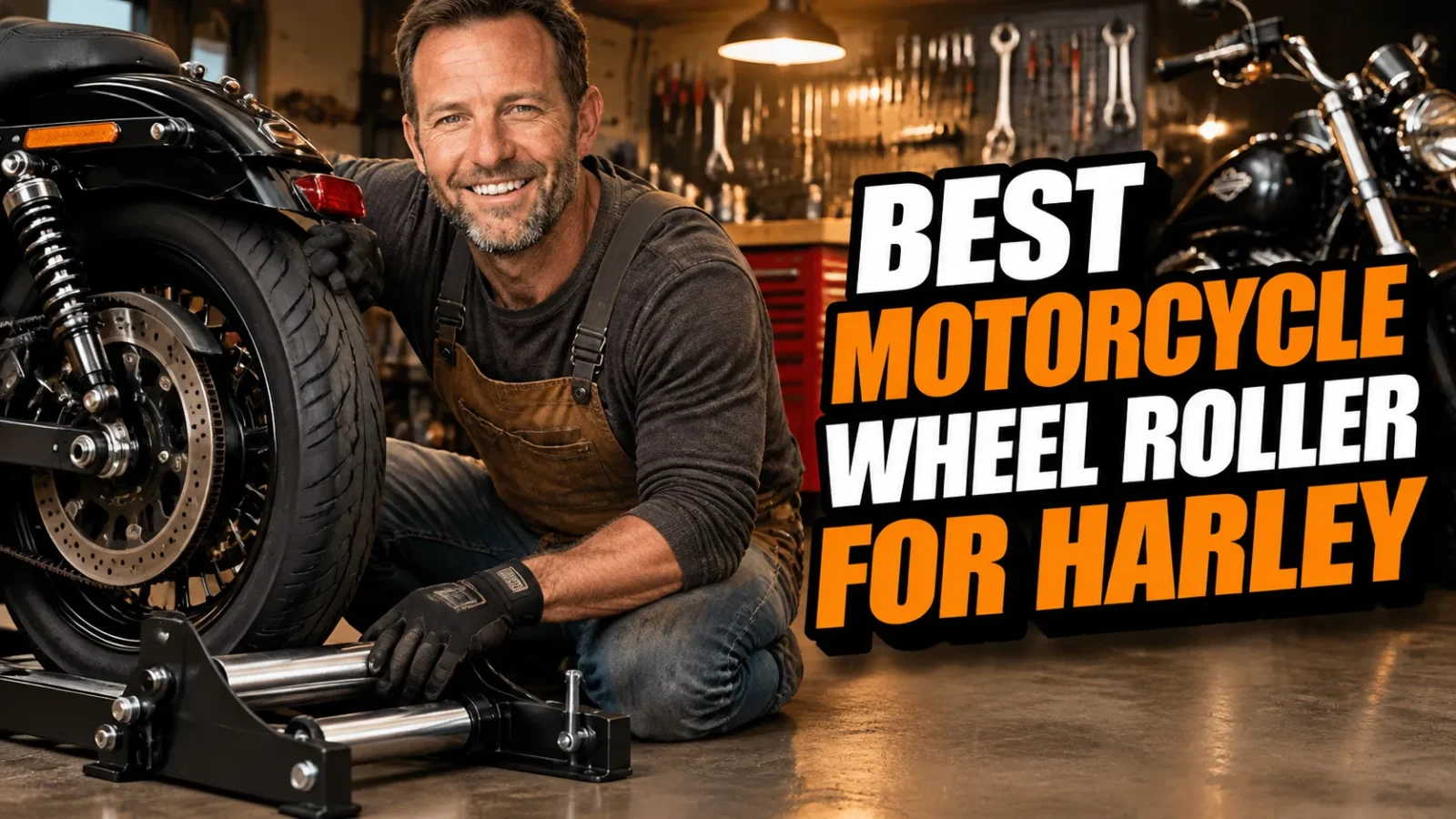
I have owned a Harley-Davidson Road Glide for six years, and I have learned one thing the hard way: a 900 lb touring bike does not care how strong you think you are. Backing it out of a tight single-car garage, or nudging it two feet sideways so I can reach the shelf behind it, used to be a full-body event.
Cleaning the rear wheel was worse. On a belt-drive Harley there is no chain to lube, but there is a rim to scrub, whitewalls to wipe, spokes to polish, and a belt to inspect. Without a way to spin the wheel, you end up cleaning a quarter of the rim at a time and rolling the bike forward a few inches, over and over.
So I bought a wheel roller. Then I bought another one. Then I borrowed a few from friends with Softails, Fat Boys, and one very heavy Tri Glide. This list is what I actually kept, what I gave away, and what I would spend my own money on again.
- The Wheel Jockey is my overall pick if you want one tool that spins the wheel and slides the bike sideways.
- If your garage is genuinely tiny, a Dynamoto dolly rotates a big twin 360 degrees in its own footprint.
- Budget buyers can get a workable caster dolly for under $150, but expect cheaper casters and thin paint.
- If you only want to clean rims and check the belt, a simple spinning roller stand costs about the price of two tanks of gas.
- Whatever you buy, never leave a Harley parked on rollers unattended without locking the casters.
1. Wheel Jockey Motorcycle Wheel Roller — Best Overall
The Wheel Jockey is the one I reach for every single weekend. It is a low, US-made steel plate with a curved dish of rollers in the middle. You push your front or rear tire into the dish, and suddenly the bike is free to spin, pivot, and slide.
What sold me is the height. It sits only an inch or two off the floor, so there is no ramp, no lifting, and no risk of the bike tipping while I get it up. I just roll the Road Glide forward until the tire drops into the cradle.
What I like
Capacity is the headline. The Wheel Jockey is rated in the 1,200 lb range, which comfortably swallows a wet Road Glide Limited or Ultra Limited with saddlebags loaded. I have had a friend’s Street Glide and my own bike on it in the same afternoon.
Because the wheel can spin freely, cleaning the rear rim takes me five minutes instead of twenty. I can also spin the wheel and watch the belt run true, which is a genuinely useful pre-ride check.
What I do not like
It is not cheap. Expect to pay somewhere around $200 to $260 depending on where you buy it, and shipping a heavy steel plate is never free. It also wants smooth concrete. On a rough or gravel driveway it fights you.
And you are only moving one end of the bike. The other tire stays planted, so it pivots rather than rolls. For most garage tasks that is exactly what I want, but it is worth knowing.
2. Dynamoto Motorcycle Dolly — Best for Tight Garages
If your garage is the kind where you have to fold the mirrors in to close the door, the Dynamoto is the answer. It is an Australian system that replaces your front and rear stands with two caster-equipped bases, each with twin swivel wheels.
Once the bike is up, you can rotate it 360 degrees inside its own footprint. I have watched a friend tuck a Fat Boy nose-first into a corner that I would have sworn could not hold a lawnmower. It is genuinely impressive.
What I like
Each stand is rated around 400 kg (roughly 880 lb), so a big twin is well within spec. The casters are proper industrial units, not the flimsy hardware you see on cheap imports. Build quality is the best on this list, full stop.
What I do not like
The price. A full front-and-rear kit lands somewhere in the $700 to $1,000 range once you factor in shipping from Australia, and that is a hard pill for a lot of riders.
It is also more work per use. You have to lift the bike onto both stands before you get any benefit, which is a two-minute job on a good day and a frustrating one when you are in a hurry.
3. Black Widow Motorcycle Dolly (MCD-1500) — Best Heavy-Duty Pick
Black Widow sells through Discount Ramps, and their MCD-1500 dolly is the unit I recommend to anyone with a touring Harley and a normal-sized garage. You roll the bike onto a steel deck with a wheel cradle, then push the whole platform around on four casters.
The 1,500 lb capacity is the reason I trust it with a fully loaded Ultra Limited. The deck is diamond-plate steel and the frame does not flex when you step on it next to the bike.
What I like
Because the entire motorcycle moves as one unit, I can reposition the Road Glide in about ten seconds. That is a game changer when I am shuffling bikes around to get the truck out.
Price sits around $250 to $350, which puts it in the middle of the market but with better steel than the budget imports.
What I do not like
It eats floor space permanently. This is not a tool you fold up and hang on a hook. It also needs a smooth transition from the floor to the deck, so if your garage apron has a lip, you will want a small ramp.
4. Vevor Motorcycle Wheel Roller Dolly — Best Budget Option
I bought a Vevor dolly as a second unit for my trailer, fully expecting to hate it. I did not hate it. For the money, it does the job.
It is a steel frame with four casters and a wheel cradle, and the listing claims a 1,500 lb capacity. Realistically, I would keep a touring bike under 900 lb on it and feel fine. Prices hover around $80 to $150.
What I like
It costs a third of what the premium dollies do. If you only move your bike twice a year, that math is hard to argue with. Assembly took me about twenty minutes with basic hand tools.
What I do not like
The casters are the weak point. Mine developed flat spots after a year of sitting loaded, and the paint is thin enough that surface rust showed up on the welds. The instructions are also clearly translated and occasionally confusing.
Treat it as a disposable tool and you will be happy. Treat it as a lifetime shop fixture and you will be disappointed.
5. K&L Supply Motorcycle Wheel Dolly — Best Shop-Grade Choice
K&L Supply makes the sort of gear you see in dealership service departments, and it shows. Their wheel dolly is heavier gauge steel, better casters, and a locking brake that actually holds a loaded touring bike in place on a sloped floor.
I used one at a friend’s independent shop for a month while my own garage was torn up. The difference between this and my budget dolly was obvious the first time I pushed a 900 lb bike across a painted floor.
What I like
The casters roll smoothly under load and do not shimmy. The cradle holds the tire securely, and the lock is a genuine safety feature rather than an afterthought. Expect to pay roughly $250 to $400.
What I do not like
Availability. You often have to order through a dealer or a shop supply distributor, which means waiting. It is also overkill if your bike lives in a wide, open garage where you never need to shuffle it.
6. BikeTek Motorcycle Wheel Roller Stand — Best for Cleaning and Detailing
This is a different tool for a different job. The BikeTek roller stand is a paddock-style unit with two free-spinning rollers that cradle the rear wheel, letting it spin while the bike stays put.
I keep one in the corner for detailing days. Pop the rear tire into the cradle, and I can spin the rim with one hand while scrubbing with the other. On a laced wheel with whitewalls, that saves me a solid half hour.
What I like
It is light, portable, and cheap. Prices land around $50 to $80. It stores on a shelf and takes seconds to set up.
It is also genuinely useful for diagnostics. Spin the wheel and you can watch for a wobble, a bent rim, or a bearing that is starting to growl. On a belt-drive Harley it is the easiest way I have found to eyeball belt tracking.
What I do not like
It does not move the motorcycle. That is the whole point, but it means this is a companion tool, not a replacement for a dolly. You also need a way to get the rear wheel off the ground, which usually means a stand or a lift.
7. Pit Posse Motorcycle Wheel Dolly — Best for Trailers and Storage
Pit Posse builds a lot of garage and trailer hardware, and their wheel dolly is the one I see most often in enclosed trailers at track days and bike shows.
It is a compact steel unit with a wheel cradle and casters, often sold with tie-down loops built in. The idea is that you roll the bike onto the dolly, strap it down, and then position the whole thing inside the trailer without dragging the bike itself.
What I like
The tie-down points are the smart part. They let me secure a big twin properly without fighting the dolly for strap angles. Pricing runs roughly $150 to $250.
It also doubles as a storage aid. Rolling a bike into a corner on a dolly beats trying to walk it backwards into a tight spot.
What I do not like
The footprint is not tiny, so it eats trailer floor space. And like any caster dolly, it wants a smooth, level surface. In a gravel or dirt shed it is close to useless.
8. Extreme Max Motorcycle Wheel Dolly — Best Value Runner-Up
Extreme Max makes a wide range of trailer and powersports accessories, and their motorcycle wheel dolly is a solid middle-of-the-road option that I recommend to riders who want better build than the cheapest imports without paying shop-grade money.
It is a low-profile steel deck with a cradle and four casters, priced around $150 to $250. I have used one on a friend’s Softail Deluxe and it handled the weight without complaint.
What I like
The deck sits low, so getting a bike on and off is less dramatic than with taller dollies. The casters are a clear step up from the budget tier, and the powder coat has held up better than the paint on my Vevor unit.
What I do not like
It does not have a locking brake on every model, which matters more than people think. On a slightly sloped garage floor, an unlocked dolly with 900 lb of Harley on it will drift. If you buy one, chock the wheels or add your own lock.
How I Chose and Tested These
I did not just read spec sheets. I own two of these units outright, borrowed three more from friends for at least a month each, and used the remaining ones at shops and swap meets where I could get hands-on time.
My test bike for most of this was a 2016 Road Glide, which sits right around 900 lb wet with bags loaded. That is a deliberately punishing test. If a dolly feels sketchy with a bagger on it, it will feel sketchy with anything.
I judged each unit on capacity honesty, caster quality, how low the deck sits, whether the cradle actually holds the tire, and how much floor space it consumes when not in use.
What Actually Matters When You Buy One
Capacity, and the margin you leave
Add up your bike’s wet weight, your luggage, and your own weight if you ever sit on it while it is on the roller. Then leave yourself at least 30 percent headroom. A dolly rated at exactly your bike’s weight is a dolly that is already working too hard.
Caster quality
This is where cheap dollies fall apart, literally. Good casters are sealed, roll smoothly under load, and do not develop flat spots when parked. If the product listing does not mention the caster rating, that tells you something.
Deck height
The lower the better. Every extra inch is another inch you have to push a heavy motorcycle up and over, and another chance for the front tire to catch an edge and kick sideways.
A locking brake
Never leave a motorcycle parked on unlocked rollers. Ever. My rule is simple: if the dolly does not have a lock, I add one or I chock the wheels before I walk away.
Harley-Specific Notes From My Own Garage
Belt drive changes the job
Because there is no chain to lubricate, a lot of riders assume they do not need a roller. In my experience that is backwards. Belt drive means I am checking tension and alignment more often, and a roller makes that a two-minute job instead of a wrestling match.
Winter storage
A roller helps with flat spots, but it is not a complete storage plan on its own. I still move my bike a few inches every couple of weeks, top off the tank, and pull the battery. If you are putting yours away for the season, work through a proper checklist like this guide on how to winterize your motorcycle before the first hard freeze.
Laced wheels and whitewalls
If you run spokes or whitewalls, buy a spinning roller stand as well as a dolly. Cleaning spokes one at a time by rolling the bike forward is the single most tedious job on a Harley, and a $50 roller stand eliminates it completely.
Final Thoughts
If I had to buy one thing tomorrow, it would be the Wheel Jockey. It is the best balance of capacity, usability, and build quality, and it does both jobs: it spins the wheel for cleaning and lets me slide a 900 lb bagger sideways with one hand.
If my garage were the size of a closet, I would stretch for the Dynamoto. If I were on a tight budget, the Vevor would do the job for a fraction of the price and I would accept that I might replace it in three years.
And if all I wanted was to clean rims and check belt tension, I would skip the dollies entirely and buy a simple spinning roller stand for the price of a tank of fuel. Match the tool to the job you actually do, and you will not waste money.
Frequently Asked Questions
What does a motorcycle wheel roller actually do?
A wheel roller cradles your tire on a set of free-spinning rollers or casters. That lets you spin the wheel by hand for cleaning and belt checks, and on dolly-style units it lets you slide the whole bike sideways in a tight garage without muscling it.
Will a wheel roller hold a fully dressed Harley touring bike?
Most quality units are rated between 1,200 and 1,500 lb, which covers a wet Road Glide Limited or Ultra Limited with luggage. Check the rating before you buy, and stay well under it if you park a trike on it.
My Harley is belt drive, so do I still need one?
Yes. You are not lubing a chain, but you are cleaning rims, checking belt tension, inspecting the rear tire for nails, and dragging a heavy bike around the garage. A roller makes all four jobs easier.
How much should I budget for a decent wheel roller?
A simple spinning roller stand starts around $50. A full caster dolly that moves the whole motorcycle runs roughly $120 to $400, and premium twin-stand systems can push past $700.

Related Articles

10 Best Harley-Davidson Tool Kits and Roadside Tools I Actually Carry
After years of roadside repairs on my Milwaukee-Eight, here are the best tool kits for Harley-Davidson riders, from CruzTOOLS to…
Jake Miller
11 min read

8 Best Motorcycle Lift Tables for Harley-Davidson: Shop-Tested Picks
I've lifted everything from Sportsters to Road Glides. Here are the 8 best motorcycle lift tables for Harley-Davidson, with real…
Jake Miller
13 min read

10 Best Leatherman Tools for Motorcycle Adventures, Ranked by a Rider
I've carried Leatherman multitools on thousands of miles of pavement and dirt. Here are the 10 best picks for motorcycle…
Jake Miller
13 min read