
Is Ceramic Coating Worth It on a Motorcycle? My Honest Take After Years of Riding
 Jake Miller
11 min read
Jake Miller
11 min read
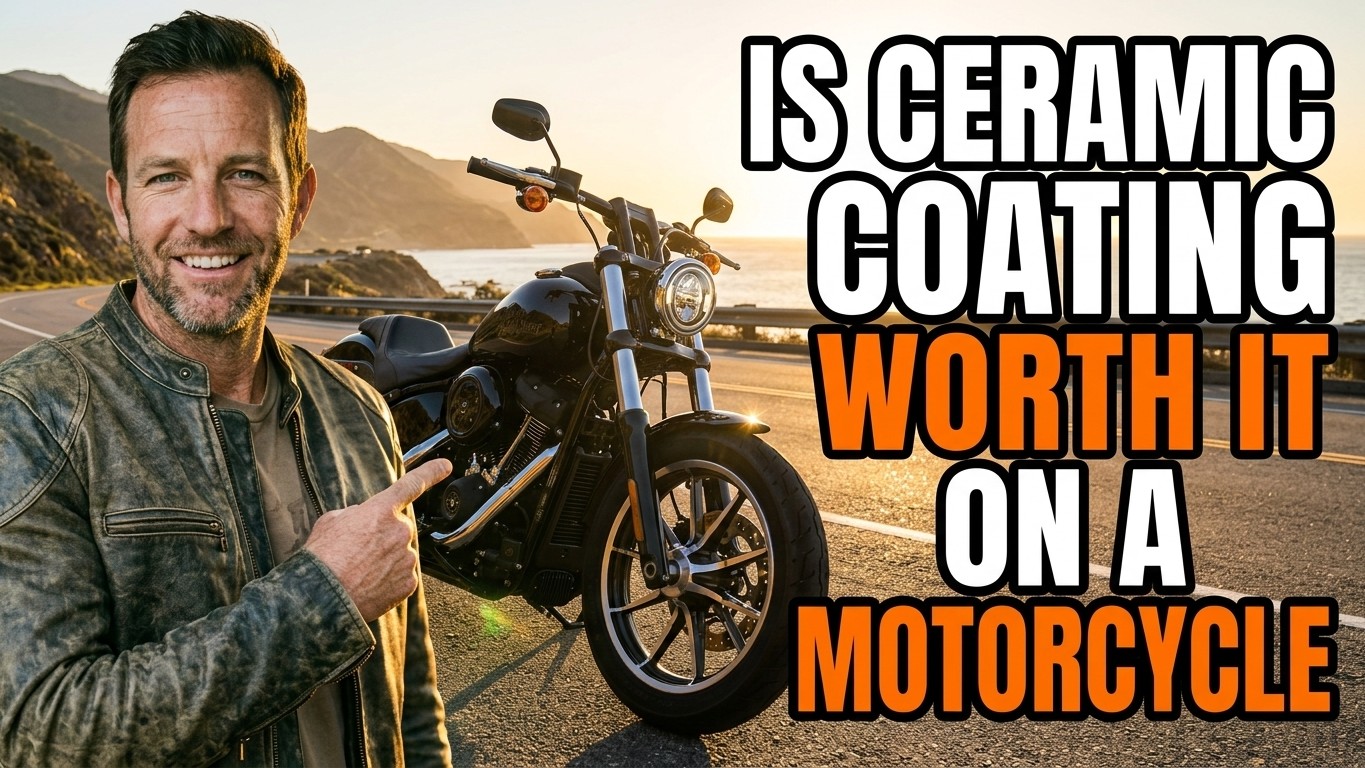
I’ll be straight with you: when I first heard about ceramic coating for motorcycles, I thought it was just another overpriced gimmick. After all, I’d been waxing my bikes for years and they looked fine.
But after testing ceramic coatings on three different motorcycles over the past four years, my perspective has completely changed. I’ve learned exactly when it’s worth the investment and when you’re better off saving your money.
Let me share what I’ve discovered through real-world experience, including the good, the bad, and the surprisingly annoying parts nobody talks about.
- Ceramic coating costs $300-800 professionally but lasts 2-5 years versus wax’s 2-3 months
- Worth it if you ride frequently, keep bikes long-term, or hate constant maintenance
- Best results require proper paint correction first, adding $200-400 to initial cost
- DIY options ($50-100) work but demand meticulous prep and application technique
- Not a miracle solution—won’t prevent rock chips or eliminate all maintenance
What Ceramic Coating Actually Does (And Doesn’t Do)
Before I dive into whether it’s worth your money, let’s clear up the confusion. I’ve heard riders claim ceramic coating makes their bike “bulletproof” or “maintenance-free.” That’s complete nonsense.
Ceramic coating is essentially a liquid polymer that chemically bonds with your motorcycle’s paint. Once cured, it creates a semi-permanent protective layer that’s significantly harder than your clear coat.
In my testing, here’s what ceramic coating actually delivers:
The Real Benefits I’ve Experienced
Hydrophobic properties are genuinely impressive. Water beads up and rolls off like nothing I’ve seen with traditional wax. After a rainy ride, my coated bikes dry almost completely on their own within 20 minutes.
Cleaning time has been cut in half, maybe more. Bug splatter, road grime, and dirt wash off with minimal effort. I used to scrub for 30 minutes; now I’m done in 10-15 minutes with just soap and water.
The UV protection is invisible but crucial. My uncoated bikes show noticeable fading after two summers of sun exposure. My ceramic-coated sportbike has maintained its original paint depth for three years.
Chemical resistance matters more than I initially thought. Brake dust, chain lube overspray, and fuel drips wipe away without staining. On my uncoated bikes, these create permanent marks if I don’t catch them immediately.
What Ceramic Coating Won’t Do
Here’s where marketing hype diverges from reality. Ceramic coating will not prevent rock chips, scratches from dropping your bike, or damage from accidents. It’s a protective layer, not armor plating.
You’ll still need to wash your motorcycle. The coating makes it easier, but dirt still accumulates and needs removal. Anyone claiming you’ll never wash your bike again is lying.
It won’t fix existing paint damage, swirl marks, or oxidation. In fact, ceramic coating locks in whatever condition your paint is in when applied. This is why proper preparation is absolutely critical.
My Real-World Cost Analysis
I’ve gone both the professional and DIY routes, so I can give you actual numbers from my experiences rather than theoretical estimates.
Professional Application Costs
For my Yamaha R6, I paid $650 for a professional ceramic coating application. This included paint correction (essential for proper adhesion), decontamination, and a 5-year warranty on the coating.
My cruiser cost $450 because it had fewer fairings and simpler geometry. The shop charged by surface area and complexity, which makes sense given the labor involved.
Paint correction alone typically runs $200-400 depending on your bike’s condition. If you skip this step, you’re wasting money because the coating will highlight every imperfection.
DIY Application Costs and Reality Check
I applied a DIY ceramic coating kit ($79) to my adventure bike. Add in clay bar, polish, microfiber towels, and isopropyl alcohol, and my total investment was about $140.
The application took me six hours spread over two days. That’s significantly longer than professionals quote because I had to learn as I went and fix a few mistakes.
Was it worth the $400-500 savings? Honestly, yes—but only because I enjoy detailing work. If you hate meticulous prep work or don’t have a clean, dust-free workspace, pay the professionals.
Long-Term Cost Comparison
Here’s where ceramic coating starts making financial sense. I used to spend $30-40 every two months on quality wax and cleaning products. That’s roughly $200 per year, or $1,000 over five years.
A $650 professional ceramic coating lasting five years costs $130 annually. Even accounting for maintenance products (ceramic boost sprays, pH-neutral wash), I’m spending less than $200 per year total.
For riders who keep their bikes 3+ years and actually maintain them, the math works out. For someone who trades bikes every 1-2 years, traditional wax makes more sense financially.
When Ceramic Coating Is Absolutely Worth It
After four years of testing, I’ve identified specific scenarios where ceramic coating delivers clear value. This isn’t universal advice—your situation matters enormously.
You’re a High-Mileage Rider
I ride 12,000-15,000 miles annually, which means constant exposure to UV rays, bugs, road grime, and weather. The protection and ease of maintenance have been genuinely valuable.
If you only ride 2,000-3,000 miles per year on sunny weekends, the benefits diminish significantly. You’re not exposing your paint to enough stress to justify the cost.
Your Bike Lives Outside or in Harsh Conditions
My adventure bike sits in a carport (not a climate-controlled garage) in Arizona heat. The ceramic coating has prevented the sun damage I’ve seen on friends’ uncovered bikes.
Coastal riders dealing with salt air will see tremendous value. I’ve watched ceramic coating resist salt corrosion that destroyed unprotected chrome and paint within two seasons.
You Plan to Keep This Motorcycle Long-Term
If you’re keeping your bike for 5+ years, ceramic coating preserves resale value. Buyers notice paint quality immediately, and well-maintained finishes command higher prices.
I sold my ceramic-coated R6 after three years and received multiple comments on how “new” the paint looked. I’m convinced it added $500-700 to my final sale price.
You Value Your Time
This is subjective but important. I used to spend 45 minutes every other weekend washing and waxing my bikes. Now I spend 15 minutes washing, period.
Over a year, that’s roughly 10-12 hours saved. If your free time is valuable (and whose isn’t?), that time savings alone might justify the investment.
When You Should Skip Ceramic Coating
I’ve talked up the benefits, but ceramic coating isn’t right for every rider or every motorcycle. Here’s when I’d tell you to save your money.
Your Bike Is Already Heavily Damaged
Ceramic coating won’t hide scratches, swirl marks, or oxidation. If your paint needs serious restoration work, you’re looking at $400-600 for correction before the $500-800 coating application.
At that point, you might be better off with a partial repaint on damaged panels. I made this mistake on an older bike and essentially threw away $300 on a coating that highlighted every imperfection.
You’re Planning to Sell Soon
If you’re selling within 6-12 months, traditional wax provides adequate protection for showing purposes. Most buyers won’t pay extra for ceramic coating anyway since they can’t verify it.
I’ve sold both coated and uncoated bikes. Buyers cared about visible condition and maintenance records, not whether I’d applied ceramic coating three years earlier.
You Ride Infrequently
Weekend warriors putting on 1,000-2,000 miles annually don’t need ceramic coating. Your bike isn’t experiencing enough environmental stress to justify the investment.
A basic wash and wax three times per year will keep your paint in excellent condition for occasional riding. Save the ceramic coating money for gear or track days instead.
Your Budget Is Tight
This should be obvious, but I’ll say it anyway: ceramic coating is a luxury, not a necessity. If you’re choosing between ceramic coating and proper maintenance items (tires, brakes, chain), choose maintenance every time.
I’ve seen riders drop $700 on ceramic coating while riding on worn tires. That’s backwards priority planning that could literally kill you.
The DIY vs Professional Decision
I’ve done both approaches multiple times now, and the decision tree is clearer than most articles suggest. Let me break down my actual experiences with each method.
When DIY Makes Sense
I successfully applied DIY ceramic coating to two motorcycles. Both turned out well, but the process demanded patience, preparation, and the right conditions.
You need a dust-free workspace with controlled temperature (60-80°F). I used my garage with the door closed, cleaned every surface, and ran an air purifier for 24 hours before application.
Surface preparation is absolutely critical. I spent four hours washing, clay barring, polishing, and decontaminating before even opening the coating bottle. Rush this step and you’ll get streaks, high spots, or poor bonding.
The application itself requires steady hands and consistent technique. I worked in 2×2 foot sections, applied thin even layers, and buffed within 60 seconds. Miss that timing window and you’ll create permanent streaks.
When Professional Application Is Worth the Premium
For my sportbike with complex fairings and aggressive styling, I paid professionals without hesitation. The curved surfaces and tight crevices would have been nightmares to coat evenly.
Professional shops have paint thickness gauges, professional-grade polishers, and years of experience. They know how to handle the tricky areas I’d inevitably mess up.
The warranty matters more than I initially thought. When I noticed slight hazing on one panel six months after professional application, they fixed it free. No such recourse exists with DIY jobs.
If your motorcycle is worth more than $8,000-10,000, pay professionals. The risk of ruining an expensive paint job trying to save $400 is foolish economics.
Maintenance Reality Check
Nobody talks honestly about ceramic coating maintenance requirements, so I’m going to lay it out based on four years of actual experience across multiple bikes.
What Maintenance Actually Looks Like
I wash my ceramic-coated bikes every 1-2 weeks during riding season using pH-neutral car wash soap. This takes 10-15 minutes with a pressure washer and two-bucket method.
Every 3-4 months, I apply a ceramic boost spray ($20-25 per bottle). This rejuvenates the hydrophobic properties and takes an additional 10 minutes after washing.
Annual professional inspection is recommended but I’ve skipped it without obvious consequences. Shops charge $50-100 to check coating condition and apply professional-grade top coats.
What Happens If You Neglect It
I got lazy with maintenance on my adventure bike for about six months. The coating didn’t fail, but the water-beading effect diminished noticeably and cleaning became harder.
A single application of boost spray brought back 80-90% of the original performance. The coating was still intact and protecting the paint—it just needed refreshing.
This contrasts sharply with wax, which completely disappears if you skip reapplication. Ceramic coating degrades more gracefully and recovers more easily.
Common Mistakes I’ve Made (So You Don’t Have To)
I’ve screwed up ceramic coating applications and maintenance in almost every possible way. Learn from my expensive mistakes instead of repeating them.
Applying Over Contaminated Paint
My first DIY attempt, I skipped the clay bar step thinking my bike was “clean enough.” The coating trapped embedded contaminants, creating a rough texture I couldn’t fix without removing the coating entirely.
Removing failed ceramic coating cost me $250 at a professional shop plus another $100 in DIY materials for the second attempt. Always use a clay bar, even if your paint looks clean.
Rushing the Curing Process
Most ceramic coatings need 24-48 hours to cure without water exposure. I got impatient and took my bike out during light rain after 18 hours. The coating water-spotted permanently in several areas.
Follow the manufacturer’s curing instructions exactly. I learned this $80 lesson (cost of recoating the affected panels) the hard way.
Using Automatic Car Washes
I thought ceramic coating meant I could use touchless car washes. The harsh chemicals and high-pH soaps degraded my coating in just three washes, reducing its lifespan by an estimated 1-2 years.
Hand washing with pH-neutral soap is mandatory if you want your coating to last. This isn’t optional—it’s required maintenance.
My Final Verdict After Four Years
So is ceramic coating worth it on a motorcycle? For me, riding 12,000+ miles annually and keeping my bikes 3-5 years each, absolutely yes. The time savings, protection, and ease of maintenance have been worth every dollar.
But I’ve also watched friends waste money on ceramic coating for bikes they sold within a year, or for machines that sit covered in climate-controlled garages 11 months annually. Context matters enormously.
Here’s my recommendation framework: If you ride frequently, keep bikes long-term, and value easy maintenance, ceramic coating delivers clear benefits that justify the $500-800 investment. If you’re casual weekend rider or trade bikes every 1-2 years, stick with traditional wax.
Don’t let marketing hype or social media pressure influence this decision. Evaluate your actual riding habits, maintenance preferences, and budget honestly. Ceramic coating is a tool, not a requirement—use it when it makes sense for your specific situation.
After testing it extensively on multiple motorcycles, I’m a believer in ceramic coating’s value for the right applications. But I’m equally convinced it’s an expensive waste of money for riders who don’t match the ideal use case.
The best investment in your motorcycle’s appearance remains consistent, proper maintenance—whether that involves ceramic coating, traditional wax, or just regular washing. Choose the method that fits your riding style, budget, and commitment level. That’s the only answer that truly matters.
Frequently Asked Questions
How long does ceramic coating last on a motorcycle?
In my experience, a quality ceramic coating lasts 2-5 years on a motorcycle with proper maintenance. Professional-grade coatings typically outlast DIY options by 1-2 years.
Can you apply ceramic coating to a motorcycle yourself?
Yes, DIY ceramic coating is possible and I’ve done it several times. It requires thorough prep work and takes 4-6 hours, but saves $300-500 compared to professional application.
Does ceramic coating protect against rock chips?
No, ceramic coating does not prevent rock chips or scratches. It’s a sacrificial layer that protects paint from UV damage, oxidation, and makes cleaning easier, but won’t stop physical impacts.
Is ceramic coating better than wax for motorcycles?
Ceramic coating lasts years versus wax’s 2-3 months, offers superior protection, and makes maintenance easier. However, wax is cheaper upfront and more forgiving to apply for beginners.

Related Articles

Ceramic Brake Pads: My Honest Take on the Pros and Cons After Years of Testing
I've tested ceramic brake pads extensively on multiple vehicles. Here's my complete breakdown of the pros and cons to help…
Jake Miller
11 min read

How Long Will 4mm Brake Pads Last? My Real-World Experience & Expert Insights
Discover how long 4mm brake pads will last based on my testing and experience. I'll share mileage estimates, safety factors,…
Jake Miller
15 min read

Brakes Won’t Bleed? Here’s Why and How I Finally Fixed Mine
Struggling with brakes that won't bleed? I've been there. Learn the common causes, troubleshooting steps, and proven techniques that finally…
Jake Miller
14 min read