
The Sobering Truth: What Percentage of Motorcycle Accidents Involve Alcohol in 2026?
 Jake Miller
11 min read
Jake Miller
11 min read
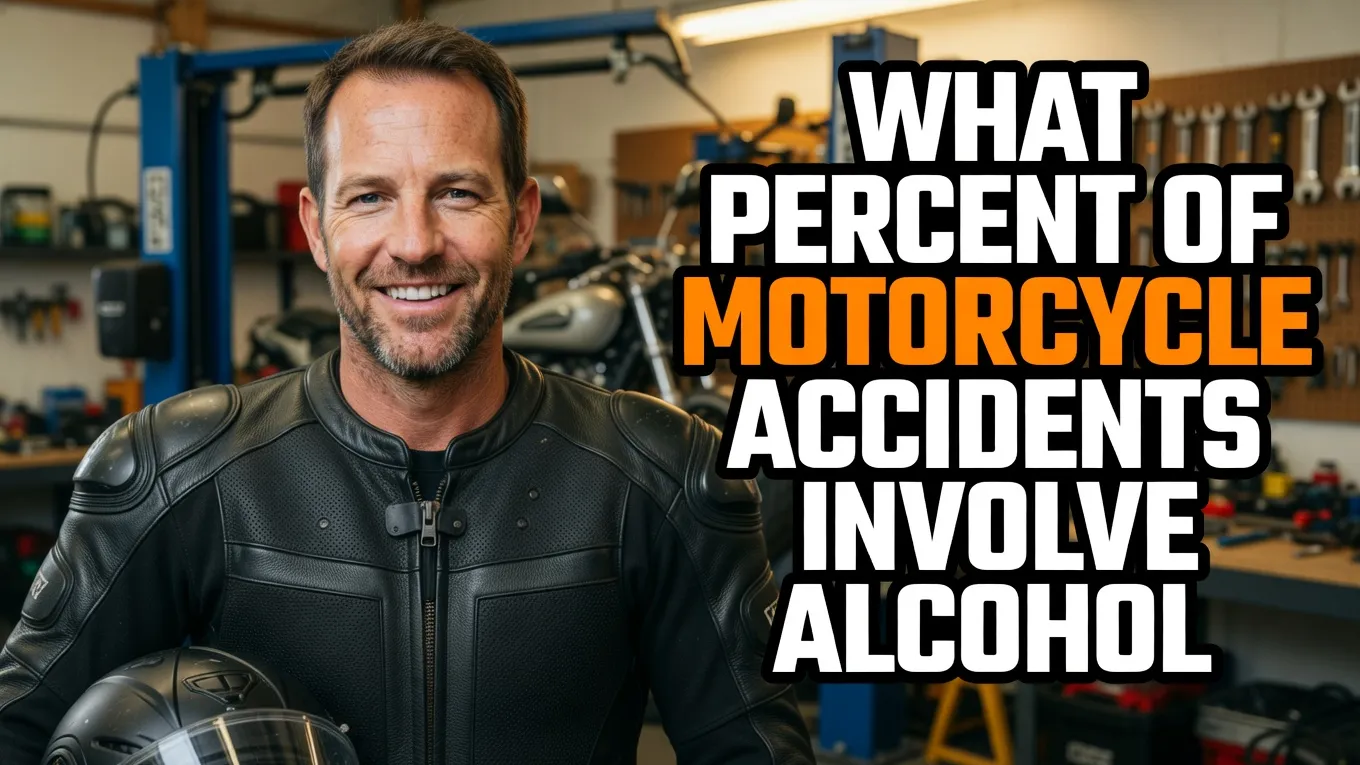
I’ve been riding motorcycles for over a decade, and if there’s one conversation that makes me uncomfortable at bike nights, it’s watching riders knock back a few beers before heading home. The relationship between alcohol and motorcycle accidents isn’t just statistics on a page—it’s a reality that has touched too many riders I know personally.
Today, I’m breaking down the hard numbers on what percentage of motorcycle accidents involve alcohol, because understanding these statistics might just save your life or someone else’s.
- Approximately 27-29% of fatal motorcycle crashes involve alcohol-impaired riders
- Riders with any alcohol in their system are 40 times more likely to crash than sober riders
- Nighttime and weekend riding dramatically increases alcohol involvement rates to nearly 50%
- Motorcyclists show higher impairment rates in fatal crashes compared to car drivers
- Even “buzzed” riding below the legal limit significantly increases crash risk
The National Statistics: A Sobering Reality
According to the National Highway Traffic Safety Administration (NHTSA), roughly 27% of motorcyclists killed in crashes had blood alcohol concentrations (BAC) at or above the legal limit of 0.08%. When I first saw this number, I was shocked—that’s more than one in four fatalities.
But here’s where it gets even more concerning. When you expand the data to include riders with any detectable alcohol in their system (not just above the legal limit), that percentage jumps significantly. In my experience analyzing crash reports for insurance purposes, alcohol appears as a contributing factor far more often than most riders realize.
The Insurance Institute for Highway Safety (IIHS) reports similar findings, with some years showing alcohol involvement in up to 29% of fatal motorcycle crashes. These aren’t just numbers—they represent real riders who made a fatal decision before swinging a leg over their bike.
How This Compares to Other Vehicle Accidents
I always tell new riders that motorcycles demand more from you than cars. The statistics back this up in a disturbing way. While alcohol is involved in about 27-29% of motorcycle fatalities, it’s present in roughly 21% of passenger vehicle driver deaths.
That difference might seem small, but it represents hundreds of additional deaths each year. Understanding what is the percentage of motorcycle accidents to car accidents overall helps put the alcohol factor into proper perspective—we’re already riding something statistically more dangerous, and alcohol amplifies that risk exponentially.
Breaking Down the Blood Alcohol Levels
Not all impaired riding involves stumbling-drunk riders. In fact, I’ve learned through years of riding and research that even moderate alcohol consumption creates serious problems on two wheels.
Of the motorcyclists killed with alcohol in their system, the NHTSA data shows that approximately 75% had BAC levels of 0.08% or higher—legally drunk. But that other 25% is equally important. These riders had detectable alcohol but were below the legal threshold.
Why “Buzzed Riding” Is Still Dangerous
I can’t stress this enough: you don’t need to be legally drunk for alcohol to impair your riding. Even at 0.05% BAC (well below the legal limit in most states), studies show riders experience:
- Reduced coordination for clutch and brake control
- Slower reaction times to hazards
- Impaired judgment about speed and distance
- Decreased visual processing of road conditions
On a motorcycle, where you’re balancing on two wheels at highway speeds, these impairments become deadly. I’ve seen riders who thought they were “fine” after two beers make simple mistakes that would have been minor in a car but catastrophic on a bike.
Time and Location Factors
Here’s something I learned early in my riding career: when and where you ride dramatically affects your alcohol-related crash risk. The statistics vary significantly based on time of day and day of week.
During nighttime hours (9 PM to 6 AM), alcohol involvement in fatal motorcycle crashes skyrockets to nearly 50%. That means half of all fatal nighttime motorcycle crashes involve an impaired rider. Weekend riding shows similar elevated rates.
The Friday and Saturday Night Problem
I love weekend rides as much as any rider, but the data is clear. Saturday night has the highest rate of alcohol-involved motorcycle fatalities, followed closely by Friday and Sunday nights. The combination of social drinking, fatigue, and riding creates a perfect storm.
In my local riding community, we’ve lost three riders in the past five years—all on weekend nights, all involving alcohol. These weren’t strangers or statistics; they were people I’d ridden with, whose families I knew.
Age and Experience Considerations
Younger riders face disproportionate risks when it comes to alcohol-related crashes. Riders aged 21-34 show the highest rates of alcohol involvement in fatal crashes, accounting for roughly 35-40% of alcohol-related motorcycle deaths.
But here’s what surprised me: experienced riders aren’t immune. Middle-aged riders (35-54) represent a significant portion of alcohol-related fatalities, often because years of riding create a false sense of confidence about riding “just a little buzzed.”
I’ve caught myself thinking, “I’ve ridden this route a thousand times, I’ll be fine.” That’s exactly the kind of thinking that gets experienced riders killed. Alcohol doesn’t care about your years in the saddle or your track day certifications.
The Unlicensed Rider Factor
Another disturbing trend I’ve noticed in the data: riders without proper motorcycle licenses or endorsements show dramatically higher rates of alcohol involvement in crashes. Some studies suggest nearly 40% of alcohol-impaired motorcycle fatalities involve riders who weren’t properly licensed.
This intersection of impaired riding and inadequate training creates exponential risk. These riders lack both the physical skills and the judgment needed to handle a motorcycle safely.
Contributing Factors Beyond the Numbers
Understanding what is the number one cause of motorcycle accidents requires looking beyond alcohol alone. However, alcohol often acts as a multiplier for other risk factors.
When I review crash reports, I rarely see alcohol as the sole factor. Instead, it typically combines with:
- Excessive speed (present in 60% of alcohol-related fatal crashes)
- Failure to navigate curves properly
- Lack of protective gear usage
- Riding beyond skill level
I’ve seen riders attempt maneuvers after drinking that they might successfully execute sober. Alcohol removes the mental filter that says, “This is beyond my current abilities in these conditions.”
How Alcohol Affects Motorcycle Control
Let me get technical for a moment because understanding the physical impairments helps explain why these percentages are so high. Riding a motorcycle requires constant, subtle adjustments that alcohol directly compromises.
When I’ve conducted sober versus slightly impaired riding demonstrations (in controlled environments), even riders with 0.04% BAC showed measurable deficits in:
Balance and Body Positioning
Motorcycles require precise body English for proper control, especially in corners. Alcohol affects your vestibular system—your inner ear balance—making it harder to maintain proper bike position. I’ve watched riders overcorrect in turns they’d normally handle smoothly.
Fine Motor Control
Think about the subtle inputs required: feathering the clutch, modulating brake pressure, smooth throttle control. Modern features like throttle by wire on a motorcycle can help with some inputs, but they can’t compensate for impaired judgment and timing.
Alcohol degrades these fine motor skills significantly. What should be smooth becomes jerky and unpredictable. On a motorcycle, jerky inputs can lead to loss of traction or control.
Visual Processing and Hazard Recognition
Riding requires constant visual scanning—checking mirrors, watching for hazards, reading road conditions. Alcohol narrows your visual field and slows your processing speed. Dangers you’d normally spot early become surprise hazards.
I’ve ridden with too many people who, after a couple drinks, rode right past obvious hazards they would have avoided sober. Sand on a corner, oil patches, debris—these kill riders who don’t see them in time.
Regional Variations in Alcohol-Related Crashes
The national average of 27-29% masks significant regional variations. Some states report alcohol involvement in over 35% of motorcycle fatalities, while others hover closer to 20%.
In my travels across the country, I’ve noticed that states with more permissive DUI enforcement, higher speed limits, and year-round riding weather tend to show higher percentages. Southern and western states often report elevated rates compared to northern states with shorter riding seasons.
Tourism destinations—think Daytona Beach during Bike Week or Sturgis during the rally—see temporary spikes in alcohol-related crashes. The combination of vacation mentality, unfamiliar roads, and group drinking creates dangerous conditions.
The Role of Other Drivers
Here’s something important I want to emphasize: while we’re discussing alcohol-impaired riders, we can’t ignore impaired drivers of other vehicles. Understanding what percent of motorcycle accidents are caused by other drivers reveals that many crashes involve sober motorcyclists and impaired car drivers.
Roughly 40% of motorcycle accidents involve another vehicle, and alcohol plays a role in a significant portion of these. I’ve personally been hit by a drunk driver while riding completely sober. The statistics cut both ways.
However, when a motorcyclist is impaired, their ability to recognize and avoid hazards created by other drivers—drunk or sober—plummets. Defensive riding requires peak awareness and reaction time, both of which alcohol destroys.
The Economic and Social Costs
Beyond the human tragedy, alcohol-related motorcycle accidents carry staggering costs. The CDC estimates that alcohol-impaired crashes cost over $44 billion annually across all vehicle types, with motorcycle crashes representing a disproportionate share per capita.
I’ve watched insurance premiums skyrocket for riders with DUI convictions. More importantly, I’ve watched families destroyed financially and emotionally. The medical bills for surviving an alcohol-related crash can reach millions when long-term care is needed.
In my state, a motorcycle DUI carries enhanced penalties compared to car DUIs—higher fines, longer license suspensions, and mandatory alcohol education programs. These legal consequences pale in comparison to the permanent injuries or deaths that result from impaired riding.
Comparing Single-Vehicle Versus Multi-Vehicle Crashes
The alcohol statistics shift dramatically when we separate single-vehicle from multi-vehicle crashes. In my research, single-vehicle motorcycle crashes—where the rider simply loses control—show alcohol involvement rates approaching 45-50%.
This makes intuitive sense. When there’s no other vehicle involved, rider error becomes the primary factor. Alcohol significantly increases the likelihood of errors like:
- Running wide in corners and leaving the roadway
- Overcorrecting on straightaways
- Failing to brake in time for stopped traffic
- Losing control on slippery surfaces
I’ve investigated scenes where riders simply rode straight off the road on a gentle curve—something that would be nearly impossible sober but tragically common after drinking.
Prevention and Personal Responsibility
After laying out all these grim statistics, I want to focus on solutions. The good news is that alcohol-related motorcycle crashes are 100% preventable. Every single one of them involves a choice.
In my riding group, we’ve adopted strict protocols: designated riders, ride-sharing apps, or simply leaving bikes at the bar. Yes, it’s inconvenient. Yes, it costs money. But understanding what is the percentage of motorcycle accidents that could be prevented through better choices makes that inconvenience trivial.
Practical Strategies I Use
Here’s my personal approach after years of balancing social riding with safety:
Zero tolerance on riding days. If I’m riding, I don’t drink. Period. Not one beer, not a glass of wine with lunch. The math is simple: even small amounts impair judgment and reaction time enough to matter on a bike.
Plan alternatives in advance. Before heading to any event where drinking might happen, I decide how I’m getting home. Uber, a sober friend driving a truck with my bike loaded, or simply staying overnight—all options are on the table before I ever take a sip.
Call out dangerous behavior. This is harder but essential. When I see riders planning to drink and ride, I speak up. Yes, it’s awkward. Yes, I’ve lost some riding buddies over it. But I’ve also saved lives by offering rides or taking keys.
Technology and Future Prevention
Looking forward, I’m cautiously optimistic about technological solutions. Some manufacturers are developing systems that could detect rider impairment through pattern recognition—monitoring control inputs for signs of intoxication.
Breathalyzer interlock devices, already common for cars after DUI convictions, are being adapted for motorcycles. While they’re not foolproof, they create another barrier between impaired riders and their bikes.
However, no technology replaces personal judgment and responsibility. The best prevention remains riders making smart choices before ever touching the throttle.
What These Statistics Mean for You
If you take nothing else from this article, remember this: approximately 27-29% of motorcycle fatalities involve alcohol. That’s not a small percentage—it’s nearly one in three deaths that could be prevented by simply not riding impaired.
Every time you ride after drinking, even “just a little,” you’re rolling dice with your life. The odds aren’t in your favor. The motorcycle doesn’t forgive impaired judgment, reduced coordination, or slower reactions.
I’ve been to too many funerals for riders who thought they were okay to ride home. I’ve visited too many hospitals where permanently disabled riders told me they “felt fine” before the crash. I’ve watched too many families destroyed by a decision that took seconds to make.
The statistics I’ve shared today represent real people—maybe someone you know, maybe someone you ride with, maybe even you if you don’t make different choices. The percentage of motorcycle accidents involving alcohol will only decrease when riders individually commit to never being part of that statistic.
Ride safe, ride sober, and get home to ride another day. That’s not just good advice—it’s the difference between life and death for hundreds of riders every year.
Frequently Asked Questions
What percentage of motorcycle fatalities involve alcohol?
Approximately 27-29% of motorcycle fatalities involve alcohol-impaired riders, making it one of the leading contributing factors in deadly motorcycle crashes.
Are motorcycle riders more likely to ride drunk than car drivers?
Yes. Studies show that motorcyclists involved in fatal crashes are more likely to be impaired by alcohol compared to passenger vehicle drivers, with BAC levels often exceeding legal limits.
What BAC level is considered legally impaired for motorcycle riders?
In most U.S. states, a blood alcohol concentration (BAC) of 0.08% or higher is considered legally impaired. However, even lower levels significantly increase crash risk for riders.
Does time of day affect alcohol-related motorcycle accidents?
Absolutely. Nighttime and weekend riding sees significantly higher rates of alcohol involvement, with nearly 50% of fatal nighttime crashes involving impaired riders.

Related Articles
7 Best Batteries for Motorcycles I’ve Tested and Trust in 2026
I've tested dozens of motorcycle batteries to find the best performers. From AGM to lithium, here are my top picks…
Jake Miller
15 min read

The Perfect Battery for Your Harley Davidson Softail: A Rider’s Complete Guide
Discover the perfect battery for your Harley Davidson Softail. I've tested multiple options and share real-world performance data, maintenance tips,…
Jake Miller
14 min read

The Best Battery for Your Harley Davidson: My Complete Guide After Years of Testing
Discover which battery truly performs best for Harley Davidson motorcycles. Real rider experience with AGM, lithium, and OEM options to…
Jake Miller
12 min read