
Is a 2-Into-1 Exhaust Actually Better? What Years of Swapping Pipes Taught Me
 Jake Miller
8 min read
Jake Miller
8 min read
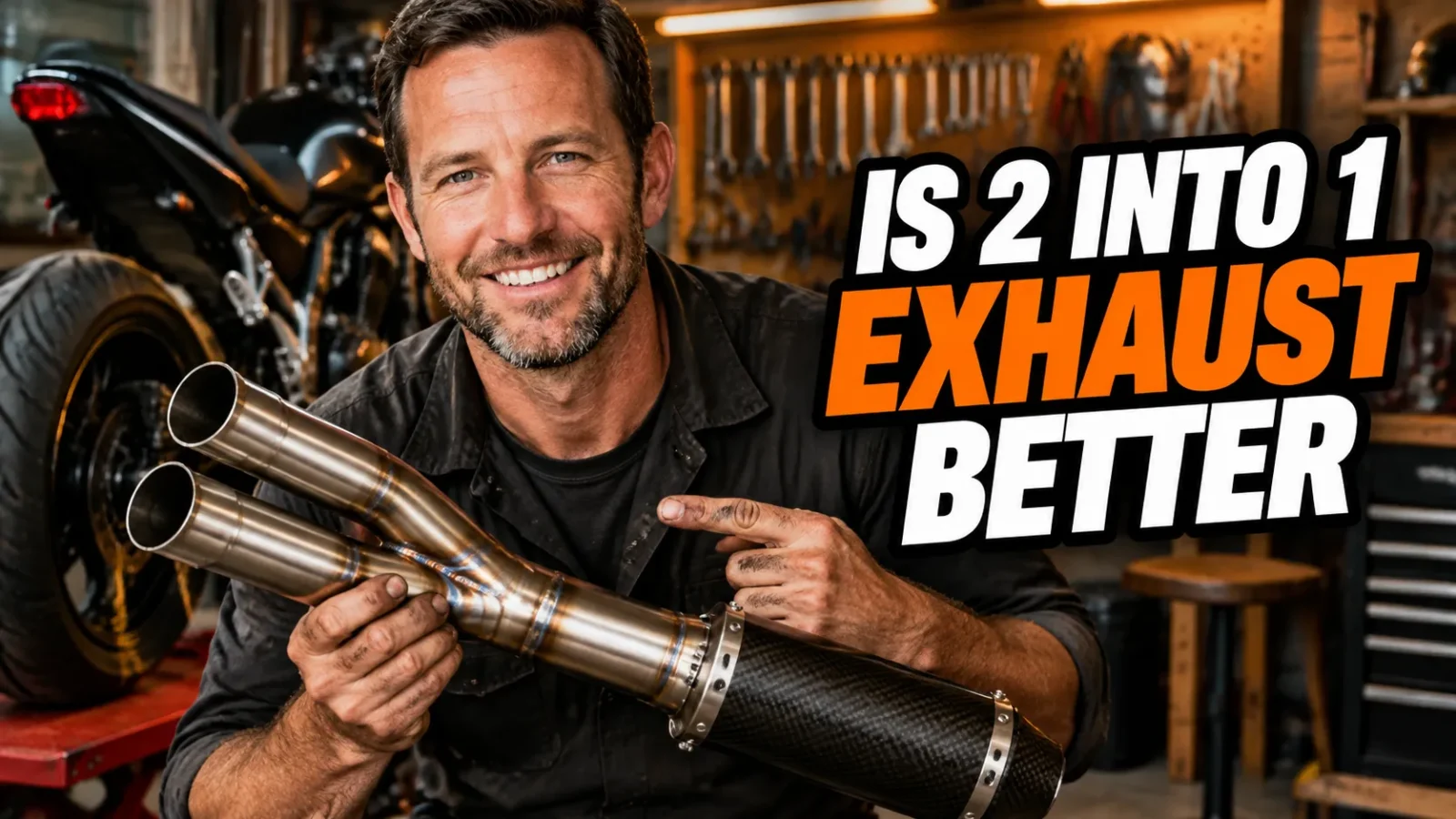
I’ve lost count of how many exhaust systems I’ve bolted onto my own bikes over the years. Twins, inline fours, a couple of thumping singles, and one very loud V-twin that I still feel guilty about. And the question I get asked more than any other, usually in a pub car park with someone pointing at my bike, is a simple one: is 2 into 1 exhaust better?
My honest answer is that it depends entirely on what you want from the bike. But that’s a boring answer, so let me give you the real one, based on what I’ve actually felt through the seat of my pants rather than what a spec sheet claims.
Short version: for most street riders on twins and V4s, a good 2-into-1 is the better choice. For screaming inline fours chasing peak power, it’s much closer to a coin flip.
- A well-built 2-into-1 typically adds usable mid-range torque and cuts 5 to 15 lbs of weight compared to duals.
- On high-revving inline fours, a mismatched 2-into-1 can cost you a couple of peak horsepower at the very top end.
- Header diameter and length, plus proper fuel tuning, matter far more than the number of pipes.
- For street riding and back-road twisties, the weight savings and mid-range punch usually make 2-into-1 the better pick.
- Sound, heat management, and local noise laws are real factors, and I’d never ignore them.
Why Everyone Asks This Question in the First Place
The 2-into-1 exhaust has become the default aftermarket choice on almost every naked bike and sportbike for the last twenty years. Walk into any dealer and you’ll see rows of them. That alone makes people assume they’re automatically better.
But plenty of manufacturers still fit dual pipes from the factory, and plenty of riders swear by them. So there’s clearly something more going on than simple marketing.
I think the confusion comes from mixing up two different things: exhaust design and exhaust pipe count. They’re related, but they’re not the same thing at all.
What a 2-into-1 Exhaust Is Actually Doing
A 2-into-1 system takes the exhaust gases from both cylinders (or both banks, in a V-twin’s case) and merges them into a single collector before they exit through one muffler. Sounds simple. It isn’t.
Scavenging, Explained Without the Textbook
When exhaust gas pulses leave a cylinder at speed, they create a low-pressure wave behind them. If you tune the pipe length and diameter correctly, that low-pressure wave arrives back at the exhaust valve at exactly the right moment to help pull the next pulse out.
That’s scavenging. It’s free horsepower, and it’s the entire reason exhaust design matters.
A 2-into-1 collector lets the pulses from one cylinder influence the other. Get it right and you get a genuinely stronger, fatter torque curve in the mid-range, which is exactly where I spend 90 percent of my riding time.
Weight and Packaging: The Underrated Win
This is where 2-into-1 absolutely crushes duals, and it’s the part people underestimate. You’re removing an entire header pipe and a whole muffler.
On my last swap, I dropped just under 12 lbs off the rear of the bike. That’s before we even talk about where that weight was sitting.
Less weight is nice. Less weight high up and at the back is transformative. The bike turns in quicker, flicks side to side with less effort, and feels noticeably more planted when I’m pushing through a set of switchbacks.
Where 2-Into-1 Genuinely Wins
Let me be specific, because vague advice is useless.
Mid-Range Torque on Twins and V4s
On a V-twin, a parallel twin, or a V4, a properly designed 2-into-1 is close to a no-brainer. The collector smooths out the lumpy low-rpm fuelling, fattens the mid-range, and makes roll-on acceleration feel effortless.
I rode a friend’s 2-into-2 bike back to back with mine on identical models. His sounded glorious at idle. Mine pulled a clean bike length on him coming out of a third-gear corner, every single time.
Ground Clearance and Lean Angle
Dual pipes on the left side are a constant enemy of lean angle. I’ve scraped more mufflers than I care to admit, and it’s genuinely unnerving mid-corner.
A single can tucked up high or routed under the engine frees up real estate. On track days, that difference shows up immediately in how confidently I can commit to a corner.
Sound and Looks Are Legitimate Reasons Too
I’m not going to pretend aesthetics don’t matter. A single-sided high-mount can makes almost any bike look sharper and more modern.
The sound is subjective, and honestly, a good V-twin with dual pipes has a richness a 2-into-1 can’t quite replicate. But a well-tuned 2-into-1 on an inline four has a hard, metallic bark that I personally love.
Where 2-Into-1 Falls Short
This is the part where I have to be honest, because 2-into-1 isn’t universally superior.
Top-End Power on High-Revving Engines
On an engine that makes its living above 10,000 rpm, the maths changes. A single collector can become a restriction at very high gas flow rates, and a well-designed 2-into-2 or 2-into-1-into-2 can sometimes hold peak power a touch longer.
I’ve seen dyno runs where a 2-into-1 gained 4 lb-ft in the mid-range but lost 2 horsepower at redline. Whether that’s a win depends entirely on whether you ride on the street or race at the top of the tach.
Noise Regulations and Neighbour Relations
One muffler means all the exhaust gas goes through one can. That usually means more noise, and noise is the fastest way to get your favourite road closed or your bike flagged at a track day.
I run a baffle in mine for early Sunday morning starts. It costs me almost nothing in power and saves me a lot of awkward conversations.
Heat Management
Merging two hot exhaust streams into one pipe concentrates heat in a smaller area. On air-cooled twins or bikes with the exhaust routed close to the shock or your leg, that can be a genuine problem.
I’ve had to add heat shielding on one build and reroute the rear header on another. Not a dealbreaker, but definitely a consideration.
What Actually Matters More Than Pipe Count
Here’s the thing I wish more riders understood before spending money.
Header Diameter and Length
A badly designed 2-into-1 will lose to a well-designed dual system every time. Pipe diameter and primary length determine where the engine makes its power more than the number of pipes ever will.
A pipe that’s too large kills low-end response and makes the bike feel flat until 7,000 rpm. Too small and you strangle it up top. This is why cheap eBay systems so often disappoint.
Fuel Tuning Is Not Optional
Bolting on an exhaust without retuning the fuelling is the single most common mistake I see. You’ve changed how the engine breathes, so the fuel map needs to change with it.
On carburetted bikes, that means rejetting. On fuel-injected bikes, it means a flash or a piggyback module. Skip it and you’ll run lean, lose the gains you paid for, and risk real engine damage over time.
Build Quality and Materials
Stainless steel holds up. Titanium is lighter and sounds different. Cheap mild steel coated in chrome will be rusting behind your shock within two winters.
I’ve owned all three, and I’ll take a well-welded stainless system over a flashy budget titanium one any day of the week.
So, Is 2 Into 1 Exhaust Better? My Verdict
For the vast majority of street riders, yes, a 2-into-1 is the better choice. The weight savings are real, the mid-range gains are real, and the packaging benefits are undeniable.
If you commute, ride back roads, do the occasional track day, and want your bike to feel lighter and punchier, I’d genuinely point you toward a quality 2-into-1 without hesitation.
But if you’re chasing every last horsepower at the top of the rev range on a high-strung inline four, or you simply love the look and sound of dual pipes, there’s no shame in staying two-into-two. A properly tuned dual system is not a downgrade.
What matters is buying a good system and tuning it properly. A mediocre 2-into-1 fitted badly will feel worse than a well-sorted set of duals in every measurable way.
Do your research, match the pipe to your engine and your riding, and get the fuelling sorted. Do that and you’ll be happy whichever number you pick.
Frequently Asked Questions
Does a 2-into-1 exhaust make more power than duals?
Not automatically. A well-designed 2-into-1 usually adds mid-range torque and shaves weight, but peak horsepower depends far more on header diameter, length, and fuel tuning than on pipe count alone.
Will a 2-into-1 exhaust hurt my bike’s top-end power?
Sometimes, yes. On engines that breathe hard at high rpm, a poorly matched 2-into-1 can cost a few peak horsepower. On most twins and V4s, though, the mid-range gains more than make up for it.
Do I need to retune my fuel injection after fitting a 2-into-1?
I always do. Changing the exhaust changes how the engine breathes, so without a flash, Power Commander, or jetting change you risk running lean, losing the gains, and cooking your valves.
Is a 2-into-1 exhaust louder than dual pipes?
It can be, because you’re pushing the same exhaust gas volume through a single muffler. Check your local noise limits and consider a baffle or quieter can if you ride early mornings in a residential area.

Related Articles

White Smoke on Startup That Vanishes: What I’ve Learned After Years of Cold Mornings
White smoke from your exhaust on startup that vanishes? I explain when that puff is harmless condensation and when it…
Jake Miller
9 min read

Loss of Power and Black Smoke From a Diesel? Here’s How I Track Down the Real Cause
Black smoke plus power loss in a diesel almost always means too much fuel and not enough air. I share…
Jake Miller
9 min read

Black Smoke From Your Exhaust at Startup? What I Found After Years of Chasing It
Black smoke from the exhaust when starting usually means a rich fuel mixture. I'll walk through the real causes I've…
Jake Miller
8 min read