
Red Oil Light on Your Bike: How Many Seconds Do You Actually Have?
 Jake Miller
10 min read
Jake Miller
10 min read
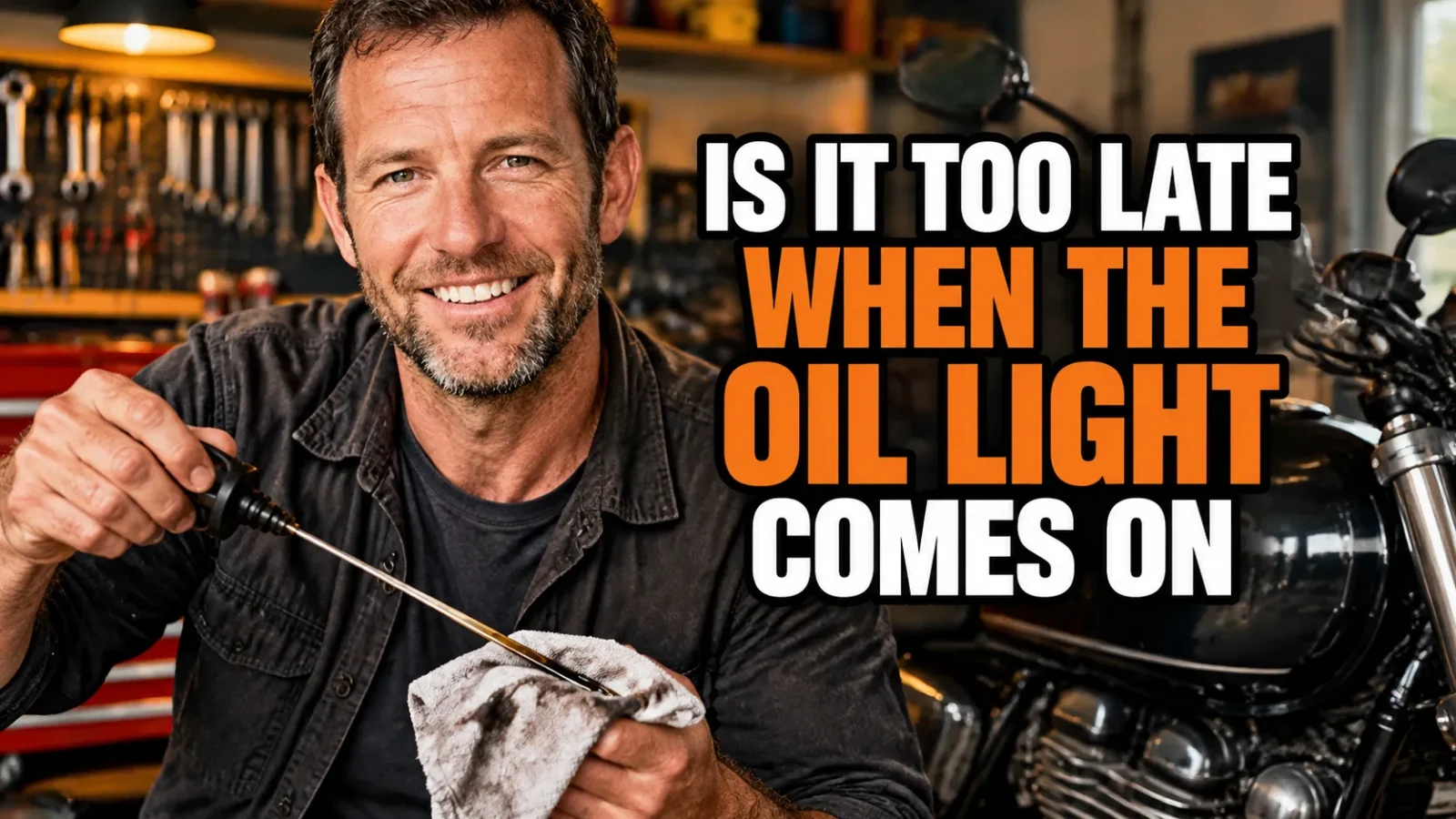
I was doing about 70 mph on a two lane highway when a small red light I’d never paid attention to lit up on my dash. It looked like a genie’s lamp with a drip underneath. My honest first thought wasn’t “pull over,” it was “eh, probably a sensor.”
Two miles later the engine started ticking. By the time I rolled off the throttle, that tick had become a knock I could feel through the footpegs. That was an expensive lesson, and it’s the reason I now have a very specific answer to the question every rider eventually asks: is it too late when the oil light comes on?
- A red oil light means pressure loss, not a low oil level reminder, and it trips at roughly 4 to 7 psi.
- You usually have seconds, not miles. Kill the engine first and diagnose second.
- If the level is fine and the engine sounds normal, it may be a failed sender, chafed wire, or bad ground.
- Topping off a full sump does nothing except hide a real mechanical failure.
What That Little Red Light Is Actually Telling You
The oil pressure warning light is not an oil level gauge. It’s wired to a dumb little pressure switch that opens and closes at somewhere around 4 to 7 psi. On or off, nothing in between.
Normal hot idle pressure on most motorcycle engines runs 15 to 30 psi, and it climbs to 50 or 60 at speed. So if that switch closes, your pressure hasn’t dipped. It has fallen off a cliff.
The light isn’t telling you something might be wrong. It’s telling you something is wrong right now, and it’s happening while you read it.
Pressure and Level Are Two Different Things
You can have a completely full sump and zero oil pressure. A clogged pickup screen, a failed pump, or a stuck relief valve will do exactly that.
That’s why “I checked the dipstick last week” is not a defense. Level and pressure are related, but they are not the same problem, and only one of them puts a warning light on your dash.
The Amber Maintenance Light Is a Different Animal
Plenty of modern bikes also flash an amber lamp or a “service” message when the oil change interval is due. That one is a calendar reminder, not an emergency.
Learn which is which on your own bike. A yellow reminder that cries wolf every 4,000 miles is exactly how riders get desensitized to a red light that means stop now.
How Much Time Do You Actually Have?
More than zero, less than you’d like. A hot engine turning at highway RPM with no oil pressure is destroying itself in real time, not in some vague future sense.
Rod and main bearings ride on an oil film a few microns thick. Remove the pressure and the crank starts kissing the bearing shells, and it does not take long for that kiss to become metal transfer, scoring, and heat.
At load, I measure the safe window in single digit seconds. At a hot idle with no load, you might get 30 seconds or a minute. Either way, “I’ll just limp to the next exit” is gambling with the most expensive assembly on your motorcycle.
The One Scenario Where You’re Probably Too Late
If the light came on, you kept riding because the engine still sounded fine, and then the noise started, the damage is already done. Bearings don’t heal.
Once you hear a knock underneath that light, you’re looking at a teardown and a machine shop, not an oil top up. That’s the threshold I never want to cross again.
Real Failure or Phantom Warning?
This is the judgment call that actually matters, and you have to make it in about ten seconds on the shoulder. Here’s what I look for.
Signs It’s a Genuine Pressure Loss
- The light comes on at idle and stays on, or gets brighter as you rev.
- You hear ticking, knocking, or a new rattle that follows RPM.
- The oil smells burnt, or looks milky or metallic on the dipstick.
- Engine temperature is climbing while you watch.
Signs It Might Be Electrical
- The light flickers over bumps or when you wiggle the bars.
- It only shows up in the rain or right after a wash.
- Other dash lights are acting strange at the same time.
- The engine runs and sounds completely normal.
Here’s the problem: from the saddle, you cannot fully separate those two lists. The safe assumption is always the expensive one. Shut it down, then diagnose.
Why the Light Sometimes Flickers Right After an Oil Change
I’ve seen this a few times, including on my own bike. A loose filter, a drain plug that isn’t quite tight, or oil spilled onto the sender connector can all trigger a warning that has nothing to do with the pump.
On some engines, a dry filter that never got primed can also cause a brief pressure dip on the first start. It’s usually harmless, but I still shut it off, check for leaks, and verify the level before I ride away.
My Roadside Protocol, In Order
I’ve done this three times now, twice on my own bikes and once for a stranded rider on the side of a county road. The sequence matters.
- Clutch in, kill switch, coast. Don’t ride to a “better” spot. Coast as far as you safely can with the engine off.
- Get out of the travel lane. Shoulder, driveway, parking lot. Your safety beats the engine every time.
- Check the level. Sight glass or dipstick, bike upright, engine off for a minute.
- Look underneath. A fresh puddle, a backed off filter, or a loose drain plug changes the whole diagnosis.
- Smell and feel the oil. Burnt or gritty oil tells you the story fast.
- Top off only if the level is genuinely low. Then restart and watch the light at idle for ten seconds. Light out? Ride gently to the nearest shop.
- Light still on? Shut it down and call for a tow. No debate, no negotiating with it.
Why I Never Just Top It Off and Ride
If the level was already correct and the light came on anyway, adding oil does nothing except make you feel productive. It hides the symptom while a spun bearing gets a little more ruined.
The only time topping off is genuinely the fix is when you were truly low. Even then, I want to see that light go out at idle before I trust the bike under load again.
What It Costs When You Push Your Luck
I’ve seen the invoices. A spun rod bearing on a parallel twin ran a friend about $2,400 in parts and machine work. A wiped cam journal on an older V twin cost more than the bike was worth.
And that’s before you count the tow, the lost weekend, and the pile of “while it’s apart” parts. An oil light is the cheapest warning your bike will ever give you. Ignoring it is the most expensive way to save five minutes.
Symptoms That Mean Damage Already Happened
A deep knock that follows RPM, low hot idle pressure on a gauge, or glitter in the oil are all bad signs. A magnetic drain plug with a light gray fuzz is normal. A plug with actual flakes is not.
If you’re genuinely unsure whether you got away with it, send an oil sample for analysis before you decide to keep riding. It’s a lot cheaper than a rebuild.
What Actually Causes Sudden Pressure Loss
In my experience, and from what my mechanics have told me, it’s usually one of a handful of things.
- A failing oil pump or a stuck pressure relief valve.
- A pickup screen clogged with sludge or leftover sealant.
- A collapsed or wrong spec oil filter.
- Chronically low oil from consumption you didn’t notice.
- Oil thinned past its limits by heat or fuel dilution.
The Filter Mistake I Made Once
I once bought a bargain filter with a cheap anti drainback valve. Cold starts rattled, and I chased that noise for a week before a tech pointed at the filter itself.
Now I run quality filters and I keep the receipts. It’s the cheapest insurance you can buy for an engine you actually care about.
Phantom Oil Lights Are Usually an Electrical Problem
A pressure switch is a dumb, cheap part, and it fails. So do the wires running to it and the grounds they depend on.
If my oil light comes on, the engine sounds fine, and the bike just came back from a wash, I’m looking at the sender and its connector first. Testing is simple: pull the connector, check for corrosion and moisture, then test the switch with a multimeter or swap in a known good one.
If the light behaves after that, you’ve found your culprit. If it doesn’t, you’re back to assuming the worst, which is the correct instinct anyway.
The Upside of a Breakdown: Fix the Electrical Stuff You’ve Been Ignoring
Any time my bike is on the stand waiting for parts, I knock out the electrical jobs I’ve been putting off. Bad grounds, tired connectors, and dim dash lights usually share one root cause, and warning lights are often the first thing to complain.
Once the wiring is sorted, I upgrade the lighting. On my bagger, the best front light headlight motorcycle for harley davidson upgrade I made transformed night riding for me. On the Fatboy, the best front light headlight motorcycle for fatboy harley davidson option I chose was a plug and play swap that took one afternoon.
If your bike runs an H4 housing, a best h4 led headlight bulb for motorcycle replacement is about the easiest brightness win you’ll ever buy. And I always add the best led auxiliary lights for motorcycle I can afford, because being seen is not a luxury at dusk.
Getting Seen When You’re Broken Down
That first breakdown happened at dusk on a highway shoulder, and I was nearly invisible to traffic. I’ve since started carrying the best strobe light for motorcycle riders keep in their luggage, a small visibility beacon that clips on in seconds.
If you ever find yourself pushing a dead bike along a dark shoulder, you’ll understand exactly why that’s the first thing I grab now.
Prevention: The Habits That Keep It Off
Almost every oil light emergency I’ve seen started with something boring and preventable. Mine included.
The 30 Second Habit That Saved Me Twice
Check the level weekly, on level ground, engine off, bike upright. On a bike without a center stand, that means sitting on it and holding it vertical. It takes 30 seconds, and it has caught low oil twice before the light ever complained.
Other Things I Do
- Use the viscosity the manual actually calls for, not whatever is on sale.
- Change oil based on miles ridden and heat cycles, not just the calendar.
- Run a quality filter and replace it every single time.
- Watch engine temperature in traffic, since heat thins oil and drops pressure.
- On older bikes, add a mechanical oil pressure gauge so I see numbers instead of guessing.
My Bottom Line
So, is it too late when the oil light comes on? Not automatically. You usually have seconds, sometimes a little more at idle, and a real chance the warning is electrical rather than mechanical.
But you cannot tell the difference from the saddle, and the cost of guessing wrong is an engine. My rule is simple and I’ve never regretted it: kill the engine first, ask questions later. A tow is cheap. A crankshaft is not.
Frequently Asked Questions
Is it too late when the oil light comes on?
Not automatically. If you kill the engine within a few seconds you often avoid damage, but bearing wear can start in under 30 seconds at highway RPM. The light is a now problem, not a later one.
Can I ride with the oil light on?
I never do. Pull in the clutch, hit the kill switch, and coast to a safe spot. If the level is fine and the light stays on at idle, call for a tow instead of limping home.
Why does my oil light come on when the oil level is fine?
Often it’s electrical: a failed pressure switch, a chafed wire, or a corroded ground. Test the sender with a multimeter or swap in a known good one before you assume the worst.
How long can you drive with the oil light on before damage?
At speed and under load, think seconds. At a hot idle with no load you might get 30 to 60 seconds, but that is a gamble with your crankshaft, not a safety margin.

Related Articles

Harley Davidson Headlight Problems: What I Learned Fixing Mine in the Dark
Chasing a dead, dim, or flickering Harley headlight? I walk through the real causes, my own diagnostic steps, and the…
Jake Miller
9 min read

Best HID Kits for Motorcycles: How I Choose the Right One for Night Riding
Wondering which HID kit suits your bike? I break down wattage, color temperature, ballasts, legality, and wiring so you can…
Jake Miller
9 min read

Why Only One Headlight Works on Your Motorcycle (and How I Fix It)
Only one headlight working on your motorcycle? I break down the real causes, from dead bulbs to bad relays, and…
Jake Miller
10 min read