
Why Only One Headlight Works on Your Motorcycle (and How I Fix It)
 Jake Miller
10 min read
Jake Miller
10 min read
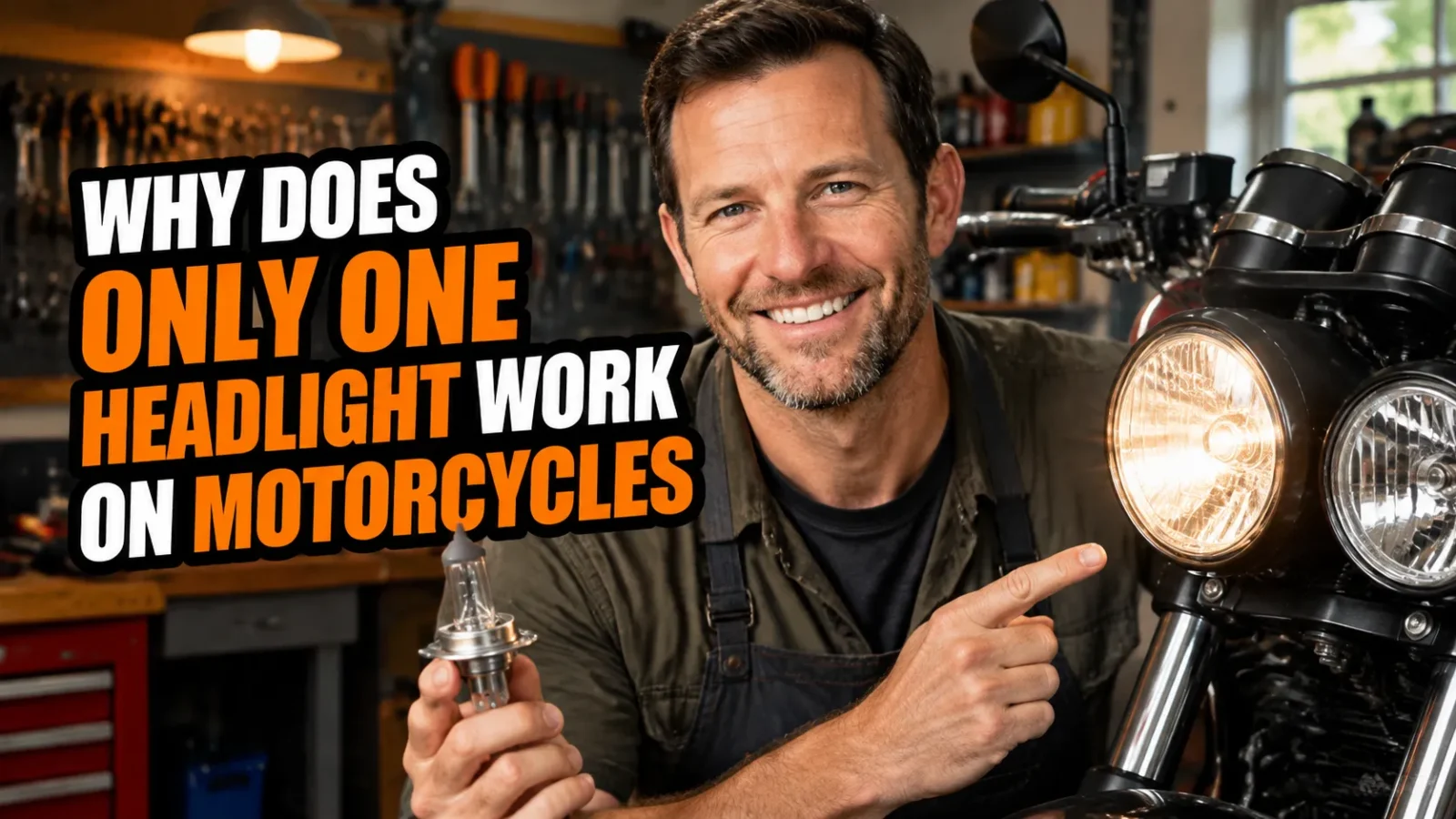
There’s a special kind of dread that hits when you glance at your bike in a dark garage and see only one eye staring back at you. I’ve been there more than once, usually five minutes before a night ride. The good news is that this problem is almost always easier to solve than it looks.
Most one-sided headlight failures come down to a handful of simple causes. A bulb, a connector, a fuse, or a ground wire is usually the culprit. Before you start worrying about your charging system, it helps to understand your power source, and I’ve found the what are the different types of motorcycle batteries ultimate guide a handy reference for that.
In this article, I’ll walk you through what I check first, what I check next, and how I decide whether it’s a ten-minute fix or a job for the shop.
- A burned-out bulb filament is the most common reason only one headlight works.
- Many dual-headlight bikes are designed so that only one light runs on low beam, so check your manual first.
- Loose connectors, corroded grounds, and bad relays are the next suspects.
- A cheap multimeter lets you pinpoint the fault in minutes.
- Fix it quickly, because riding with a weak or missing headlight is both unsafe and often illegal.
First, Is It Actually a Problem?
Before I grab any tools, I always ask one question: is this bike supposed to run both lights at once? A surprising number of riders panic over something that’s perfectly normal.
Dual-Headlight Bikes Often Split Their Duties
Many twin-headlight motorcycles, especially sport bikes and some cruisers, use a split design. On low beam, only one lamp is lit. When you flip to high beam, both lamps come on.
If your bike behaves this way, a single lit headlight on low beam isn’t a fault at all. It’s engineering. I always flip between high and low beam and watch what happens before assuming anything is broken.
Check Your Owner’s Manual
Your manual will usually tell you exactly how the lighting is supposed to work. It takes two minutes and can save you an afternoon of troubleshooting a problem that doesn’t exist.
If the manual says both lights should be on in low beam and only one is, then you have a genuine fault. Let’s get into the causes.
The Most Common Culprits I See
In my experience, about eight out of ten cases fall into the first three categories below. I start there every time.
1. A Burned-Out Bulb or Filament
Bulbs wear out, plain and simple. Halogen bulbs in particular can fail suddenly, and they tend to do it in pairs of months rather than pairs of minutes. So when one dies, the other is often not far behind.
Many bikes use H4 bulbs, which have two filaments inside one glass envelope. One handles the low beam and the other handles the high beam. If one filament fails, you might lose just the high or just the low setting on that side.
My advice is to replace bulbs in pairs. If you’re shopping, my guide to the best headlight bulb for motorcycle riding covers what I’d look for in brightness, lifespan, and fit.
2. A Loose or Corroded Connector
Motorcycles live a rough life. Vibration, rain, road salt, and heat cycles all work against the plastic connector that plugs into the back of your bulb.
I’ve fixed more than one “dead” headlight just by unplugging the connector, cleaning the contacts with electrical contact cleaner, and pushing it back on firmly. A bit of dielectric grease afterward helps keep moisture out.
3. A Blown Fuse
Some bikes run each headlight circuit through its own fuse. If one fuse pops, one light goes dark while the other carries on happily.
Pull the fuse and hold it up to the light. If the thin metal strip is broken or the glass looks smoky, it’s blown. Always replace it with the same amperage rating, never a bigger one, or you risk melting wiring.
Deeper Electrical Causes
If the bulb, connector, and fuse all check out, I move on to the parts of the system that take a little more patience.
A Bad Ground Connection
Electricity needs a complete circuit. If the ground wire for one headlight is corroded, loose, or broken, that light will be dim or dead even though power is reaching it.
I look for the ground wire near the headlight housing or at the frame, then clean the terminal until it’s shiny bare metal. It’s not glamorous, but it works more often than you’d expect.
A Faulty Relay
Modern bikes often use relays to carry the heavy current headlights demand. If a relay sticks or burns out, it can cut power to one circuit.
A quick test is to swap the headlight relay with another identical relay in the fuse box, such as the horn or fan relay. If the light comes to life, you’ve found your problem.
The Dimmer or Beam Switch
The switch on your handlebar sends power to different filaments depending on your selection. Over time, the contacts inside can wear or get dirty.
If your low beam works but your high beam doesn’t, or vice versa, suspect the switch. Spraying contact cleaner into it and working it back and forth sometimes brings it back from the dead.
A Quick Tell I Watch For
If the light flickers when you tap the switch housing or wiggle the harness, that’s a classic sign of a loose connection. Intermittent faults are almost always mechanical, not electronic.
When the Charging System Is Involved
Not every lighting problem is local to the headlight. Sometimes the whole electrical system is telling you something.
Low Voltage and Dim Lights
A failing stator or regulator/rectifier can leave your system running on battery power alone. Typically that dims both lights, but a marginal connection can make one side look worse than the other.
If your headlights seem weak or your starter sounds lazy, I’d read up on why is my motorcycle battery draining fast to rule out a charging problem. A healthy system should show roughly 13.5 to 14.5 volts at the battery with the engine running.
Keep Your Battery Healthy
A weak battery puts stress on everything that runs off it. If your bike sits for weeks at a time, I strongly recommend a maintainer, and it helps to understand how does a battery tender work before you buy one.
A properly maintained battery won’t cause a one-sided headlight failure by itself. But it removes one big variable from your troubleshooting list, and that alone is worth it.
LED Conversions Add Their Own Wrinkles
I love LED headlights, but I’ll be honest: they introduce extra ways for one side to misbehave. If you’ve upgraded recently, this section is for you.
Polarity and Driver Issues
Unlike halogen bulbs, many LED bulbs care about polarity. If the plug is reversed on one side, that bulb may simply refuse to light up.
Try unplugging the LED, rotating the connector 180 degrees if it allows it, and plugging it back in. I’ve seen this fix a “dead” LED within seconds.
Heat and Fitment Problems
LED bulbs generate heat at the base, and they need airflow to survive. If the dust cap won’t seat properly or the fan is blocked, the bulb may overheat and shut down.
If you’re choosing a replacement, take a look at my picks for the best h4 led headlight bulb for motorcycle setups. Quality matters here, because cheap LEDs are often the cause of the very problem you’re trying to solve.
Mismatched Pairs
If you replaced only one bulb, the old one on the other side may now be noticeably dimmer or a different color. It can look like a fault when it’s really just a mismatch.
That’s one more reason I always replace headlight bulbs as a pair.
My Step-by-Step Diagnosis
When a headlight goes out, I follow the same order every time. It saves me from chasing complicated problems when the answer is simple.
- Confirm the design. Check whether your bike is meant to run one or both lights on each beam setting.
- Swap the bulb. Move the working bulb to the dead side. If it lights, the old bulb was bad. If it doesn’t, the problem is upstream.
- Inspect the connector. Look for melted plastic, green corrosion, or loose pins.
- Check the fuse. Replace it only with the correct rating.
- Test the relay. Swap it with a matching one.
- Test for voltage. Use a multimeter at the connector with the switch on.
- Check the ground. Clean and tighten any ground terminals.
Using a Multimeter Without Fear
A basic multimeter costs very little and pays for itself immediately. Set it to DC volts, touch the probes to the two terminals at the connector, and turn on the lights.
Seeing around 12 volts means power is arriving, so the bulb is the likely problem. Seeing zero volts tells you to work backward toward the fuse, relay, and switch.
Lessons From Other Electrical Systems
Diagnosing electrical faults is a transferable skill. The same logic applies to almost any small vehicle with a battery and a controller.
For example, if you’ve ever wondered why does my electric scooter turn on but not move, the underlying lesson is the same: power showing up doesn’t mean the whole circuit is healthy. You have to trace the path from source to load.
Safety Matters More Than Convenience
I know it’s tempting to ride with one light and fix it “this weekend.” I don’t recommend it, and I don’t do it myself.
A single headlight cuts your visibility and makes you look like a car with one light, or worse, a distant bike with something strange going on. Drivers misjudge your distance and speed, and that’s a risk I’m not willing to take.
Legal Considerations
In most regions, a motorcycle must have a functioning headlight, and some require all original lamps to work. A dead bulb can mean a ticket or a failed inspection.
If you ride at dusk, at night, or in rain, treat this as a fix-it-now item, not a fix-it-later one.
Preventing the Problem Next Time
A little routine care keeps this from happening again. Here’s what I do on my own bikes.
- Check lights before every ride with a quick walk-around.
- Replace bulbs in pairs so brightness stays even.
- Apply dielectric grease to connectors to fend off moisture.
- Keep the battery and charging system healthy with regular testing.
- Avoid cheap, no-name LED bulbs that skimp on cooling and quality.
When to Call a Professional
I’m a big believer in doing as much as you comfortably can yourself. But there’s no shame in handing it off when the situation calls for it.
If you’ve checked the bulb, fuse, relay, and ground and still can’t find the problem, the fault may be inside the wiring harness. Chasing a hidden short can be time-consuming, and a shop with the right tools will usually do it faster. The same goes for any sign of melted wiring or burning smells, which I’d treat as urgent.
Final Thoughts
When only one headlight works, it’s easy to assume something expensive has failed. In my experience, the answer is usually a bulb, a plug, or a fuse, and a methodical approach gets you there quickly.
Start with the simple checks, work your way into the wiring, and don’t ignore the health of your battery and charging system. Do that, and you’ll be back on the road with two bright, confident beams cutting through the dark.
Ride safe, stay visible, and give those connectors a little love now and then. Your future self on a dark road will thank you.
Frequently Asked Questions
Is it legal to ride with only one working headlight?
In most places, no. Many jurisdictions require a working headlight at all times, and a single dead bulb on a dual-headlight bike can earn you a fix-it ticket. Check your local rules, and fix it before your next ride.
Can a bad battery cause just one headlight to go out?
Rarely on its own. A weak battery or failing charging system usually dims both lights or causes flickering. A single dead light more often points to a bulb, connector, or ground problem.
Why does my high beam work but my low beam doesn’t?
On a typical H4 bulb, the high and low beams use separate filaments. If one filament burns out, the other can keep working. A faulty dimmer switch or relay can cause the same symptom.
How much does it cost to fix a single dead headlight?
If it’s a bulb, you can often fix it yourself for the price of a replacement bulb. Wiring, relay, or switch faults cost more, mainly in labor if you take the bike to a shop.

Related Articles

Harley Davidson Headlight Problems: What I Learned Fixing Mine in the Dark
Chasing a dead, dim, or flickering Harley headlight? I walk through the real causes, my own diagnostic steps, and the…
Jake Miller
9 min read

Red Oil Light on Your Bike: How Many Seconds Do You Actually Have?
Is it too late when the oil light comes on? After nearly losing an engine to a 30-second delay, here's…
Jake Miller
10 min read

Best HID Kits for Motorcycles: How I Choose the Right One for Night Riding
Wondering which HID kit suits your bike? I break down wattage, color temperature, ballasts, legality, and wiring so you can…
Jake Miller
9 min read