
8 Best Motorcycle Tires for Cornering: Grip, Feel, and Confidence
 Jake Miller
9 min read
Jake Miller
9 min read
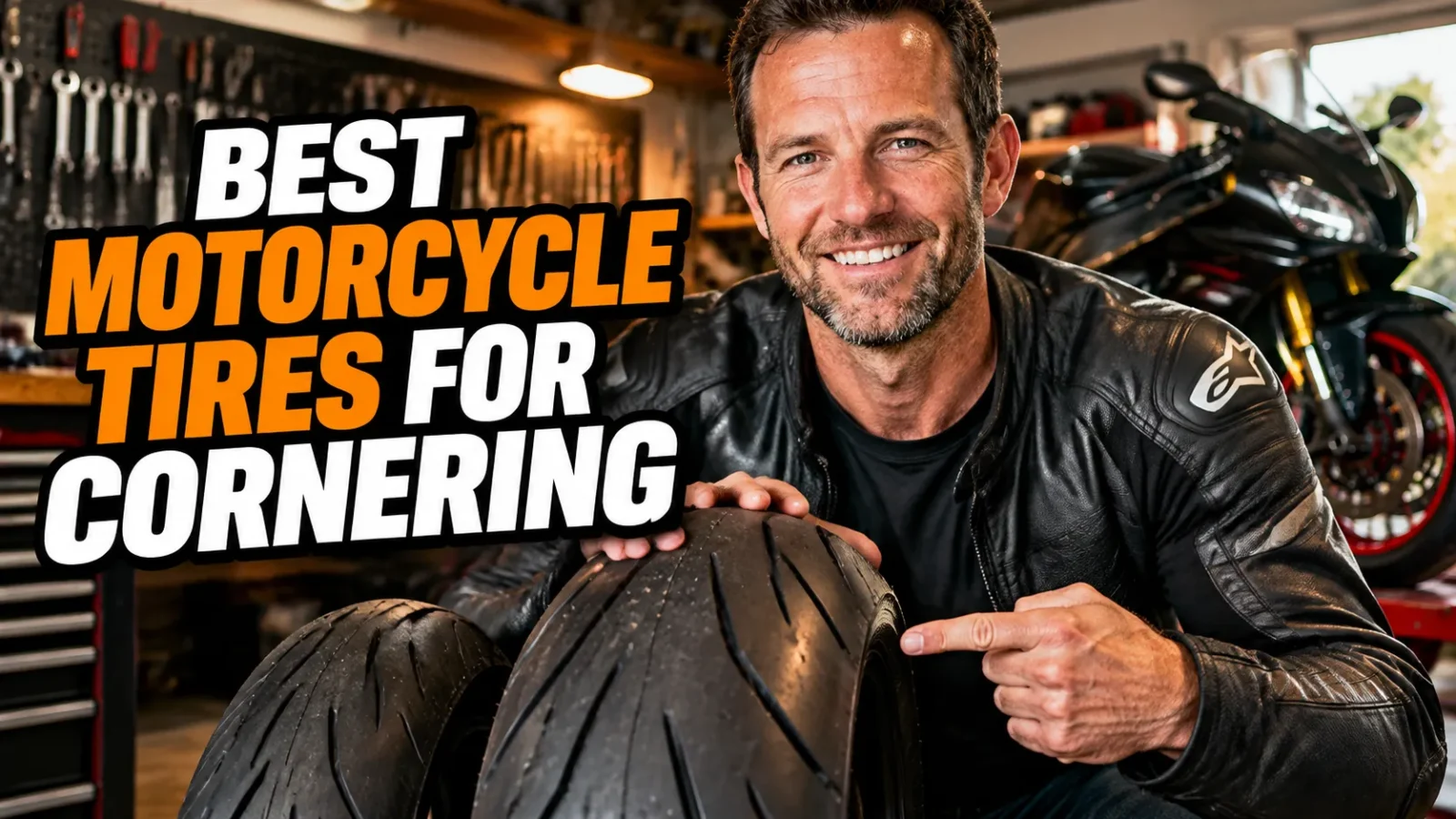
Nothing on a motorcycle shapes your confidence in a corner like the two small patches of rubber touching the road. I’ve ridden everything from mountain switchbacks to local track days, and I can tell you that a tire swap changes a bike’s personality more than almost any other upgrade. The right set makes turn-in feel natural and mid-corner feel calm.
In this guide I’m sharing the eight tires I’d put on my own bikes if cornering performance was the priority. I’ve weighed grip, feedback, wet behavior, wear, and price. Some are road-focused, some lean toward the track, and each one earns its spot for a specific reason.
- My top all-around pick for spirited road riding is the Michelin Power 5, with the Pirelli Diablo Rosso IV close behind.
- For track days and maximum grip, I reach for the Pirelli Diablo Supercorsa SP V3 or Metzeler Racetec RR.
- If you ride long distances and still love corners, the Michelin Road 6 and ContiRoadAttack 4 are excellent.
- Correct pressure, proper warm-up, and fresh rubber matter as much as the brand you choose.
How I Judge a Great Cornering Tire
Before the list, here’s what I look for. Peak grip gets the headlines, but it’s only part of the story. A tire that grips hard yet gives no warning before it lets go is not one I trust.
Compound and Profile
Most modern sport tires use multiple compounds. A harder center strip handles straight-line miles and acceleration, while softer shoulders bite when you’re leaned over. The profile, meaning how round or pointed the crown is, decides how quickly the bike falls into a turn.
Feedback and Warm-Up
I value a tire that tells me what it’s doing through the bars and pegs. I also pay attention to how quickly it comes up to temperature, because a cold morning ride is where mistakes happen. Wet-weather ability and wear life round out my scorecard.
If you’re still sorting out which manufacturer suits you, my breakdown of the best brand for motorcycle tires is a good companion to this list.
1. Michelin Power 5 — Best Overall for Spirited Road Cornering
The Michelin Power 5 is the tire I recommend most often to friends who love twisty roads but still ride in real-world weather. It replaced the Power RS and improved on it in nearly every area. The rear uses Michelin’s dual-compound approach, with firmer rubber down the middle and softer rubber toward the edges.
What stands out to me is how neutral the Power 5 feels. Turn-in is quick without being twitchy, and mid-corner stability is superb. I can adjust my line halfway through a bend and the tire simply follows.
Why I Like It
Wet performance is the surprise. The Power 5’s tread pattern clears water well, and I’ve felt confident on damp mountain roads where other sport tires made me nervous. Pricing for a front and rear pair typically lands in the $260 to $380 range depending on size.
The tradeoff is wear. If you commute heavily on it, expect a shorter life than a sport-touring tire, though it still beats most track-focused rubber.
2. Pirelli Diablo Rosso IV — Best for Feel and Turn-In Precision
The Pirelli Diablo Rosso IV is my favorite when I want a sharp, communicative front end. Pirelli designed it with a multi-compound rear and a profile that rolls onto its shoulders smoothly. On naked bikes and sport bikes alike, it makes the machine feel lighter.
In my experience, the Rosso IV warms up quickly and gives you a lot of confidence on the first few corners of a ride. It is a tire that rewards smooth inputs and tells you the truth when you push a bit harder.
Who It Suits
I’d choose the Diablo Rosso IV for riders who love canyon roads and want maximum feedback without a race-only compound. Expect to pay roughly $280 to $400 per set. It’s also a strong contender if you are comparing options for the best motorcycle tires for street riding.
3. Bridgestone Battlax Hypersport S22 — Best Grip-to-Wear Balance
The Bridgestone Battlax Hypersport S22 impressed me with how much grip it offers while still lasting a respectable number of miles. Its rear tire uses a dual-compound construction and Bridgestone’s pulse groove design to help with water evacuation and heat control.
On a fast road ride, the S22 feels planted and progressive. I can lean deep, apply throttle early, and the rear hooks up without drama. Sizes like 190/55ZR17 fit a huge range of sport bikes.
My Take
The S22 isn’t the sharpest turn-in tire on this list, but it’s remarkably forgiving. For a rider who wants high-level cornering ability and decent mileage, I find the Battlax Hypersport S22 hard to beat. Typical pricing runs about $250 to $360 per pair.
4. Dunlop Sportmax Q5 — Best for Stability and Sharp Handling
The Dunlop Sportmax Q5 is a tire I enjoy for its stability at lean. Dunlop built it with a multi-tread rear and a profile that stays steady through long, sweeping corners. It feels rooted when the road gets bumpy mid-turn.
I notice the Q5 shines on fast, flowing roads. It gives a reassuring, solid feel, and I can hold a lean angle for a long time without the bike wanting to stand up or fall in.
Value and Fitment
The Sportmax Q5 is often a little cheaper than its European rivals, with pairs commonly around $240 to $350. If you want strong cornering performance without paying top dollar, I’d put it high on your shortlist.
5. Metzeler Racetec RR — Best Road-Legal Tire for Track Days
The Metzeler Racetec RR is where I go when my weekend includes a track day but I still ride to the circuit. It’s a DOT-approved tire with a race-derived construction, available in K1, K2, and K3 compound options so you can match it to conditions.
The grip is astonishing once the tire has some heat. I find the Racetec RR very predictable on corner exit, which gives me the confidence to open the throttle sooner.
What to Know
Cold performance and wet traction are weaker than the Power 5 or Rosso IV, and wear is faster. Expect to spend around $300 to $450 per set. It’s brilliant for what it is, but I wouldn’t choose it as a daily commuter.
6. Pirelli Diablo Supercorsa SP V3 — Best for Maximum Dry Grip
The Pirelli Diablo Supercorsa SP V3 is the most aggressive tire here. It’s a DOT-legal tire with racing DNA, offered in different compound choices, and it delivers phenomenal grip at serious lean angles when it’s warm.
On a track, the SP V3 gave me the sort of mid-corner confidence that made me brake later and drive out harder. The front end feels immensely supportive.
The Catch
I’d never use it on cold or damp public roads. It wears quickly and demands proper heat. Budget about $330 to $480 for a pair, and treat it as a dedicated track-day tire.
7. Michelin Road 6 — Best Sport-Touring Tire for Cornering
Not every cornering tire has to be a sport tire. The Michelin Road 6 offers superb grip for riders who cover big miles on bikes like the Yamaha Tracer 9 or BMW R 1250 RS. It uses a dual-compound rear and Michelin’s advanced wet-weather tread technology.
What I love is the lean angle it permits for a tire with such long life. The Road 6 feels light on turn-in and impressively sticky in the rain, which makes it a fine all-season choice.
Longevity Advantage
Mileage is excellent compared to true sport tires, with prices around $270 to $400 per pair. If you want to see how it stacks up against other long-haul options, my guide to the best motorcycle tires for touring bikes goes deeper.
8. Continental ContiRoadAttack 4 — Best Value Sport-Touring Option
The Continental ContiRoadAttack 4 is a tire I think gets overlooked. Continental designed it as a sport-touring tire with strong wet grip and long wear, and it handles curves with a calm, neutral feel.
On mixed-weather rides, the ContiRoadAttack 4 earned my trust quickly. It doesn’t have the razor-sharp edge of a Rosso IV, but it feels secure and predictable when the road surface is unpredictable.
Who Should Buy It
I’d recommend the ContiRoadAttack 4 to riders who want one tire for commuting, weekend canyons, and the occasional tour. Pairs generally cost $240 to $370, making it a strong value.
Matching a Tire to Your Bike and Riding Style
The best cornering tire depends on what you ride. A lightweight bike has different demands than a heavy cruiser, and choosing from the wrong category leaves performance on the table.
Small and Lightweight Bikes
Smaller machines often need tires with softer carcasses so they can reach operating temperature. If that’s your situation, check my notes on the best tires for small motorcycle models before buying a big-bike sport tire.
Cruisers and Heavy Bikes
If you ride a cruiser, the equation changes because of ground clearance and weight. I put together recommendations for the best motorcycle tires for harley davidson that cover this territory properly.
Tips to Get the Most Out of Your Cornering Tires
Even the best tire underperforms if it’s poorly maintained. These are the habits that make the biggest difference in my riding.
- Check pressure cold, every ride week. Even a few psi off will blur steering feel.
- Warm them up gently. Give new tires a few miles of easy riding before leaning hard.
- Scrub in new tires. The slick mold-release coating needs a short, gradual break-in.
- Watch tire age. Look at the DOT date code and replace tires that are well past five years old.
- Inspect for damage. Cracks, plugs, or uneven wear are reasons to replace early.
Final Thoughts From My Garage
If I had to pick one tire for most riders who love corners, I’d go with the Michelin Power 5. It balances grip, feel, and real-world versatility better than anything else I’ve tested. For maximum feedback I’d choose the Pirelli Diablo Rosso IV, and for track days the Metzeler Racetec RR or Supercorsa SP V3.
Whichever tire you choose, remember that confidence in corners comes from a mix of good rubber, proper pressure, and smooth technique. Invest in fresh tires, ride within your limits, and enjoy every curve.
Frequently Asked Questions
What makes a motorcycle tire good for cornering?
A good cornering tire combines a sticky, heat-responsive compound, a rounded profile that stays predictable as you lean, and a carcass that gives clear feedback. Multi-compound designs put harder rubber in the center for wear and softer rubber on the shoulders for grip.
Are sport tires safe for daily street riding?
Yes, as long as they are DOT road-legal and you respect warm-up time. Tires like the Michelin Power 5 and Pirelli Diablo Rosso IV are built for the street. Race-only DOT tires such as the Supercorsa SP V3 wear fast and are less forgiving in cold or wet conditions.
How much tire pressure should I run for better cornering?
Always start with your bike manufacturer’s recommended cold pressure, then adjust in small steps of 1 to 2 psi. Too much pressure shrinks the contact patch, and too little makes the bike feel vague and overheats the carcass.
How often should I replace cornering tires?
Replace them when the center tread reaches the wear indicators or when the shoulders lose grip, whichever comes first. Sport tires also age, so I replace any tire older than about five to six years regardless of tread depth.

Related Articles

8 Best Cruiser Motorcycle Tires for Street Riding: My Real-World Picks
I rank the 8 best cruiser motorcycle tires for street riding, from Michelin to Pirelli, with real notes on grip,…
Jake Miller
9 min read

8 Best Michelin Motorcycle Tires for Every Riding Style (Tested Picks)
Looking for the best Michelin motorcycle tires? I break down my 8 favorite models for sport, touring, adventure, cruiser, and…
Jake Miller
9 min read

Yamaha Tire Pressure Guide: The Right PSI for Safer, Smoother Rides
Learn the right tire pressure for your Yamaha, from sportbikes to cruisers and dirt bikes. Check, adjust and maintain PSI…
Jake Miller
9 min read