
8 Best Tires for the BMW R1200RT Motorcycle: Sport-Touring Rubber I Actually Trust
 Jake Miller
10 min read
Jake Miller
10 min read
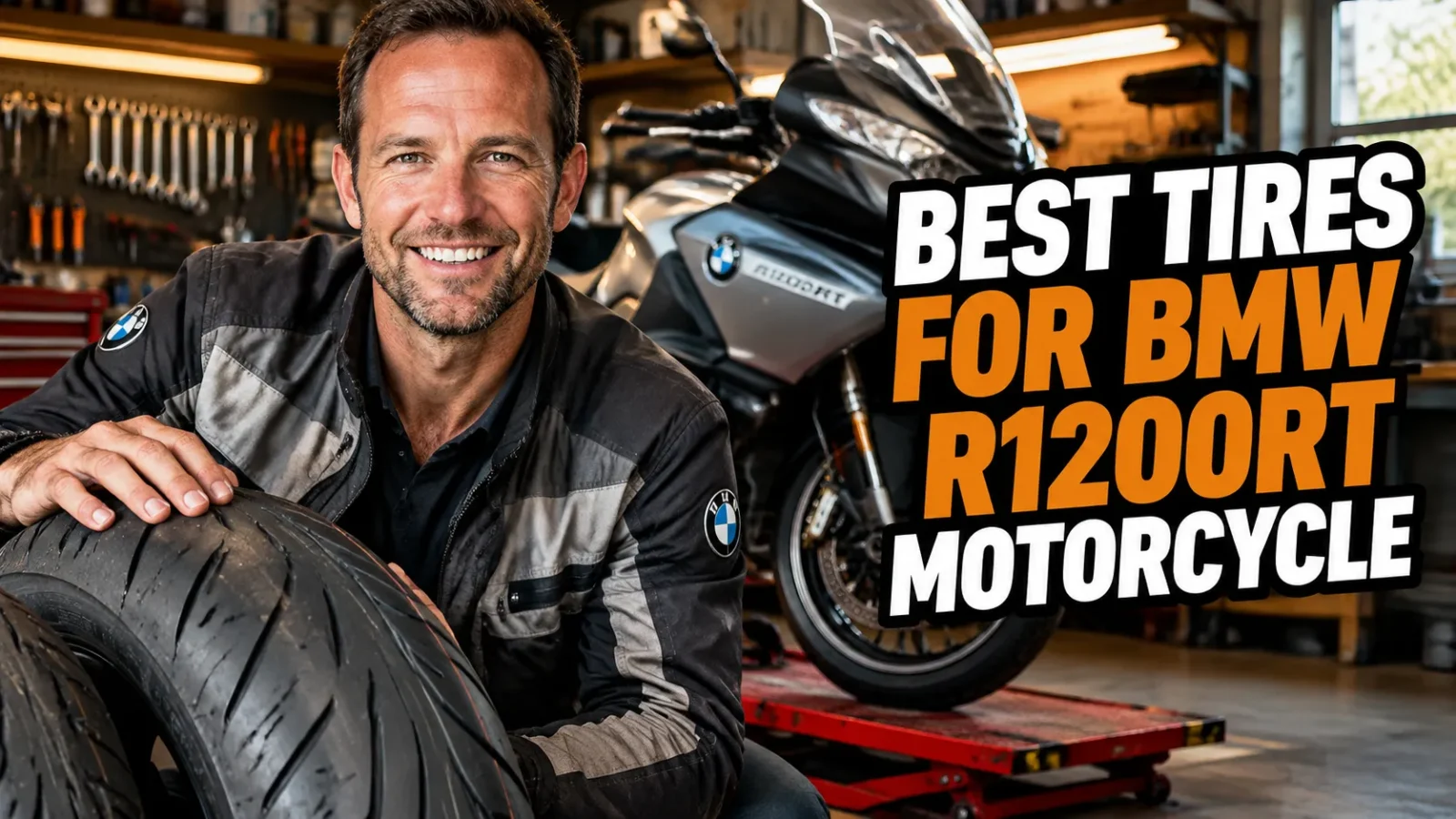
I’ve owned three BMW R1200RTs over the last fifteen years and put somewhere north of 70,000 miles on them, most of it loaded with panniers, a top box and a pillion who packs like we’re emigrating. Along the way I’ve burned through more sport-touring tires than I care to admit, and I’ve learned that the RT is a fussy old thing about rubber.
It’s a heavy bike. A liquid-cooled RT tips the scales around 274 kg wet before you add anything, and it makes 125 hp. That combination eats soft tires for breakfast and turns vague-feeling rubber into a genuine safety issue in the rain.
So this list is what I’d actually bolt to my own bike. Every tire here is a real, currently available model that comes in the RT’s sizes: 120/70 ZR17 front and 180/55 ZR17 rear. I’ve noted where a GT or heavy-duty rear variant exists, because on an RT you want it.
- My overall pick is the Michelin Road 6 GT — the best balance of wet grip, feedback and mileage I’ve found on an RT.
- If wet-weather confidence matters most, the Metzeler Roadtec 02 is the tire I trust in a downpour.
- Always fit the GT, HWM or heavy-duty rear version on an RT — the standard carcass squirms under a fully loaded bike.
- Run 36 psi front / 42 psi rear cold as a baseline and add pressure for luggage and pillions.
- Budget roughly £220 to £320 (or $250 to $400) for a fresh matched pair, plus fitting.
What Actually Matters on an R1200RT
Before the list, here’s the filter I use. The RT is a 250 kg-plus tourer with a Telelever front end, which means very little fork dive under braking. That’s great for comfort, but it also means the front tire takes less of a beating than you’d expect, and fronts often outlast rears.
The rear is where the punishment lands. All that torque plus luggage plus a pillion means you want a tire with a stiff, heat-resistant carcass and a harder centre compound. That’s exactly what GT and HWM fitments give you.
I also prioritise wet grip over dry grip. Any modern sport-touring tire is more capable in the dry than I am. It’s the cold, greasy, standing-water day in the Pennines that decides whether I get home relaxed or terrified.
1. Michelin Road 6 GT — The Best All-Rounder I’ve Used
If you only read one entry, make it this one. The Michelin Road 6 GT is the tire I keep coming back to, and it’s the one I’d fit if I were riding to the Alps tomorrow with a full load.
Michelin builds a specific GT (Grand Touring) version in 120/70 ZR17 and 180/55 ZR17 with a reinforced carcass designed for heavy sport-tourers. That’s not marketing fluff; on my RT the GT rear simply doesn’t squirm the way the standard carcass did when I ran one by mistake.
What I noticed in the real world
The XST+ siping and silica-rich compound give it genuinely remarkable wet grip. I’ve ridden through standing water on the A68 and felt the front stay planted in a way that the older Pilot Road 3 never managed. Michelin claims around 14% more wet grip than the Road 5, and my backside agrees.
Mileage is strong too. I got just over 11,000 miles from a rear on my last RT, which is excellent for a 125 hp, 274 kg machine. The steering stays neutral and predictable right down to the wear bars, which isn’t something I can say for every tire here.
The downside is price. Expect to pay around £150 to £180 for a front and £200 to £240 for a rear in the UK, and similar in dollars across the Atlantic. Worth it, in my view.
2. Metzeler Roadtec 02 — My Wet-Weather Weapon of Choice
Metzeler’s Roadtec 02 replaced the much-loved Roadtec 01 and it’s the tire I’d pick if I lived somewhere that rains sideways. Which, historically, I have.
The headline trick is what Metzeler calls an adaptive tread design, where the groove pattern and compound distribution change as the tire wears. In practice that means the wet performance stays consistent for far longer than a conventional design.
The rear is available in a HWM (Heavy Weight Motorcycle) fitment for 180/55 ZR17, and that’s the one you want on an RT. It’s a stiffer, more reinforced carcass built for exactly this kind of bike.
Where it shines and where it doesn’t
Cold, wet, greasy roundabouts: this is the most confidence-inspiring tire on this list. I’ve had the front tuck on other rubber in the same conditions and the Roadtec 02 just shrugged it off.
The trade-off is that it can feel slightly slower steering than the Michelin and it doesn’t quite match the Road 6 GT’s mileage, though I still saw comfortably over 9,000 miles from a rear. It’s a superb touring tire, just a touch less sporty in feel.
3. Continental RoadAttack 4 — Best for Sporty Riding
If you’re the type of RT owner who rides the bike like a much lighter machine, the Continental RoadAttack 4 is the one to try. It’s the sharpest-steering sport-touring tire I’ve had on an RT and it warms up fast.
Conti’s BlackChili compound is the star here. It’s the same family of rubber they use on their sportier tires, and it gives the RoadAttack 4 a level of dry grip and braking bite that genuinely surprised me on a bike this heavy.
The profile is a little more pointed than the Michelin, so turn-in is quicker and the bike feels noticeably more agile through tight mountain passes. For an RT, that’s a nice trick.
The honest downsides
Mileage is the weak point. I got around 7,500 miles from the rear before it squared off, which is a few thousand less than the Michelin or the Metzeler. If you tour 12,000 miles a year, that adds up.
It also isn’t quite as reassuring in heavy standing water. It’s far from bad, but the Roadtec 02 and Road 6 GT both edge it out on a genuinely filthy day.
4. Metzeler Roadtec 01 SE — The Bad-Weather Touring Classic
The Roadtec 01 SE is still widely available and still an excellent choice, particularly if you find it discounted now that the 02 has taken over at the top of the range.
It’s a silica-heavy compound with a high land-to-sea ratio, which is a fancy way of saying there’s a lot of rubber on the road and plenty of groove to shift water. High-silica compounds also warm up quickly, which matters on a cold morning.
I ran two sets of these back to back on my 2012 RT and got close to 12,000 miles from a rear, which is the best mileage figure on this entire list. The HWM rear version is the one to specify.
What I’d flag
As they wear, the steering gets noticeably heavier. I noticed mine felt wooden for the last thousand miles or so, and the front developed a slight ridge down the centre. Still, for pure longevity and wet performance, it’s a cracking tire.
5. Pirelli Angel GT II — Consistent, Predictable, Long-Lasting
The Pirelli Angel GT II is the tire I’d recommend to someone who wants zero surprises. It’s not the sharpest or the stickiest here, but it’s wonderfully linear in everything it does.
Pirelli uses a bi-compound rear with a harder centre belt for straight-line mileage and softer shoulders for cornering grip. Combined with a stiff, high-speed-stable carcass, it’s a natural match for a long-legged tourer like the RT.
What I love most is the feedback. You always know how much grip is left. On a 274 kg bike in the rain, that predictability is worth more than a tenth of a second on a lap you’re never going to time.
Mileage and wear
I saw just over 10,000 miles from a rear, with the front comfortably going further. It’s a sensible, mature tire for a sensible, mature motorcycle.
6. Bridgestone Battlax T32 GT — The Value Pick That Punches Above Its Price
Bridgestone’s Battlax T32 doesn’t get the same hype as the Michelin and Metzeler offerings, which is precisely why it’s often the smartest buy. The GT spec rear is built for heavier touring bikes and fits the RT’s 180/55 ZR17 perfectly.
It uses a triple-compound rear construction with a hard centre and softer shoulders, plus a revised tread pattern that Bridgestone claims improves wet braking. From the saddle, that translates to a secure, planted feel and very good stability at motorway speeds.
Comfort is a genuine strength. The T32 GT absorbs coarse chip seal and expansion joints better than the Continental, and on a bike you might ride for eight hours straight, that matters more than you’d think.
Where it gives ground
Dry grip and steering sharpness are a notch behind the best here. It’s also slightly slower to warm up on a cold, damp morning. But at typically 20 to 30% less than the Michelin, I’d happily run a set on a high-mileage commuter RT.
7. Michelin Road 5 GT — Still Brilliant, Now Great Value
The Road 5 GT is the Road 6’s predecessor, and while Michelin would rather you bought the newer tire, the Road 5 GT remains a genuinely excellent option, especially at discounted prices.
It introduced the XST siping concept that carried over to the Road 6, and it still delivers superb wet grip and a very neutral, confidence-inspiring feel. The GT carcass is the same reinforced touring construction.
Mileage is a little below the Road 6, but I still managed around 10,000 miles from a rear on a loaded RT. If you’re cost-conscious but want Michelin’s wet-weather character, this is where I’d look.
8. Dunlop RoadSmart IV — The Quiet Long-Distance Achiever
Dunlop’s RoadSmart IV is the tire I’d describe as quietly competent. It never blows you away, but it never lets you down either, and it lasts.
It uses a high-silica compound for wet grip and a multi-tread rear with a hard centre band for straight-line durability. There’s also a jointless band construction that keeps the tire’s shape stable at high speed, which suits the RT’s motorway manners.
On my bike it was one of the most comfortable tires I’ve run, and I got over 10,000 miles from the rear. Wet grip is good rather than outstanding, and it takes a little longer to warm up than the Continental.
Best for
Long, straight, high-mileage touring in mixed weather. If your RT spends most of its life on dual carriageways and motorways with the occasional alpine pass, the RoadSmart IV is a sensible, durable choice.
Sizes, Pressures and Fitting Notes for the RT
Every R1200RT, from the 2005 hexhead through to the liquid-cooled models, runs the same fitment: 120/70 ZR17 front on a 3.50-inch rim and 180/55 ZR17 rear on a 5.50-inch rim. That makes shopping easy.
Start with 36 psi front and 42 psi rear cold. That’s BMW’s own recommendation for solo riding. With panniers, a top box and a pillion, I run closer to 42 psi front and 44 psi rear, and I check the pressures cold before every long trip.
One more thing: if your RT has the RDC tyre pressure sensors, tell your fitter before they break the bead. Those sensors are expensive to replace and easy to crack if someone is careless with a tire lever.
My Final Verdict
After all these miles, the tire I keep buying is the Michelin Road 6 GT. It’s the best all-round package for a heavy sport-tourer: superb wet grip, neutral handling, strong mileage and consistent behaviour right to the end of its life.
If you ride in genuinely foul weather, go Metzeler Roadtec 02. If you want maximum mileage, the Roadtec 01 SE or Angel GT II will serve you well. And if you want sporty feel over longevity, try the RoadAttack 4 once.
Whatever you pick, buy the GT or HWM rear, keep the pressures right, and replace tires as a matched pair. Your RT will thank you, and so will your pillion.
Frequently Asked Questions
What size tires does a BMW R1200RT take?
Every R1200RT from the 2005 hexhead to the latest liquid-cooled model runs a 120/70 ZR17 front and a 180/55 ZR17 rear. Because the RT is a heavy sport-tourer, I always look for a GT, HWM or heavy-duty rear fitment rather than the standard carcass.
What tire pressures should I run on an R1200RT?
BMW’s own figures are 2.5 bar (36 psi) front and 2.9 bar (42 psi) rear for solo riding. Load up panniers and a pillion and I bump the rear up to around 2.9 to 3.1 bar and add a little to the front, then check cold.
How many miles should R1200RT tires last?
On my RT I expect roughly 8,000 to 12,000 miles from a rear and 10,000 to 14,000 from a front on a good sport-touring tire. Telelever front ends wear the front more evenly than a conventional fork, so fronts often outlast the rear by a wide margin.
Can I mix different tire brands front and rear?
You physically can, but I do not. Sport-touring tires are developed as a pair, and a mismatched set can upset the Telelever front end and the bike’s stability under load. I always fit a matched pair.

Related Articles

8 Best Cruiser Motorcycle Tires for Street Riding: My Real-World Picks
I rank the 8 best cruiser motorcycle tires for street riding, from Michelin to Pirelli, with real notes on grip,…
Jake Miller
9 min read

8 Best Michelin Motorcycle Tires for Every Riding Style (Tested Picks)
Looking for the best Michelin motorcycle tires? I break down my 8 favorite models for sport, touring, adventure, cruiser, and…
Jake Miller
9 min read

Yamaha Tire Pressure Guide: The Right PSI for Safer, Smoother Rides
Learn the right tire pressure for your Yamaha, from sportbikes to cruisers and dirt bikes. Check, adjust and maintain PSI…
Jake Miller
9 min read