
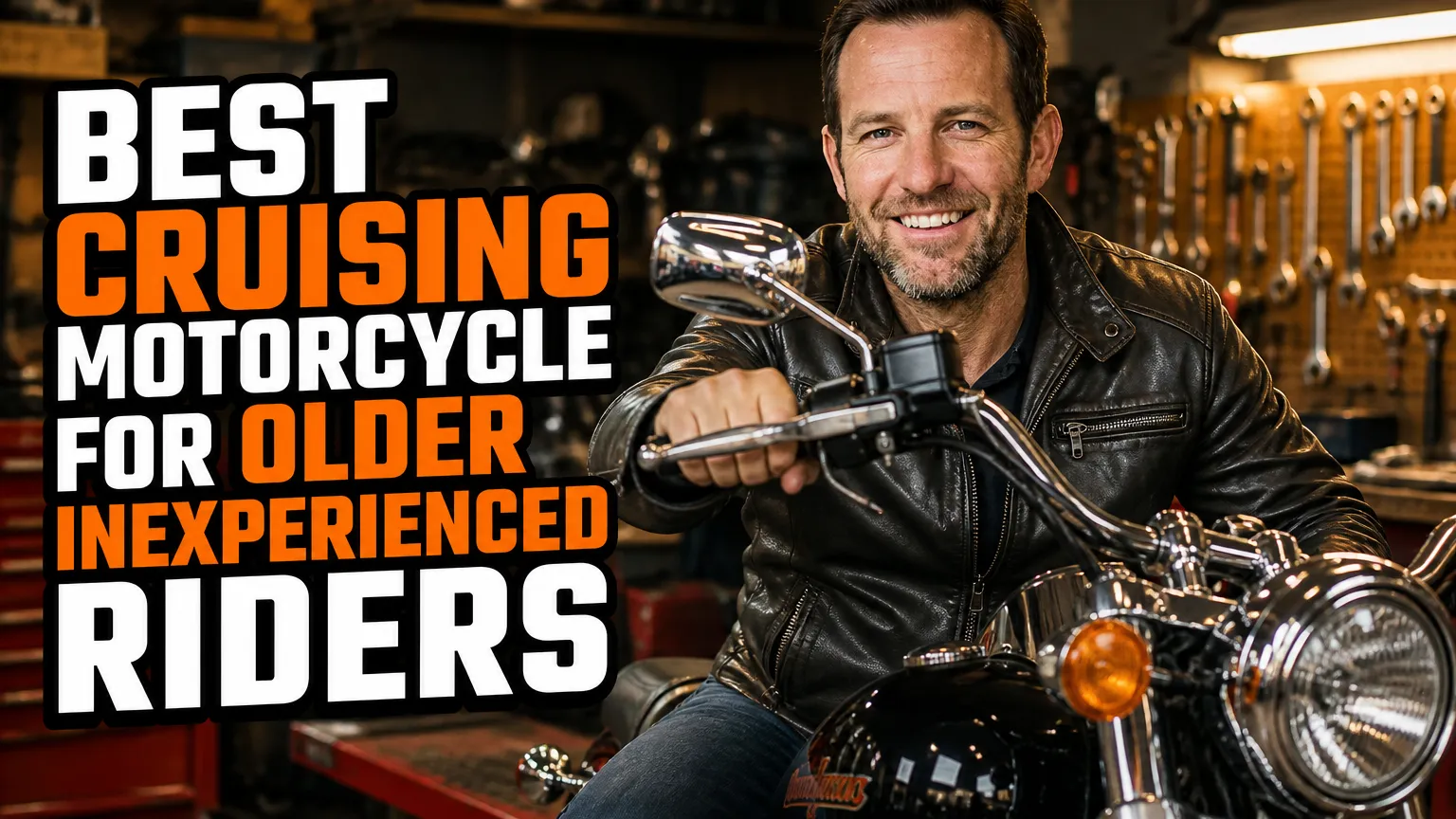
When I help someone choose their first cruiser, I look beyond engine size and styling. A comfortable seat, predictable throttle, manageable weight, and controls that fit your body can make learning more enjoyable, especially if you’re returning to riding or starting later in life.
My picks for the best cruising motorcycle for older inexperienced riders range from approachable small-displacement bikes to larger cruisers that may suit a confident beginner after training. I’ve included key specifications and practical trade-offs so you can make a shortlist, then check the fit for yourself at a dealership.
- I’d start with the Honda Rebel 300 ABS or Royal Enfield Meteor 350 if approachable power matters most.
- I’d consider the Kawasaki Eliminator ABS or Honda Rebel 500 ABS for a useful balance of manageable size and highway ability.
- I’d choose by real-world fit and low-speed handling, not seat height or engine displacement alone.
- I’d take a certified beginner course and wear protective gear before riding on public roads.
1. Honda Rebel 300 ABS: My pick for a gentle first step
I like the Honda Rebel 300 ABS as a straightforward way to learn cruiser basics without starting on a large, heavy motorcycle. Its 286cc liquid-cooled single-cylinder engine is modest, and the ABS version adds a useful safety feature for braking on changing road surfaces. It’s a bike I’d consider for local rides, practice, and building confidence gradually.
The Rebel 300 has a low seat of about 27.2 inches and a curb weight in the mid-360-pound range, depending on model year and configuration. Those figures can make it easier for me to settle into a stop than on a tall adventure bike, though I’d still test the bar reach, clutch feel, and balance before deciding.
What I’d consider before buying
I wouldn’t expect the Rebel 300 to feel effortless on every fast highway or when carrying a passenger. Its smaller engine is best suited to moderate speeds and lighter-duty use, so I’d be honest about the routes I plan to ride. If most of my trips involve busy, high-speed roads, I’d compare it with the Rebel 500 or Eliminator.
For a shorter rider, I’d also compare the Rebel’s fit with this guide to the best motorcycle for short riders. A low seat is helpful, but I’d pay equal attention to whether I can turn the bars comfortably and put a foot down without tipping my hips awkwardly.
2. Royal Enfield Meteor 350: My choice for relaxed back-road rides
The Royal Enfield Meteor 350 appeals to me when comfort and an unhurried pace matter more than strong acceleration. Its air-oil-cooled 349cc single-cylinder engine produces modest power, which can make the throttle feel approachable for someone learning to coordinate clutch, throttle, and braking. I also like its traditional cruiser posture and simple, classic look.
The Meteor 350’s seat is approximately 30.1 inches high, and its curb weight is around 421 pounds, with figures varying by trim and market. That seat is higher than the Rebel’s, so I wouldn’t assume the Meteor is automatically easier for shorter riders. I’d sit on it and check how securely I can place my feet while keeping the bike upright.
Why I’d take a test ride
I’d shortlist the Meteor for scenic roads, commuting at sensible speeds, and relaxed weekend rides. Its engine is not designed to deliver the passing punch of a middleweight twin, so I’d think carefully about frequent freeway travel before buying. The Meteor’s relaxed character is a real advantage when it matches my intended riding.
Royal Enfield offers different trims and accessory packages, and prices vary by region and model year. I’d confirm the current local price, ABS equipment, and warranty details with a dealer rather than relying on an old listing. For me, the right question is whether the bike feels easy to control once I’m moving and when I’m maneuvering it slowly.
3. Kawasaki Eliminator ABS: My balanced lightweight twin
I’d look closely at the Kawasaki Eliminator ABS if I wanted more power than a small single without stepping straight into a heavy traditional cruiser. Its 451cc liquid-cooled parallel twin has a smooth, modern feel, and the bike’s low, straightforward layout makes it appealing to riders who want an uncomplicated riding position.
Kawasaki lists the Eliminator with a seat height of about 28.9 inches and a curb weight around 390 pounds for the ABS model. I find that combination promising: the seat is low enough to feel accessible for many riders, while the motorcycle remains relatively light compared with larger cruisers. Still, I’d check the reach to the ground and the weight distribution in person.
Where I think it fits best
In my view, the Eliminator can make sense for a newer rider who expects to ride beyond quiet neighborhood streets. Its twin-cylinder engine gives it more flexibility than a 300cc-class bike, but I’d still practice gentle starts, tight turns, and controlled stops before taking it into faster traffic. ABS is a feature I’d prioritize when comparing versions.
For riders who want to compare small, approachable machines, I’d also browse the best 250cc motorcycle for short riders and best 300cc motorcycle for short riders guides. They can help me see whether a smaller bike may better suit my experience, inseam, and typical route.
4. Honda Rebel 500 ABS: My all-rounder for growing skills
The Honda Rebel 500 ABS is one of my strongest all-round choices for a beginner who wants room to grow. Its 471cc liquid-cooled parallel twin provides a broader spread of power than the Rebel 300, while the bike retains the low-slung cruiser layout that many riders find reassuring. I’d choose the ABS-equipped version when available.
The Rebel 500 has a seat height of about 27.2 inches and a curb weight of roughly 414 pounds in ABS trim, though exact specifications vary by year. I appreciate that the low seat doesn’t require me to stretch far to reach the ground, but I’d remember that a low seat does not make a motorcycle weightless. I’d practice backing it up and holding it steady on a slight slope.
My main trade-off
I’d expect the Rebel 500 to manage everyday roads and moderate highway use more comfortably than a small-displacement cruiser. At the same time, its engine is still powerful enough that I’d treat throttle control seriously, especially during the first few months. A beginner course and gradual practice matter more than a reassuring spec sheet.
When I compare bikes across engine classes, I use guides such as the best 600cc motorcycle for short riders as a starting point, not as a reason to chase displacement. Fit, weight, and how calmly a bike responds are more useful to me than a number on the tank.
5. Kawasaki Vulcan S ABS: My option for a more adjustable fit
I’d consider the Kawasaki Vulcan S ABS if I wanted a roomier motorcycle and liked the idea of adjusting the fit. Kawasaki’s Ergo-Fit system offers different seat, handlebar, and footpeg arrangements through dealer-installed components, depending on configuration. That adjustability can help me find a more natural posture than a one-size-fits-all cruiser setup.
The Vulcan S uses a 649cc liquid-cooled parallel twin and has a seat height of about 27.8 inches. Its curb weight is close to 500 pounds in ABS trim, so I’d take the extra mass seriously if I were a complete novice. I’d also test how the footpegs feel: the forward position suits some riders, while others prefer a more neutral leg position.
Who I’d recommend it to
I’d put the Vulcan S on the list for someone who has taken training, feels comfortable with a larger motorcycle, and expects to ride longer distances. I wouldn’t choose it just because the seat is low; at parking-lot speeds, weight and steering effort matter a great deal. If I struggled to push it backward or make a slow U-turn, I’d move to a lighter model.
For a rider who is still developing confidence, I’d compare the Vulcan S with the Rebel 500 and Eliminator before committing. I’d ask a dealer whether I can try the different Ergo-Fit components and confirm which configuration is available for the model year I’m shopping.
6. Honda Shadow Phantom ABS: My traditional cruiser with a low seat
The Honda Shadow Phantom ABS is a more traditional-looking option with a 745cc liquid-cooled V-twin engine. I like its classic cruiser proportions and low seat, around 25.6 inches, which may help me feel grounded at a stop. Honda’s current versions include ABS, a feature I’d value when comparing this bike with older used examples.
The Phantom weighs roughly 543 pounds curb, depending on model year and specification. That is a substantial step up from the Rebel models, so I wouldn’t treat the low seat as proof that it’s beginner-easy. I’d check whether I can confidently balance it, make slow turns, and manage it in a parking space before putting down a deposit.
What I’d watch for
I’d see the Shadow Phantom as a possible first cruiser for a careful learner with good instruction and enough strength to handle its mass, rather than my default recommendation for every new rider. Its larger engine offers more relaxed potential on open roads, but I’d keep the first rides short and controlled while learning its throttle and braking response.
I’d also compare new and used examples carefully. Equipment and pricing can change by year, and an older bike may not have the ABS found on newer versions. Before buying used, I’d arrange a qualified inspection and check service records, tires, brakes, and signs of damage.
7. Suzuki Boulevard C50: My heavyweight pick for a confident learner
The Suzuki Boulevard C50 is a full-size cruiser with an 805cc, liquid-cooled, fuel-injected V-twin and a classic low-slung profile. I’d include it as a possibility for someone who specifically wants a traditional, larger cruiser, but I would not call it the easiest choice for a brand-new rider. Its scale asks more of me at walking pace and when parking.
The C50 has a seat height of around 27.6 inches, but its curb weight is approximately 611 pounds. That contrast is important: I might be able to reach the ground easily and still find the bike difficult to move around when stopped. I’d only shortlist it after sitting on it, pushing it with the engine off, and trying slow maneuvers in a safe area.
My buying advice
I’d consider the Boulevard C50 after training or for someone who has already developed sound low-speed control. The larger V-twin and heavy chassis may feel appealing on open roads, but the C50’s weight can become a liability on gravel, a sloped driveway, or a cramped parking spot. I’d compare insurance and maintenance costs as part of the purchase.
Availability, prices, and equipment can differ by market and model year, so I’d confirm current details directly with a Suzuki dealer. If I were uncertain about managing the C50, I’d pick a lighter cruiser first and revisit a heavyweight model later, once my skills and confidence had grown.
How I’d choose the right cruiser for my first season
I’d start with a training course before buying, if possible. A course gives me a safe way to learn clutch control, emergency braking, and low-speed turns, and it may also help me identify the type of motorcycle that feels natural. I’d ask the instructor about fit and control issues rather than choosing by appearance alone.
Next, I’d sit on my shortlist and check the complete riding position. I’d make sure I can reach the bars without straining, operate the clutch and brake comfortably, and put a foot down in a controlled stop. I’d ask a salesperson to help me lift the bike from its side stand, then try walking it backward on level ground.
Features I’d prioritize
- ABS: I’d favor an ABS-equipped version when available, while remembering that ABS supports good braking technique rather than replacing it.
- Manageable weight: I’d choose a motorcycle I can control at a standstill, not merely one I can balance once it is moving.
- Predictable power: I’d look for smooth throttle response and enough performance for my regular routes without more power than I can comfortably manage.
- Comfortable controls: I’d check the seat, handlebar reach, footpeg position, and clutch effort because small discomforts can become tiring on longer rides.
I’d budget for a properly fitted helmet, gloves, abrasion-resistant jacket and pants, and over-the-ankle boots alongside the motorcycle. I’d also practice in an empty, legal area before taking on busy roads, and build ride length and traffic complexity gradually. If an unfamiliar bike feels awkward or intimidating, I’d trust that reaction and keep shopping.
My final pick
For the most approachable starting point, I’d compare the Honda Rebel 300 ABS and Royal Enfield Meteor 350 first. If I wanted a little more flexibility for mixed roads, I’d test the Kawasaki Eliminator ABS and Honda Rebel 500 ABS. For the Vulcan S, Shadow Phantom, and Boulevard C50, I’d give weight and low-speed handling extra attention before calling them suitable for me.
There isn’t one perfect cruiser for every older new rider. I’d choose the motorcycle that fits my body, strength, budget, and riding plans, then pair it with training and protective gear. A comfortable, manageable bike is the one most likely to help me enjoy the ride and keep learning.
Frequently Asked Questions
What is the easiest cruiser for an older beginner to ride?
I would start by comparing the Honda Rebel 300 ABS and Royal Enfield Meteor 350. Both have manageable power and low seats, but I recommend sitting on each and practicing a safe, controlled stop before choosing.
Is a 500cc cruiser too powerful for a new rider?
Not automatically. I consider a bike’s throttle response, weight, balance, and fit along with its engine size. A well-mannered 500cc model such as the Honda Rebel 500 can suit some beginners, especially after training.
Should older beginners choose a low seat height?
A low seat can help me feel secure at a stop, but it is only one part of fit. I also check reach to the bars and controls, foot placement, steering effort, and whether I can manage the motorcycle’s weight.
Is a heavy cruiser a good first motorcycle?
I generally prefer a lighter motorcycle for learning, because low-speed turns and parking can be challenging on a heavy bike. I would choose a heavier cruiser only after checking that I can confidently handle it at a standstill.

Related Articles

7 Best Cruisers for Comfortable Two-Up Motorcycle Trips
Compare seven comfortable cruisers for two-up rides, with real-world notes on passenger comfort, power, luggage, pricing, and how to choose…
 Jake Miller
12 min read
Jake Miller
12 min read

8 Comfortable Cruisers That Make Two-Up Riding More Enjoyable
Find a cruiser you and your passenger can enjoy together. I compare eight comfortable motorcycles, with real-world strengths, trade-offs, and…
Jake Miller
11 min read

7 Luxury Cruisers That Make Long-Distance Riding Feel First-Class
I compare seven luxurious cruisers for long-distance comfort, power, weather protection, luggage, technology, and value to help you choose the…
Jake Miller
13 min read