
11 Best Motorcycle Electrical Test Tools for Chasing Dead Batteries and Wiring Gremlins
 Jake Miller
11 min read
Jake Miller
11 min read
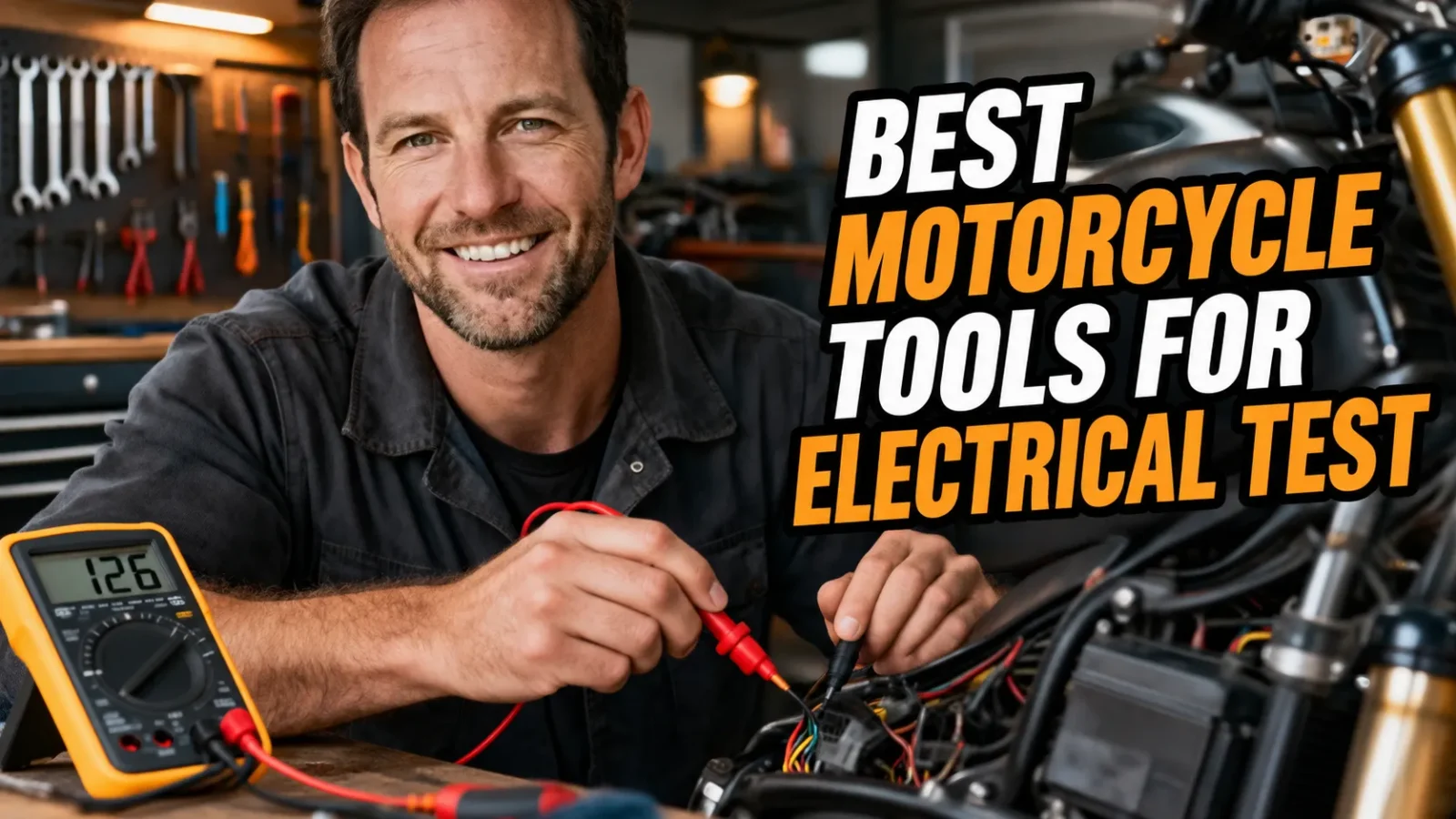
I’ve spent more evenings than I care to admit crouched next to a bike in a cold garage, multimeter in one hand and a wiring diagram balanced on my knee, wondering why a machine that ran perfectly yesterday now clicks instead of cranks. Electrical faults are the worst kind of problem on a motorcycle because you can’t see them, you can’t smell them, and they rarely give you a clean answer.
Over the years I’ve built up a small arsenal of test gear that I reach for every single time something goes sideways. If you’re still learning how the 12-volt side of your bike actually works, start with this guide to what are the different types of motorcycle batteries ultimate guide — it explains why a battery can show 12.6 volts and still be completely useless under load, which is a lesson I learned the hard way.
Below is the gear I actually use. Some of it is expensive, some of it costs less than a tank of fuel, and all of it has earned a permanent spot in my toolbox.
- The Fluke 88V is the gold standard for diagnosis, but the Klein MM700 and AstroAI AM33D cover most riders for far less money.
- A DC clamp meter like the Uni-T UT210E is the only sensible way to chase a parasitic draw without disconnecting the battery.
- You need three separate tools for three separate jobs: a meter for voltage, a load tester for battery health, and an inline tester for spark.
- Battery tenders and jump starters aren’t glamorous, but they prevent more breakdowns than any diagnostic tool ever will.
1. Fluke 88V — Best Overall for Serious Diagnosis
If I could only keep one electrical tool, it would be the Fluke 88V. This is the automotive version of Fluke’s legendary 87V, and it’s built specifically for the kind of work we do on bikes: 0.1% DC accuracy, True RMS, a 1000-volt range, and a LoZ (low impedance) mode that instantly eliminates the “ghost voltage” readings that plague cheap meters on corroded harnesses.
What makes it worth the money
The 88V records MIN/MAX values so you can catch a voltage drop that only appears for a split second when you hit the starter. It also measures duty cycle and millisecond pulse width, which is genuinely useful if you’re diagnosing an injector or an ignition signal. The automotive kit adds an inductive RPM pickup and a temperature probe.
At roughly $400 to $500 for the kit, it’s a serious investment. But I’ve had mine for years, dropped it off a lift twice, and it still reads dead-on against a calibrated reference. If you only work on your own bike occasionally, this is overkill.
2. Klein Tools MM700 — Best Mid-Range Multimeter
For most riders, the Klein Tools MM700 is the sweet spot. It’s True RMS, auto-ranging, rated to 1000 volts, and carries a CAT IV 600V safety rating, which means it won’t turn into a firework if you accidentally probe a live circuit at the wrong setting.
The feature I use most is the LoZ mode. On older bikes with crusty grounds, a standard high-impedance meter will happily read 8 volts on a wire that’s supposed to be dead, because it’s picking up induced voltage from a neighbouring harness. The MM700’s low impedance setting loads the circuit down and shows you the truth.
It measures capacitance, frequency, and temperature, ships with a thermocouple and a decent case, and costs roughly $130 to $150. Mine lives in the top tray of my box and gets grabbed before the Fluke at least half the time, purely because it’s lighter and I don’t wince when it lands on the garage floor.
3. AstroAI AM33D — Best Budget Multimeter
Not everyone wants to spend real money on a meter, and honestly, the AstroAI AM33D covers about 80% of what a home mechanic needs for around $20. It does DC and AC voltage, DC current up to 10 amps, resistance, continuity with an audible beep, and diode testing.
I keep one of these in my travel toolkit because if it gets crushed under a seat or forgotten at a campsite, I’m out twenty bucks instead of four hundred. The continuity beeper is loud enough to hear over a running engine, which matters more than people realise when you’re testing a ground circuit with one hand.
Where it falls short is precision. It’s a 2000-count manual-ranging meter, so it won’t resolve the tiny milliamp changes you need for parasitic draw hunting, and its leads are noticeably thinner than what you get from Fluke or Klein. Use it for voltage checks and continuity, and leave the fine measurement work to something better.
4. Power Probe III — Best Circuit Tester
The Power Probe III is the tool that changed how I think about electrical diagnosis. Instead of just measuring a circuit, it lets you power it. You clip it to the battery, and a trigger on the handle lets you send battery voltage or ground down the probe tip to test a component directly.
That means I can unplug a fan connector, touch the probe to the fan terminal, pull the trigger, and immediately know whether the fan itself is dead or whether the problem is upstream in the wiring. On a bike with a no-start fault, I can bypass the starter relay, the kill switch, or the sidestand switch in seconds. It has audible and visual indicators, built-in circuit protection, and a long enough lead that I can reach the front of the bike while the unit sits on the seat.
Expect to pay around $130 to $160 for the kit. It won’t replace a multimeter, but it will cut your diagnostic time dramatically.
5. Uni-T UT210E — Best Clamp Meter for Parasitic Draw
Chasing a battery drain used to mean pulling the negative cable and inserting a meter in series, which resets the ECU and half the electronics on a modern bike. The Uni-T UT210E solves that problem completely, because it clamps around the cable and measures DC current without breaking the circuit.
The 2-amp DC range resolves down to 1 milliamp, which is exactly the resolution you need when you’re hunting a key-off draw. I clamp it around the negative cable, confirm the reading, then start pulling fuses until the current drops. Its 17mm jaws fit comfortably around motorcycle battery cables.
It’s True RMS, has a non-contact voltage detector, and costs around $50. I’ve written before about how to handle a situation where your harley lost all electrical power, and nine times out of ten the clamp meter is the first tool out of the box.
6. Ancel BA101 — Best Battery Load Tester
Voltage tells you almost nothing about a battery’s health. I’ve seen batteries sit at a happy 12.6 volts and collapse to 6 volts the moment the starter engaged. The Ancel BA101 tests the battery under a real load and reports cranking amps, internal resistance, state of charge, and state of health.
It supports the common CCA, DIN, EN, and JIS standards, so you can punch in the number printed on your battery and get an honest verdict in about three seconds. It also runs a charging system test that shows you whether your regulator and stator are doing their job, including ripple voltage that indicates a failing rectifier.
At roughly $70, it’s cheaper than one unnecessary battery replacement. If your bike is sluggish to crank and you’re not sure whether you’re looking at a tired battery or a tired starter, this is the tool that settles the argument.
7. NOCO Boost Plus GB20 — Best Jump Starter
Lithium jump packs have gotten absurdly good, and the NOCO Boost Plus GB20 is sized just right for motorcycles. It delivers 500 amps of peak current, which is plenty for anything up to a 4.0-litre gas engine, and it’ll hold enough charge for roughly 20 jumps.
I’ve used mine to rescue everything from a fuel-injected adventure bike to a snowblower. It has reverse polarity protection and spark-proof clamps, so you can’t fry your bike’s electronics by hooking it up backwards in the dark, and the built-in LED flashlight has saved me more than once on the side of a road.
Some people argue that a bike with a kickstarter never has this problem, and there’s a fun debate about kickstart vs electric start that makes exactly that point. But since virtually every modern motorcycle uses a button, a jump pack in your pannier is cheap insurance.
8. Battery Tender Plus 021-0128 — Best Battery Maintainer
Most of the electrical problems I see in spring were caused the previous winter. A lead-acid battery left to self-discharge for four months will sulphate, and no amount of charging brings it all the way back. The Battery Tender Plus runs 1.25 amps through a four-step charge profile and then holds the battery in a temperature-compensated float mode indefinitely.
I keep one on every bike I own, and I swap the harness between the ring terminals and the alligator clips depending on whether I’m in a hurry. If you’re not sure what the difference is between a maintainer and a charger read this breakdown of how does a battery tender work before you buy the wrong thing.
Physically getting to the battery is half the battle on some models, so it’s worth knowing the procedure first. This walkthrough on how to remove harley street 750 battery is a good example of how buried some batteries are, and why installing a permanent tender pigtail is worth the twenty minutes.
9. Power Probe ECT3000 — Best Short and Open Circuit Finder
This one is more specialised, but when you have a dead short in a harness, nothing else comes close. The Power Probe ECT3000 uses a transmitter and a receiver to trace a shorted or open circuit through the loom without you having to cut open the harness insulation or unwrap tape.
You connect the transmitter in place of the fuse, then sweep the receiver along the wiring. It follows the signal and tells you where it stops or grounds out, which turns a two-day job into a twenty-minute one. It’s the sort of tool that pays for itself the first time you use it on a bike with a mystery fuse that keeps popping.
It’s not cheap, and most riders will never need one. But if you own a project bike with a butchered wiring harness, or you restore old machines, it’s genuinely transformative.
10. Lisle 20610 — Best Inline Spark Tester
When an engine cranks but won’t fire, the first question is always whether you have spark. The Lisle 20610 inline spark tester answers that in about thirty seconds. You pull the plug boot, plug the tester into it, clip the other end to a good ground or the plug itself, and crank.
You can watch the spark jump across the adjustable gap through the clear window, and the colour and intensity give you a rough sense of coil output. It’s adjustable, so you can widen the gap to stress-test a weak coil. Best of all, it costs around $15.
The only limitation is access. On bikes with deeply recessed coil-on-plug setups, you may not have room to fit a tester without an extension, so check the plug location first.
11. Fluke TP88 Back Probe Pins — Best Probing Accessory
This one sounds boring, and it’s the tool I’m most annoyed I didn’t buy years ago. The Fluke TP88 pins are rigid, 2mm back probes that slide alongside a wire into the back of a connector, letting you take a reading without piercing the insulation or unplugging anything.
Because motorcycle harnesses are small and densely packed, most standard multimeter probes are too fat to fit. The fine tips on the TP88 let me test a TPS sensor, an injector, or a relay socket while everything is still plugged in and running, which is when the best diagnostic information appears.
They cost around $35 and work with any meter that takes standard 4mm shrouded leads. Combined with the Fluke 88V or the Klein MM700, they turn a frustrating connector into an easy test point.
What I’d Actually Buy First
If you’re starting from nothing and you own a single motorcycle, buy the Klein Tools MM700 and the Uni-T UT210E. That combination covers voltage, resistance, continuity, and current, which handles virtually every electrical fault you’ll ever encounter.
Add the Battery Tender Plus, and you’ll prevent most of the problems before they start. If you ride a lot and you’ve been stranded once already, add the NOCO GB20 and stop worrying about it. Everything else on this list is a tool you buy once you’ve decided that electrical diagnosis is something you actually enjoy.
One last thing: even the best meter won’t help you if you don’t understand your battery. If you want to know how long a slow charge should realistically take, this piece on how long to charge a car battery at 10 amps explains the math that applies to your bike’s battery just as well.
Frequently Asked Questions
Do I really need a Fluke multimeter for motorcycle work?
Not strictly, but a Fluke 88V or 115 gives you True RMS accuracy, fast sampling, and LoZ mode that kill ghost voltage readings. Cheap meters often read a floating 3 to 4 volts on a dead circuit, which sends you chasing a fault that does not exist.
How do I find a parasitic draw on my bike?
Clamp a DC clamp meter like the Uni-T UT210E around the negative battery cable with the key off, then pull fuses one at a time until the reading drops. Anything over about 30 milliamps on a modern bike is worth investigating.
Can I test a motorcycle battery without a load tester?
You can get close by watching voltage sag, but a proper tester like the Ancel BA101 measures internal resistance and cranking voltage, which tells you the true state of health instead of just the surface charge.
What is the cheapest way to check for spark?
An inline spark tester such as the Lisle 20610 costs around 15 dollars and lets you see the spark jump while the engine cranks. It is far safer than holding a plug against the cylinder head.

Related Articles

How to Fix a Short Circuit on a Motorcycle: A Rider’s Step-by-Step Guide
Learn how to find and repair a motorcycle short circuit step by step, from blown fuses to chafed wires, with…
Jake Miller
11 min read

What Does a CDI Unit Do on a Motorcycle? Purpose, Symptoms and Fixes
Wondering what a CDI does on your bike? I explain how the capacitor discharge ignition works, signs of failure, testing…
Jake Miller
10 min read

How to Test a 6 Volt Motorcycle Battery and Charging System (Step-by-Step)
Learn how to test a 6 volt motorcycle battery and charging system step by step, with multimeter readings, load tests,…
Jake Miller
10 min read