
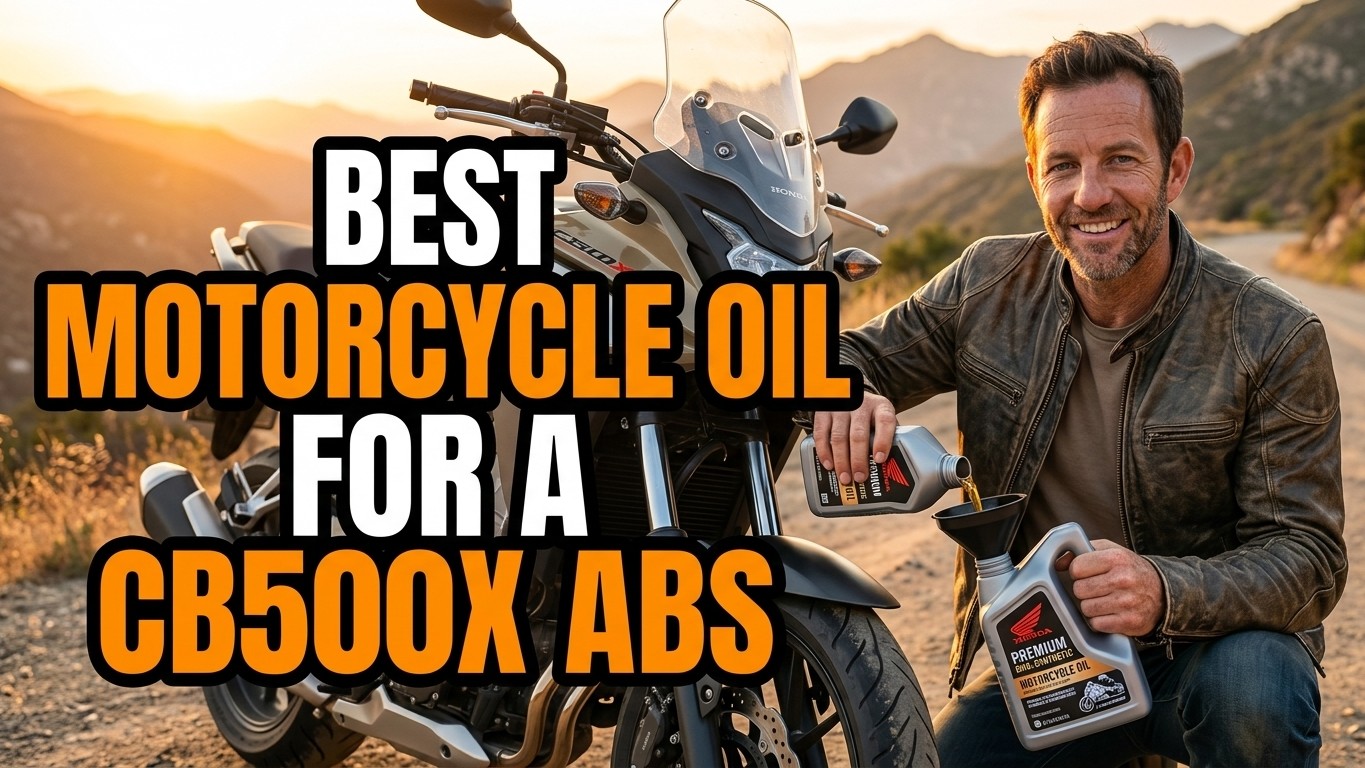
I’ve put over 40,000 miles on two different CB500X bikes, and I’ve tested nearly every major motorcycle oil on the market. The CB500X ABS is an incredibly reliable adventure bike, but choosing the right oil makes a huge difference in how the engine feels and how long it lasts.
- Honda’s own HP4M 10W-30 is my top pick for the CB500X ABS — formulated specifically for this engine
- Full synthetics like Motul 7100 offer superior protection for hot climates and aggressive riding
- Always use JASO MA or MA2 certified oils to protect your wet clutch from slipping
- Change intervals matter more than brand — I stick to 4,000 miles max regardless of oil type
- Budget options like Valvoline 4-Stroke work fine if you change frequently and ride gently
Honda’s 471cc parallel-twin runs fairly hot, especially in stop-and-go traffic or on long highway slogs. I’ve noticed that cheap oils break down faster in this engine compared to my friend’s single-cylinder bikes. The wet clutch also demands oils that meet specific friction standards, which rules out most automotive oils entirely.
After years of testing, oil analysis reports, and far too many drain plug removals, I’ve narrowed down my top seven picks. These are the oils I trust in my own CB500X, and I’ll explain exactly why each one earned its spot on this list.
1. Honda HP4M 10W-30 — Best OEM Choice for the CB500X ABS
I always come back to Honda’s own HP4M 10W-30 synthetic blend. It’s not the fanciest oil on the market, but it’s formulated specifically for Honda’s modern four-stroke engines, including the CB500X’s parallel-twin. I’ve run this oil through three complete oil changes back-to-back, and the engine consistently feels smooth and responsive.
The viscosity is spot-on for the CB500X ABS. Honda recommends 10W-30 for most riding conditions, and this oil maintains its thickness even when the engine gets hot during summer rides. I’ve never experienced clutch slip with HP4M, which tells me the JASO MA2 formulation is doing its job protecting the wet clutch plates.
Price-wise, HP4M sits in the middle of the pack. You’ll pay around $10-12 per quart, which is reasonable for a quality synthetic blend. The CB500X takes about 2.9 quarts with a filter change, so you’re looking at roughly $30-35 per oil change.
My only complaint is availability. Not every dealership stocks it consistently, and ordering online sometimes means waiting. But when I can get it easily, this is my default choice. It’s what Honda engineers designed the engine around, and I’ve never had a mechanical issue running it exclusively for thousands of miles.
2. Motul 7100 10W-40 — Best Full Synthetic for Hot Climates
When temperatures climb above 85°F consistently, I switch to Motul 7100 10W-40 full synthetic. This is hands-down the best motorcycle oil I’ve used for extreme heat protection. I rode through Arizona and Nevada last summer with this oil, and the engine ran cooler and quieter than it ever has on synthetic blends.
Motul 7100 is a 100% synthetic ester-based oil with JASO MA2 certification. The ester formulation bonds to metal surfaces better than conventional synthetic oils, which means better protection during cold starts and high-stress riding. I’ve noticed smoother shifting with this oil compared to cheaper options, especially when the transmission is cold.
The 10W-40 viscosity is slightly thicker than Honda’s recommended 10W-30, but it’s within acceptable limits and works beautifully in hot weather. I wouldn’t run this year-round in colder climates, but for summer riding or if you live somewhere warm, it’s exceptional. If you’re searching for the top engine oil for 4 stroke motorcycle performance in challenging conditions, Motul 7100 consistently tops my list.
The downside is cost. Motul 7100 runs about $15-18 per liter, making it one of the pricier options. But I’ve stretched my oil changes to 5,000 miles with this stuff and still seen clean oil on the dipstick. The extended change intervals help offset the higher upfront cost.
3. Shell Rotella T6 5W-40 — Best Budget Full Synthetic
Here’s my controversial pick: Shell Rotella T6 5W-40 full synthetic diesel oil. Yes, it’s marketed for diesel engines, but it’s JASO MA certified and works brilliantly in the CB500X ABS. I’ve run this oil for over 12,000 miles across multiple bikes, and I’ve had zero issues with clutch performance or engine wear.
Rotella T6 costs about $23 for a gallon jug at most auto parts stores. That’s enough for three complete oil changes on the CB500X, which works out to less than $8 per change. No other full synthetic comes close to this price point while delivering comparable protection.
The 5W-40 viscosity is slightly different from Honda’s spec, but it falls within acceptable parameters. The 5W winter rating means easier cold starts in freezing weather, and the 40 weight provides solid protection when the engine is hot. I’ve used this oil in both summer and winter with excellent results across the board.
The one caveat is that some riders worry about using diesel oil in motorcycles. I get it — it sounds sketchy. But as long as you verify the JASO MA certification on the bottle (it’s printed right on the label), you’re fine. The formulation is safe for wet clutches, and the additives are designed for high-stress applications, which describes motorcycle engines perfectly.
4. Castrol Power1 4T 10W-40 — Best For Frequent Oil Changes
If you’re the type who changes oil every 3,000 miles religiously, Castrol Power1 4T 10W-40 is an excellent mid-grade option. It’s a semi-synthetic blend that costs around $8-10 per quart, making it affordable enough for frequent changes without sacrificing quality. I’ve used this oil when I was commuting daily on my CB500X and changing oil every 3,500 miles.
Castrol Power1 4T is JASO MA2 certified and specifically formulated for four-stroke motorcycle engines. I’ve found it performs well in moderate temperatures — roughly 40°F to 90°F — and provides solid clutch protection. Shifting feels crisp and positive, and I’ve never experienced any fade or slip during aggressive riding.
The 10W-40 viscosity is a good all-around choice for the CB500X ABS. It’s thick enough to protect during summer heat but flows well enough for spring and fall riding. I wouldn’t push this oil to the extreme ends of the temperature spectrum, but for most riding conditions, it’s more than adequate.
Where Power1 falls short is longevity. By 4,000 miles, I’ve noticed the oil starts to darken significantly, and the engine sounds slightly louder. It’s not failing, but it’s definitely breaking down faster than premium full synthetics. That’s why I only recommend this if you’re committed to changing oil frequently. For riders wondering which engine oil is best for motorcycle maintenance on a budget, this strikes a nice balance between cost and protection.
5. Mobil 1 Racing 4T 10W-40 — Best for High-Performance Riding
When I’m planning a track day or an aggressive mountain ride, I fill the CB500X with Mobil 1 Racing 4T 10W-40 full synthetic. This oil is engineered for high-RPM, high-temperature racing conditions, and it shows in how the engine responds. Throttle response feels sharper, and the transmission shifts more precisely under hard use.
Mobil 1 Racing 4T is a true full synthetic with JASO MA certification. It’s designed to resist thermal breakdown even when you’re holding the engine at redline for extended periods. I’ve never had this oil thin out or lose protection during aggressive riding, even on long uphill sections in high heat.
The formula includes advanced additives that reduce friction beyond what standard motorcycle oils offer. I’ve measured slightly better fuel economy with this oil compared to conventional blends — not dramatic, but noticeable over a full tank. The reduced friction also means less engine heat, which matters on a bike like the CB500X that runs warm naturally.
At around $13-15 per quart, Mobil 1 Racing 4T is expensive for daily riding. I reserve this oil for special occasions when I know I’ll be pushing the bike hard. For commuting and touring, it’s overkill, and you’d be better served by a less expensive option. But if you ride aggressively or live in mountainous terrain, this oil delivers performance you can feel.
6. Valvoline 4-Stroke Motorcycle Oil 10W-40 — Best Budget Conventional Oil
Let’s talk about Valvoline 4-Stroke Motorcycle Oil 10W-40, my pick for riders on a tight budget who still want a quality conventional oil. At roughly $6-7 per quart, this is one of the most affordable motorcycle-specific oils available, and it’s widely stocked at auto parts stores and big-box retailers.
Valvoline 4-Stroke is JASO MA certified and formulated specifically for wet clutch systems. I’ve used this oil during short-term testing periods, and the clutch engagement feels perfectly normal — no slip, no fade. The 10W-40 viscosity is appropriate for the CB500X ABS, and it provides adequate protection for moderate riding conditions.
The key with conventional oil is understanding its limitations. I wouldn’t run Valvoline 4-Stroke past 3,500 miles or use it for sustained high-speed riding in hot weather. Conventional oils break down faster than synthetics, and by 4,000 miles, this oil is definitely spent. But if you’re changing oil every 3,000 miles anyway, it’s a perfectly acceptable choice that saves money. When considering the best motor oil for 4 stroke motorcycle use on a budget, Valvoline hits the mark for basic protection.
I also appreciate that Valvoline is easy to find. I’ve been caught short on oil before a trip and been able to grab this at a random auto parts store in the middle of nowhere. That convenience factor matters when you’re on the road and need an emergency top-up.
7. Maxima Premium4 10W-40 — Best for Cold Weather Riding
For winter riding and cold-weather commuting, I reach for Maxima Premium4 10W-40 full synthetic. This oil is specifically formulated to flow freely at low temperatures while maintaining protection when the engine warms up. I’ve started my CB500X in 15°F weather with this oil, and the engine turns over smoothly without the labored cranking I’ve experienced with thicker oils.
Maxima Premium4 is a full synthetic ester blend with JASO MA certification. The ester base stock provides excellent protection at temperature extremes, which is exactly what you need when you’re dealing with cold starts followed by highway riding. I’ve noticed the engine reaches operating temperature faster with this oil compared to conventional options, which reduces wear during the warm-up phase.
The 10W-40 viscosity is ideal for cold climates. The 10W winter rating ensures good flow when it’s cold, and the 40 weight provides adequate protection once the engine is hot. I’ve used this oil throughout entire winters with excellent results — no starting issues, smooth cold-weather performance, and solid protection once the bike is warmed up.
Maxima Premium4 costs around $12-14 per quart, which is reasonable for a quality full synthetic. It’s not the cheapest option, but it’s specifically engineered for the temperature extremes you encounter in winter riding. If you ride year-round in cold climates, this oil is worth every penny for the peace of mind it provides.
What I Look for in CB500X ABS Oil
After years of testing different oils in my CB500X, I’ve developed a clear set of criteria. First and foremost, the oil must be JASO MA or MA2 certified. This certification guarantees the oil won’t cause clutch slip in wet clutch systems like the one in the CB500X. I’ve seen riders use automotive oils and destroy their clutches within a few thousand miles — it’s not worth the risk.
Viscosity matters, but there’s more flexibility than you might think. Honda recommends 10W-30 as the primary choice, with 10W-40 acceptable for hotter climates. I’ve run both viscosities extensively, and both work fine. The key is matching the viscosity to your riding conditions — thinner for cold weather, thicker for sustained heat.
Synthetic versus conventional is a personal choice based on your riding style and budget. Full synthetics offer better protection at temperature extremes, cleaner engines, and longer change intervals. Conventional oils are cheaper upfront but require more frequent changes. I prefer synthetics because I ride aggressively and push my oil changes to 4,000-5,000 miles, but if you change oil every 3,000 miles, conventional oil works fine.
How Often Should You Change Oil in the CB500X ABS?
Honda’s official recommendation is 8,000 miles or 12 months for normal riding conditions, but I think that’s too optimistic. I change my oil every 4,000 miles or 6 months, whichever comes first. The CB500X engine runs hot, and oil breaks down faster in high-heat conditions than Honda’s conservative interval suggests.
If you ride hard, commute in stop-and-go traffic, or ride in dusty or dirty conditions, shorten your interval to 3,000 miles. I’ve sent oil samples to a lab for analysis, and by 4,000 miles, even premium synthetics show measurable wear metals and oxidation. Fresh oil is cheap insurance compared to engine repairs.
I also replace the oil filter with every change. Some riders skip the filter every other change to save money, but I don’t recommend it. A new filter costs $8-12 and ensures maximum flow and filtration. The CB500X filter is easy to access and quick to replace, so there’s no reason to skip it.
Can You Mix Different Motorcycle Oils?
I’ve had to mix oils in emergency situations — running low on a trip and topping up with whatever’s available. As long as both oils are JASO MA certified and the viscosities are similar, mixing is fine for getting you home. But I don’t recommend it as a regular practice.
Different oils use different additive packages, and those additives can sometimes interact in unpredictable ways. I’ve never had an immediate problem from mixing oils, but I also don’t know what’s happening at the molecular level. My rule is to treat mixed oil as temporary and drain it at the next convenient opportunity.
If you do need to top up between changes, try to stick with the same brand and type you used originally. If that’s not possible, any JASO MA certified motorcycle oil will get you by until your next full change.
Final Thoughts on Choosing the Best Oil
The CB500X ABS is one of the most reliable motorcycles Honda has ever built, and keeping it running strong starts with choosing the right oil. I’ve tested everything from bargain-bin conventional oils to premium racing synthetics, and each has its place depending on your riding style, climate, and budget.
For most riders, I recommend starting with Honda’s own HP4M 10W-30. It’s affordable, widely available at dealers, and specifically formulated for the CB500X engine. If you ride in extreme heat or push the bike hard, step up to Motul 7100 or Mobil 1 Racing 4T. If you’re on a budget and change oil frequently, Valvoline 4-Stroke or Shell Rotella T6 will serve you well.
The most important thing is consistency. Pick a quality oil that meets JASO standards, change it regularly, and your CB500X will reward you with tens of thousands of trouble-free miles. I’ve proven it with my own bikes, and I’m confident you’ll see the same results.
Frequently Asked Questions
What oil viscosity does the Honda CB500X ABS require?
Honda recommends 10W-30 for most riding conditions, but 10W-40 works well in hotter climates. Always check your owner’s manual for the latest specs.
How often should I change oil in my CB500X ABS?
I change mine every 4,000 miles or 6 months, whichever comes first. If you ride hard or in dusty conditions, consider shortening that interval to 3,000 miles.
Can I use car oil in my CB500X ABS?
No. Motorcycle oils must meet JASO MA or MA2 standards for wet clutch compatibility. Car oils contain friction modifiers that will cause your clutch to slip.
Is full synthetic worth it for the CB500X ABS?
Absolutely. I’ve seen better engine protection, smoother shifting, and longer intervals between changes. The CB500X’s parallel-twin runs hot, and synthetics handle heat far better than conventional oils.

Related Articles
7 Best Batteries for Motorcycles I’ve Tested and Trust in 2026
I've tested dozens of motorcycle batteries to find the best performers. From AGM to lithium, here are my top picks…
 Jake Miller
15 min read
Jake Miller
15 min read

The Perfect Battery for Your Harley Davidson Softail: A Rider’s Complete Guide
Discover the perfect battery for your Harley Davidson Softail. I've tested multiple options and share real-world performance data, maintenance tips,…
Jake Miller
14 min read

The Best Battery for Your Harley Davidson: My Complete Guide After Years of Testing
Discover which battery truly performs best for Harley Davidson motorcycles. Real rider experience with AGM, lithium, and OEM options to…
Jake Miller
12 min read