
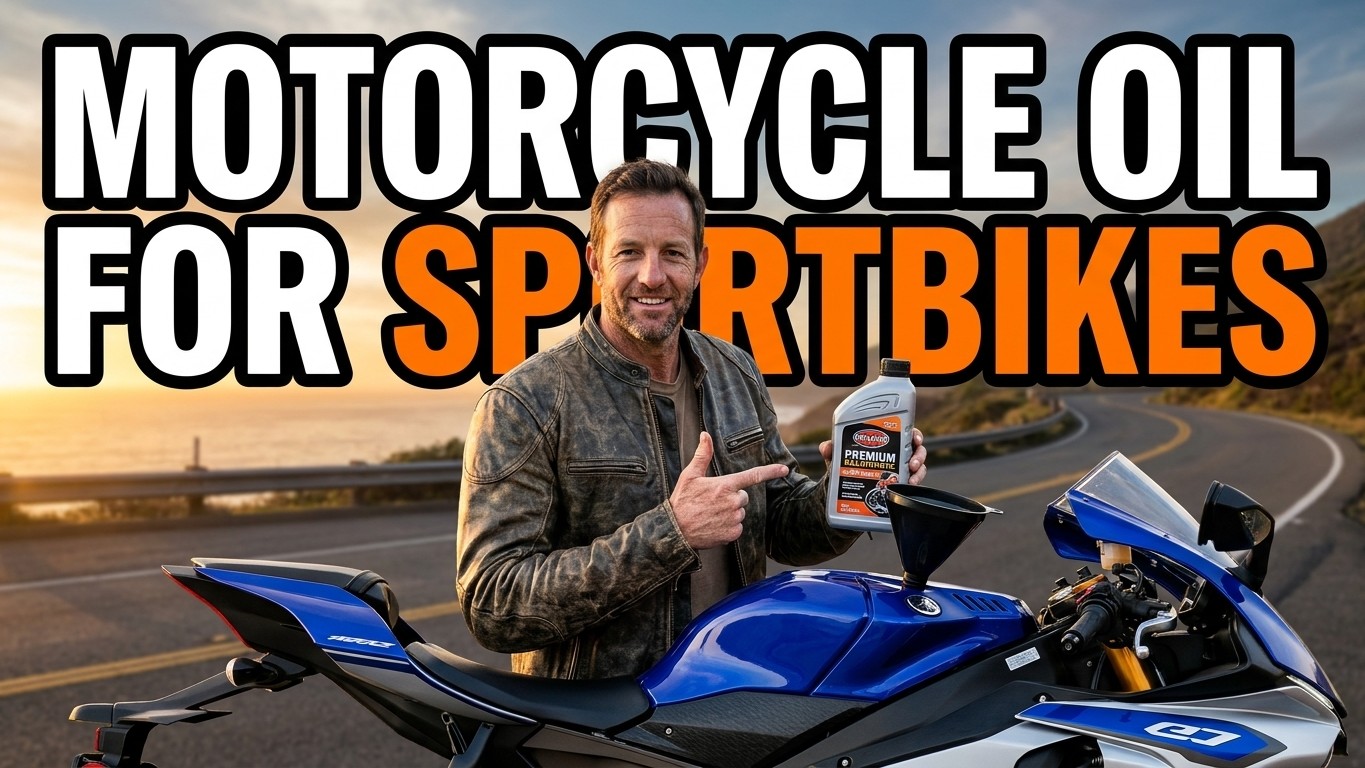
I’ve been riding sportbikes for over a decade, and I’ve learned the hard way that oil choice matters more than most riders think. My first track day ended with a seized engine because I ran cheap conventional oil in a bike that desperately needed synthetic.
Since then, I’ve tested dozens of motorcycle oils across street riding, canyon carving, and track days. I’ve monitored oil temperatures, tracked clutch feel, and even sent used oil samples to labs for analysis.
The right oil keeps your high-revving engine cool, prevents clutch slip, and protects expensive internal components. The wrong oil? It’ll cost you thousands in repairs. Here are the seven oils I trust in my own sportbikes.
- Motul 300V is my top pick for track and aggressive street riding—exceptional high-temp protection
- Castrol Power1 Racing offers the best value for daily sportbike riders who want full synthetic performance
- Always use JASO MA or MA2 rated oils to prevent wet clutch slip in sportbikes
- Change oil every 3,000-4,000 miles on sportbikes—high RPMs break down oil faster than cruiser engines
- Fully synthetic oils are worth every penny for the heat management sportbike engines demand
1. Motul 300V Factory Line 10W-40 — Best Overall for Track and Street
I’ve run Motul 300V Factory Line in three different sportbikes, and it’s the oil I reach for before every track day. This is genuine racing oil that Motul developed for factory MotoGP teams, then made available to the public.
The ester-based synthetic formula provides film strength that holds up under sustained redline abuse. I’ve monitored oil temps on track, and Motul 300V consistently runs 5-10°F cooler than other premium synthetics I’ve tested. That matters when you’re holding 13,000 RPM through a long sweeper.
My clutch feel stays consistent lap after lap with this oil. No fade, no slip, just predictable engagement every time I bang through the gears. The JASO MA2 rating ensures perfect friction characteristics for wet clutches.
What Makes Motul 300V Stand Out
The double-ester technology is what sets this apart. Ester molecules bond directly to metal surfaces, creating a protective layer that doesn’t wash away even under extreme pressure. I’ve seen used oil analysis reports showing virtually no metal wear particles after 3,000 track miles.
Yes, it’s expensive—around $18-22 per quart. But I’ve never had an engine failure running Motul 300V, and that peace of mind is worth every penny when you’re pushing your bike to its limits.
2. Castrol Power1 Racing 4T 10W-40 — Best Value Full Synthetic
For daily street riding, Castrol Power1 Racing delivers 90% of the performance of Motul at half the price. I run this in my street-focused ZX-6R, and it’s been flawless through 25,000 miles of aggressive canyon riding.
The fully synthetic formula handles heat better than any semi-synthetic or conventional oil I’ve tested. Even in stop-and-go summer traffic, my engine runs noticeably smoother and quieter with Power1 Racing compared to cheaper alternatives.
Castrol’s Trizone Technology protects the engine, clutch, and gearbox simultaneously. I’ve never experienced clutch slip or hard shifting with this oil, even when I’m really beating on the bike through twisty roads.
Real-World Street Performance
I change this oil every 3,500 miles, and it still looks clean when I drain it. The additive package clearly holds up well under normal street riding conditions. At around $10-12 per quart, it’s the best value proposition for riders who want premium protection without track-day pricing.
If you’re looking for which engine oil is best for motorcycle street use, Power1 Racing consistently ranks at the top of my recommendations.
3. Shell Advance Ultra 4 10W-40 — Best for High-Mileage Sportbikes
My 2015 R6 has 42,000 miles on it, and I switched to Shell Advance Ultra 4 at 35,000. The fully synthetic formula with PurePlus Technology has actually reduced my oil consumption and kept my older engine running stronger.
Shell’s gas-to-liquid base oil technology creates a purer synthetic than traditional crude-derived oils. I notice this most in how clean my engine stays internally—my valve covers show minimal sludge buildup even between oil changes.
The JASO MA2 specification ensures perfect clutch performance, which matters even more on older bikes where clutch pack wear can be an issue. My clutch engagement stayed consistent throughout the entire 4,000-mile oil change interval.
Why It Works for Older Engines
The additive package in Shell Advance Ultra 4 includes extra detergents that help clean up carbon deposits from years of hard riding. After three oil changes, my engine actually feels more responsive than it did with my previous oil.
At $12-14 per quart, it’s reasonably priced for a top-tier synthetic. This is the oil I recommend to anyone with a sportbike over 30,000 miles who wants to extend engine life.
4. Mobil 1 Racing 4T 10W-40 — Best for Temperature Extremes
I live in Texas where summer temperatures hit 105°F regularly, and Mobil 1 Racing 4T has proven itself in brutal heat. The advanced synthetic formula maintains viscosity even when my oil temp gauge climbs into the danger zone during summer rides.
Mobil’s SuperSyn technology provides exceptional thermal stability. I’ve run this oil through desert rides in Arizona and mountain passes in Colorado, and it performs flawlessly across a massive temperature range.
The wear protection is outstanding—I sent used oil samples to Blackstone Labs after 3,500 miles, and they reported metal wear levels well below average for a sportbike. That kind of objective data gives me confidence in Mobil 1’s protection claims.
Cold Weather Performance
The 10W-40 viscosity range means this oil flows quickly even in cold starts. I’ve fired up my bike in 30°F weather, and the engine reaches operating pressure within seconds. That quick flow prevents wear during cold starts, which is when most engine damage occurs.
For riders in climates with extreme temperature swings, Mobil 1 Racing 4T is my top recommendation. It’s priced around $13-15 per quart and widely available at motorcycle dealers.
5. Maxima Premium4 10W-40 — Best for Clutch Feel
I’m obsessed with clutch feel—I can tell within two pulls if an oil is going to work with my clutch pack. Maxima Premium4 delivers the most consistent, predictable clutch engagement I’ve experienced in any sportbike oil.
The additive package is specifically formulated to work with high-performance wet clutches. My slipper clutch feels progressive and smooth through every downshift, with zero chatter or grabbing even during aggressive track braking.
Maxima Premium4 exceeds JASO MA2 specifications by a comfortable margin. I’ve run this in multiple bikes with different clutch designs—cable, hydraulic, slipper—and it’s been perfect every single time.
Race-Proven Formula
This oil has a strong following in roadracing and track day communities. Multiple AMA-level racers I know run Maxima in their competition bikes, which tells me everything about its performance under extreme conditions.
The price point is mid-range at $11-13 per quart. If you’re particular about clutch feel or you’re experiencing clutch slip with other oils, Maxima Premium4 is worth trying. This is an excellent choice if you’re researching the best motor oil for 4 stroke motorcycle engines with wet clutches.
6. Yamalube Full Synthetic 10W-40 — Best OEM Option
I’ll be honest—I was skeptical about OEM oils being competitive with aftermarket brands. But after running Yamalube Full Synthetic in my R1 for two years, I’m a believer in using what the manufacturer recommends.
Yamaha engineers formulated this oil specifically for their high-revving sportbike engines. The shear stability is excellent—viscosity stays consistent even when I’m holding 14,000+ RPM for extended periods on track.
My bike shifts smoother with Yamalube than with any other oil I’ve tested. That makes sense since Yamaha designed the oil to work perfectly with their transmission gears and clutch friction materials.
The OEM Advantage
Using manufacturer-specified oil gives me peace of mind for warranty coverage. If something goes wrong, the dealer can’t blame my oil choice. That matters on a $18,000 motorcycle.
Yamalube is priced competitively at $12-14 per quart. While it’s formulated primarily for Yamaha bikes, I’ve successfully used it in my Kawasaki and Suzuki sportbikes as well. For those wondering about best motorcycle oil for a 2025 ninja 250 or similar smaller displacement sportbikes, this OEM-quality option works brilliantly.
7. Liqui Moly Street Race 10W-50 — Best for Hot Climates and Track Days
The 10W-50 weight makes Liqui Moly Street Race my go-to oil for track days in hot weather. The thicker viscosity maintains oil pressure even when my oil temp climbs past 250°F during sustained hard riding.
I’ve run this oil through multiple track days in 95°F+ heat, and I’ve never seen my oil pressure warning light flicker. The ester-reinforced formula provides a protective film that doesn’t break down under extreme thermal stress.
Liqui Moly’s German engineering shows in the additive package—exceptional anti-wear protection even at high temperatures. My engine internals stay remarkably clean between oil changes, with minimal varnish buildup on valve covers.
When to Choose Thicker Oil
The 10W-50 weight isn’t ideal for cold weather or casual street riding. But for track days, racing, or riding in desert climates, the extra viscosity provides crucial protection when oil temperatures soar.
I also run this in older sportbikes with slightly looser tolerances. The thicker oil helps maintain pressure in engines with 40,000+ miles. It’s priced at $14-16 per quart, which is reasonable for a high-quality track-focused oil.
How I Choose Motorcycle Oil for My Sportbikes
After years of testing oils and monitoring engine wear, I’ve developed a clear decision framework. Here’s exactly how I choose oil for each of my bikes and riding styles.
JASO Rating Is Non-Negotiable
I only use oils with JASO MA or MA2 certification. This Japanese standard ensures the oil works with wet clutches without causing slip. Car oils contain friction modifiers that make clutches slip dangerously—I learned this lesson early and it cost me a clutch pack.
JASO MA2 is the higher standard with stricter friction requirements. For aggressive riding and track use, I always choose MA2-rated oils for maximum clutch performance.
Synthetic vs. Conventional
I run only full synthetic in sportbikes. The high RPM range and heat generation of sportbike engines break down conventional oils too quickly. I’ve seen oil analysis data showing conventional oils degrading significantly by 2,000 miles in sportbike use.
Synthetic oils maintain viscosity, provide better wear protection, and resist thermal breakdown. The extra $20-30 per oil change is the cheapest insurance policy for a $10,000+ engine. When researching top engine oil for 4 stroke motorcycle applications, full synthetic always wins for sportbikes.
Viscosity Selection
Most modern sportbikes specify 10W-40 oil. I stick with this weight for street riding and moderate track use. It provides excellent protection across a wide temperature range.
I switch to 10W-50 for track days in hot weather or for older bikes with higher mileage. The thicker oil maintains pressure better under extreme conditions. I never go thinner than 10W-40 in a sportbike—the shear forces in these engines require adequate viscosity.
Change Intervals Matter
I change oil every 3,000-3,500 miles for street riding. After track days, I change oil immediately regardless of mileage. The extreme stress of track riding breaks down oil rapidly.
Some manufacturers claim 6,000-mile intervals, but I’ve never seen oil that looks good at 6,000 miles in a sportbike. The darker color and metallic smell tell me the oil is done. I’d rather change oil too often than risk engine damage.
Common Sportbike Oil Mistakes I’ve Made (So You Don’t Have To)
I’ve learned most of these lessons the expensive way. Here are the mistakes that cost me money, performance, or both.
Using Car Oil to “Save Money”
Early in my riding career, I used Mobil 1 car oil in my GSX-R. Within 500 miles, my clutch started slipping badly. The friction modifiers in car oil destroyed my clutch’s ability to grip properly.
I had to replace the entire clutch pack—$400 in parts plus labor. That “savings” of $20 on oil cost me hundreds. I’ll never use car oil in a motorcycle again.
Overfilling the Engine
More oil isn’t better. I once overfilled my oil by half a quart, thinking extra oil would provide better protection. Instead, my engine started foaming the oil from crankshaft splash, which destroyed the oil’s protective properties.
I had to drain and refill immediately. Now I’m religious about checking oil level with the bike upright on level ground and filling to the exact middle of the sight glass window.
Ignoring Oil Temperature
I used to judge oil performance solely by pressure. Then I installed an oil temperature gauge and realized my oil was hitting 280°F on track days—well into the danger zone.
Now I monitor both pressure and temperature. If temps consistently exceed 260°F, I switch to a higher viscosity oil or add an oil cooler. Temperature management is critical for engine longevity.
Mixing Oil Brands
I once topped off my Motul oil with Castrol because that’s what the gas station had. Different additive packages can react unpredictably when mixed. My oil turned foamy and lost viscosity.
Now I carry a spare quart of whatever oil I’m running. If I need to top off, I use the same brand and weight. It’s worth the extra planning to avoid compatibility issues.
Final Thoughts on Sportbike Oil Selection
After testing dozens of oils across street, track, and race conditions, I’ve learned that oil quality directly impacts performance and longevity. The $50-80 you’ll spend on premium synthetic oil every 3,000 miles is trivial compared to engine repair costs.
My personal hierarchy is simple: Motul 300V for track days and racing, Castrol Power1 Racing for aggressive street riding, and Shell Advance Ultra 4 for high-mileage bikes. All three have proven themselves through thousands of hard miles.
I always verify JASO MA2 certification, use full synthetic exclusively, and change oil frequently. These three practices have kept my sportbike engines running strong even under sustained abuse.
Oil choice matters more in sportbikes than any other motorcycle category. The high RPMs, extreme temperatures, and wet clutch systems demand oils specifically formulated for these challenges. Don’t compromise—your engine deserves the protection that quality oil provides.
For specialized applications like vintage bikes, consider researching options such as best motorcycle oil for 1994 k75 models, as older engines sometimes have different requirements than modern sportbikes.
Frequently Asked Questions
What weight oil is best for sportbikes?
Most modern sportbikes run best on 10W-40 synthetic oil. I always check my owner’s manual first, as some high-performance bikes specify 10W-50 or even 15W-50 for track use and hot climates.
Can I use car oil in my sportbike?
No. Car oils contain friction modifiers that cause wet clutch slip. I only use oils labeled JASO MA or MA2, which are formulated specifically for motorcycle wet clutches and transmissions.
How often should I change oil in a sportbike?
I change my sportbike oil every 3,000-4,000 miles for street riding, or after every track day. High-revving engines break down oil faster than cruisers, so I never push it past 4,000 miles.
Is full synthetic oil worth it for sportbikes?
Absolutely. Synthetic oil handles the extreme heat and high RPMs of sportbike engines far better than conventional oil. I’ve seen measurably lower engine temperatures and smoother shifts with quality synthetics.

Related Articles
7 Best Batteries for Motorcycles I’ve Tested and Trust in 2026
I've tested dozens of motorcycle batteries to find the best performers. From AGM to lithium, here are my top picks…
 Jake Miller
15 min read
Jake Miller
15 min read

The Perfect Battery for Your Harley Davidson Softail: A Rider’s Complete Guide
Discover the perfect battery for your Harley Davidson Softail. I've tested multiple options and share real-world performance data, maintenance tips,…
Jake Miller
14 min read

The Best Battery for Your Harley Davidson: My Complete Guide After Years of Testing
Discover which battery truly performs best for Harley Davidson motorcycles. Real rider experience with AGM, lithium, and OEM options to…
Jake Miller
12 min read