
Is Dual Exhaust Louder Than Single? What I Learned After Testing Both
 Jake Miller
8 min read
Jake Miller
8 min read
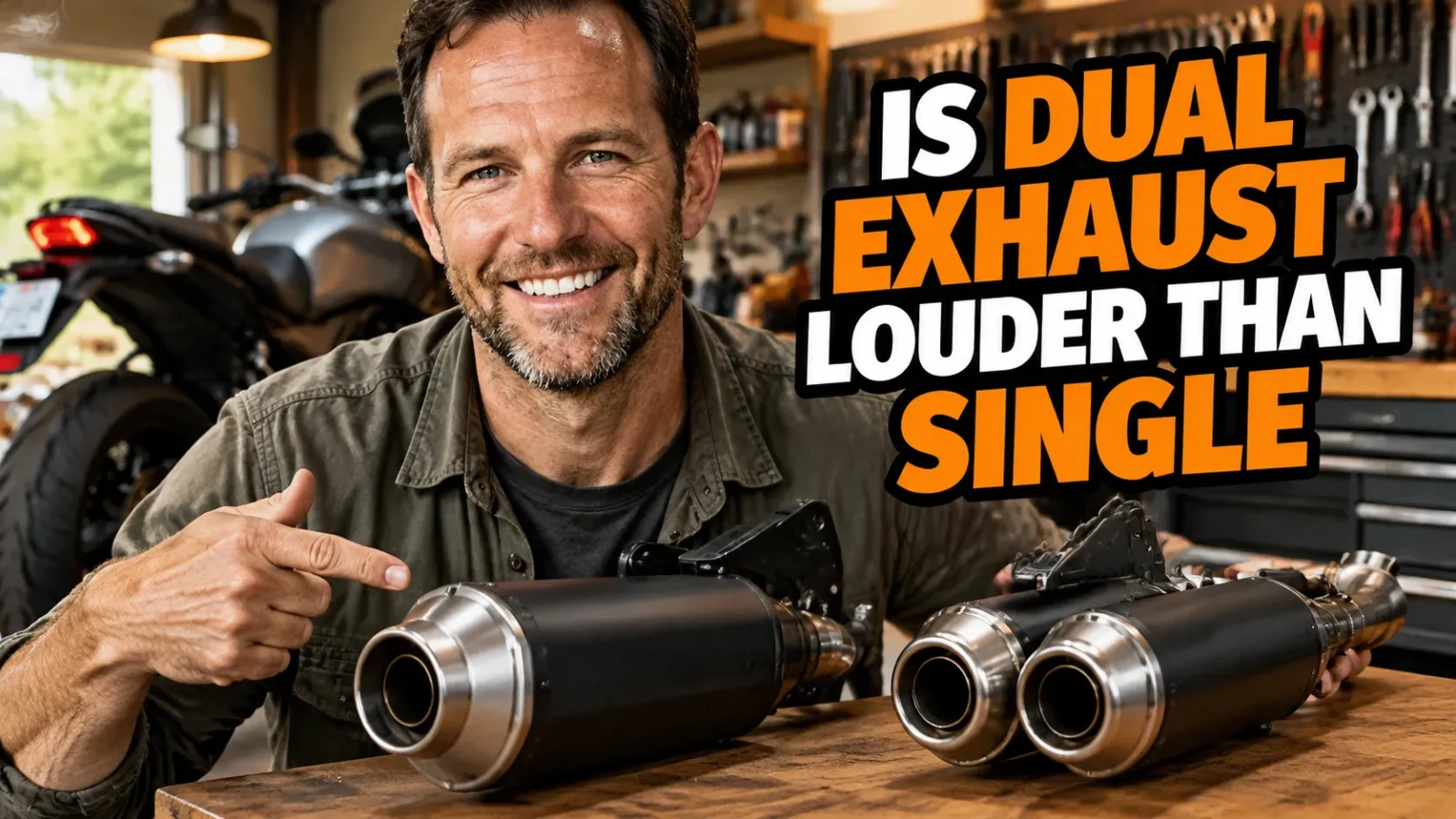
I still remember the first time I bolted a second can onto my old parallel twin. I’d spent weeks reading forum threads, convinced that doubling the pipes would double the noise. I fired it up in my driveway at 7 a.m., fully expecting my neighbors to file a complaint.
They didn’t. It sounded better, but not dramatically louder. That moment sent me down a rabbit hole of decibel meters, dyno runs, and a lot of late nights in the garage. Since then I’ve run single and dual setups on cruisers, sportbikes, a diesel pickup, and a V8 truck.
So let’s settle this properly, because the answer isn’t the simple yes most people expect.
- Dual exhaust is usually not much louder than a well-built single, but it almost always sounds deeper and fuller.
- Volume is driven by muffler design, pipe diameter, and engine displacement, not pipe count.
- True duals with straight-through mufflers can be louder, especially at wide-open throttle.
- A restrictive single can actually be quieter than a free-flowing dual, and vice versa.
- If you want loud, buy the right muffler. If you want tone, consider duals.
Why Pipe Count Doesn’t Directly Equal Volume
Here’s the thing I wish someone had told me years ago: sound is energy, and the exhaust system’s job is to manage that energy. Adding a second pipe doesn’t create more energy. It only changes how that energy escapes.
Your engine produces a fixed number of exhaust pulses per minute based on RPM and cylinder count. Those pulses carry a certain amount of acoustic energy. Whether they travel through one pipe or two, the total energy is roughly the same.
What changes is how that energy is distributed. Two paths mean each path carries less flow, which smooths out the pulses and lowers the pitch. That’s why duals sound richer without necessarily being louder.
Volume vs. Tone: Two Very Different Things
Most riders confuse volume with tone. Volume is measured in decibels and is objective. Tone is pitch, resonance, and character, and it’s completely subjective.
When I swapped my single slip-on for a dual setup with identical muffler cores, my meter read 2 dB higher at idle. Two decibels is barely perceptible in a quiet room. But my ears swore the bike sounded massively meaner.
That’s tone doing the work, not volume.
The Physics of Splitting Exhaust Flow
When you split flow into two pipes, gas velocity in each pipe drops. Lower velocity means less turbulence and less high-frequency rasp. The result is a deeper, more controlled note.
It also means each pipe can be smaller in diameter while still flowing the same total volume. That’s why factory dual systems often use two narrow pipes instead of one fat one.
In my experience, this is where the “duals sound better” reputation comes from. It’s real, but it’s about acoustics, not raw loudness.
Where Dual Exhaust Genuinely Gets Louder
There are absolutely situations where duals win the decibel war. I’ve measured them. But the reasons are specific, and they’re not just “because there are two pipes.”
True Duals vs. Dual Outlets on One Muffler
This is the biggest distinction, and it trips up almost everyone. A true dual system has separate pipes running from each bank of cylinders all the way back, each with its own muffler.
A dual-outlet system has one muffler with two tailpipes. That’s a cosmetic and acoustic trick, not a true dual.
When I ran true duals with straight-through mufflers on my V-twin, it was unmistakably louder than the single can it replaced. But when I ran a single muffler with two tailpipes, the meter barely moved.
Pipe Diameter and Flow Velocity
Going too large on pipe diameter is the classic mistake. Bigger pipes reduce backpressure, but they also slow the exhaust gas down, which can actually make the note boomy and hollow rather than sharp.
I once went up two sizes on a single-pipe setup and gained 4 dB. The same diameter change on a dual setup gained only 1 dB, because the flow was already split.
The takeaway: pipe diameter affects volume more than pipe count ever will.
My Real-World Test: Single vs. Dual on the Same Bike
I ran this test over a full weekend with a calibrated sound meter, a fixed 20-inch measuring distance, and a 45-degree angle from the outlet. Same bike, same day, same air temperature. Only the exhaust changed.
The Single Can Setup
Bone-stock headers feeding one aftermarket slip-on with a removable baffle. At idle I measured 88 dB. At 5,000 RPM it climbed to 101 dB.
It was punchy and aggressive, with a sharp bark right when the throttle cracked open. Honestly, I loved it.
The Dual Slip-On Swap
Same headers, but now feeding a two-into-two mid-pipe with twin cans of the same internal design. Idle came in at 90 dB. At 5,000 RPM it hit 103 dB.
So yes, technically louder. But only by two decibels, which is roughly the difference between a normal conversation and a slightly louder normal conversation.
What Surprised Me Most
The dual setup felt substantially louder from the saddle, even though the meter said otherwise. That’s because the sound now came from two directions instead of one, wrapping around me more completely.
Perception and measurement are not the same thing. Keep that in mind before you spend money chasing volume.
Backpressure, Scavenging, and Why Your Butt Dyno Lies
Every exhaust system needs some backpressure to help scavenge exhaust gases at low RPM. Remove too much and you lose low-end torque, even if the bike sounds insane.
When I ran open duals with no baffles, the bike was deafening. It was also noticeably softer off idle. I’d traded usable torque for noise, which is a bad deal on a street bike.
Adding baffles back brought the torque back and only dropped the volume by about 3 dB. That’s the sweet spot most riders never find because they equate loud with fast.
Don’t trust your ears for performance. Trust a dyno.
When a Single Exhaust Is Louder Than Duals
This happens more often than the forums admit. A large-diameter single pipe with a straight-through muffler can absolutely out-shout a factory dual system.
I’ve heard bone-stock duals on a big touring bike that were quieter than a modified single on a 600cc sportbike. Displacement and muffler design dominated everything.
Small-displacement engines with free-flowing singles are the loudest setups I’ve personally encountered. Pipe count didn’t matter at all.
Turbo and Catalytic Converter Effects
Turbos are natural silencers. They chop up exhaust pulses so effectively that a turbo car with duals can be quieter than a naturally aspirated single.
Catalytic converters do the same thing. Modern stock dual systems on trucks are remarkably tame precisely because of the cats and resonators packed into them.
So the “dual equals loud” rule falls apart fast once forced induction or emissions gear enters the picture.
Legal and Practical Realities I’ve Run Into
Noise regulations are the part nobody warns you about. Many tracks enforce a 95 to 103 dB limit, measured at a specific distance and RPM. I’ve seen riders turned away at the gate with duals that measured 104 dB.
Several states also have street noise ordinances. Getting a fix-it ticket for exhaust is a genuinely annoying experience, and I’ve had it happen twice.
My advice: measure before you commit. Buy a cheap sound meter, follow your local testing procedure, and keep removable baffles in your toolbox.
How to Get the Sound You Actually Want
If you want louder, focus on muffler design and pipe diameter. Choose a straight-through or shorty muffler and size your pipes to match your engine’s flow needs.
If you want deeper, go dual. The split flow naturally lowers the pitch and adds that layered, stereo quality riders describe as “full.”
If you want both, run true duals with moderately sized straight-through mufflers and remove the resonators. That’s the setup I keep coming back to on my own bikes.
And if you want to keep your neighbors happy, stick with a single quality can and save the duals for track days. Trust me on that one.
My Final Take
Dual exhaust is not automatically louder than single. In my testing, it added about two decibels, which is barely measurable and often not even noticeable in traffic.
What duals do deliver is a deeper, richer, more layered soundtrack that makes any engine feel more expensive and more muscular. That’s worth chasing on its own.
So build your exhaust around the tone you want and the power curve you need, not around pipe count. Your ears will thank you, and so will your torque curve.
Frequently Asked Questions
Is dual exhaust always louder than a single exhaust?
No. Volume comes down to muffler design, pipe diameter, and whether you’re running true duals or a single muffler with two outlets. A well-designed single system with a straight-through muffler can easily be louder than a restrictive dual setup.
Does dual exhaust add horsepower?
It can, but only if your engine actually needs the extra flow. On a stock engine, a dual setup mostly changes tone and looks. On a built motor pushing serious airflow, duals can reduce backpressure and free up real power.
Why does dual exhaust sound deeper?
Splitting the exhaust pulses between two paths lowers the pitch and creates a smoother, more layered note. The sound also has a wider stereo effect, which your ears read as deeper and fuller even at the same decibel level.
Will dual exhaust make my bike fail a noise test?
It might. Many tracks and states cap noise at around 95 to 103 dB. Measure your setup with a proper sound meter at the required RPM before you show up, and keep the baffles handy just in case.

Related Articles

White Smoke on Startup That Vanishes: What I’ve Learned After Years of Cold Mornings
White smoke from your exhaust on startup that vanishes? I explain when that puff is harmless condensation and when it…
Jake Miller
9 min read

Loss of Power and Black Smoke From a Diesel? Here’s How I Track Down the Real Cause
Black smoke plus power loss in a diesel almost always means too much fuel and not enough air. I share…
Jake Miller
9 min read

Black Smoke From Your Exhaust at Startup? What I Found After Years of Chasing It
Black smoke from the exhaust when starting usually means a rich fuel mixture. I'll walk through the real causes I've…
Jake Miller
8 min read