
10 Best Adventure Motorcycle Tires for Gravel, Ranked by a Rider Who’s Actually Burned Through Them
 Jake Miller
10 min read
Jake Miller
10 min read
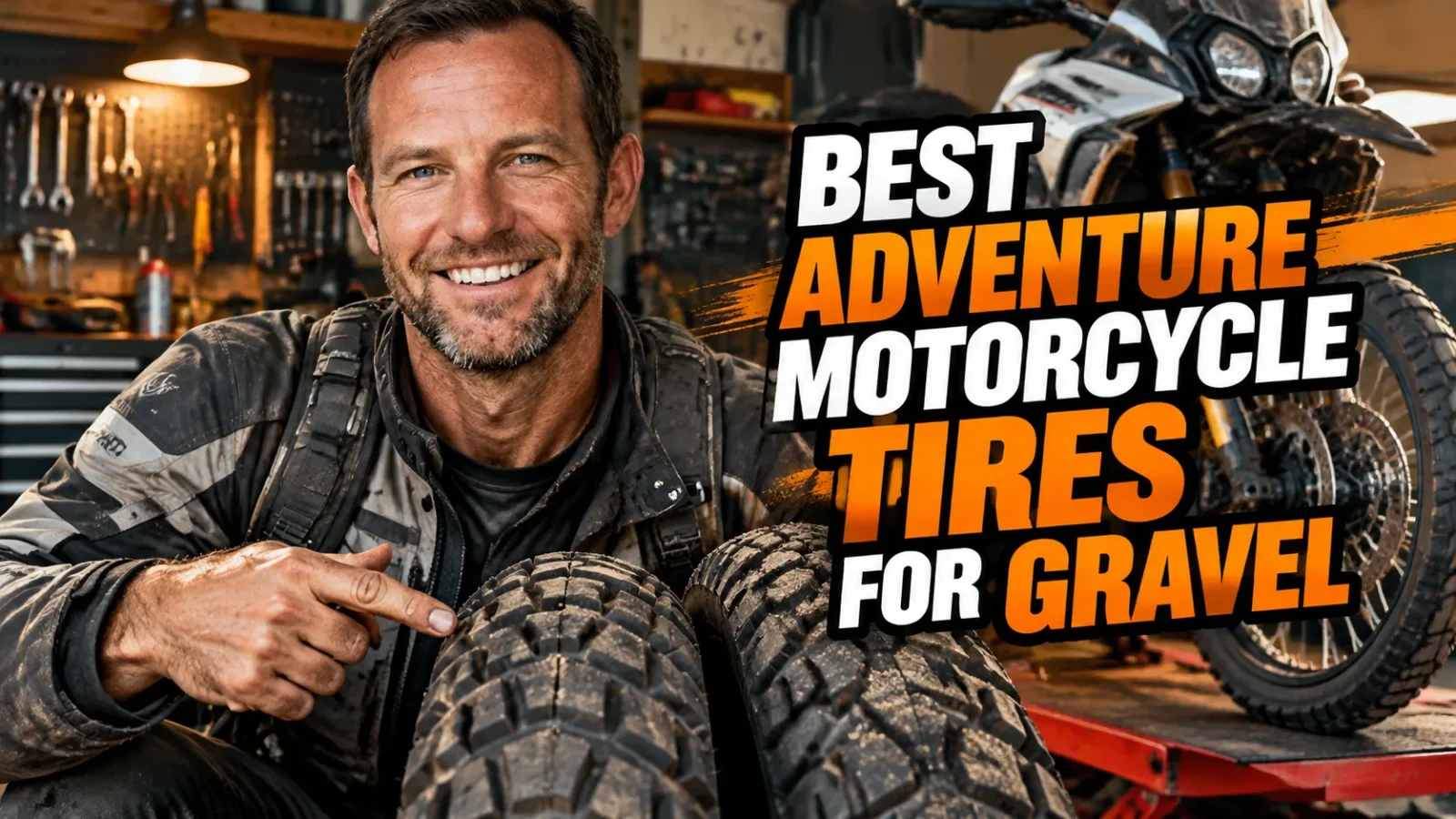
I’ve been riding adventure bikes on gravel for the better part of a decade, and I’ve learned the hard way that the single biggest upgrade you can make isn’t suspension, luggage, or a louder exhaust. It’s tires. A good gravel tire turns a heavy, intimidating ADV bike into something that actually goes where you point it.
Over the years I’ve run everything from road-biased 80/20 rubber to full-on knobbies, on bikes ranging from a thumping single to a big-bore twin loaded with panniers. Some tires I loved from the first mile. Others I yanked off after 200 miles because the front kept washing out on loose marbles.
So here’s my honest, real-world list of the 10 best adventure motorcycle tires for gravel that I’d spend my own money on today. I’ve included actual sizes, the price ranges I’m seeing, and where each tire genuinely shines and where it doesn’t.
- For a true 50/50 gravel tire, my overall pick is the Continental TKC 80 Twinduro.
- Riding a heavy adventure bike on rough, rocky gravel? The Metzeler Karoo 4 is the most stable tire I’ve used.
- If mileage matters more than grip, the Heidenau K60 Scout and Mitas E-07+ Dakar go the distance.
- On a budget, the Shinko 804/805 Big Block delivers knobby grip for roughly half the price.
- Air down to around 24 to 28 psi on gravel and you’ll feel a night-and-day difference in traction.
What I Actually Look For in a Gravel Tire
Before I get into the list, here’s the lens I’m using. Gravel is a weird surface: it’s loose, it shifts under you, and it punishes a tire that can’t clear material out of the tread. These three things matter most to me.
Tread Block Spacing
Widely spaced, tall blocks self-clean and dig in. Tight, shallow tread clogs with gravel and dust, and then you’re basically riding on a slick. Every tire on this list clears well, but the aggressive ones clear better.
Carcass Stiffness
A floppy carcass folds under hard cornering on gravel and pinches easily at low pressures. A stiff, reinforced carcass feels planted, protects your rims, and lets you run lower pressures without fear.
Compound and Wear
Soft compounds grip beautifully and vanish in 3,000 miles. Hard compounds last forever and feel wooden. The sweet spot depends entirely on how much tarmac is between you and the gravel.
1. Continental TKC 80 Twinduro: The 50/50 Benchmark
The TKC 80 has been around since the 1980s and it’s still the tire I recommend first when someone asks me what a proper 50/50 adventure tire feels like. It’s the classic Twinduro tread: chunky, tall, self-cleaning blocks that dig into gravel and shed mud instead of packing up.
I’ve run TKC 80s on a 21-inch front and 17-inch rear on a middleweight twin, and the front-end bite on loose gravel is genuinely confidence-inspiring. The usual ADV fitments are covered, from 90/90-21 and 110/80-19 fronts to 150/70-17 and 170/60-17 rears.
On tarmac it’s surprisingly civil for a knobby, though you’ll notice the hum and a slightly vague turn-in. I’m seeing roughly $140 to $180 for a front and $220 to $280 for a rear.
The catch is wear. On a big, torquey bike with a loaded pannier set, I’ve chewed a rear TKC 80 down in under 4,000 miles. If longevity is your priority, keep reading.
2. Metzeler Karoo 4: Best for Heavy Bikes on Rough Gravel
Metzeler’s Karoo 4 replaced the Karoo 3, and it’s the tire I’d pick for a big adventure bike that genuinely sees rocky two-track. The block pattern is aggressive, but the carcass is stiff and reinforced, which matters enormously when you’re pushing 250 kg of bike, rider and luggage through loose rock.
Where the Karoo 4 impressed me most was stability. It doesn’t squirm or fold under hard braking on gravel the way softer knobbies can, and the rear hooks up beautifully out of tight corners. Fitments cover 19 and 21 inch fronts and 17 and 18 inch rears.
Expect roughly $160 to $190 front and $230 to $280 rear. On wet tarmac it’s noticeably better than a full knobby, though it’s still an off-road leaning tire at heart. If you ride 60 percent gravel and 40 percent road, this is a very strong pick.
3. Michelin Anakee Wild: Best Wet-Gravel Grip
The Anakee Wild was Michelin’s answer to the TKC 80, and in my experience it’s the better tire when the gravel is wet or the surface is greasy. It’s a radial 50/50 with a deep, staggered block pattern and a reinforced sidewall that resists pinching at low pressures.
I ran a set through a mix of hardpack, loose marbles and shallow mud. The front tracks predictably and I never felt like I was fighting the bars. Real-world sizes include 110/80-19, 120/70-19 and 90/90-21 fronts, plus 150/70-17 and 170/60-17 rears.
Budget roughly $150 to $190 front and $240 to $290 rear. The downsides: it’s loud on tarmac, and the rear wears fairly quickly if you’re heavy on the throttle. For pure gravel grip, though, it’s one of the best I’ve used.
4. Pirelli Scorpion Rally STR: Best for 70/30 Riders
This is the tire that came stock on the Yamaha Ténéré 700, which tells you exactly how Pirelli positioned it: a 70/30 tire that’s genuinely competent on gravel roads without ruining your daily commute.
If your adventure riding is mostly tarmac with long stretches of graded gravel road, the Scorpion Rally STR is what I’d run. The tread is blocky enough to clear loose gravel, but the profile and compound are road-focused, so it turns in sharply and holds well in the wet.
I’ve done multi-day trips on these with a lot of hardpack gravel and never felt out of my depth. What it won’t do is handle deep mud or loose, rocky climbs the way the Karoo 4 or Anakee Wild will. Prices sit around $140 to $175 front and $200 to $250 rear. Be honest about being a 70/30 rider and this is the tire.
5. Heidenau K60 Scout: Best for Long-Distance Gravel Touring
If mileage matters more than ultimate grip, the Heidenau K60 Scout is the tire I’d point you to. It’s German-made, hugely popular with round-the-world riders, and famous for rear tires that go 10,000 miles or more.
It’s a 50/50 tire and it handles gravel well, though on some rear sizes there’s a solid centre band that helps road life while cutting traction in proper mud. Where it truly shines is on long, mixed-surface trips where you can’t afford to be swapping tires in the middle of nowhere.
The carcass is stiff and tough, and it shrugs off sharp rocks that would damage softer rubber. Expect $150 to $200 front and $220 to $280 rear. It isn’t the grippiest gravel tire here, but it might be the most dependable.
6. Motoz Tractionator Adventure: Best for Loose Rock and Dust
Motoz is an Australian brand, and their Tractionator line is built for exactly the riding I love: loose, rocky, dusty gravel that eats softer tires alive. The Tractionator Adventure is a 50/50 with tall, widely spaced blocks and a seriously tough carcass.
In loose gravel and rock gardens the bite is outstanding, and self-cleaning in mud is excellent. The front tracks well through gravel corners rather than skating across the top of the marbles.
Fair warning: it’s loud on tarmac and not the smoothest tire at highway speed. But if gravel is the mission, it’s one of the most capable tires I’ve run. Around $160 to $200 front and $230 to $290 rear.
7. Bridgestone Battlax Adventurecross AX41: Best Value Aggressive Knobby
The AX41 is Bridgestone’s 50/50 knobby, and it’s the tire I recommend when someone wants proper aggressive gravel grip without paying premium European prices. It’s a genuinely blocky knobby with a stiff carcass and good sidewall protection.
On gravel and dirt roads it’s stable and predictable, and I’ve found the front particularly good at holding a line through loose corners. It’s not quite as refined on tarmac as the Anakee Wild, and it’s louder than any 70/30 tire, but for the money it’s hard to argue with.
Sizes include 110/80-19, 120/70-19 and 90/90-21 fronts, plus 150/70-17, 170/60-17 and 150/70-18 rears. Typically $120 to $160 front and $180 to $230 rear.
8. Mitas E-07+ Dakar: Best Hard-Wearing 50/50
The Mitas E-07+ Dakar is the tire I’d fit to a bike that’s going to spend weeks at a time on gravel, dirt and broken tarmac. The Dakar version has a reinforced carcass designed specifically for heavy loads and low pressures.
Compared to the standard E-07, the E-07+ gets a more aggressive tread pattern, and on gravel the improvement in bite is noticeable from the first ride. It’s still a 50/50 tire, so don’t expect knobby-level mud performance.
Wear is where it wins. I’ve known riders to get 8,000 to 10,000 miles from a rear. Prices run roughly $140 to $180 front and $200 to $260 rear. It’s a quietly brilliant tire that doesn’t get the attention it deserves.
9. Dunlop Trailmax Raid: Best All-Rounder
The Trailmax Raid is Dunlop’s newer 50/50 adventure tire, and it’s the one I’d fit to a bike that has to do absolutely everything. It sits in the off-road leaning slot in Dunlop’s lineup and it’s a genuine improvement on their older road-biased adventure rubber.
On gravel the Raid is stable and confidence-inspiring, with good straight-line traction and predictable behaviour when the rear steps out. On wet tarmac it’s one of the better blocky tires I’ve used, which matters a lot when your nearest gravel road is 200 miles away.
Sizes cover the usual 19 and 21 inch fronts and 17 and 18 inch rears across the common adventure fitments. Expect roughly $150 to $185 front and $210 to $260 rear. If you can only own one set of tires, this is a smart choice.
10. Shinko 804/805 Big Block: Best Budget Gravel Setup
If you want maximum gravel capability for minimum money, the Shinko 804 (front) and 805 (rear) Big Block combo is hard to beat. It’s a proper knobby at a budget price, and a huge number of dual-sport riders run them for exactly that reason.
I’ve run a set on a lighter adventure bike and the grip on loose gravel and dirt genuinely impressed me. They’re heavy, stiff, and they howl on tarmac at highway speed, but out on the loose stuff they just work.
The pricing is the headline: often $80 to $110 for a front and $110 to $150 for a rear. That’s roughly half what a premium European knobby costs. They won’t last as long as a K60 Scout, but if you’re doing a big gravel trip and want fresh rubber without blowing your budget, this is the pair I’d buy.
My Final Thoughts and Setup Advice
If I had to pick just one tire off this list for mixed gravel riding, it would be the Continental TKC 80 Twinduro. It’s the best compromise between gravel bite, road manners and availability, and it’s the tire I keep coming back to.
For heavy bikes on rough terrain, the Metzeler Karoo 4 is the one I’d trust. For long trips where mileage rules, the Heidenau K60 Scout or Mitas E-07+ Dakar won’t let you down. And for pure value, the Shinko 804/805 is unbeatable.
One last thing that matters as much as the tire itself: pressure. I run noticeably lower pressures on gravel than on tarmac, usually around 24 to 28 psi front and 26 to 30 psi rear on a loaded big bike. It transforms how a tire conforms to the surface and finds traction.
Invest in a good small pump so you can air back up when you hit pavement. And if you’re running tubes at low pressures, rim locks are cheap insurance against a spun valve stem. Get those two things right, pick the right tire from this list, and gravel stops being scary and starts being fun.
Frequently Asked Questions
Do I really need knobby tires to ride gravel on an adventure bike?
Not strictly, but you’ll be far happier. A 50/50 tire like the Continental TKC 80 or Michelin Anakee Wild clears loose gravel and gives you bite in corners, while a 70/30 tire starts fighting you the moment the surface gets loose or wet.
How low should I air down for gravel?
On most big adventure bikes I run about 24 to 28 psi front and 26 to 30 psi rear on gravel, depending on load. On a lighter dual sport I’ll go lower. Never go below what your rim and sidewall can safely handle, and use rim locks if you’re running tubes at low pressure.
How long do gravel-focused adventure tires actually last?
Expect roughly 4,000 to 8,000 miles from an aggressive knobby like the Motoz Tractionator Adventure, and 8,000 to 12,000 miles from a harder, longer-wearing 50/50 such as the Heidenau K60 Scout.
Can I mix tire brands front and rear?
Plenty of riders do, but I prefer matched pairs. Handling, wear and carcass stiffness are engineered as a set, and pairing an aggressive front with a road-biased rear can make the bike feel unpredictable once the gravel gets loose.

Related Articles

8 Best Cruiser Motorcycle Tires for Street Riding: My Real-World Picks
I rank the 8 best cruiser motorcycle tires for street riding, from Michelin to Pirelli, with real notes on grip,…
Jake Miller
9 min read

8 Best Michelin Motorcycle Tires for Every Riding Style (Tested Picks)
Looking for the best Michelin motorcycle tires? I break down my 8 favorite models for sport, touring, adventure, cruiser, and…
Jake Miller
9 min read

Yamaha Tire Pressure Guide: The Right PSI for Safer, Smoother Rides
Learn the right tire pressure for your Yamaha, from sportbikes to cruisers and dirt bikes. Check, adjust and maintain PSI…
Jake Miller
9 min read