
10 Best Motorcycle Tires for a Harley Road King, Ranked by a Rider Who Owns One
 Jake Miller
11 min read
Jake Miller
11 min read
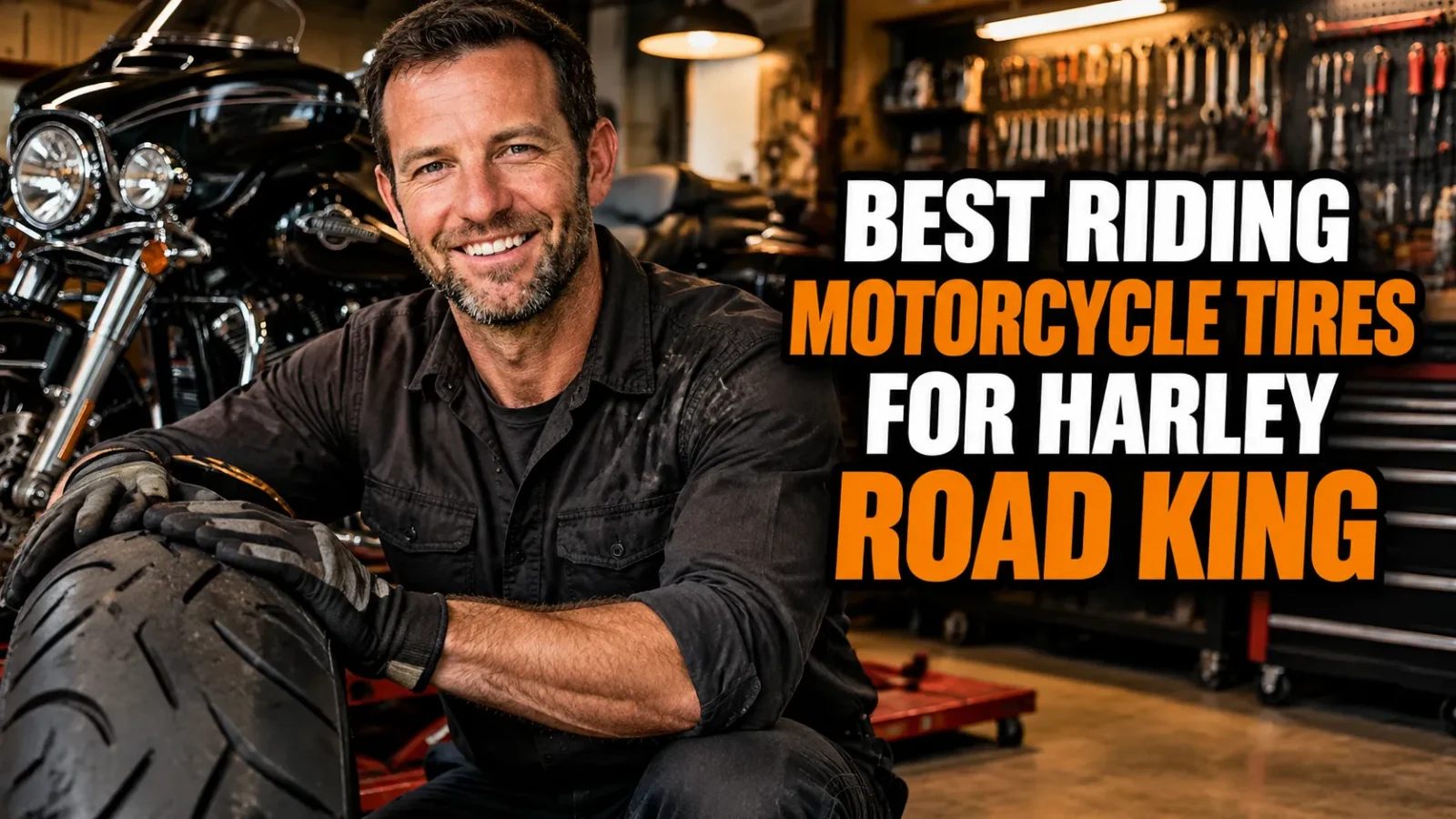
I’ve put well over 60,000 miles on Road Kings, and I’ve burned through more rear tires than I care to admit. The big touring bagger is a wonderful motorcycle, but it is also heavy, torque-rich, and unforgiving of cheap rubber. A bad tire choice shows up as vague steering, nervous wet-weather behavior, and a rear tire that is bald at 6,000 miles.
Over the years I’ve run almost every major touring tire on the market, from the factory Dunlops to budget Shinkos to premium Michelins. Some were brilliant. A couple I pulled off early. What follows is my honest ranking of the tires I’d actually spend my own money on for a Road King.
One thing before we start: the 2009 and later Road King runs a 130/80B17 front and a 180/65B16 rear from the factory. Earlier bikes like my old 2003 ran 16-inch wheels front and rear. Know your sizes before you order, because not every tire on this list covers every year.
- My overall pick: Michelin Commander III Touring. The best blend of wet grip, mileage, and steering feel I’ve found on a Road King.
- Best for mega-mileage: Metzeler ME 888 Marathon Ultra, if you rack up 15,000+ miles a year like I do.
- Best on a budget: Shinko 777 H.D. Costs about half as much, and it genuinely holds up on a heavy bagger.
- Stick with matched pairs and run 36 psi front / 40 to 42 psi rear. Pressure matters more than brand.
Before You Buy: Getting the Right Tire for Your Road King
I’ve watched too many riders order the wrong size and eat return shipping. So let’s get the boring stuff out of the way first, because it will save you money and a headache.
Sizes: What Actually Fits
If you ride a 2009 or later Road King, you need a 17-inch front and a 16-inch rear. If you ride a 2008 or earlier bike, you’re almost certainly on 16-inch wheels at both ends, usually in MT90-16 or 130/90-16.
The Road King Special, introduced in 2017, runs an 18-inch rear. That narrows your options a bit, so check the fitment chart before you commit. Every tire in this list is available in at least one common Road King fitment, but not every one covers every year.
Bias-Ply vs. Radial
Modern touring tires are mostly bias-belted or radial, and I’ve found radials generally give a more compliant ride and better heat management on long highway days. Bias-belted tires tend to feel a touch stiffer but last well. Don’t mix the two across axles on a bagger this heavy.
Pressure and Load Matter More Than You Think
I run 36 psi in the front and 40 solo in the rear, bumping to 42 when I’ve got my wife on the back and the tour pack loaded. Under-inflation is the single fastest way to destroy a rear tire on a Road King, and it also makes the bike wander in corners.
1. Michelin Commander III Touring — My Overall Pick
If I had to pick one tire and never think about it again, this is it. The Commander III Touring is the tire I’ve come back to more than any other on my Road King, and it’s the one I recommend to friends who ask me at gas stations.
Michelin builds it with a silica-rich compound and aramid-fiber casing reinforcement, which is the same class of material they use in their sport tires. What that translates to in the real world is a tire that grips a wet road far better than a touring tire has any right to, while still wearing evenly across the crown.
Mileage I Actually Got
On my last set I got just under 14,000 miles out of the rear before the wear bars showed, which is excellent for a bike that weighs 800-plus pounds with me and luggage aboard. The front still had life left at that point, so I replaced it on the next go-round.
Steering feel is neutral and predictable. It’s not as sharp as the Metzeler Cruisetec, but it never feels vague either. Expect to pay somewhere in the $220 to $300 range per tire, which is premium money, but I think it’s justified.
2. Dunlop American Elite — Best Made-in-the-USA All-Rounder
The American Elite is the tire I’d hand to someone who wants zero drama and a bit of patriotism in the bargain. It’s built in the USA and it has been a staple of the Harley touring world for years.
Dunlop uses what it calls MT Multi-Tread on the rear, which means a harder compound in the center for straight-line mileage and softer compound on the shoulders for cornering grip. It also uses aramid fiber reinforcement, and the jointless band construction keeps the tire round at highway speed, which I can feel in the mirror.
Handling is beautifully linear. It doesn’t turn in as quickly as the Cruisetec, but it holds a line through sweepers with total confidence. Wet grip is good, not exceptional. I’d put it a step behind the Commander III and the Elite 4 in the rain.
Pricing lands around $200 to $280. For a rider who mostly tours and wants a tire that will quietly do its job for 10,000 to 12,000 miles, this is a very safe bet.
3. Metzeler ME 888 Marathon Ultra — Best for Big Mileage
When I was doing 15,000-plus miles a year and commuting on the interstate, the Marathon Ultra was my go-to. It’s designed specifically for heavy cruisers and touring bikes, and it shows.
Metzeler’s high-silica compound and their Advanced Winding construction, which varies belt tension across the crown, combine to give a remarkably stiff, stable carcass. That stiffness is exactly what you want on a fully loaded bagger at 75 mph with crosswinds pushing you around.
Long-Haul Comfort and Wear
Metzeler claims meaningful mileage gains over the older ME 880, and my experience backs that up. I’ve seen 13,000 to 15,000 miles out of a rear on a Road King, and the front wears so evenly that it’s almost boring.
The trade-off is a slightly firmer ride and a little less feedback in tight corners. This is a tire built for eating states, not for carving canyons. Budget roughly $180 to $280 per tire.
4. Dunlop Elite 4 — Best in the Rain
The Elite 4 is the tire I wish I’d discovered earlier, because it is outstanding in wet conditions. Dunlop engineered the tread pattern and silica compound specifically to move water, and you can feel it the moment you hit a soaked highway.
It also uses MT Multi-Tread on the rear, along with aramid reinforcement, so you get the same mileage-focused center compound as the American Elite with better water evacuation. Dunlop claims up to double the mileage of the older Elite 3, and while I never measured it that precisely, it definitely lasts.
Dry grip is strong and the steering is crisp for a touring tire. If you ride year-round or live somewhere with a real rainy season, this belongs at the top of your list. Expect $200 to $270 per tire.
5. Metzeler Cruisetec — Best Sporty Upgrade
If you’ve ever wished your Road King felt a little lighter on its feet, the Cruisetec is the tire that does it. Metzeler developed this as a performance cruiser tire, and it’s a genuine step up in agility over any traditional touring tire.
It uses a dual-compound rear with a grippier shoulder, and the profile is noticeably more rounded than the Marathon Ultra. Turn-in is quicker, mid-corner grip is higher, and the bike feels less like a barge and more like a big standard.
The trade-off is mileage. I’d expect closer to 8,000 to 11,000 miles on a rear, versus 13,000-plus from the ME 888. Pricing runs $230 to $320, and it’s available in the 18-inch rear the Road King Special needs.
6. Pirelli Night Dragon — Best Dry Grip
The Night Dragon is the tire I fit when I want to actually enjoy the twisties on the way to wherever I’m going. It’s a cruiser tire with a genuinely sporty compound, and it sticks to warm asphalt in a way touring tires don’t.
Pirelli tunes the profile for V-twin geometry, so turn-in feels natural on a Road King rather than nervous. Straight-line stability is still solid, though I’d rank it a notch below the Elite 4 in standing water.
Mileage is the obvious compromise. I’ve gotten around 8,000 to 10,000 miles from a rear, sometimes less if I’m enjoying myself too much. At $190 to $280 per tire, it’s a fair deal for the grip you get.
7. Avon Cobra Chrome — Best Looking Tire With Real Wet Grip
I’ll be honest: I first bought the Cobra Chrome because it looks fantastic. The smooth sidewall and the aggressive tread pattern give a bagger a custom-bike vibe without any other changes. But it turned out to be a genuinely good tire.
Avon builds it with 3D sipes in the tread blocks, and those interlocking edges do real work in the wet. I’ve ridden these through torrential summer storms and never felt the front step out. Wear is even, which is unusual for a tire with this much visual attitude.
Rear mileage lands in the 9,000 to 12,000 mile range for me. Pricing is $200 to $300. If you care about how your Road King looks in a parking lot as much as how it rides, this is the one.
8. Bridgestone Exedra Max — Best Value Brand-Name Tire
The Exedra Max is the quiet overachiever on this list. It doesn’t get the hype of the Michelin or the Metzeler, but it’s a solid, well-made cruiser tire at a price that undercuts most of the premium options.
Bridgestone designed it for heavy cruisers, so the carcass is stiff enough to handle a loaded Road King without squirming. Stability at highway speed is excellent, and the wear is predictable rather than suddenly squared off.
Where it falls short is feel. The ride is slightly firmer than the Commander III, and wet grip is merely good. But at $150 to $220 per tire, it’s a genuinely smart buy if you want a name brand without the premium price tag.
9. Shinko 777 H.D. — Best Budget Pick That Actually Holds Up
Plenty of riders will tell you never to put a budget tire on a bagger. I disagree, and the Shinko 777 H.D. is why. The “H.D.” stands for heavy duty, and Shinko reinforces the casing specifically for heavyweight cruisers and touring bikes.
I ran a set for a full season, including a 3,000-mile road trip, and never had a single complaint. Grip is decent in the dry, acceptable in the wet, and the ride quality is far better than the price suggests.
Where It Shows Its Price
Two places. First, mileage: I got roughly 7,000 to 9,000 miles out of the rear, which is meaningfully less than the premium tires. Second, wet braking is not in the same league as the Michelin or the Avon.
That said, at roughly $110 to $180 per tire, you can replace them twice for the price of one premium set. Shinko builds the 777 H.D. in a wide spread of 16- and 17-inch Harley fitments, so ordering for a 2009-later Road King is straightforward.
10. Dunlop D408 and D407 — Best Stock Replacement
These are the tires your Road King left the factory with, and there’s a reason Harley specifies them. The D408 front and D407 rear are bias-belted, durable, and tuned specifically for the weight and geometry of the touring chassis.
If you liked how your bike handled when it was new and you just want that back, this is the simplest and often the cheapest answer. Handling is neutral, stability is excellent, and the wear is predictable.
My honest take, though, is that aftermarket options have moved past them. The Michelin Commander III and Dunlop Elite 4 both offer better wet grip and comparable or better mileage in my experience. The D408/D407 remains a perfectly respectable choice, especially at $180 to $260 per tire.
A Few Last Words From a Rider Who’s Been There
If you take nothing else from this, take this: the single best upgrade you can make to a Road King is a fresh, correctly inflated set of matched tires. No exhaust, no tuner, nothing transforms the bike the way new rubber does.
My personal order of preference after all these miles is the Michelin Commander III Touring first, the Metzeler ME 888 Marathon Ultra second for pure mileage, and the Dunlop Elite 4 if you ride in the rain more than most. Budget-conscious riders should not overlook the Shinko 777 H.D. at all.
Whatever you pick, check your pressures before every long ride, replace tires as a matched pair when you can, and don’t try to squeeze an extra thousand miles out of a rear that’s already squaring off. Your Road King, and your cornering confidence, will thank you.
Frequently Asked Questions
How many miles should I expect from a set of Road King tires?
Most touring tires on a Road King will last somewhere between 8,000 and 16,000 miles on the rear, with the front usually going 1.5 to 2 times longer. A high-mileage touring tire like the Michelin Commander III Touring or Metzeler ME 888 Marathon Ultra will land at the top of that range if you keep your pressures right and avoid a lot of hard acceleration.
Can I mix a bias-ply and a radial tire on my Harley Road King?
I would not. Keep the pair matched by construction and brand family whenever possible. Mixing a radial front with a bias-ply rear can change how the bike turns in and how it behaves under hard braking, and on a heavy bagger that is the last place you want surprises.
What tire pressure should I run on a Road King?
The factory spec for most 2009 and later Road Kings is 36 psi front and 40 psi rear solo, bumping the rear to about 42 psi when you load luggage or carry a passenger. Check cold, check often, and add a couple of psi if you are riding two-up with a full tour pack on a hot day.
Do I need to replace both tires at the same time?
Not necessarily, but I always inspect them together. The rear usually wears out first on a bagger because it is doing all the driving. If your front still has plenty of tread and is not cupped or cracking, you can replace just the rear, but I personally prefer a matched pair for consistent handling.

Related Articles

8 Best Cruiser Motorcycle Tires for Street Riding: My Real-World Picks
I rank the 8 best cruiser motorcycle tires for street riding, from Michelin to Pirelli, with real notes on grip,…
Jake Miller
9 min read

8 Best Michelin Motorcycle Tires for Every Riding Style (Tested Picks)
Looking for the best Michelin motorcycle tires? I break down my 8 favorite models for sport, touring, adventure, cruiser, and…
Jake Miller
9 min read

Yamaha Tire Pressure Guide: The Right PSI for Safer, Smoother Rides
Learn the right tire pressure for your Yamaha, from sportbikes to cruisers and dirt bikes. Check, adjust and maintain PSI…
Jake Miller
9 min read