
How Many Spokes on a Motorcycle Wheel? What Riders Really Need to Know
 Jake Miller
9 min read
Jake Miller
9 min read
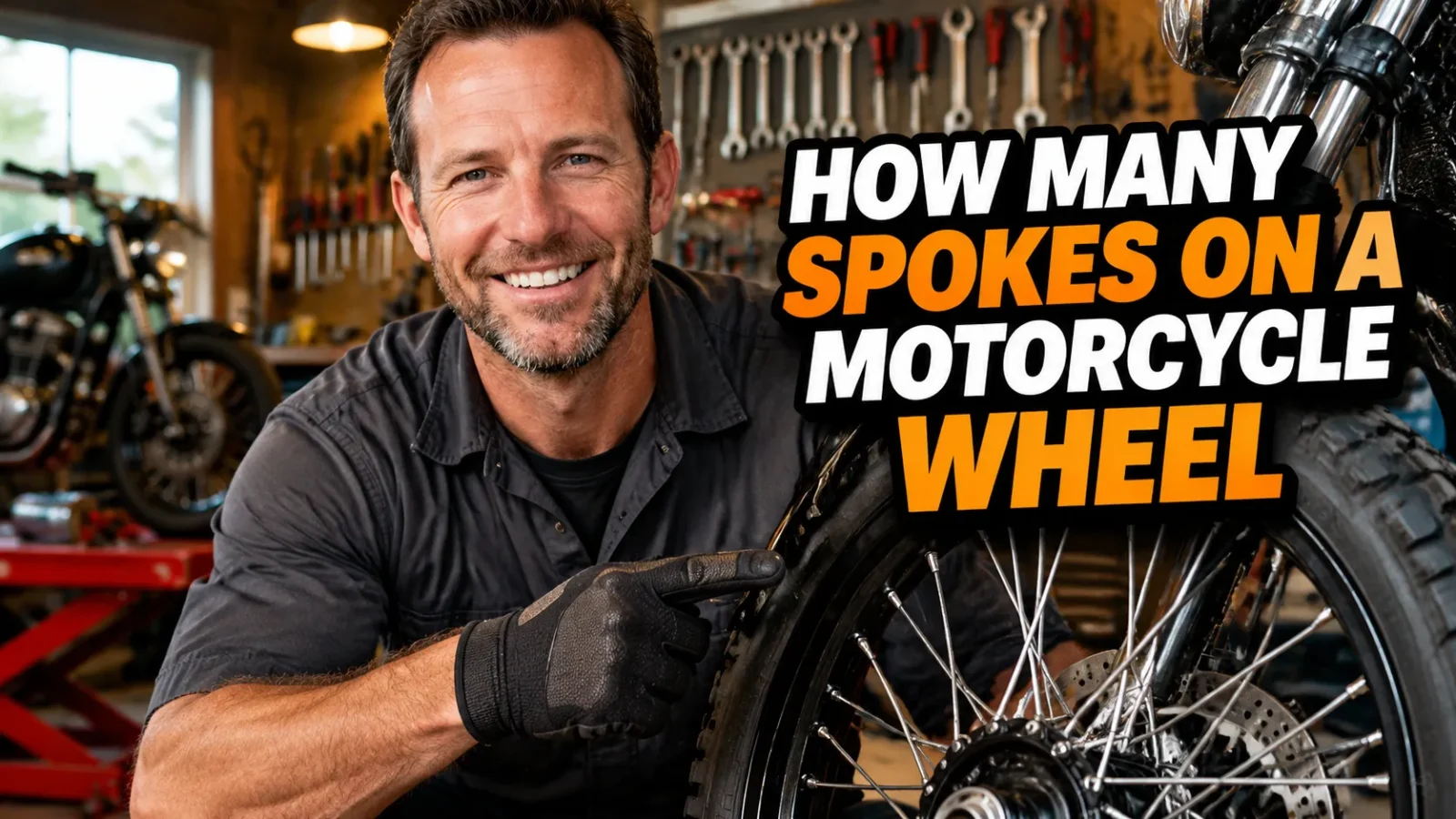
I still remember the first time I tried to order replacement spokes online. I typed the part number, stared at the screen, and realized I had absolutely no idea how many spokes my rear wheel actually had. I’d ridden that bike for three years and never once counted.
So I went out to the garage, got on my knees with a flashlight, and counted. Thirty-six. Then I counted again because I didn’t trust myself. Thirty-six.
That little moment taught me something useful: spoke count is one of those specs riders ignore until something breaks or they want to convert to tubeless. Then it suddenly matters a lot. So let me save you the garage-floor confusion.
- Most spoked motorcycle wheels have 32, 36, or 40 spokes, with 28 and 48 at the extremes.
- Motocross and dual-sport bikes lean toward 32 or 36; cruisers, touring bikes, and vintage machines often run 40.
- More spokes does not automatically mean a stronger wheel. Rim quality, spoke gauge, and lacing pattern matter just as much.
- Your spoke count is fixed by the rim and hub you own. You cannot simply swap in a different number.
- Always verify against your owner’s manual before ordering parts or converting to tubeless.
The Short Answer: Somewhere Between 32 and 40
If you want the fast version, here it is. The vast majority of spoked motorcycle wheels on the road and trail today carry between 32 and 40 spokes.
Within that range, three numbers dominate. Thirty-two spokes show up constantly on modern dirt bikes and lightweight dual-sports. Thirty-six is the classic all-rounder and still appears on tons of enduro and adventure machines. Forty is the traditional count for cruisers, tourers, and old British iron.
Below 32 you start getting into specialty territory: lightweight trials bikes, small-displacement commuters, and some vintage machines. Above 40, you’re usually looking at heavy-duty sidecar rigs, cargo bikes, or very old designs that needed every bit of strength they could get.
So when someone asks me how many spokes a motorcycle wheel has, my honest answer is: usually 32, 36, or 40, and you should go count yours.
Why the Number Changes From Bike to Bike
Spoke count isn’t random. Engineers pick a number based on a handful of real-world constraints, and once you understand them, the numbers start making sense.
Rim Size and Type
A big 21-inch front rim has more circumference to work with than a 17-inch rear. That extra real estate allows for more spoke holes without crowding them together.
Narrow rims also limit how many holes you can drill before the rim gets weak between them. A skinny trials rim physically can’t take 40 spokes without turning into Swiss cheese.
Bike Weight and Intended Use
A 250-pound motocross bike and an 800-pound touring rig put wildly different loads through their wheels. Heavier bikes generally need more spokes to distribute that load across the rim.
That’s why a loaded touring bike with luggage, a passenger, and a full tank tends to run 40 spokes, while a featherweight trail bike gets away with 32.
Tube-Type vs Tubeless
Here’s one most riders don’t think about. Every spoke nipple is a potential leak point on a tubeless setup. Fewer spokes means fewer places for air to sneak out.
That’s part of why so many modern tubeless adventure wheels use 32 spokes with a sealed rim bed, rather than 40. If you’re considering a tubeless conversion, spoke count genuinely affects how much sealing work you’re signing up for.
What Each Common Spoke Count Usually Means
Let me walk through the numbers I see most often and what they typically tell you about a bike.
28 to 32 Spokes: Light and Modern
This range is home to modern motocross bikes, supermotos, trials machines, and lightweight dual-sports. These wheels prioritize low rotating mass over brute strength.
Fewer spokes means less unsprung weight, which translates to better suspension response and quicker direction changes. On a track or tight trail, you feel that difference.
The tradeoff is that each individual spoke works harder. Hit a square-edged rock at speed with a 32-spoke wheel and you’ll find out quickly whether your spokes were properly tensioned.
36 Spokes: The All-Rounder
Thirty-six is the Goldilocks number for a lot of riders, and it’s my personal favorite. It’s strong enough for loaded adventure riding but not so heavy that you feel it in the bars.
Lots of enduro bikes, mid-weight ADV machines, and classic standards run 36. If you’re building a wheel from scratch and you’re not sure what to pick, 36 is rarely a bad call.
It also laces beautifully in a three-cross pattern, which gives you a nice balance of lateral stiffness and a bit of radial compliance.
40 Spokes: Built to Carry Weight
Forty spokes is the traditional cruiser and touring count. Harleys, big tourers, and vintage British twins all leaned on 40 for decades.
More spokes spread the load across more of the rim, which reduces the chance of a single spoke pulling through or a rim cracking under a heavy hit. On a bike that weighs 700-plus pounds before you add luggage, that redundancy is worth the extra weight.
Forty-spoke wheels also tend to hold tension longer under constant heavy loading, which matters on long trips where you’re not stopping to true a wheel every 500 miles.
48 Spokes and Beyond: Heavy-Duty Territory
Once you pass 40, you’re usually into sidecar outfits, cargo trikes, and vintage machines designed before metallurgy caught up to modern standards.
These wheels are incredibly strong but noticeably heavy and a genuine pain to true. I’ve helped a friend rebuild a 48-spoke sidecar wheel, and I can confirm it takes an entire afternoon and a lot of patience.
Cast and Forged Wheels Are a Whole Different Conversation
Here’s where people get confused, and I don’t blame them. When someone says a cast alloy wheel has “five spokes,” they mean something completely different from a spoked wheel with 36.
On a cast or forged wheel, the “spokes” are the thick structural arms connecting the hub to the rim. Those count in threes, fives, sixes, or sevens. They’re not tensioned wire spokes at all.
So if your bike has factory alloy wheels with five chunky arms, the answer to “how many spokes” is five. If it has laced wire wheels, the answer is a number in the 30s or 40s. Two entirely different systems.
Cast wheels are stiffer, need almost no maintenance, and run tubeless easily. Wire wheels absorb impacts better, can be repaired in the field, and look fantastic. I own bikes with both, and I appreciate each for different reasons.
Do More Spokes Actually Make a Wheel Stronger?
Not on their own. This is the myth I hear most often, and it deserves a proper response.
A well-built 32-spoke wheel will outlast and outperform a sloppily built 40-spoke wheel every single time. Strength comes from the whole system: rim stiffness, spoke gauge, nipple quality, lacing pattern, and above all, correct and even tension.
More spokes do give you redundancy. If one spoke snaps on a 40-spoke wheel, you’ll probably ride home fine. Snap one on a 28-spoke wheel and you’ll feel the wobble immediately.
But adding spokes also adds weight and wind drag. At some point, you’re carrying extra grams for a strength increase you’ll never notice. That’s why modern engineering has actually trended down toward 32 spokes on performance bikes while improving rim materials.
How to Count the Spokes on Your Own Wheel
This takes about ninety seconds and saves you from ordering the wrong parts. Here’s the method I use.
Pick a starting spoke, ideally one right next to the valve stem. Mark it mentally, then work your way around the rim, tapping each spoke as you go so you don’t lose your place.
Count all the way around until you’re back where you started. Don’t count the starting spoke twice.
Most wheels use an even number, and laced wheels typically alternate between the left and right hub flange. So an easier trick is to count the spokes on one side and double it. Thirty-six spokes means eighteen per side.
Then check your owner’s manual or a parts diagram to confirm. If your manual says 36 and you counted 37, you miscounted. Count again.
Lacing Pattern Matters as Much as the Count
Spoke count tells you how many wires you have. The lacing pattern tells you how they’re arranged, and it changes the wheel’s character significantly.
A three-cross pattern is the standard for most motorcycle wheels. Each spoke crosses three others on its way to the rim. It gives a good balance of strength and a bit of give.
A two-cross pattern is shorter and stiffer, common on disc-brake fronts where you want less flex under braking. A four-cross pattern is longer and more forgiving, often found on heavy touring wheels.
Radial lacing, where spokes go straight from hub to rim, is rare on motorcycles because it can’t handle braking torque well. You’ll mostly see it on bicycle wheels.
When I rebuilt my adventure bike’s rear wheel, I stuck with the factory three-cross pattern. Changing the lacing on a bike the manufacturer engineered for a specific load case is a gamble I wasn’t willing to take.
What This Means for Maintenance
Spoke count directly affects how much maintenance your wheels need. More spokes means more nipples to check, more chances for one to loosen, and longer truing sessions.
I check spoke torque every few rides on my dirt bike. With 36 spokes to tap, it’s a five-minute job. On a 48-spoke wheel, it’s a project.
Fewer spokes also means each one carries more tension, so a single loose spoke is more noticeable. On a 32-spoke wheel, one sloppy spoke shows up as a distinct wobble almost immediately, which is actually helpful for catching problems early.
If you’re doing regular wheel maintenance, keep your spoke count written down somewhere. It makes ordering replacement spokes, buying the right rim strip, and setting up tubeless sealing dramatically easier.
My Honest Take After Years of Wheel Work
I’ve ridden 32-spoke motocross wheels through rock gardens, 36-spoke adventure wheels across continents, and 40-spoke cruiser wheels down highways. Each number exists for a reason, and none of them is “the best.”
What I’ve learned is that build quality beats spoke count every time. A carefully tensioned, properly trued wheel with 32 spokes will serve you better than a neglected 40-spoke wheel that’s never seen a spoke wrench.
If you’re buying a bike and the spec sheet says 36 spokes, that tells you it’s a general-purpose machine. If it says 32, expect something lighter and sportier. If it says 40, expect to carry some weight.
And if you genuinely don’t know what your bike has? Go count. Get on your knees, grab a flashlight, and do the ninety-second job. Your future self, standing in a parts shop or wrestling with a tubeless conversion, will thank you for it.
Frequently Asked Questions
How many spokes does a typical motorcycle wheel have?
Most spoked motorcycle wheels fall between 32 and 40 spokes. Modern motocross and dual-sport bikes usually run 32 or 36, while cruisers, touring bikes, and vintage machines often use 40.
Do more spokes make a motorcycle wheel stronger?
Not automatically. Spoke count spreads load, but rim stiffness, spoke gauge, lacing pattern, and build quality matter just as much. A well-built 32-spoke wheel often outperforms a sloppy 40-spoke one.
Can I change the number of spokes on my wheel?
No. Spoke count is set by how many holes are drilled in your rim and hub. Changing it means buying a new rim and hub, not just a different set of spokes.
How do I count the spokes on my motorcycle wheel?
Pick one spoke, then count every spoke around the rim until you return to your starting point. Most wheels use an even number, so count in pairs for accuracy and double check against your owner’s manual.

Related Articles

8 Best Cruiser Motorcycle Tires for Street Riding: My Real-World Picks
I rank the 8 best cruiser motorcycle tires for street riding, from Michelin to Pirelli, with real notes on grip,…
Jake Miller
9 min read

8 Best Michelin Motorcycle Tires for Every Riding Style (Tested Picks)
Looking for the best Michelin motorcycle tires? I break down my 8 favorite models for sport, touring, adventure, cruiser, and…
Jake Miller
9 min read

Yamaha Tire Pressure Guide: The Right PSI for Safer, Smoother Rides
Learn the right tire pressure for your Yamaha, from sportbikes to cruisers and dirt bikes. Check, adjust and maintain PSI…
Jake Miller
9 min read