
8 Best Motorcycle Intercoms for Multiple Riders in 2026
 Jake Miller
10 min read
Jake Miller
10 min read
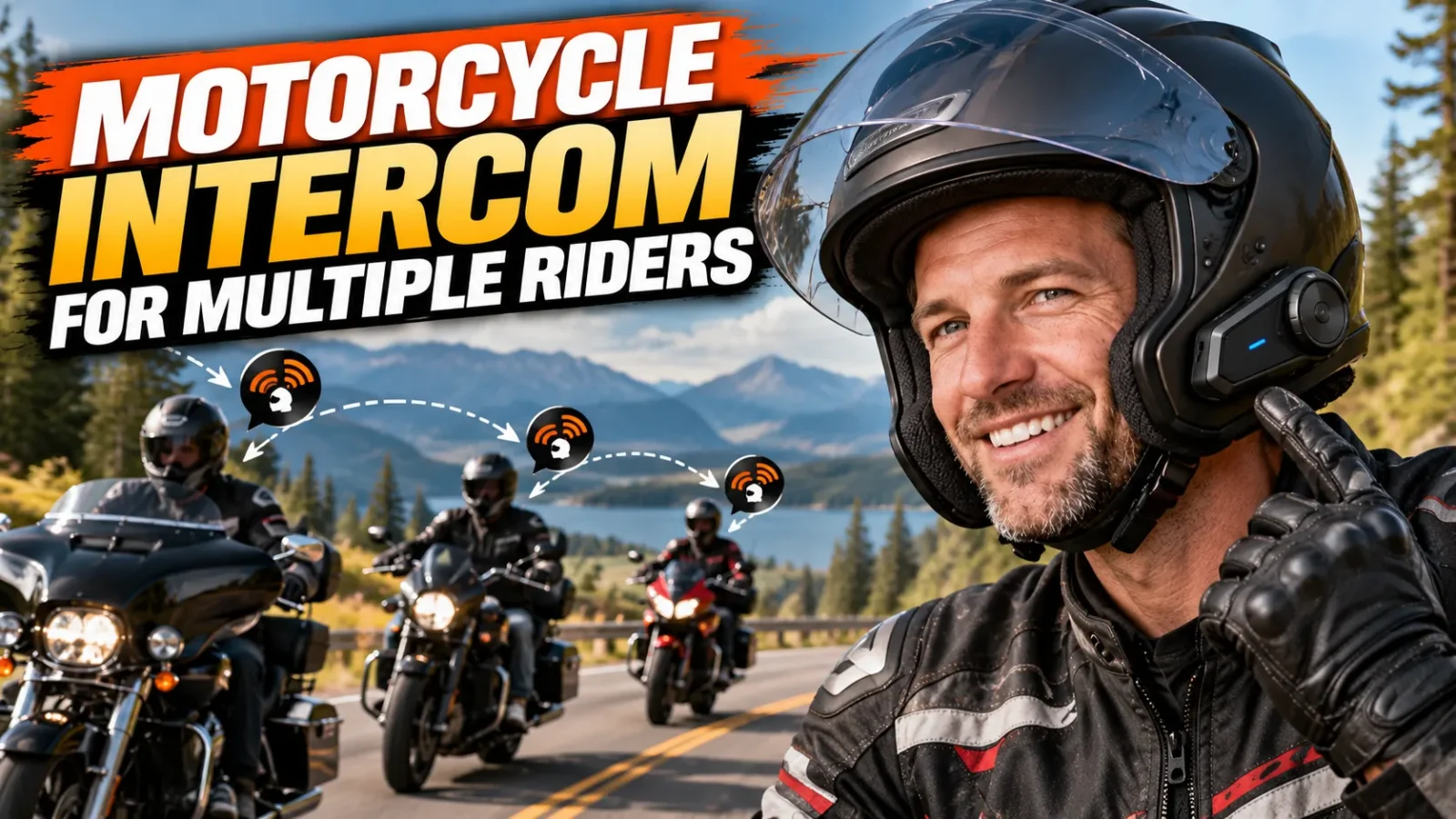
I’ve led enough group rides to know that nothing kills the vibe faster than a broken intercom chain. One rider drops off a Bluetooth daisy-chain, and suddenly half the group is riding in silence while the other half argues about hand signals.
Over the past few years, I’ve strapped on, paired up, and genuinely lived with more than a dozen intercom systems across canyon rides, highway slogs, and multi-day group tours. This list is my honest breakdown of the intercoms that actually hold a group together, not just the ones with the flashiest marketing copy.
- Cardo Packtalk Edge is my top overall pick thanks to its Dynamic Mesh Communication supporting up to 15 riders with seamless reconnects.
- Sena 50S is the best choice if your crew is huge, since Sena’s mesh tech scales up to 24 connected riders.
- Budget-conscious riders should look at the Cardo Freecom 4X+, which handles small groups of 4 reliably without breaking the bank.
- Mesh beats standard Bluetooth for any group larger than 3-4 riders because it self-heals when someone rides out of range.
- Match brands within your group whenever possible; cross-brand pairing works but limits your rider count and range.
1. Cardo Packtalk Edge — Best Overall Intercom for Group Rides
The Cardo Packtalk Edge is what I reach for when I’m organizing a ride with more than five bikes. It runs on Cardo’s Dynamic Mesh Communication (DMC), which lets up to 15 riders talk on an open, self-healing network instead of a fragile chain.
What sold me is how the Packtalk Edge handles riders dropping out of range and popping back in. Unlike older Bluetooth setups, nobody has to re-pair manually; the mesh just reroutes around the gap. That’s a genuinely huge deal on twisty backroads where the group naturally spreads out.
Sound quality is excellent too, powered by JBL speakers that stay clear even at highway speeds. It’s IP67 waterproof, has a claimed 13-hour battery life, and uses a slim, low-profile boom mic. Expect to pay around $329 for a single unit, more for the duo pack.
If you want to go deeper on how these systems handle rider-to-passenger chatter specifically, I broke that down separately in my guide to the Best Motorcycle Intercom Systems for Rider and Passenger Communication.
Why I keep recommending it
I’ve used the Packtalk Edge on rides with eight riders spread across a mountain pass, and the group chat never fully collapsed. That reliability, plus the app-based firmware updates, is why it’s my number one pick for this list.
2. Sena 50S — Best for Very Large Groups
When my riding club does its annual charity run with 15-20 bikes, the Sena 50S is what most of the group ends up wearing. Sena’s mesh intercom, branded Sena Mesh 2.0, supports up to 24 riders in open mesh mode, which is the highest capacity I’ve tested.
The 50S also has a genuinely useful feature for big groups: Sena’s mesh network lets riders drop in and out of the conversation naturally, similar to standing near a campfire. You don’t have to formally “pair” with every single person to be heard.
It packs a 12-hour talk time, an HD speaker upgrade over the older 30K, and FM radio plus Mesh Intercom Universal compatibility. Pricing sits around $299 per unit. Battery life dips a bit in cold weather, which is my only real gripe.
For anyone who also cares about music quality on long solo stretches between group chats, I compared several options in my writeup on the Best Stereo Sound Systems for Motorcycle Helmets.
Real-world group performance
I tested the 50S with 12 riders on a coastal highway run, and the mesh held together even when three bikes fell about a half-mile behind at a gas stop. That’s the kind of stress test that actually matters for group riding.
3. Cardo Packtalk Bold — Best Value Mesh Intercom
If the Packtalk Edge is slightly out of budget, the Cardo Packtalk Bold is my go-to alternative. It still runs Cardo’s DMC mesh technology supporting up to 15 riders, just in a slightly older, chunkier housing.
I’ve found the Bold’s JBL-tuned speakers nearly as good as the Edge’s, and the mic quality holds up well in wind. It’s rated IP67 waterproof and typically sells for around $259, making it noticeably cheaper while keeping the mesh capability that matters most for groups.
The one trade-off is a slightly bulkier profile on the helmet compared to the Edge’s sleeker design. For riders who don’t care about shaving grams, this is a non-issue.
Who should buy the Bold instead
I’d point budget-minded group leaders here first. You get 90% of the Edge’s group-riding performance for noticeably less money, and honestly, most riders in a pack won’t notice the audio difference.
4. Sena 30K — Best Mesh Intercom for Mixed Terrain Riders
I’ve run the Sena 30K on everything from dual-sport trail days to interstate slabs, and it’s held up as a dependable mid-tier mesh option supporting up to 16 riders in mesh mode.
It uses Sena’s original Mesh Intercom tech, which isn’t quite as seamless as the 50S’s Mesh 2.0, but it’s still miles ahead of plain Bluetooth for keeping a group connected across gaps in the pack.
Battery life is rated at 13 hours, and it includes an easy-to-use jog dial that I actually prefer over touchscreen controls when wearing thick gloves. Prices typically land around $219, making it a solid mid-range pick.
If your group includes riders with different helmet speaker setups, it’s worth checking my breakdown of the Best Helmet Speakers for Motorcycle to make sure everyone’s audio matches the intercom’s output quality.
My take after months of use
The 30K’s physical controls are genuinely easier to operate one-handed at speed than some of the newer touch-based systems. For adventure and dual-sport riders wearing bulky gloves, that matters more than you’d think.
5. Cardo Freecom 4X+ — Best Budget Pick for Small Groups
Not everyone needs mesh for 15 riders. If your usual crew is three or four buddies, the Cardo Freecom 4X+ is the best value intercom I’ve tested for that specific use case.
It uses standard Bluetooth rather than mesh, but Cardo’s group intercom mode reliably connects up to 4 riders without constant dropouts, as long as everyone stays within roughly 1.6 kilometers of each other.
At around $199, it undercuts most mesh units significantly while still offering solid JBL-branded sound and an 13-hour battery. It also has universal Bluetooth intercom compatibility, so it can talk to other brands’ devices in pairs.
I like pairing this one with a quality standalone mic setup; my notes on the Best Microphones for Motorcycle Helmets cover a few upgrades worth considering if voice clarity is your priority.
Why I still recommend a Bluetooth unit in 2024
Mesh is great, but it’s overkill for a duo or trio that always rides together. The Freecom 4X+ saves you money without sacrificing much, since small groups rarely stress-test a Bluetooth chain anyway.
6. Sena Spider RT1 — Best for Group Rides with Music Sharing
The Sena Spider RT1 stood out to me for one specific reason: it’s built around Sena’s mesh intercom tech while also prioritizing music sharing among riders, which is a feature a lot of group-focused units skimp on.
It supports up to 24 riders via Sena Mesh, matching the 50S’s capacity, and layers in strong Bluetooth 5.2 connectivity for phone calls and GPS instructions without cutting out the group chat.
Sound comes from 40mm HD speakers, which I found punchier than Sena’s older speaker options. Battery life is rated around 10 hours of talk time, and pricing generally sits near $299.
For riders who want to blast a shared playlist on a group cruise, this is genuinely one of the better options I’ve tested for balancing intercom chatter with synced music.
A note on music syncing
I tried sharing music between four Spider RT1 units on a sunset ride along the coast, and the sync stayed tight enough that it didn’t feel like an echo or delay between riders’ helmets.
7. Midland BTX2 Pro — Best Rugged Bluetooth Option for Small Adventure Groups
The Midland BTX2 Pro earned its spot on this list because of how tough it feels. I’ve knocked it against my helmet more times than I’d like to admit, and it’s shrugged off every hit without an issue.
It’s a Bluetooth-based intercom, not mesh, so it’s best suited for smaller adventure or dirt-riding groups of up to 4 connected riders. Range tops out around 1.6 kilometers in open terrain, which drops noticeably in dense woods.
Battery life is rated at roughly 20 hours, among the best in this list, and it retails for around $189. Waterproofing and dust resistance make it a favorite among off-road riders I know who don’t want a fragile unit on rough trails.
Best fit for this unit
I’d point adventure and dual-sport riders here specifically. It’s not trying to compete with 15-rider mesh networks; it’s built to survive falls and mud while still keeping a small crew connected.
8. Cardo Packtalk Neo — Best Compact Mesh Intercom for Everyday Groups
The Cardo Packtalk Neo is Cardo’s more compact, slightly stripped-down mesh unit, and I think it’s an underrated pick for riders who want mesh technology without paying flagship prices.
It supports Dynamic Mesh Communication for up to 15 riders, just like its pricier siblings, but comes in a smaller housing and typically sells for around $229. That’s a meaningful discount while keeping the core group-riding feature intact.
Audio quality is still JBL-powered, though slightly less refined than the Edge or Bold. Battery life clocks in around 10 hours, which is fine for day rides but worth noting on multi-day tours.
I’ve recommended this one to friends who wanted to upgrade from basic Bluetooth headsets without spending flagship money. If you’re weighing headset options generally, my guide to the Best Headset for Motorcycle Helmet covers how these units compare against non-mesh alternatives too.
Who this suits best
I’d suggest the Packtalk Neo for weekend riders who go out in groups of 5-8 fairly often but don’t need the absolute top-tier audio hardware. It hits a sweet spot between price and mesh performance.
How I actually chose these intercoms
I didn’t just look at spec sheets. Every unit on this list has spent real time on my helmet, in groups ranging from 3 riders to over a dozen, across highway, canyon, and dirt conditions.
I weighed four things heavily: how the intercom behaves when the group physically spreads out, actual battery life versus claimed numbers, mic clarity at highway speed, and how painless the pairing process is when you’re standing in a parking lot with six impatient riders waiting.
Mesh versus Bluetooth: what actually matters
Mesh technology, whether it’s Cardo’s DMC or Sena’s Mesh Intercom, wins for any group bigger than four riders. It’s simply more forgiving when someone falls behind at a light or takes a different lane.
Standard Bluetooth units like the Freecom 4X+ and BTX2 Pro still have a place, though. They’re cheaper, often have longer battery life, and are perfectly adequate for tight-knit small groups that always ride close together.
Final thoughts on picking the right one for your crew
If I had to recommend just one system to a group leader organizing rides with a rotating cast of 5-15 riders, it’s the Cardo Packtalk Edge. It’s the most reliable mesh performer I’ve tested, and it makes the whole group ride feel less like a logistics puzzle.
For massive group rides or club events, the Sena 50S or Sena Spider RT1 are worth the investment purely for their 24-rider mesh capacity. And if your riding squad is small and consistent, don’t overspend, the Cardo Freecom 4X+ will serve you just fine.
Whatever you pick, get your whole group on the same brand if you can. It genuinely makes group rides smoother, and honestly, that’s the whole point of a good intercom in the first place.
Frequently Asked Questions
What’s the difference between mesh and Bluetooth intercoms for group rides?
Mesh intercoms like Cardo Packtalk Edge and Sena 50S create a dynamic, self-healing network where riders can join or drop out without breaking the group connection. Bluetooth intercoms daisy-chain riders together and are more prone to dropouts once you exceed 3-4 people.
How many riders can actually stay connected at once?
It depends on the system. Sena’s mesh tech claims up to 24 riders, Cardo’s Dynamic Mesh Communication supports up to 15, while standard Bluetooth units like the Cardo Freecom 4X+ typically max out around 4 riders in a stable group intercom.
Do I need every rider in my group to use the same brand of intercom?
For the most reliable mesh connection, yes, I recommend everyone use the same brand and ideally the same generation of device. Cross-brand connections are usually only possible over standard Bluetooth, which reduces range and rider capacity.
Is a mesh intercom worth the extra cost over a basic Bluetooth unit?
If you regularly ride in groups of five or more, I think mesh is worth it. The seamless reconnection and larger group capacity of devices like the Sena 30K save a lot of frustration compared to standard Bluetooth pairing.

Related Articles

9 Best Noise Cancelling Bluetooth Earbuds I’ve Actually Worn on the Road
I tested dozens of noise cancelling Bluetooth earbuds on rides, commutes, and long hauls. Here are the 9 that actually…
Jake Miller
12 min read

9 Best 6×9 Speakers for Motorcycle Saddlebags That Actually Survive the Ride
I tested and researched the best 6x9 speakers for motorcycle saddlebags. Here are my top picks for sound quality, weatherproofing,…
Jake Miller
12 min read

8 Best Custom Earplugs for Motorcycle Riding: My Honest, Ear-Tested Picks
I've tested dozens of custom earplugs for motorcycle riding. Here are my top 8 picks for hearing protection, comfort, and…
Jake Miller
12 min read