
9 Best Motorcycle Intercom Systems for Group Riding in 2026
 Jake Miller
12 min read
Jake Miller
12 min read
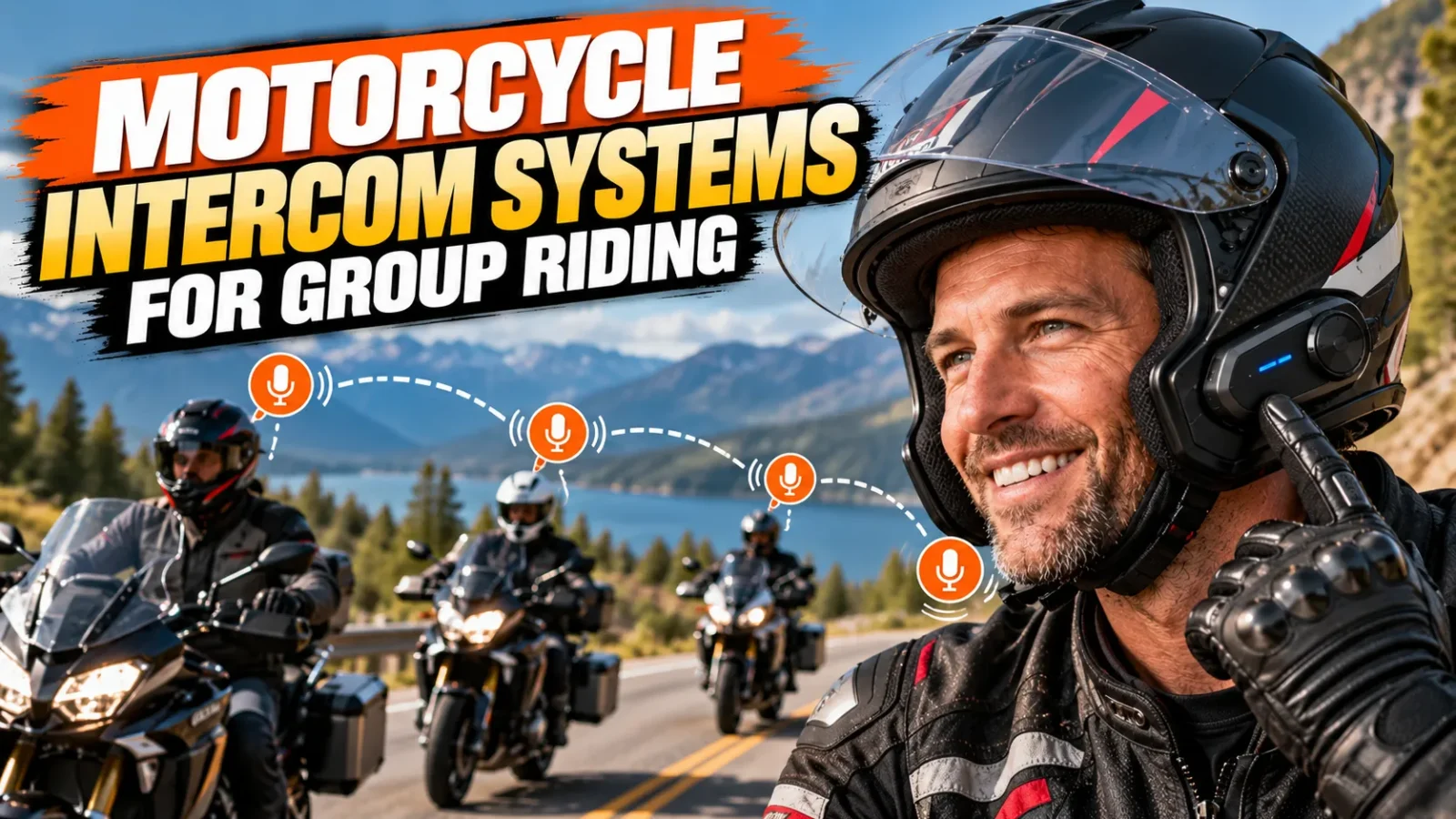
I’ve led enough group rides to know that a good intercom system can make or break the day. Nothing kills the vibe faster than someone missing a turn because their headset dropped out three miles back, or a rider yelling into a dead mic at a gas stop.
Over the years I’ve run everything from clunky first-gen Bluetooth units to the latest mesh networks, and I’ve learned that not all group intercoms are built the same. Some handle 4 riders beautifully but fall apart at 8. Others are overkill for a two-person Sunday cruise.
In this guide, I’m breaking down the intercom systems I’d actually trust on a multi-bike ride, based on real testing, real dropped connections, and a few frustrating parking lot pairing sessions. If you want a deeper dive into two-person setups specifically, I’ve also written about the Best Motorcycle Intercom Systems for Rider and Passenger Communication, which covers a slightly different use case.
- My top overall pick for group riding is the Cardo Packtalk Edge, thanks to its Dynamic Mesh Communication and 15-rider group capacity.
- If you’re already in the Sena ecosystem, the Sena 50S is the strongest mesh alternative with excellent audio quality.
- For groups of 4 or fewer riders on a budget, the Cardo Freecom 4x delivers reliable Bluetooth performance without the mesh price tag.
- Mesh intercoms (Cardo DMC, Sena Mesh) are worth the upgrade for any group of 5+ riders because they auto-reconnect without manual pairing.
- Always match your intercom choice to your typical group size, not the biggest number on the box.
What I Actually Look For in a Group Riding Intercom
Before I get into the list, let me explain my criteria, because “best” means different things depending on how many bikes are in your pack.
For group rides, I prioritize mesh networking capability, real-world intercom range, battery life that survives a full day, and how forgiving the system is when riders scatter and regroup. A great two-person intercom isn’t automatically great for 10 people.
I also weigh audio quality heavily. If you can’t hear directions clearly over wind noise at 70 mph, the fanciest mesh network in the world doesn’t help you. For more on getting clean audio through your lid, check out my breakdown of the Best Stereo Sound Systems for Motorcycle Helmets.
1. Cardo Packtalk Edge — Best Overall for Group Rides
The Cardo Packtalk Edge is what I reach for when I’m organizing a ride with more than 6 bikes. It uses Cardo’s Dynamic Mesh Communication 2.0 (DMC), which lets up to 15 riders connect in a single mesh network without anyone manually pairing to each other.
What sold me on the Packtalk Edge is how it handles riders dropping in and out of range. On a canyon ride with a lot of switchbacks, I lost connection to two riders behind me, and the system automatically reconnected them the moment they came back into range. No fiddling with buttons at a stoplight.
Standout Features
The claimed range is up to 5 miles rider-to-rider in mesh mode, though I typically see closer to 1.5-2 miles in real hilly terrain. Battery life sits around 13 hours of talk time, and it charges fast with USB-C.
It also has JBL-tuned 45mm speakers, which genuinely sound better than most competitors I’ve tried, plus natural voice operation that actually understands commands the first time. Price runs around $400-$430, which isn’t cheap, but for serious group organizers, it’s worth it.
Who It’s For
If you’re the person who plans the routes and leads the pack, this is my top recommendation. It’s also a great pick if your riding crew is a mix of sportbikes, tourers, and adventure bikes since it mounts to nearly any helmet shell.
2. Sena 50S — Best for Large, Established Groups
The Sena 50S is Cardo’s biggest rival, and honestly, it’s neck-and-neck in terms of performance. It runs on Sena’s Mesh 2.0 technology and supports open mesh groups with essentially unlimited riders within range, plus a dedicated group intercom mode for up to 24 people.
I’ve used the 50S on a charity ride with 18 bikes, and the mesh held up impressively well across a spread-out formation. Riders further back occasionally hopped between mesh nodes, but the audio never cut out completely.
The speakers are HD 50mm units that sound noticeably richer than older Sena models. Battery life is rated at 14 hours, and it includes a built-in FM tuner plus Sena’s app for group management, which I found more customizable than Cardo’s app at the time I tested it.
Pricing lands around $300-$350, making it slightly more affordable than the Packtalk Edge while offering comparable group performance. If your crew already runs Sena gear, this is the natural upgrade path.
3. Cardo Packtalk Slim — Best Value Mesh System
Not everyone needs the flagship model, and that’s where the Cardo Packtalk Slim comes in. It uses the same DMC mesh technology as the Edge but in a slimmer, lighter housing, and it typically sells for around $220-$280.
I like recommending the Packtalk Slim to riders who want mesh reliability without paying flagship prices. It still connects up to 15 riders in mesh mode and shares Cardo’s ecosystem, meaning it pairs seamlessly with Packtalk Edge units in a mixed group.
The tradeoff is slightly less powerful speakers (40mm vs the Edge’s 45mm JBL units) and a marginally shorter claimed range. In everyday group riding, though, I honestly didn’t notice a huge difference between the two.
Battery life comes in around 8-10 hours, which is enough for most day rides but something to watch on multi-day trips. Still, for the price, this is one of the smartest mesh purchases in this whole list.
4. Sena 30K — Best Sena Mesh Alternative
The Sena 30K was one of Sena’s first mesh-capable units, and it’s aged surprisingly well. It supports Mesh Intercom for large groups and also has a traditional Bluetooth intercom mode for pairing with up to 3 additional riders directly.
I appreciate that the 30K gives you flexibility. If half your group has mesh headsets and half doesn’t, you can still bridge connections using the standard Bluetooth mode, something that’s saved me during mixed-brand group rides.
Audio quality is solid with 40mm HD speakers, and battery life is rated at 13 hours of talk time. It usually retails for around $220-$260, positioning it as a strong mid-range option.
If you’re weighing this against Bluetooth-only headsets, I’d point you to my full comparison of the best bluetooth headset for motorcycle riding to see how traditional units stack up against mesh for smaller crews.
5. Cardo Freecom 4x — Best Budget Pick for Smaller Groups
Not every group ride needs mesh technology, and honestly, most of my weekend rides top out at 4 bikes. For that, the Cardo Freecom 4x is my go-to budget recommendation, usually priced around $170-$200.
It supports up to 4-way Bluetooth intercom conferencing, which covers the vast majority of casual riding groups. Setup is genuinely simple, Cardo’s app walks you through pairing in a couple of minutes even if you’ve never used an intercom before.
I’ve found the range to be around 1 mile in open road conditions, which is plenty for staying in a tight group formation. Battery life is rated at 13 hours, matching some of the pricier mesh units on this list.
The catch is that once you exceed 4 riders, connections get messy fast, just like any traditional Bluetooth intercom. But if your crew is small and consistent, there’s no need to overspend on mesh you won’t fully use.
6. Sena 20S EVO — Best Reliable Bluetooth Workhorse
The Sena 20S EVO has been around for years, and I still recommend it because it simply works. It supports intercom conferencing with up to 8 riders total (paired in a daisy-chain configuration), which covers a decent-sized group for a Bluetooth unit.
In my testing, I found the 20S EVO’s audio to be crisp and the pairing process, while more involved than mesh systems, straightforward once you understand Sena’s process. It’s a great entry point for riders new to intercom systems entirely.
Range is rated up to 1.2 miles, battery life sits around 13 hours, and it typically sells for $180-$220. It also works with Sena’s HD Audio feature when paired with compatible units.
If you want a broader look at helmet-integrated comms beyond just this model, my guide to the Best Communication Systems for Motorcycle Helmets covers several other Sena and Cardo options in detail.
7. Cardo Spirit HD — Best for Half-Helmet and Cruiser Riders
Cruiser and touring riders often run open-face or half helmets, and the Cardo Spirit HD was designed with exactly that in mind. It’s a more affordable Cardo unit, typically priced around $140-$170, but it still supports group intercom conferencing for up to 4 riders.
I tested this one on a coastal highway cruiser ride, and the wind-noise handling impressed me given the exposed helmet styles most of the group was wearing. Cardo tuned the microphone specifically to cut down on wind interference, which matters a lot more on half helmets than full-face lids.
It doesn’t have mesh technology, so it’s not built for massive groups, but for a tight-knit cruiser crew of 3-4 riders, it punches above its price point. Battery life is rated around 10-13 hours depending on usage.
8. Midland BTX2 Pro S — Best Budget Universal Option
The Midland BTX2 Pro S doesn’t get talked about as much as Cardo or Sena, but I think it deserves more attention, especially for riders on a tighter budget. It typically retails for around $130-$160 for a single unit and supports intercom pairing with up to 4 riders.
What I like about the BTX2 Pro S is its universal compatibility. It’s designed to work across different helmet types and even integrates with two-way radio functionality, which is handy if part of your group still runs old-school CB-style comms.
Audio quality won’t blow you away compared to the flagship Cardo and Sena units, but for casual group rides where budget matters more than premium sound, it gets the job done reliably. Range is around 1 mile in optimal conditions.
9. UClear AMP Go — Best Compact, Lightweight Option
The UClear AMP Go stands out because of its bone-conduction-adjacent design and genuinely compact footprint. It’s priced around $150-$180 and supports intercom pairing with multiple riders through Bluetooth.
I found the low-profile mounting especially appealing for riders who wear tighter, more aggressive sportbike helmets where bulky units can create pressure points. It doesn’t compromise much on sound either, using UClear’s proprietary speaker tech for clear voice audio.
It’s not a mesh system, so I wouldn’t recommend it for groups larger than 4-5 riders, but for smaller sportbike crews who value comfort and a sleeker fit, it’s a genuinely solid choice. Battery life runs around 10 hours of continuous talk time.
How I’d Choose Based on Your Group Size
If your crew regularly rides with 8 or more bikes, I’d steer you toward mesh systems every time, either the Cardo Packtalk Edge, Sena 50S, or the more affordable Cardo Packtalk Slim. The auto-reconnect feature alone saves so much hassle on longer routes with traffic lights and gaps.
For groups of 4-6 riders who ride together consistently, a traditional Bluetooth intercom like the Sena 20S EVO or Cardo Freecom 4x is honestly more than enough, and you’ll save a decent chunk of money.
And if comfort or helmet style is your priority, like cruiser riders in half helmets or sportbike riders in aggressive full-face shells, look at the Cardo Spirit HD or UClear AMP Go respectively.
A Quick Note on Speaker Upgrades
Regardless of which intercom you choose, the built-in speakers matter more than people realize. If you find your chosen unit’s stock speakers underwhelming, it’s worth browsing my guide on the Best Helmet Speakers for Motorcycle to see which aftermarket options pair well with these systems.
Final Thoughts From the Road
After running all nine of these systems across different group sizes, terrains, and helmet styles, my honest takeaway is that there’s no single “best” intercom, just the best one for how you actually ride.
If I had to pick just one for a genuinely mixed, growing group of riders, I’d still go with the Cardo Packtalk Edge. It’s the most future-proof option since it scales from a small crew to a 15-person mesh network without needing a whole new setup.
But honestly, if your group rarely exceeds 4 bikes, save your money and grab the Cardo Freecom 4x or Sena 20S EVO instead. There’s no point paying for mesh capability you’ll never use.
Whatever you choose, test it with your actual riding buddies before a big trip. Pairing quirks and range limitations always show up faster in a parking lot test ride than they do reading a spec sheet, trust me, I’ve learned that the hard way more than once.
Frequently Asked Questions
How many riders can connect on a motorcycle intercom system?
It depends on the technology. Bluetooth intercoms like the Cardo Freecom 4x typically max out around 4 riders, while mesh systems like the Cardo Packtalk Edge or Sena 50S can connect 15-24+ riders simultaneously without the daisy-chain dropouts older Bluetooth setups suffer from.
Is mesh intercom technology worth the extra cost for group rides?
In my experience, yes, if you regularly ride with more than 4 people. Mesh intercoms automatically reroute connections when riders drop out of range and rejoin, which eliminates the constant re-pairing headaches that plague larger Bluetooth groups.
Can different intercom brands communicate with each other?
Generally no, most mesh and proprietary systems only talk to units from the same brand or ecosystem, though many now include a universal Bluetooth intercom mode for connecting to one rider on a different brand. Always check compatibility before a mixed-brand group ride.
What’s the realistic range I should expect from a group intercom?
Manufacturer claims (often 1-8 miles) are measured in open, obstacle-free conditions. In real-world riding with hills, buildings, and traffic, I typically see 30-60% of the advertised range, which is still plenty for a staggered group formation.

Related Articles

9 Best Noise Cancelling Bluetooth Earbuds I’ve Actually Worn on the Road
I tested dozens of noise cancelling Bluetooth earbuds on rides, commutes, and long hauls. Here are the 9 that actually…
Jake Miller
12 min read

9 Best 6×9 Speakers for Motorcycle Saddlebags That Actually Survive the Ride
I tested and researched the best 6x9 speakers for motorcycle saddlebags. Here are my top picks for sound quality, weatherproofing,…
Jake Miller
12 min read

8 Best Motorcycle Intercoms for Multiple Riders in 2026
I tested the top mesh and Bluetooth intercoms for group rides. Here are my picks for the best motorcycle intercom…
Jake Miller
10 min read