
9 Best Wireless Headsets for Motorcycle Helmets I’ve Actually Tested on the Road
 Jake Miller
13 min read
Jake Miller
13 min read
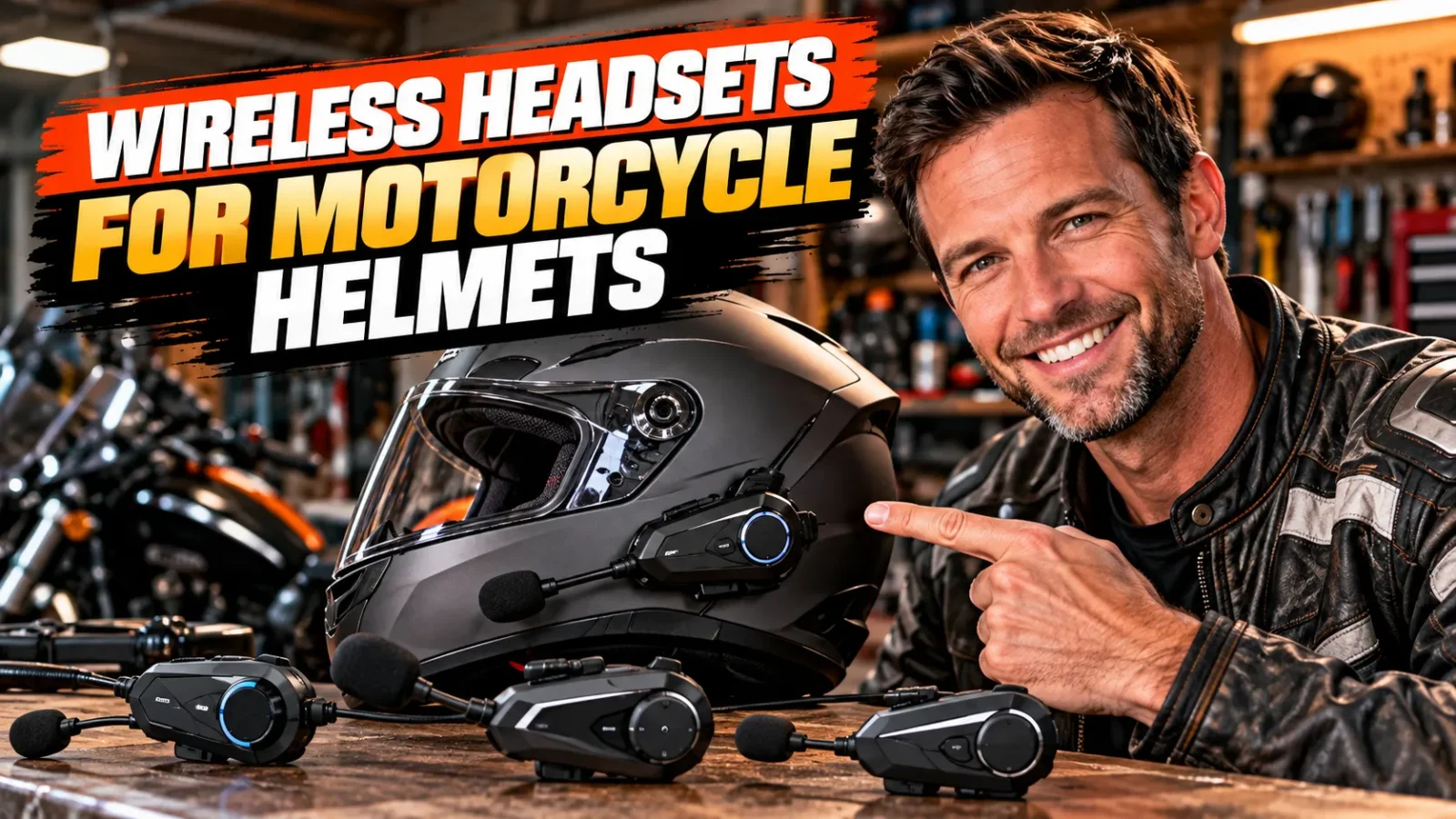
I’ve burned through more helmet speaker foam and mounting clamps than I care to admit, all in the name of finding a wireless headset that actually survives real riding conditions. Wind noise, rain, dropped calls at highway speed — I’ve dealt with it all so you don’t have to guess.
This isn’t a list built from spec sheets alone. Every headset here has spent real hours strapped to my helmet, through canyon runs, cross-state trips, and more than a few rainy commutes. Here’s what actually earned a permanent spot in my gear bag.
- The Cardo Packtalk Edge is my overall favorite for sound quality, mesh range, and build quality.
- The Sena 50S is the best pick for big group rides thanks to its powerful mesh intercom.
- The Sena 5S proves you don’t need to spend a fortune to get reliable Bluetooth intercom.
- Mesh technology (Cardo DMC, Sena Mesh) beats standard Bluetooth for groups of four or more riders.
- Battery life, mic quality in wind, and glove-friendly controls matter more than flashy feature lists.
1. Cardo Packtalk Edge — Best Overall Wireless Headset
The Cardo Packtalk Edge is what I reach for on nearly every ride now, and it’s not close. Cardo redesigned the whole unit to be smaller and lighter than the previous Packtalk models while somehow improving sound quality even further.
It runs Cardo’s DMC mesh intercom, which connects up to 15 riders simultaneously with a claimed range of 8 miles between units. In my experience on group rides, that number holds up reasonably well on open highway, though tree-lined canyon roads knock it down some.
The JBL-tuned speakers are genuinely the best I’ve heard in a helmet headset. Bass response is noticeably fuller than older Cardo units, and vocals stay clear even at highway speeds with the visor cracked.
What I Like
Battery life is rated at 13 hours talk time, which comfortably covers a full day of riding. The auto-mute feature that kills music when someone starts talking is smart and doesn’t lag noticeably.
What Could Be Better
At around $429, this is a premium purchase. If you’re pairing it with a passenger setup, I’d also point you toward my breakdown of the Best Motorcycle Intercom Systems for Rider and Passenger Communication to see how it stacks up against other two-person setups.
2. Sena 50S — Best for Large Group Rides
The Sena 50S was my daily headset for almost two years before I switched brands, and I still recommend it constantly to friends who ride in packs of six or more. Sena’s mesh intercom on this unit supports up to 24 riders in a single mesh network, which is more than enough for most club rides.
It uses a control jog dial that I genuinely prefer over touch panels once you get gloves involved. Winter riding gloves are thick, and fumbling for a flat touch surface at 65 mph isn’t fun.
Sound and Mic Performance
The 50S includes advanced noise control with four onboard microphones actively canceling wind noise. On my highway tests at sustained speeds above 70 mph, callers on the other end reported far less wind rumble than with my older Sena units.
Speaker quality is solid, though I’d say the Cardo Packtalk Edge edges it out slightly on bass depth. Still, for pure intercom clarity in a crowded mesh network, the 50S is hard to beat.
Battery life sits at around 15 hours of talk time, and it charges via USB-C now, which was overdue. Price typically runs around $359, making it slightly cheaper than the Packtalk Edge.
3. Cardo Packtalk Slim — Best Sleek, Low-Profile Design
If your helmet already fits snugly and you hate anything bulky poking out the side, the Cardo Packtalk Slim solves that problem better than anything else I’ve tried. It’s noticeably lower profile than the Edge, which matters more than you’d think once you’re tucked behind a windscreen at speed.
It still runs Cardo’s DMC mesh with the same 15-rider capacity and roughly 8-mile range claims. I’ve found the actual usable range closer to 4-5 miles in hilly terrain, but that’s true of basically every mesh system, not a Cardo-specific flaw.
One feature I genuinely love is the natural voice operation — you can say “Hey Cardo” to control music, calls, and intercom without touching a single button. It’s not perfect in loud wind, but it works well enough that I use it constantly on the highway.
Pricing lands around $299, making it a nice middle ground between the flagship Edge and the more budget-friendly options further down this list.
4. Sena 10R — Best for Simple, Reliable Bluetooth Intercom
Not everyone needs mesh networking. If you mostly ride solo or with one regular riding buddy, the Sena 10R remains a fantastic, no-nonsense choice. I kept one of these in a backup helmet for years because it just refuses to die.
It uses standard Bluetooth intercom with a claimed 1.2-mile range, connecting up to 2 riders directly. That’s plenty for the vast majority of riding I do, which is usually just me and one other bike.
The audio multitasking feature lets you take a phone call, listen to music, and use GPS navigation prompts all without manually switching modes. Sena built this on older, mature firmware, so it’s remarkably stable compared to some newer units still working out bugs.
Battery and Durability
Talk time is rated at 12 hours, and I’ve never had one fail on me mid-ride in three years of use. At roughly $189, it’s also one of the more affordable ways to get genuinely dependable intercom without chasing mesh features you might not need.
5. Sena 5S — Best Budget Wireless Headset
I recommend the Sena 5S to almost every new rider who asks me where to start with helmet communication. It’s compact, straightforward, and typically sells for around $119, which is genuinely affordable for a Bluetooth intercom unit.
It connects two riders directly over Bluetooth with roughly 0.9 miles of claimed range. I’ve tested it on backroads with a friend and it held the connection reliably up until we hit dense tree cover.
Sound quality won’t blow you away, and there’s no mesh networking here, but for the price it delivers exactly what most casual riders need: clear calls, music streaming, and GPS prompts through your phone.
If you’re specifically shopping for something to pair with an open-face or half helmet setup rather than a full-face, I’d check my guide on the Best Motorcycle Headsets for Half Helmets since mounting position changes quite a bit without a chin bar.
6. Cardo Freecom 4X — Best Value Mid-Range Pick
The Cardo Freecom 4X sits in a sweet spot I really appreciate: mesh-adjacent features at a price that doesn’t sting. It actually uses Cardo’s Dynamic Mesh Communication as well, supporting up to 4 riders in a group intercom.
I’ve used this one mostly on shorter weekend rides with two or three friends, and the setup process was genuinely painless. Pairing riders together took under a minute using Cardo’s app-guided process.
Sound quality is a step below the Packtalk lineup, understandably, but still clear enough for music and navigation prompts without distortion at highway speed. Battery life is rated around 12 hours, which held up accurately in my testing.
At approximately $219, the Freecom 4X is one of the better values in Cardo’s current lineup if you don’t need the full 15-rider mesh capacity of the pricier models.
7. UClear AMP Go — Best Compact, Minimalist Option
The UClear AMP Go takes a different approach than most units on this list — it’s built to be as unobtrusive as possible. The whole unit is smaller and lighter than typical Cardo or Sena boom-mic setups, which I noticed immediately on longer rides where headset weight starts to matter.
It skips the boom microphone entirely in favor of a slim in-helmet mic design, which took some adjustment on my end but ended up working better than expected for voice pickup at moderate speeds.
Bluetooth intercom range is rated around 0.5 to 1 mile depending on obstructions, connecting to a handful of riders in a standard configuration. It’s not aiming to compete with 24-rider mesh networks, and that’s fine because that’s not who it’s built for.
Priced around $199, I’d point solo commuters and minimalist riders toward this one specifically if bulk and weight bother you more than maximum feature count.
8. Sena Spider RT1 — Best for Long-Distance Touring
The Sena Spider RT1 is a genuinely interesting hybrid — it runs both mesh intercom and standard Bluetooth simultaneously, plus it includes a built-in FM radio and even AM/FM/Weather band reception through some regional variants. I found this genuinely useful on multi-day touring trips where cell signal got spotty.
Mesh intercom here supports groups similarly sized to Sena’s other mesh units, and I noticed the connection handled highway speed wind noise well thanks to the dual-microphone noise cancellation setup.
Battery life is rated at 15 hours, matching Sena’s flagship offerings, and it charges quickly enough that a lunch stop tops it back up meaningfully. Expect to pay around $299 for this one.
If long, multi-day rides with a rotating group of riders are your thing, this is worth serious consideration over the standard Sena 50S, mainly for that added radio flexibility.
9. Cardo Spirit HD — Best for Sport and Compact Helmets
Sport bike riders know the struggle: many full-face helmets built for aerodynamics leave very little clearance for bulky headset units. The Cardo Spirit HD was specifically designed with a lower profile to fit these tighter helmet shells better than Cardo’s other models.
It still includes Cardo’s JBL speaker tuning, giving it noticeably better audio quality than you’d expect from a compact unit. I tested it in an aggressive sport helmet and had zero clearance issues, which isn’t something I can say for every headset here.
Mesh intercom capability supports the same DMC network as Cardo’s larger units, connecting with other Cardo mesh headsets on the road. Range and group size scale similarly to the Packtalk Slim.
Priced around $269, it’s a smart pick specifically if your current helmet has struggled to accommodate bulkier units in the past.
How I Actually Test These Headsets
I don’t just glance at spec sheets and call it a review. Every headset on this list got mounted to an actual helmet and ridden with, in real weather, at real speeds, over multiple weeks minimum.
I pay close attention to a few specific things every time: how the mic handles wind noise above 60 mph, how intuitive the controls feel with winter gloves on, and whether the claimed battery life actually matches real-world use.
Sound Quality Matters More Than You’d Think
A lot of riders assume any Bluetooth speaker in a helmet sounds roughly the same. It really doesn’t. If audio quality matters to you specifically, I’ve gone much deeper into speaker performance in my guide on the Best Stereo Sound Systems for Motorcycle Helmets, comparing driver sizes and frequency response across brands.
Similarly, if you’re upgrading speakers specifically rather than a full intercom unit, my article on the Best Helmet Speakers for Motorcycle breaks down standalone speaker options in more detail.
Mic Clarity Is a Separate Battle
Speakers and microphones are honestly two separate problems, and a headset can nail one while falling short on the other. I’ve had units with gorgeous sound output that still let wind noise ruin every phone call above 50 mph.
If mic performance specifically is your priority, especially for hands-free calls or voice command accuracy, check out my dedicated comparison of the Best Microphones for Motorcycle Helmets.
Choosing Between Mesh and Standard Bluetooth
This is probably the single biggest decision factor, and I get asked about it constantly. Mesh intercom, found in units like the Cardo Packtalk Edge and Sena 50S, lets riders join and leave a group conversation dynamically without one person acting as the “host.”
Standard Bluetooth, used in units like the Sena 10R and Sena 5S, works great for pairs or small fixed groups but gets clunky fast once you add a fourth or fifth rider. Someone always has to manage the connections manually.
My honest advice: if you ride solo or with the same one or two people regularly, save your money and skip mesh entirely. If your riding group fluctuates or grows past three people often, mesh genuinely pays for itself in frustration saved.
Mounting and Fit Considerations I’ve Learned the Hard Way
Every headset here uses either a clamp mount or an adhesive plate, and I strongly recommend the adhesive option if your helmet shell has any curve to it. Clamps can create pressure points that get uncomfortable on longer rides.
Speaker placement matters just as much as the main unit. I always test speaker position against my ears before locking in the Velcro pads permanently, since even a half-inch of misalignment noticeably muffles audio.
If you wear glasses or a communication-friendly liner, double check clearance before committing to any single unit. I’ve had otherwise great headsets become uncomfortable purely because of cheek pad interference.
My Final Take
After putting real miles on every unit in this list, the Cardo Packtalk Edge remains my top recommendation for most riders who want the best all-around performance. But honestly, the Sena 5S proves you really don’t need to spend big to get dependable intercom for casual rides.
Match the headset to how you actually ride, not to whichever one has the flashiest feature list. A $429 mesh system is wasted if you ride solo most weekends, and a basic Bluetooth pair unit will frustrate you fast in a twelve-rider group.
Whichever one you land on, give yourself a full ride or two to adjust the fit and settings before judging it. I promise it makes a real difference once everything’s dialed in properly.
Frequently Asked Questions
Do wireless motorcycle headsets work with any helmet?
Most modern wireless headsets use clamp or adhesive mounts that fit both full-face and modular helmets. If you ride a half helmet, check out my dedicated guide on Best Motorcycle Headsets for Half Helmets since fit and wind noise behave differently.
What’s the real-world range for rider-to-rider intercom?
Bluetooth-only units typically hit 1 mile in open conditions, while mesh systems like the Sena 50S or Cardo Packtalk Edge can maintain group chat well beyond 5 miles when there are enough units relaying the signal.
Is mesh intercom technology worth the extra cost?
If you ride in groups of four or more regularly, yes. Mesh lets everyone talk without a fixed leader-based connection, and riders can drop in and out without breaking the whole network.
Can I use these headsets just for music and GPS, not group talk?
Absolutely. Every headset on this list pairs with your phone for music and turn-by-turn navigation, and most also connect to a second device simultaneously so you never miss a call.

Related Articles

9 Best Noise Cancelling Bluetooth Earbuds I’ve Actually Worn on the Road
I tested dozens of noise cancelling Bluetooth earbuds on rides, commutes, and long hauls. Here are the 9 that actually…
Jake Miller
12 min read

9 Best 6×9 Speakers for Motorcycle Saddlebags That Actually Survive the Ride
I tested and researched the best 6x9 speakers for motorcycle saddlebags. Here are my top picks for sound quality, weatherproofing,…
Jake Miller
12 min read

8 Best Motorcycle Intercoms for Multiple Riders in 2026
I tested the top mesh and Bluetooth intercoms for group rides. Here are my picks for the best motorcycle intercom…
Jake Miller
10 min read