
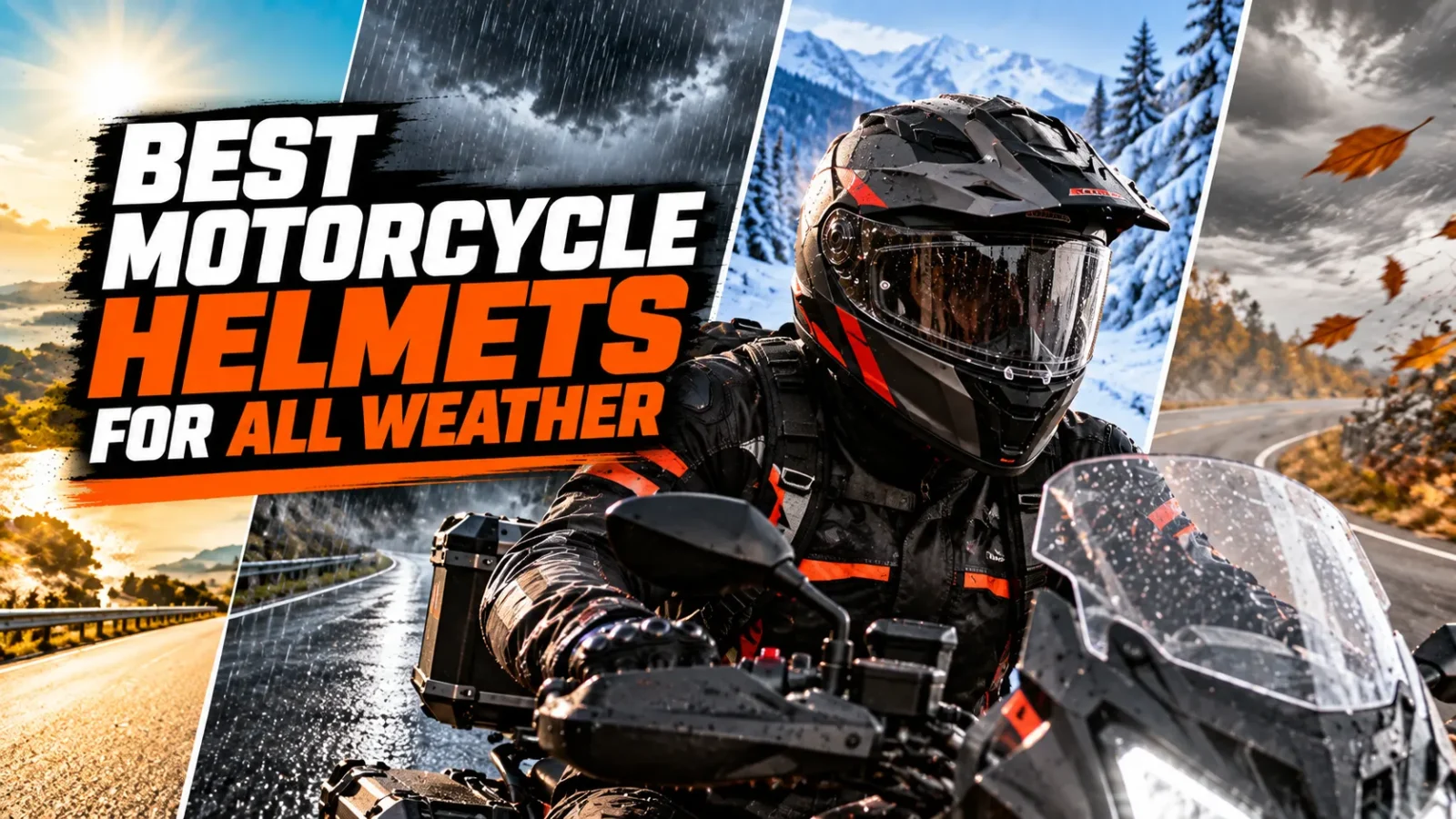
I’ve ridden through 100°F summer highways, sudden downpours, and frosty morning commutes all within the same riding season. If there’s one piece of gear that’s taken the most abuse from Mother Nature, it’s my helmet.
Finding the best motorcycle helmet for all weather isn’t about buying the flashiest lid on the shelf. It’s about ventilation that actually works, a shield that won’t fog up on you, and a fit that stays comfortable whether you’re sweating in July or shivering in November.
I’ve spent years swapping helmets, chasing storms, and freezing my fingers off just to bring you real, tested opinions. For a deeper dive into helmet construction, certifications, and shell materials, my Ultimate Guide to Motorcycle Helmets is a great companion read to this list.
- My overall top pick is the Schuberth C5 for its unmatched versatility between modular convenience and full-face protection in any climate.
- Budget riders should look at the HJC i71, which offers solid ventilation and Pinlock compatibility for under $250.
- Adventure and touring riders will love the Shoei Hornet X3 for its peak visor and adjustable airflow across temperature extremes.
- Every helmet here is Pinlock-ready or comes with anti-fog inserts, which I consider essential for true all-weather use.
- Fit matters more than features, so check out my Motorcycle Helmet Fitment Guide before you buy anything on this list.
1. Schuberth C5 — Best Overall All-Weather Helmet
The Schuberth C5 is the helmet I reach for when I genuinely don’t know what the day’s ride will throw at me. It’s a modular helmet, so I can flip the chin bar up at a gas stop without fully removing my head from the equation, but it still seals up like a full-face when closed.
What sets the C5 apart is its climate control system. There’s an anti-fog Pinlock lens included standard, plus a lower vent that channels air directly onto the inside of the shield to fight condensation on cold, wet rides.
The multi-density EPS liner is genuinely one of the more sophisticated safety setups I’ve tested, and it’s ECE 22.06 rated. At around $700-$800, it’s not cheap, but I’ve used mine through blazing heat and near-freezing rain and it’s never let me down.
Standout features: integrated sun visor, anti-fog Pinlock included, removable/washable liner, near-silent aerodynamics at highway speed.
2. Shoei Neotec 3 — Best Premium Modular for Variable Climates
The Shoei Neotec 3 is the helmet I recommend to friends who ask me to “just pick the best one, money isn’t the issue.” It’s Shoei’s flagship modular, and the fit and finish show it.
Ventilation on the Neotec 3 is excellent, with a large chin vent and dual crown intakes that you can crank open on a scorching day. Close them down and the shell seals tight enough to keep out a surprising amount of cold wind and rain.
It ships with a Pinlock EVO insert already installed, which I appreciate because I’ve forgotten to buy one separately on cheaper helmets before and regretted it. Expect to pay somewhere in the $750-$900 range depending on graphics.
If you tend to ride mostly in extreme heat rather than truly mixed conditions, it’s worth comparing this against my picks in the best motorcycle helmet for hot weather guide, since a lighter, more open helmet might suit you better.
3. AGV K6 — Best Lightweight Full-Face for Year-Round Comfort
The AGV K6 punches way above its weight class. It’s one of the lightest full-face helmets I’ve worn, which makes a real difference on long all-day rides regardless of season.
Despite the low weight, AGV didn’t skimp on ventilation. There are two forehead intakes and a chin vent that move a surprising amount of air on hot days, and they close up cleanly when the temperature drops.
The K6 comes Pinlock-ready with an anti-fog insert included, and the shell is a carbon-aramid fiberglass composite, which keeps it strong without adding bulk. Pricing usually lands between $500-$600, which feels fair for what you get.
4. HJC i71 — Best Budget Pick for All Weather
Not everyone wants to spend $700+ on a helmet, and that’s exactly why I keep recommending the HJC i71 to newer riders. It’s HJC’s mid-tier full-face, and it punches well above its roughly $200-$250 price tag.
The i71 has a solid ventilation setup with a chin vent and two top intakes, plus rear exhaust vents that actually pull air through rather than just looking good on paper. That matters a lot when you’re riding through a heat wave one week and a cold front the next.
It comes with a Pinlock-ready shield, and HJC includes the insert with select graphics packages, so double-check before you buy. The liner is fully removable and washable, which I consider mandatory for sweaty summer rides.
For the price, I genuinely think it’s one of the smartest buys on this whole list.
5. Shoei Hornet X3 — Best for Adventure and Touring Riders
If your “all weather” riding also includes gravel roads, dust, and the occasional unexpected rainstorm, the Shoei Hornet X3 is my pick. It’s an adventure-style helmet with a peak visor that actually works well at highway speeds without excessive buffeting.
The ventilation system here is genuinely excellent. Multiple intake and exhaust vents let me fine-tune airflow, and I’ve worn this helmet comfortably from cold mountain passes down into hot desert valleys on the same trip.
It’s Pinlock-ready (insert typically included), and the shield can run with or without the peak depending on your setup. Priced around $600-$700, it’s an investment, but it’s earned its spot in my adventure-touring rotation.
6. Arai Regent-X — Best for Superior Head Fit and Wind Management
Arai helmets have a reputation for exceptional fit, and the Arai Regent-X lives up to it. I’ve found Arai’s rounder oval shell shape sits more securely on my head than some competitors, which matters a lot in gusty crosswinds or sudden weather shifts.
The VAS (Variable Axis System) shield mechanism seals tightly against the elements, and the ventilation, while more understated than some rivals, is thoughtfully placed to avoid turbulence noise.
It’s Pinlock-ready and the shell is Arai’s hand-laid fiberglass construction, known for its glancing-off safety design philosophy. Expect prices in the $650-$750 range. If you’re unsure how shell shape affects fit, my Motorcycle Helmet Fitment Guide covers this in detail.
7. Nolan N100-6 — Best Value Modular Helmet
The Nolan N100-6 is one of those helmets that quietly does everything right without demanding a premium price. It’s a modular design with a solid flip-up chin bar and an integrated sun visor, which I use constantly during shoulder-season rides when the light changes fast.
Ventilation is handled through a large chin vent and top intake, and the helmet ships Pinlock-ready. Some versions even include the anti-fog insert standard, so check the specific model listing.
At roughly $350-$450, the N100-6 delivers a surprising amount of the comfort and versatility you’d expect from pricier modular helmets like the Schuberth C5 or Shoei Neotec 3.
8. Klim Krios Pro Karbon — Best for Hot-to-Cold Extreme Swings
The Klim Krios Pro Karbon was built for adventure riders who deal with genuinely brutal temperature swings, and I’ve found it holds up impressively well on pavement too. It’s a carbon-fiber shell with a removable peak and dual-pane shield.
What really sold me on this helmet is the ventilation design, which channels air through the EPS liner itself rather than just across your scalp. That means better cooling in heat and less fogging in cold, wet conditions.
It’s Pinlock 100 ready out of the box, and while it’s pricier at around $700-$800, the lightweight carbon shell makes long rides in any weather noticeably less fatiguing.
9. Bell Qualifier DLX MIPS — Best Entry-Level All-Weather Helmet
For riders just building out their gear closet, the Bell Qualifier DLX MIPS is a helmet I recommend without hesitation. It includes MIPS (Multi-directional Impact Protection System) technology, which is a nice safety bonus at this price point.
The Qualifier DLX comes with a Transitions photochromic shield on some versions, which automatically adjusts tint based on light, genuinely useful when you’re riding from a shaded cold morning into bright midday sun.
It’s Pinlock-ready, has a five-vent cooling system, and typically runs around $200-$230. It won’t compete with the Schuberth C5 on refinement, but for the price, it’s a fantastic all-rounder.
How I Actually Test Helmets for All-Weather Performance
I don’t just glance at spec sheets and call it a day. I wear each helmet on multiple ride types: highway commutes, twisty backroads, and at least one genuinely uncomfortable weather day, whether that’s a downpour or a heat advisory.
Ventilation Under Real Conditions
I check whether vents actually flow air or just look good closed. Some helmets have vents that are more marketing than function, and I’ve learned to spot the difference through sweat, quite literally.
Fog Resistance and Shield Quality
Anti-fog performance is huge for all-weather riding. A Pinlock insert genuinely changes the game here, and I won’t recommend a helmet that doesn’t offer one, especially after riding home in autumn drizzle with a fogged-up visor more times than I’d like to admit.
Noise and Fatigue Over Long Rides
A quieter helmet isn’t just more comfortable, it’s safer because you’re less fatigued by the end of a long day. I pay close attention to wind noise at highway speeds across every helmet I review.
Full-Face vs. Modular: Which Handles Weather Extremes Better?
This is a question I get asked constantly, and honestly, it depends on your priorities. Full-face helmets like the AGV K6 or Arai Regent-X tend to seal slightly better against cold and rain because there’s no seam at the chin bar.
Modular helmets like the Schuberth C5 or Nolan N100-6 give you flexibility, letting you flip up the chin bar at a rest stop or chat with a gas station attendant without removing the whole helmet. I personally lean modular for touring, but full-face for aggressive riding.
If you want the full breakdown of pros and cons, I wrote an entire comparison in my Full Face vs. Modular vs. Open Face Helmets guide.
Don’t Forget Safety Ratings
Every helmet on this list meets or exceeds DOT or ECE safety standards, but I always encourage riders to actually understand what those ratings mean rather than just trusting a sticker. Not all certifications test the same things, and some are more rigorous than others.
I’ve broken this all down in plain language in my Helmet Safety Ratings Explained article, which I think is essential reading before you spend hundreds of dollars on any helmet.
Seasonal Extremes: When One Helmet Isn’t Quite Enough
I’ll be honest, even the best all-weather helmet has limits. If you’re riding through genuinely extreme heat for months at a time, a dedicated helmet with maximum airflow might serve you better day-to-day.
I’ve put together a separate list of my favorites in the best motorcycle helmet for hot weather guide for exactly this scenario.
Similarly, if you’re commuting through genuinely freezing winters, a helmet built specifically for cold weather with breath deflectors and heavier insulation might outperform anything on this list. My best motorcycle helmet for cold weather riding guide covers those options in depth.
My Final Take
If I had to own just one helmet for every season, it would be the Schuberth C5. It’s not the cheapest option here, but its ventilation, fog resistance, and modular flexibility have made it my go-to for years of unpredictable riding.
That said, the HJC i71 remains my favorite recommendation for riders on a budget, and the Shoei Hornet X3 is unbeatable if your rides regularly take you off the beaten path.
Whichever helmet you choose, make sure it actually fits your head shape properly before committing. A perfectly ventilated, Pinlock-equipped helmet does you no good if it’s loose, noisy, or uncomfortable after an hour in the saddle.
Frequently Asked Questions
What makes a motorcycle helmet good for all weather conditions?
The best all-weather helmets combine adjustable ventilation, a Pinlock-ready anti-fog shield, removable/washable liners, and quiet aerodynamics. Modular and full-face helmets with multiple intake and exhaust vents tend to perform best since you can dial airflow up for heat or shut it down for cold and rain.
Is a modular helmet or a full-face helmet better for all-season riding?
Both can work great. Modular helmets like the Schuberth C5 offer flexibility for chin-strap breaks and glasses, while full-face helmets like the Shoei Neotec II alternative or the AGV K6 often seal out cold and rain slightly better. Check out my Full Face vs. Modular vs. Open Face Helmets breakdown for more detail.
Do I need a Pinlock insert for all-weather riding?
Yes, absolutely. Fog builds up fast when temperatures swing between hot and cold, especially in rain or humidity. Nearly every helmet on this list either ships with a Pinlock insert or is Pinlock-ready, and I consider it a non-negotiable feature.
How do I make sure my all-weather helmet fits correctly?
Even the best helmet will underperform if it doesn’t fit your head shape properly. I’d recommend reading my Motorcycle Helmet Fitment Guide before buying, and always try a helmet on with the same glasses or earplugs you ride with.

Related Articles

8 Best Motorcycle Headsets for Half Helmets (Tested & Reviewed)
I've tested the top Bluetooth headsets for half helmets so you don't have to. Here are my 8 favorites for…
 Jake Miller
10 min read
Jake Miller
10 min read
9 Best Motorcycle Goggles for Half Helmets I’ve Actually Ridden In
I tested the best motorcycle goggles for half helmets on real rides. Here are my honest picks for wind, bugs,…
Jake Miller
13 min read

8 Best Helmet Speakers for Motorcycle Riders in 2026
I tested and researched the best helmet speakers for motorcycle riders. See my top picks for sound quality, easy install,…
Jake Miller
11 min read