
9 Best Motorcycle Helmets for Claustrophobia: My Picks for Anxious Riders
 Jake Miller
12 min read
Jake Miller
12 min read
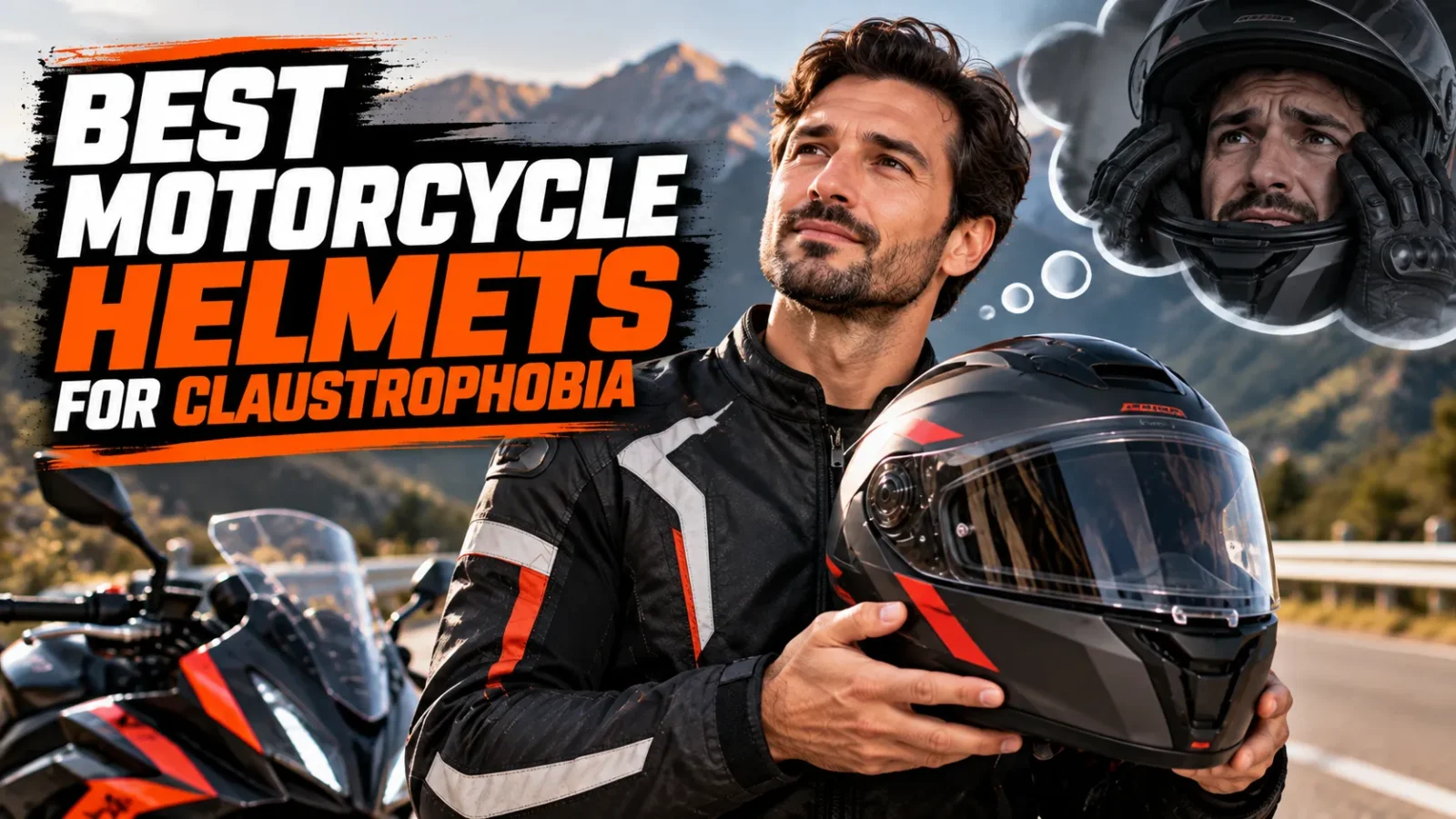
I remember the first time I zipped up a full-face helmet and felt my chest tighten before I’d even started the bike. That closed-in, walls-are-closing-in feeling is real, and it’s more common among riders than most gear shops want to admit.
Over the years I’ve tried dozens of helmets, and I’ve learned that the right shape, weight distribution, and ventilation can make an enormous difference for anxious riders. This isn’t about “toughing it out” in a helmet that stresses you out every ride.
Below is my breakdown of the best motorcycle helmets I’ve personally tested or researched extensively for riders who deal with claustrophobia. If you want the full background on helmet types and safety first, check out my Ultimate Guide to Motorcycle Helmets before you buy.
- Modular helmets like the Schuberth C5 and Shoei Neotec 3 are my top picks because the flip-up chin bar gives you an instant sense of control.
- Full-face helmets with huge eyeports, like the HJC RPHA 91 and Arai Regent-X, feel far roomier inside than their spec sheets suggest.
- Open-face and three-quarter helmets can help you ease into riding, but they trade off some protection, so treat them as a transition step.
- Proper fit and airflow matter just as much as shell shape, so don’t skip a real fitting before you commit to any model.
- Weight, liner material, and interior shape all affect how “trapped” a helmet feels, more than the outside size does.
1. Schuberth C5 — Best Overall Modular Helmet for Claustrophobia
The Schuberth C5 is the helmet I recommend most often to riders who tell me they panic the second a chin bar clicks shut. Its flip-up front means you can pop the chin bar open at a red light, at a gas stop, or honestly whenever you need a breather.
What sets the C5 apart is how it’s built from the inside out. The fiberglass composite shell is genuinely light for a modular, and the interior is shaped with a noticeably open feel around the cheeks and chin compared to competitors I’ve tried.
It also runs remarkably quiet thanks to its integrated wind deflector and refined seal design, which matters more than people realize. A loud, buffeting helmet raises your stress level even if you’re not claustrophobic, so quiet directly translates to calmer rides.
Price sits around $700-$750, which is premium territory, but the fit consistency and anti-fog Pinlock-ready visor make it worth it if you’re serious about comfort. I go deeper into why shell design matters this much in my Carbon Fiber vs. Polycarbonate Helmets breakdown.
2. Shoei Neotec 3 — Best Ventilation for a Less Enclosed Feel
The Shoei Neotec 3 is my other go-to modular recommendation, and it edges out a lot of competitors purely on airflow. Shoei added larger intake vents on the chin bar and crown compared to the older Neotec II, and I could feel the difference the first ride.
More air moving through a helmet does wonders psychologically. It’s a small trick, but constant airflow across your face keeps your brain from registering “sealed in,” which is exactly the sensation that triggers claustrophobia for a lot of riders.
The Neotec 3’s chin bar release is a simple one-button design you can operate with a gloved hand, so there’s no fumbling when you need to open it fast. It also has a drop-down internal sun visor, which means fewer times you need to flip anything up in traffic.
Expect to pay around $700-$800. It’s not cheap, but Shoei’s fit consistency across their sizing is some of the best in the industry, and getting the right fit is half the battle with anxious wearers.
3. HJC RPHA 91 — Best Full-Face with a Massive Eyeport
If you’re not ready to give up full-face protection but modular helmets feel too bulky, the HJC RPHA 91 is where I’d point you next. HJC widened the eyeport significantly on this model, and it genuinely changes how “open” the helmet feels once it’s on.
I’ve noticed that a taller visor opening does more for the claustrophobic feeling than shaving off a few ounces of weight ever could. More visible sky and road means your peripheral vision stays active, which keeps your brain from flagging the enclosure as a threat.
The RPHA 91 also comes with HJC’s fast-swap shield system, so changing tints takes seconds without tools. It’s priced in the mid-range around $400-$450, making it one of the more accessible options on this list.
It carries a solid safety rating too, which you can cross-check against other helmets in my Helmet Safety Ratings Explained guide before you decide.
4. Arai Regent-X — Best for a Roomy, Rounded Interior
Arai helmets have a reputation for being snug, but the Regent-X is actually one of the brand’s more open-feeling shapes. Arai’s rounded shell design is intentional; it’s meant to glance off impacts, but as a side benefit, it also avoids the pressure-point tightness that makes some riders feel boxed in.
I found the interior padding on the Regent-X to be plush without feeling like it’s closing in around my cheeks. The five-shell-size lineup also means you’re less likely to end up in a helmet that’s “close enough” instead of actually correct for your head shape.
It runs about $650-$700, which is on the higher end, but Arai’s reputation for consistent quality control means fewer surprises once it arrives. If you’ve never had your head shape properly assessed, this is a good excuse to finally do it.
5. AGV Tourmodular — Best Modular for Long-Distance Riders
The AGV Tourmodular is built for touring, and that focus on long-haul comfort happens to make it fantastic for claustrophobic riders too. AGV designed the interior with removable, washable padding that’s noticeably softer and less compressive than a lot of sport-oriented helmets.
Its chin bar flips up cleanly with one hand, and the helmet includes a built-in sun visor plus a Pinlock-ready main shield, so you’re rarely stuck fumbling with fogged-up plastic while feeling trapped in traffic.
I also appreciate that AGV kept the shell profile relatively compact for a modular. It doesn’t feel like you’re wearing a fishbowl, which some larger modulars unfortunately do.
Pricing lands around $500-$550, making it one of the better value modular options if you’re comparing it against the Schuberth or Shoei models above.
6. Bell SRT Modular — Best Budget-Friendly Modular Pick
Not everyone wants to spend $700 to test whether a modular helmet helps with their anxiety, and that’s exactly where the Bell SRT Modular comes in. At roughly $270-$300, it’s one of the most affordable ways to try the flip-up-chin-bar approach without a huge financial commitment.
Despite the lower price, it still meets DOT and ECE safety standards, and Bell built in a solid emergency cheek pad release system, so first responders (or you) can remove the helmet quickly if something goes wrong.
I found the ventilation to be decent, though not quite as refined as the Shoei or Schuberth options. Still, for someone dipping their toes into modular helmets for the first time, it’s a smart low-risk entry point.
If you’re unsure whether modular is even the right helmet type for you, my Full Face vs. Modular vs. Open Face Helmets comparison breaks down the pros and cons in detail.
7. Nolan N100-6 — Best Modular for Everyday Commuting
The Nolan N100-6 is a helmet I keep recommending to commuters specifically because of how easy it is to live with day to day. It’s got a lightweight polycarbonate shell, a smooth flip-up mechanism, and an interior that Nolan clearly designed with all-day wear in mind.
What stands out to me is the microlock chin strap and the effortless one-hand visor operation, both small details that reduce the number of times you have to fuss with the helmet while it’s on your head. Less fussing means less time dwelling on the enclosed feeling.
It’s priced around $350-$400, sitting comfortably between the Bell SRT and the pricier Shoei or AGV options. For commuters who stop and start a lot in traffic, being able to flip the chin bar at every light is a genuine anxiety reliever.
8. Shoei RJ Platinum-R — Best Three-Quarter Helmet for Easing In
If full-face and modular helmets both still feel too confining right now, the Shoei RJ Platinum-R is a legitimate open-face option worth considering. It covers your head and ears while leaving your face completely open to the air, which for some riders is the only way they can comfortably ride at all.
Shoei didn’t cut corners on build quality here either. The shell uses their AIM+ fiberglass composite construction, the same family of materials found in their full-face lineup, so you’re not sacrificing structural quality just because the design is open.
I do want to be upfront: an open-face helmet offers less protection around your chin and jaw than a full-face or modular helmet. I see this as a transitional tool rather than a permanent solution, something to build confidence with before eventually stepping up.
It runs about $280-$320, and if you go this route, I’d strongly encourage pairing it with goggles and reading through my Claustrophobia and Helmets: Best Options for Anxious Riders guide for extra strategies on managing the transition.
9. Simpson Ghost Bandit — Best Retro Full-Face with Airy Feel
The Simpson Ghost Bandit earns its spot here through clever shell geometry rather than any gimmick. Its rounded, low-profile shell and wide eyeport give it a surprisingly open feel for a helmet that still delivers full DOT and ECE-rated protection.
I like that Simpson kept the interior padding firm but not compressive, so it doesn’t create that squeezed sensation around the jawline that a lot of budget full-face helmets do. The dual-pane shield also helps cut down fogging, which means fewer moments of panic from a suddenly obscured view.
Priced around $400-$450, it’s a stylish middle ground for riders who want a classic look without giving up the confidence boost that comes from a genuinely well-vented, roomy-feeling full-face design.
What I Look For When Picking a Claustrophobia-Friendly Helmet
Interior Shape Matters More Than Exterior Size
A helmet can look huge on the outside and still feel tight inside if the liner is shaped aggressively around your cheeks. I always check for a rounded, evenly padded interior rather than one that pinches at specific points.
This is honestly the single biggest factor I’ve found in whether a helmet triggers that trapped feeling. Two helmets can weigh the same and look similar, yet feel completely different once they’re actually on your head.
Ventilation Is a Psychological Tool, Not Just a Comfort Feature
Every helmet on this list has strong intake and exhaust venting, and that’s intentional on my part. Moving air across your face keeps your nervous system from registering the helmet as a sealed box, which sounds minor but genuinely changes how anxious riders experience a ride.
Quick-Release Mechanisms Reduce Panic
Whether it’s a modular chin bar, a fast-swap visor, or an emergency cheek pad release, knowing you can get air or get the helmet off quickly gives your brain permission to relax. This is why I lean so heavily toward modular helmets on this list.
Getting the Fit Right Before You Blame the Helmet
I can’t stress this enough: a poorly fitted helmet will feel claustrophobic no matter which model you pick. Before you write off a helmet as “too tight,” make sure you’ve actually measured your head correctly and tried the right shell size.
My Motorcycle Helmet Fitment Guide walks through exactly how to measure your head shape and cross-reference it against brand-specific sizing charts. Arai, Shoei, and Schuberth all use slightly different head shape assumptions, so what fits great in one brand might feel awful in another.
My Final Take
If I had to pick just one helmet off this list for a claustrophobic rider, I’d point you toward the Schuberth C5 or the Shoei Neotec 3 first, simply because the flip-up chin bar gives you that instant escape valve whenever anxiety creeps in. From there, the HJC RPHA 91 is my top full-face pick if you want to stick with a traditional shell shape.
Whatever you choose, don’t rush the decision. Try helmets on in person when you can, wear them for a few minutes in the store, and pay attention to how your body reacts, not just how the spec sheet reads.
Frequently Asked Questions
Are modular helmets better than full-face helmets for claustrophobia?
In my experience, yes. A modular helmet lets you flip the chin bar up at stops or when you feel panicky, which gives you an instant escape valve that a traditional full-face helmet simply can’t offer.
Is a half helmet or three-quarter helmet safe enough for anxious riders?
They meet DOT standards and are legal in most states, but they offer less coverage than a full-face or modular helmet. I recommend them only as a stepping stone while you work up to more protective gear.
Will a bigger eyeport actually help with my claustrophobia?
Absolutely. A larger eyeport and taller visor opening increase your peripheral vision and airflow, which tricks your brain into feeling less boxed in. It’s one of the biggest factors I look for when recommending helmets to anxious riders.
How do I know if a helmet fits right without feeling too tight?
Fit should be snug but never pinching, with no pressure points on your forehead or temples. My Motorcycle Helmet Fitment Guide walks through exactly how to measure and test this at home.

Related Articles

8 Best Motorcycle Headsets for Half Helmets (Tested & Reviewed)
I've tested the top Bluetooth headsets for half helmets so you don't have to. Here are my 8 favorites for…
Jake Miller
10 min read
9 Best Motorcycle Goggles for Half Helmets I’ve Actually Ridden In
I tested the best motorcycle goggles for half helmets on real rides. Here are my honest picks for wind, bugs,…
Jake Miller
13 min read

8 Best Helmet Speakers for Motorcycle Riders in 2026
I tested and researched the best helmet speakers for motorcycle riders. See my top picks for sound quality, easy install,…
Jake Miller
11 min read