
8 Best Motorcycle Helmets for Night Riding That Actually Keep You Visible and Safe
 Jake Miller
12 min read
Jake Miller
12 min read
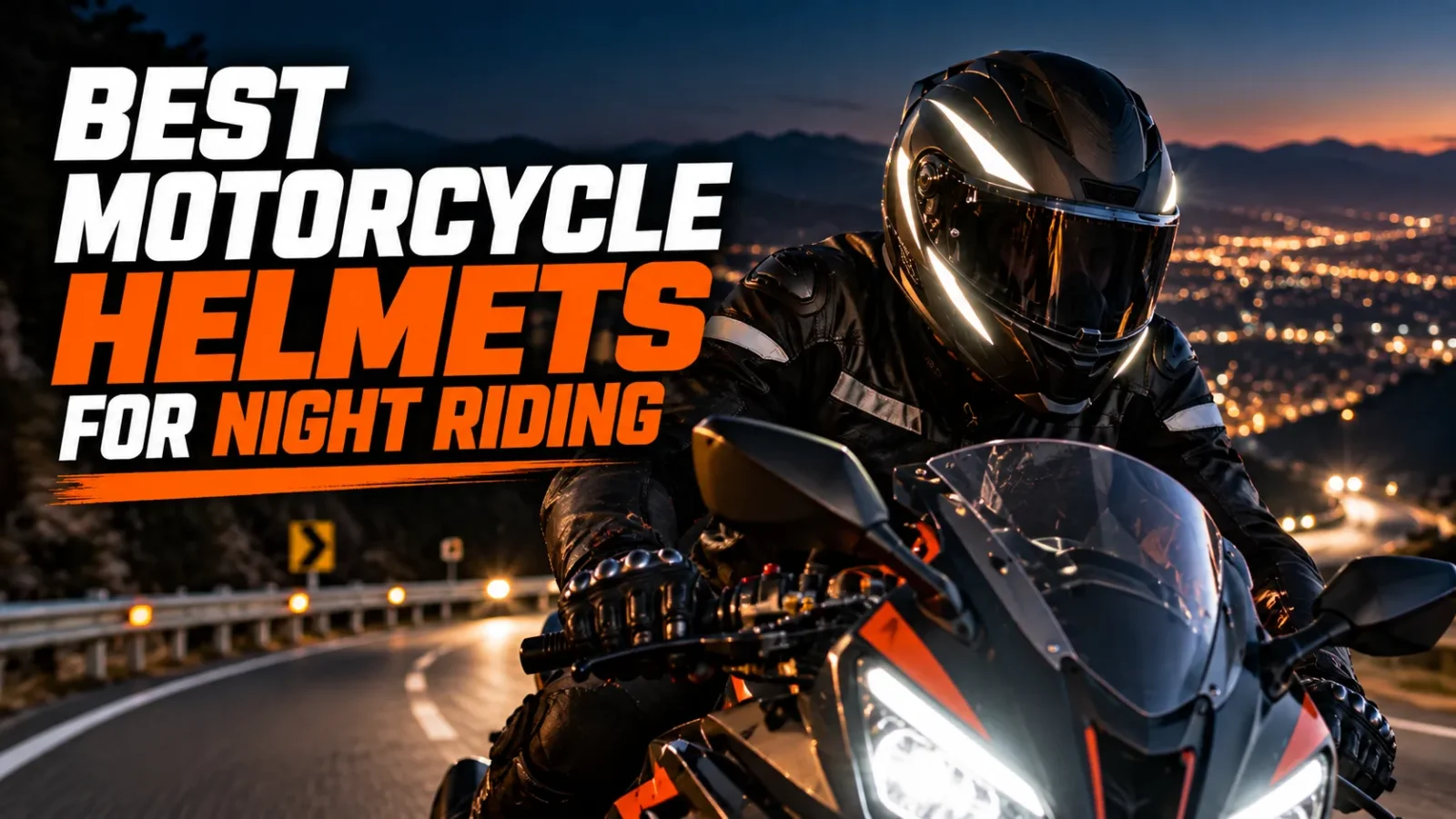
I’ve done more night riding than I probably should admit, and I’ve learned the hard way that not every helmet that’s great in daylight holds up once the sun goes down. Glare, fogging, and low-light visibility problems can turn a relaxing ride into a white-knuckle one fast.
Over the years I’ve cycled through a lot of lids specifically chasing better night performance, and I’ve landed on a shortlist that I genuinely trust after dark. If you want the full breakdown of helmet types, safety ratings, and fit before diving into this list, my Ultimate Guide to Motorcycle Helmets is a great place to start.
- My top overall pick is the Shoei RF-1400 thanks to its distortion-free optics and included Pinlock insert.
- For riders who want built-in visibility tech, the LS2 Valiant II has an actual LED brake light wired into the shell.
- The Bell Qualifier DLX MIPS with a Transitions photochromic shield is my pick if you ride from dusk into full dark and don’t want to swap visors.
- Reflective detailing matters as much as the visor — helmets like the Icon Airflite and Nolan N100-6 light up nicely under headlights.
- Never wear a dark tinted shield at night — clear or photochromic only, no exceptions.
1. Shoei RF-1400 — Best Overall Helmet for Night Riding
The Shoei RF-1400 is the helmet I reach for most often, and night riding is exactly where it earns its keep. Shoei’s CWR-F2 shield is genuinely one of the clearest on the market, with almost zero distortion even when you’re staring into oncoming headlights.
It comes with a Pinlock EVO insert included in the box, which is a big deal because fogging is one of the sneakiest dangers of night riding. You don’t notice your visor’s fogging until you’re squinting at a shadow that might be a pothole.
The shell uses Shoei’s Advanced Integrated Matrix Plus construction, blending fiberglass with organic fibers for a lightweight yet DOT and ECE-rated protective structure. At around $600-$700, it’s not cheap, but the optical quality alone justifies it for anyone who rides after sundown regularly.
Why I trust it in the dark
The peripheral vision on the RF-1400 is wider than a lot of full-face competitors, which genuinely helps you catch movement — a deer, a car drifting in a lane — at the edges of your vision. I’ve also found the internal ratchet shield mechanism seals tighter against wind noise and light leaks around the edges.
2. Arai Regent-X — Best for Distortion-Free Visibility
Arai helmets have a reputation for obsessive attention to shell geometry, and the Arai Regent-X is no exception. Its rounded shell shape is designed to glance off impacts, but the side benefit is an incredibly smooth field of view with minimal optical warping at the edges.
I noticed the difference immediately when riding under a string of sodium streetlights — other helmets I’ve owned created a slight halo or smear effect, while the Regent-X kept everything crisp. That clarity matters more than people realize when you’re trying to judge distance to a car’s taillights at night.
It’s Pinlock-ready out of the box and runs in the $500-$600 range depending on graphic. If you’re comparing options for regular commuting, this one pairs nicely with recommendations in my guide to the best motorcycle helmet for street riding.
A quieter ride matters more than you think
Wind noise fatigue sneaks up on you at night when your other senses are already working overtime. The Regent-X’s snug cheek pads and diffuser vent design keep noise down, which in my experience keeps me sharper on longer night rides.
3. Shark Evo-GT — Best Modular Helmet for Night Touring
The Shark Evo-GT has become my go-to for night touring because of its built-in drop-down internal sun visor. I can flip it up the second dusk hits without stopping to swap shields, which is a small thing that makes a real difference on long rides.
It’s a modular (flip-up) lid, so I can also crack the chin bar open at gas stops without fully removing the helmet — handy when you’re riding in a group and stopping frequently after dark. The shell is constructed from Shark’s Lexan-reinforced polymer, keeping weight reasonable at around 1,650 grams.
Pricing sits around $400-$450, making it one of the more attainable modular options with genuine night-riding features. The reflective piping along the chin bar and rear also picks up headlights nicely in my mirrors when riding with a group.
4. Schuberth C5 — Best Premium Modular for Long Night Rides
If budget isn’t a huge concern, the Schuberth C5 is one of the quietest, most refined modular helmets I’ve ever worn, and that matters a lot on multi-hour night rides where fatigue is the real enemy. It also has an integrated sun visor operated by a single external slider.
Schuberth’s anti-fog Pinlock system on the C5 is excellent, and I’ve ridden through some genuinely cold, damp nights without a single fogging issue. The aerodynamic shell is also wind-tunnel tested, which reduces buffeting at highway speed — something that becomes more fatiguing, not less, in the dark.
At roughly $750-$900, it’s a premium purchase, but if you tour at night frequently, the reduced fatigue alone is worth it. It’s also compatible with Schuberth’s SC2 communication system if you want built-in intercom for group night rides.
5. Bell Qualifier DLX MIPS (Transitions Photochromic Shield) — Best for Dusk-to-Dark Transitions
This is the one I recommend most to friends who ride the classic “leave before sunset, arrive after dark” commute. The Bell Qualifier DLX MIPS is available with a genuine Transitions adaptive photochromic shield, which automatically lightens as ambient light drops.
That means you don’t need to carry a spare clear visor or swap shields mid-ride — the lens adjusts itself within a minute or two of the light changing. I’ve used this exact setup riding home from work as the sun sets, and it removes one more thing to think about in traffic.
It includes MIPS (Multi-directional Impact Protection System) for rotational impact protection, and it’s genuinely affordable at around $220-$260. For the price, I don’t know of a better photochromic option on the market right now.
One thing to know
Photochromic lenses aren’t the same as true night-vision tech — they still need a few minutes to fully adjust. I always start my ride with the shield already in its clear state if I know I’ll be riding home after dark.
6. LS2 Valiant II — Best Helmet With a Built-In LED Brake Light
The LS2 Valiant II is genuinely unique on this list because it has an integrated LED taillight built into the rear shell that activates under braking or deceleration, powered by a small rechargeable battery. It’s one of the smartest safety features I’ve seen baked directly into a helmet.
Having a brake light right at driver eye-level, rather than just down at your bike’s rear fender, adds a genuinely useful extra visual cue for cars behind you. I noticed drivers backing off sooner in my mirrors compared to riding with just my bike’s factory brake light.
It’s also a modular helmet with a drop-down sun visor and Pinlock-ready main shield, and it typically runs around $300-$350. For the tech packed in, that’s a strong value.
7. HJC i70 — Best Budget Pick for Night Commuting
Not everyone wants to spend $500+ on a helmet, and the HJC i70 is proof you don’t have to in order to ride safely at night. It comes Pinlock-ready, has a solid anti-scratch shield, and includes reflective accents on several of its graphic options.
I’ve recommended this one to a few newer riders specifically because it hits a sweet spot — around $150-$200 — without cutting corners on optical quality or fit. The Advanced Polycarbonate shell is ECE 22.06 certified, which is one of the stricter current safety standards.
If you’re also dealing with unpredictable weather on your night rides, it’s worth cross-referencing with my picks for the best motorcycle helmet for riding in the rain, since rain and darkness often show up together.
8. Icon Airflite — Best Reflective Graphics for Urban Night Riding
The Icon Airflite has some of the boldest reflective graphic options I’ve come across, with entire panels of retroreflective material on certain colorways that light up like a stop sign under headlights. For city riding where you’re constantly crossing intersections at night, that visibility boost is huge.
Beyond the graphics, it’s a genuinely solid performer — Fiberglass/Aramid composite shell, Pinlock-ready Optics Class 1 shield, and a wide eyeport that helps with peripheral awareness at busy intersections. Pricing runs around $250-$300 depending on the graphic you pick.
I’ve worn mine on plenty of late rides through downtown traffic, and I genuinely believe the reflective panels have made drivers notice me a beat sooner at 4-way stops. It’s a small thing, but at night, small things add up.
Bonus mention: Nolan N100-6
I want to give an honest nod to the Nolan N100-6 as well. It’s a modular helmet with reflective piping, an internal sun visor, and it’s ready for Nolan’s N-Com Bluetooth system if you want intercom capability. At around $350-$400, it’s a strong alternative if the Shark Evo-GT or LS2 Valiant II aren’t quite your style.
What actually makes a helmet good for night riding
After going through all of these, a few patterns became obvious to me. It’s never just one feature — it’s a combination of optical clarity, anti-fog capability, and passive visibility like reflective trim or built-in lighting.
Optical clarity over everything
A cheap, warped shield can genuinely distort your perception of distance at night, especially around streetlights and oncoming headlights. I always check for “Optics Class 1” certification, which means the shield introduces no meaningful distortion.
Anti-fog is non-negotiable
Temperature swings between day and night riding create the perfect conditions for a fogged-up visor. I won’t buy a helmet anymore that isn’t Pinlock-ready, full stop — it’s cheap insurance against a genuinely dangerous problem.
Reflective elements and lighting
Cars are worse at spotting motorcycles at night, period. Reflective piping, retroreflective decals, and even built-in LED brake lights like the one on the LS2 Valiant II all stack the odds back in your favor.
Never ride with a tinted shield after dark
This one seems obvious, but I still see riders do it out of habit. Stick with clear or photochromic lenses like the Transitions shield on the Bell Qualifier DLX — anything darker meaningfully cuts your reaction time in low light.
How I’d choose between these eight
If I had to pick just one for myself, I’d lean toward the Shoei RF-1400 for its balance of optics, comfort, and included Pinlock lens. But if you’re commuting through a lot of stop-and-go city traffic at night, the reflective panels on the Icon Airflite or the built-in brake light on the LS2 Valiant II genuinely change how visible you are.
Budget riders shouldn’t feel left out either — the HJC i70 proves you can get real night-riding safety features without spending a fortune. And if your rides swing between temperature extremes, it’s worth pairing your helmet choice with advice from my guide to the best motorcycle helmet for cold weather riding.
Fit still comes first
None of these features matter if the helmet doesn’t fit properly. A loose helmet lets in more wind noise, fogs faster, and shifts around at speed — all things that get worse, not better, at night. If you’ve got a smaller head shape, I’d point you toward my notes on the best motorcycle helmet for riding with small head before committing to any of these models.
Don’t forget off-road night rides
If your night riding happens off pavement, none of these are quite right — you’ll want something built for dirt visibility and ventilation instead. My breakdown of the best helmet for motorcycle trail riding covers that territory in more depth.
Final thoughts from my own night rides
Night riding isn’t inherently more dangerous if you set yourself up right, and honestly, some of my favorite rides have happened after dark when traffic thins out and the roads feel like mine. The helmet you choose plays a bigger role in that safety equation than most riders give it credit for.
Whichever one of these eight you land on, the real win is combining good optics, anti-fog protection, and passive visibility into one lid. Do that, and you’ll notice the difference on your very next ride home after sunset.
Frequently Asked Questions
What makes a helmet better for night riding specifically?
The biggest factors are optical clarity (no distortion or glare from streetlights), anti-fog Pinlock compatibility, reflective materials to make you visible to other drivers, and a clear or photochromic shield rather than a tinted one.
Can I use a tinted or smoked visor at night?
No, you should never ride at night with a dark tinted visor. Stick to a clear shield or a photochromic one like Bell’s Transitions lens, which automatically lightens in low light.
Are helmets with built-in LED brake lights worth it?
In my experience, yes. A helmet like the LS2 Valiant II with an integrated LED taillight adds another layer of visibility that sits right at driver eye level, which is exactly where you want it after dark.
Do reflective decals on a helmet actually make a difference?
Absolutely. Reflective piping and graphics light up dramatically under headlights, and I’ve noticed drivers giving me more space at night when I’m wearing a helmet with reflective detailing versus an all-matte black lid.

Related Articles

8 Best Motorcycle Headsets for Half Helmets (Tested & Reviewed)
I've tested the top Bluetooth headsets for half helmets so you don't have to. Here are my 8 favorites for…
Jake Miller
10 min read
9 Best Motorcycle Goggles for Half Helmets I’ve Actually Ridden In
I tested the best motorcycle goggles for half helmets on real rides. Here are my honest picks for wind, bugs,…
Jake Miller
13 min read

8 Best Helmet Speakers for Motorcycle Riders in 2026
I tested and researched the best helmet speakers for motorcycle riders. See my top picks for sound quality, easy install,…
Jake Miller
11 min read