
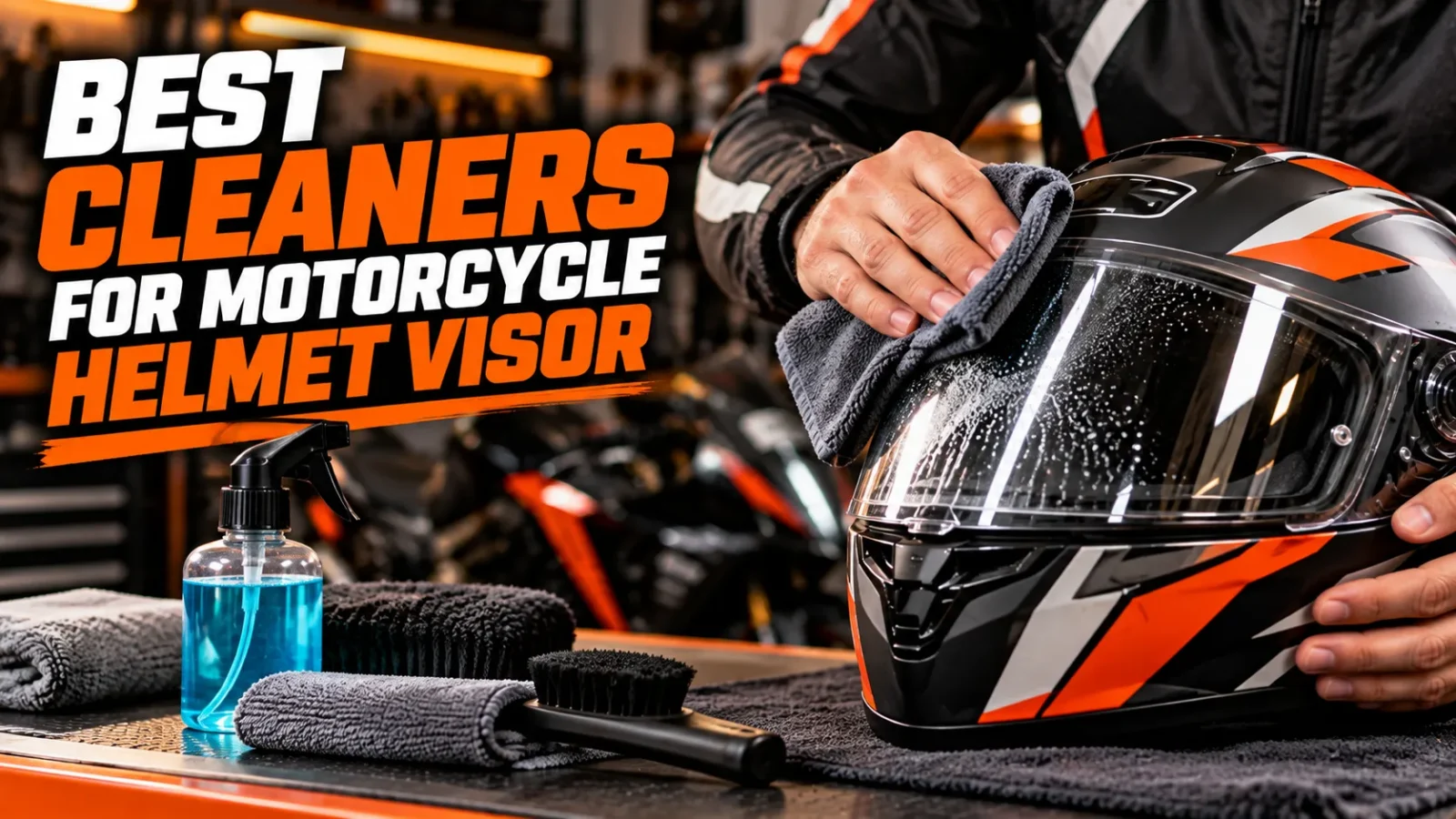
I’ve gone through more visors than I’d like to admit, mostly because I got lazy about cleaning them the right way. A dirty, hazy, or scratched-up visor isn’t just annoying, it’s genuinely dangerous when you’re staring into low sun or oncoming headlights at night.
Over the years I’ve tried everything from dish soap to dedicated aerospace-grade plastic cleaners, and I’ve learned the hard way which products actually protect your visor versus which ones slowly wreck it. If you want the full picture on choosing and maintaining your lid, my Ultimate Guide to Motorcycle Helmets covers everything from fit to ventilation, but this article is all about keeping that visor crystal clear.
Below are the nine cleaners I trust most, based on real riding, real bug splatter, and real Texas summer bake sessions on my visor.
- Plexus Plastic Cleaner is my overall favorite: safe, streak-free, and anti-static.
- Muc-Off Helmet, Visor & Lens Clean & Shine is the best purpose-built motorcycle option.
- Never use ammonia-based glass cleaner (like Windex) on a visor, it degrades polycarbonate over time.
- Pinlock inserts need their own cleaner, like Pinlock DeFog Wipes, not standard visor spray.
- Budget-conscious riders should look at S100 Motorcycle Visor Cleaner for solid everyday performance.
What I Look for in a Good Visor Cleaner
Before I get into my picks, let me explain my criteria. I’m not just grabbing whatever’s cheapest at the gas station, I actually think about what’s going onto a critical safety component.
First, it has to be ammonia-free and safe on polycarbonate. Second, it shouldn’t leave streaks or residue that catches glare from headlights. Third, bonus points if it has anti-static properties, since static attracts dust like a magnet.
I also care about whether a cleaner strips protective coatings. Many visors come with anti-scratch or anti-fog treatments, and a harsh cleaner can ruin those in a handful of uses. If your visor already feels stiff to open or close, that’s usually a hinge lubrication issue rather than a cleaning problem, and I break that down in my guide on why your helmet visor might be stiff.
1. Plexus Plastic Cleaner — Best Overall
Plexus Plastic Cleaner is basically the industry standard, and honestly, it’s earned that reputation. Originally developed for aircraft canopies, it’s an anti-static, ammonia-free spray that’s become a cult favorite among motorcyclists, pilots, and even boat owners.
I keep a can of Plexus in my garage and a travel-size bottle in my tank bag. It sprays on as a light mist, and you wipe it off with a microfiber towel, no scrubbing required, no white residue left behind.
What sold me on Plexus is how it handles bug guts and road grime without smearing them around. It also leaves a very thin protective layer that seems to repel dust for a few days afterward. A 13-ounce can typically runs around $12 to $15, and it lasts forever since you only need a couple of sprays per cleaning.
Best for: Riders who want one bottle that handles everything from bugs to fingerprints without any risk to coatings.
2. Muc-Off Helmet, Visor & Lens Clean & Shine — Best Motorcycle-Specific Spray
Muc-Off is a name most riders already trust for chain lube and bike wash, and their Helmet, Visor & Lens Clean & Shine spray is purpose-built for exactly this job. It’s formulated specifically for visors, goggles, and helmet shells, so you’re not repurposing an automotive product.
I like that this one comes in a smaller, more travel-friendly bottle, which makes it easy to toss in a tank bag or tail pack for cleaning at a gas stop. It cuts through bug residue and sunscreen smears without needing much elbow grease.
It’s priced similarly to Plexus, usually around $10 to $14 for a bottle, and it smells noticeably better too, no harsh chemical odor when you’re wiping down your lid at a rest stop.
Best for: Riders who want a motorcycle-branded product they trust across their whole gear bag, not just their visor.
3. Pinlock DeFog Wipes — Best for Pinlock Inserts
If your helmet uses a Pinlock anti-fog insert, you need a separate cleaning approach entirely. Regular visor cleaner can strip the hydrophilic coating that makes Pinlock inserts work, which defeats the whole purpose of running one.
Pinlock DeFog Wipes are individually packaged, alcohol-free wipes designed specifically for cleaning the insert side of your visor. They’re gentle enough not to damage the coating, but effective enough to clear off fingerprints and haze.
I keep a few of these wipes in my jacket pocket during colder months when fogging is a real issue. A pack of 20 individual wipes costs around $10, which isn’t bad considering how much a replacement Pinlock insert costs if you damage the original.
Best for: Anyone running a Pinlock insert who wants to protect that coating long-term.
4. Nikwax Visor Clean — Best Eco-Friendly Formula
Nikwax built its reputation on outdoor gear care, and their Visor Clean spray brings that same environmentally-conscious approach to motorcycle visors. It’s biodegradable, free of harsh solvents, and still does a genuinely good job on grime.
I tried this one during a wet spring when my visor was constantly covered in road spray and grit. It cut through the film without leaving that slightly oily residue some cleaners do.
At roughly $10 to $12 per bottle, it’s competitively priced, and I appreciate that it’s a UK-based brand with a long track record in technical gear care, not just a random private-label product.
Best for: Riders who prioritize environmentally friendly formulas without sacrificing cleaning power.
5. S100 Motorcycle Visor Cleaner — Best Budget Pick
S100 is well known in the motorcycle world for cleaning products, and their dedicated visor cleaner is one of the most affordable dedicated options out there. You can usually find an 8-ounce bottle for around $8, sometimes less if you catch a sale.
It’s a straightforward foam spray that clings to the visor surface long enough to loosen dried bugs and grime before you wipe it away. It’s not fancy, but it consistently gets the job done on my daily commuter helmet.
I wouldn’t call it as premium-feeling as Plexus or Muc-Off, but for the price, it’s hard to argue with the value, especially if you’re cleaning multiple helmets in a household.
Best for: Budget-minded riders who still want a purpose-made visor cleaner over a generic household spray.
6. Novus Plastic Polish #2 Fine Scratch Remover — Best for Light Scratch Removal
Sometimes cleaning isn’t enough, and what you’re actually dealing with is a hazy, scratched visor that no amount of spraying will fix. That’s where Novus Plastic Polish #2 comes in. It’s technically a fine scratch remover rather than a daily cleaner, but I use it a few times a year to restore clarity.
Novus makes a three-step system (#1 cleaner, #2 fine scratch remover, #3 heavy scratch remover), and the #2 formula is the sweet spot for most visor scratches picked up from careless storage or dusty wipe-downs.
If you’ve ever noticed odd glare or starburst patterns from oncoming headlights at night, it’s often down to accumulated micro-scratches rather than dirt. I go into detail on that phenomenon in my article on why you see starbursts at night, and a light polish like this can genuinely help reduce it.
A bottle costs around $10 to $13, and a little goes a long way since you’re only treating small scratched areas, not the whole visor surface.
Best for: Riders dealing with light haze or fine scratches rather than everyday dirt.
7. WD-40 Specialist Anti-Static Plastic Cleaner — Best Anti-Static Formula
Yes, that WD-40, but not the penetrating oil you’re thinking of. Their Specialist Anti-Static Plastic Cleaner line is a completely different formula, designed for clear plastics, screens, and visors, and it genuinely surprised me with how well it performs.
The anti-static component is the real selling point here. Dust clings to visors constantly, especially in dry climates, and this spray noticeably cuts down on how fast that fine layer of grime builds back up after cleaning.
It’s typically priced around $8 to $10 for an 8-ounce spray bottle, making it one of the more affordable anti-static options on this list, right alongside S100.
Best for: Riders in dusty or dry climates who are tired of constant dust buildup right after cleaning.
8. Griot’s Garage Clear Plastic Cleaner & Polish — Best for Restoring Clarity
Griot’s Garage is primarily known in car detailing circles, but their Clear Plastic Cleaner & Polish works exceptionally well on motorcycle visors and headlight lenses alike. It’s a slightly more aggressive formula than a daily-use spray, designed to actually restore clarity to dulled or hazed plastic.
I reach for this one when a visor looks cloudy even after a normal clean, usually from months of sun exposure and dried-on sunscreen or bug spray that’s etched into the surface slightly.
A bottle runs about $15 to $18, which is pricier than most on this list, but it’s a multi-use product you’ll also find yourself using on windshields, faceshields, and even car headlights.
Best for: Restoring an older, hazy visor rather than routine daily maintenance.
9. Meguiar’s Mirror Glaze #17 Plastic Cleaner — Best Multi-Purpose Pick
Meguiar’s Mirror Glaze #17 has been a detailing staple for decades, originally designed for aircraft plastics before crossing over into automotive and motorcycle use. It’s a slightly thicker cleaner than the sprays on this list, more of a lotion you apply and buff off.
I like keeping this one around specifically for shop use rather than on-the-road touch-ups, since it takes a bit more time and a clean applicator pad to use properly. The payoff is a genuinely deep clean that also helps with very light scratch reduction.
At roughly $10 to $12 per bottle, it’s competitively priced, and since Meguiar’s products are sold basically everywhere, it’s one of the easiest options to actually find locally without ordering online.
Best for: Riders who want a proper deep-clean product for periodic garage maintenance sessions.
How I Actually Clean My Visor Step by Step
Having the right cleaner matters, but technique matters just as much. I always start by rinsing the visor with plain water first to knock off loose grit before anything touches it with a cloth.
Dry wiping a dusty visor is the single fastest way to introduce fine scratches, and trust me, I learned this the hard way on more than one visor. Water first, cleaner second, that’s the rule.
From there, I spray my chosen cleaner (usually Plexus or Muc-Off) directly onto a clean microfiber cloth rather than the visor itself, then wipe in gentle straight lines rather than circles. Circular motions can create swirl patterns that show up as glare at night.
Cleaning the Inside vs. Outside
The outer surface deals with bugs, road grime, and rain. The inner surface deals with skin oils, breath moisture, and makeup or sunscreen transfer. I treat them differently.
For the outside, any of the general cleaners above work great. For the inside, especially if you’re running a Pinlock insert, I stick to Pinlock-specific wipes to avoid stripping that anti-fog coating.
Protecting Your Visor After Cleaning
Once your visor is clean, it’s worth thinking about longer-term protection, especially against rain. I’ve experimented with hydrophobic treatments on my own visors, and the difference in rain visibility at highway speeds is honestly significant.
If you want to try this yourself, I walk through the whole process in my guide on how to hydrophobic coat your visor, including which products work as safe alternatives to automotive Rain-X on polycarbonate.
Mistakes I’ve Made (So You Don’t Have To)
I’ve used paper towels on a visor before a long ride because I was in a hurry. Within a few uses, I had faint circular scratches that were only visible at night, staring straight into headlights. Not fun, and completely avoidable.
I’ve also grabbed household glass cleaner in a pinch, thinking it couldn’t be that different from a dedicated product. It left streaks and, over time, seemed to dull the anti-scratch coating faster than it should have. Lesson learned: ammonia and polycarbonate just don’t mix well long term.
Another mistake worth mentioning: cleaning a visor while it’s still attached to a hot helmet sitting in direct sun. The cleaner dries too fast, leaving streaky residue behind. I always clean in the shade now, or at least let the helmet cool first.
Does Visor Type Change How You Should Clean It?
Not massively, but there are a few nuances. Tinted visors and photochromic visors sometimes have additional coatings that are more sensitive to harsh chemicals, so I’m extra cautious with anything beyond Plexus or Muc-Off on those.
If you’re weighing whether you even want a tinted visor versus a drop-down internal sun shield, that’s a slightly separate decision from cleaning, but it does affect how many surfaces you’re maintaining. I compared the two setups in detail in my tinted visor vs. drop-down sun shield comparison if you’re still deciding.
Off-road and dual-sport riders have their own considerations too, since some dirt-focused helmets skip a visor entirely in favor of goggles. If you’re on the fence about whether you even need a visor for your riding style, my breakdown of dual-sport vs. dirt bike helmets covers that exact question.
My Final Take
If I had to grab just one product off this list, it’s Plexus Plastic Cleaner, no contest. It’s safe, versatile, and works on more than just your visor, think goggles, dash covers, and even camera lenses.
But if you want something built specifically with motorcyclists in mind, Muc-Off Helmet, Visor & Lens Clean & Shine is a close second, and honestly, I keep both in rotation depending on my mood and what’s within reach in the garage.
Whatever you choose, the real takeaway is this: don’t just wipe your visor with whatever’s handy. A few dollars spent on the right cleaner saves you from scratches, haze, and dangerous glare down the road, and that’s worth it every single time I swing a leg over the bike.
Frequently Asked Questions
Can I just use water and a microfiber cloth on my visor?
Yes, for light dust and bugs, warm water and a clean microfiber cloth work fine. But for oily grime, sunscreen, or bug guts, a dedicated cleaner like Plexus Plastic Cleaner or Muc-Off Helmet, Visor & Lens Clean & Shine will do a far better job without risking scratches.
Is it safe to use Windex or household glass cleaner on my visor?
I’d avoid it. Most window cleaners contain ammonia, which can degrade polycarbonate over time, causing clouding, yellowing, or micro-cracking. Stick to cleaners specifically labeled safe for plastic or polycarbonate.
How do I remove scratches from my visor instead of just cleaning it?
Light surface scratches can sometimes be buffed out with a plastic polish like Novus Plastic Polish #2 or Griot’s Garage Clear Plastic Cleaner & Polish. Deep scratches usually mean it’s time for a replacement visor, since they can cause glare and starbursting at night.
Will cleaning my visor remove the Pinlock anti-fog coating?
Regular glass or plastic cleaner can strip the anti-fog coating on a Pinlock insert. Always use a Pinlock-specific product like Pinlock DeFog Wipes on the insert side, and keep standard cleaners for the outer visor shell only.

Related Articles

8 Best Motorcycle Headsets for Half Helmets (Tested & Reviewed)
I've tested the top Bluetooth headsets for half helmets so you don't have to. Here are my 8 favorites for…
 Jake Miller
10 min read
Jake Miller
10 min read

9 Best Motorcycle Goggles for Half Helmets I’ve Actually Ridden In
I tested the best motorcycle goggles for half helmets on real rides. Here are my honest picks for wind, bugs,…
Jake Miller
13 min read

8 Best Helmet Speakers for Motorcycle Riders in 2026
I tested and researched the best helmet speakers for motorcycle riders. See my top picks for sound quality, easy install,…
Jake Miller
11 min read