
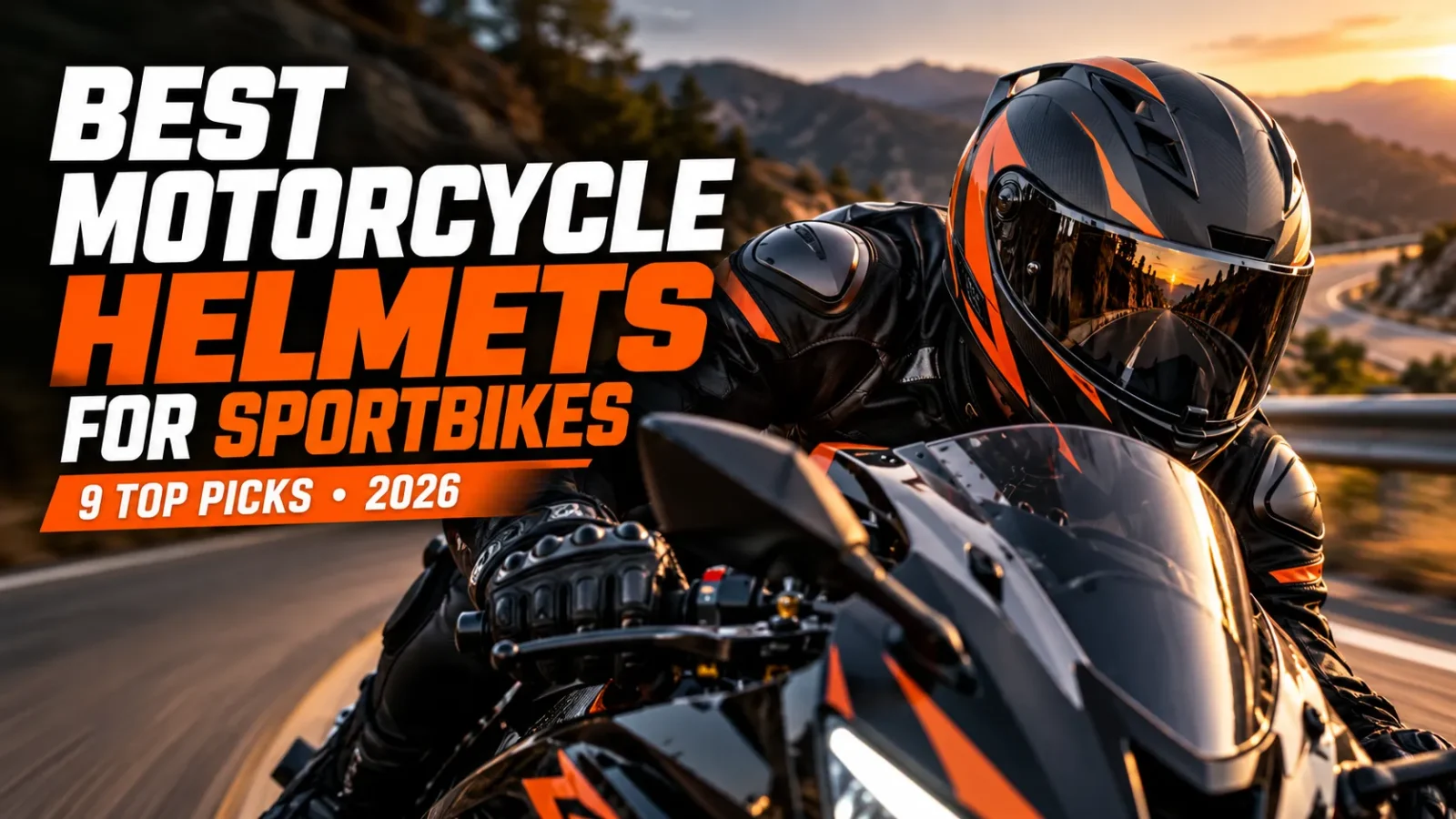
I’ve been riding sportbikes for over a decade, and if there’s one piece of gear I refuse to cheap out on, it’s my helmet. When you’re tucked behind a windscreen at triple-digit speeds, the lid strapped to your head is doing a lot of heavy lifting — aerodynamics, ventilation, noise control, and, most importantly, keeping your skull in one piece.
I’ve worn, tested, and crashed in more helmets than I care to admit over the years. Some were fantastic. Others left me with a sweaty, noisy, headache-inducing ride home. For this list, I dug through my own garage full of lids and cross-referenced them against what I know from the industry to bring you the helmets I’d actually recommend to a friend.
Before we dive in, if you want the full rundown on helmet tech, materials, and safety standards, my Ultimate Guide to Motorcycle Helmets is a great companion read to this list.
- My overall top pick is the Shoei RF-1400 — it balances aerodynamics, comfort, and quiet ride quality better than almost anything else I’ve tested.
- Riders chasing track-level performance should look at the Arai Corsair-X or AGV Pista GP RR, both of which are essentially race-homologated helmets you can wear on the street.
- If you’re on a budget, the HJC RPHA 11 Pro and Scorpion EXO-R1 Air deliver premium features without the premium price tag.
- Fit matters more than brand name — always check my Motorcycle Helmet Fitment Guide before buying any of these.
- Look for ECE 22.06 or Snell M2020 certification for the best real-world crash protection, as explained in my Helmet Safety Ratings Explained piece.
1. Shoei RF-1400 — Best Overall Sportbike Helmet
The Shoei RF-1400 is the helmet I recommend most often, and it’s also the one I currently keep on my own shelf for daily sportbike riding. Shoei nailed the aerodynamics on this shell, and I genuinely notice less buffeting at highway speeds compared to my older lids.
It uses Shoei’s AIM+ shell construction, which blends fiberglass with organic and high-performance fibers. That means it’s light on your neck but still incredibly rigid where it counts. Mine weighs in right around 3.5 pounds, which is noticeably lighter than a lot of competitors in this price bracket.
The ventilation system is where this helmet really shines for me. Three intake vents and two exhaust vents keep air moving even when I’m sitting in slow traffic on a hot day. I also love the Pinlock-ready shield that comes standard — no fogging, even on cold morning rides.
Expect to pay somewhere between $600 and $700, depending on graphics. It’s not cheap, but I think it’s worth every dollar for the noise reduction and fit alone. It’s ECE 22.06 and Snell M2020 rated, so the safety credentials back up the comfort.
2. Arai Corsair-X — Best for Track Days
If you spend serious time on a track, the Arai Corsair-X deserves a hard look. I borrowed one from a riding buddy for a track weekend and came away impressed by how stable it felt at speed, even with my head fully tucked behind the windscreen.
Arai’s PB-cLc2 shell is hand-laid and known for its “glancing off” shape philosophy, which is designed to deflect impact energy rather than absorb it head-on. It’s a different safety philosophy than most other brands, and honestly, once you understand the engineering behind it, it’s hard not to respect it.
The fit runs slightly oval, which worked great for my head shape but might not suit everyone — this is exactly why I always point people toward my Motorcycle Helmet Fitment Guide before dropping this kind of money.
Pricing sits around $800 to $900, making it one of the pricier options on this list. But for dedicated track riders, I think the stability and craftsmanship justify the cost.
3. AGV Pista GP RR — Best Race-Replica Helmet
The AGV Pista GP RR is the same helmet Valentino Rossi and other MotoGP riders have worn on the grid, and you can genuinely feel the racing DNA the moment you put it on. This is about as close as you’ll get to a factory race helmet without a contract with Aprilia or Ducati.
It features a full carbon fiber shell (specifically AGV’s 6-layer carbon construction), which drops the weight down to roughly 1350 grams for a size medium. That’s astonishingly light for a helmet with this level of protection.
AGV built in an integrated rear spoiler and forehead air extractor that were both developed in the wind tunnel with actual MotoGP feedback. I’ve had a chance to wear one at speed, and the aerodynamic stability is on another level compared to standard street helmets.
This is a serious investment, typically running $1,000 to $1,500+ depending on the paint scheme. If you’re curious about how carbon shells stack up against cheaper materials, my Carbon Fiber vs. Polycarbonate Helmets guide covers it in depth.
4. HJC RPHA 11 Pro — Best Value for Money
I always tell newer riders that the HJC RPHA 11 Pro is proof you don’t need to spend a thousand dollars to get a genuinely great sportbike helmet. HJC uses a Premium Integrated Matrix (PIM) shell here, blending carbon, fiberglass, and aramid for a shell that’s both light and strong.
At around 1,400 grams, it’s competitive with helmets twice its price. I’ve worn this one on long highway stints and found the ventilation — with its multiple adjustable intake and exhaust vents — kept things comfortable even in summer heat.
The RPHA 11 Pro also comes with a Pinlock-ready shield and a clever ratchet-style shield lock that I found easier to operate with gloves on than several pricier competitors. It’s ECE 22.06 certified, checking the important safety boxes.
Pricing typically lands between $400 and $500, which in my opinion is the sweet spot for riders who want race-inspired performance without a race-inspired price tag.
5. Bell Race Star Flex DLX — Best for Impact Absorption Tech
The Bell Race Star Flex DLX stands out because of its Flex Impact Liner, a segmented liner design that manages both direct and angled impacts differently than a traditional single-density EPS liner. I found this tech reassuring, especially given how often sportbike crashes involve oblique impact angles.
Bell built the shell from a tri-matrix composite of carbon, fiberglass, and aramid, keeping weight down while maintaining rigidity. It’s Snell M2020 rated, and Bell has always been transparent about their independent testing data, which I appreciate as someone who reads a lot of helmet spec sheets.
Ventilation is excellent too — I counted multiple forehead and chin vents that pull noticeably more air through than I expected on a helmet this aerodynamically slippery.
You’re looking at roughly $700 to $900 for this one. It’s a premium price, but the unique liner tech makes it a genuinely different option compared to the rest of this list.
6. Shark Race-R Pro GP — Best for Aggressive Riding Positions
I like recommending the Shark Race-R Pro GP to riders who spend most of their time fully tucked, because it’s literally designed around that riding posture. Shark developed this helmet with input from their MotoGP riders, and it shows in how the helmet sits when you’re leaned forward over the tank.
The shell is a lightweight carbon construction, and Shark added a magnetic pinlock system along with an emergency quick-release cheek pad system — something I think should honestly be standard on every sportbike helmet at this point, since it lets first responders remove the helmet safely after a crash.
It’s homologated to both ECE and FIM standards, meaning it’s legitimately race-legal for those who compete. For street riders, that just means you’re getting a serious level of built-in protection.
Prices generally range from $700 to $850. If your riding style is more sport-touring and upright, though, you might find the aggressive fit less comfortable off the track.
7. Scorpion EXO-R1 Air — Best Budget-Friendly Racing Helmet
The Scorpion EXO-R1 Air genuinely surprised me the first time I put it on. It’s priced well under $400, yet it has a lightweight, aerodynamic shell and ventilation that rivals helmets costing twice as much.
Scorpion uses a TCT (Tri-Composite Technology) shell blending fiberglass and other composites, which keeps the weight reasonable without ballooning the price. I found the fit true to size and the interior padding plush enough for multi-hour rides.
It comes with a KwikWick II moisture-wicking liner that’s fully removable and washable — a small detail, but one I genuinely appreciate after sweaty summer rides. The shield also has an anti-fog treatment baked in.
For riders just getting into sportbikes and not ready to drop $600+ on a helmet yet, the EXO-R1 Air is one I’d point to without hesitation.
8. Icon Airflite — Best Style-Forward Option
The Icon Airflite brings a bit more personality and graphic variety than most of the helmets on this list, without sacrificing real performance. I like it for riders who want their sportbike helmet to double as a style statement without looking like a stunt-show prop.
It’s built on a Fiberglass Composite Shell in three shell sizes, which I think is an underrated feature — matching shell size to head size keeps the fit more precise and the helmet lighter overall for smaller riders.
The Rapid-Fire face shield replacement system is genuinely one of the easiest I’ve used; I swapped shields in under a minute without tools. It’s also Pinlock-ready and DOT certified, with some graphic variants also carrying ECE certification.
Pricing sits in a very accessible $250 to $400 range depending on the graphic. It’s a great pick if you’re weighing style just as heavily as raw track performance.
9. AGV K6 S — Best All-Around Street/Sport Hybrid
I recommend the AGV K6 S constantly to riders who split their time between spirited canyon rides and daily commuting on a sportbike. It borrows a lot of aerodynamic learning from AGV’s Pista GP line but wraps it in a more street-friendly, comfort-focused package.
The shell combines carbon-aramid and fiberglass, keeping weight down around 1,350 grams, while the interior uses a moisture-wicking, removable liner treated with an antibacterial finish. After sweaty summer commutes, I’ve genuinely appreciated being able to wash the whole liner setup.
Ventilation is excellent thanks to four intake vents and two exhaust extractors, and the included Pinlock 120 lens has kept my visor fog-free even on chilly mornings. It’s ECE 22.06 rated, which puts it among the newer, more rigorously tested helmets on the market right now.
Pricing generally falls between $500 and $600. For riders who want AGV’s race pedigree without the race-replica price tag, the K6 S is one of my favorite all-rounders.
What I Look For When Choosing a Sportbike Helmet
After years of testing helmets in everything from summer heat to freezing morning commutes, I’ve developed a pretty consistent checklist. Here’s what actually matters to me when I’m evaluating a new lid.
Aerodynamics and Wind Stability
Sportbike riding positions put your head directly in the wind blast, so shape matters enormously. A poorly designed shell will buffet and pull at highway speeds, which gets tiring — and dangerous — fast.
I always test a helmet at speed before fully trusting it, paying attention to lift and buffeting around the chin bar and rear spoiler area.
Shell Material
Carbon fiber, fiberglass composite, and polycarbonate all behave differently under impact and heat. I’ve written a full comparison in my Carbon Fiber vs. Polycarbonate Helmets article if you want the nitty-gritty details.
Generally speaking, carbon fiber saves weight and dissipates heat better, but it comes at a real cost premium. Polycarbonate is heavier but far more affordable and still very protective when engineered well.
Ventilation
I ride in Texas heat and Colorado mountain cold, so ventilation is non-negotiable for me. Multiple adjustable vents with real airflow — not just decorative vent covers — make a massive difference on long rides.
Certification and Safety Ratings
This one should never be an afterthought. I only buy helmets rated DOT at minimum, and I strongly prefer ECE 22.06 or Snell M2020 certification for anything I wear at sportbike speeds.
My Helmet Safety Ratings Explained guide breaks down exactly what these certifications test for and why they matter more than marketing claims.
Fit Above All Else
Even the best helmet on this list will underperform if it doesn’t fit your head shape correctly. I’ve made the mistake of buying based on brand loyalty alone, and it cost me a helmet that gave me headaches after 30 minutes.
Take the time to go through my Motorcycle Helmet Fitment Guide before you buy — it’ll save you money and discomfort in the long run.
Full-Face vs. Other Styles for Sportbikes
I want to be direct about this: every helmet on this list is a full-face design, and that’s intentional. If you’re riding a sportbike, a full-face helmet is the only style I’d personally trust for the speeds and lean angles involved.
Modular and open-face helmets have their place for cruisers and casual commuting, but they compromise chin protection in ways that just don’t make sense on a sportbike. If you want the full breakdown of why, check out my Full Face vs. Modular vs. Open Face Helmets comparison.
My Final Take
If I had to pick just one helmet off this list for myself, I’d stick with the Shoei RF-1400 — it’s the best blend of comfort, quiet, and everyday livability I’ve found. But if budget is tight, the HJC RPHA 11 Pro or Scorpion EXO-R1 Air genuinely punch above their price point.
For dedicated trackday riders chasing that last bit of aerodynamic and safety performance, the Arai Corsair-X and AGV Pista GP RR are worth the splurge. Whatever you choose, make sure it fits properly and carries a certification you trust — that matters more than any single feature on this list.
Frequently Asked Questions
What is the safest type of helmet for sportbike riding?
A full-face helmet is the safest option for sportbike riding because it protects your chin and jaw during a crash, which open-face and modular lids can’t do as effectively. Check out my Full Face vs. Modular vs. Open Face Helmets breakdown for more detail.
Is carbon fiber worth the extra cost for a sportbike helmet?
In my experience, carbon fiber is worth it if you ride aggressively or track your bike often, since it’s lighter and dissipates heat better than polycarbonate. If you’re a casual rider, a polycarbonate shell like the AGV K6 S still offers excellent protection for less money. I go deeper on this in my Carbon Fiber vs. Polycarbonate Helmets comparison.
How do I know if a sportbike helmet fits correctly?
A properly fitted helmet should feel snug everywhere with no pressure points, and it shouldn’t shift when you shake your head. I always recommend running through my Motorcycle Helmet Fitment Guide before buying, especially online.
What safety certifications should I look for in a sportbike helmet?
Look for DOT as a minimum in the US, but ECE 22.06 and Snell M2020 are the gold standards I personally trust for high-speed impacts. My Helmet Safety Ratings Explained article breaks down what these ratings actually mean.

Related Articles

8 Best Motorcycle Headsets for Half Helmets (Tested & Reviewed)
I've tested the top Bluetooth headsets for half helmets so you don't have to. Here are my 8 favorites for…
 Jake Miller
10 min read
Jake Miller
10 min read
9 Best Motorcycle Goggles for Half Helmets I’ve Actually Ridden In
I tested the best motorcycle goggles for half helmets on real rides. Here are my honest picks for wind, bugs,…
Jake Miller
13 min read

8 Best Helmet Speakers for Motorcycle Riders in 2026
I tested and researched the best helmet speakers for motorcycle riders. See my top picks for sound quality, easy install,…
Jake Miller
11 min read