
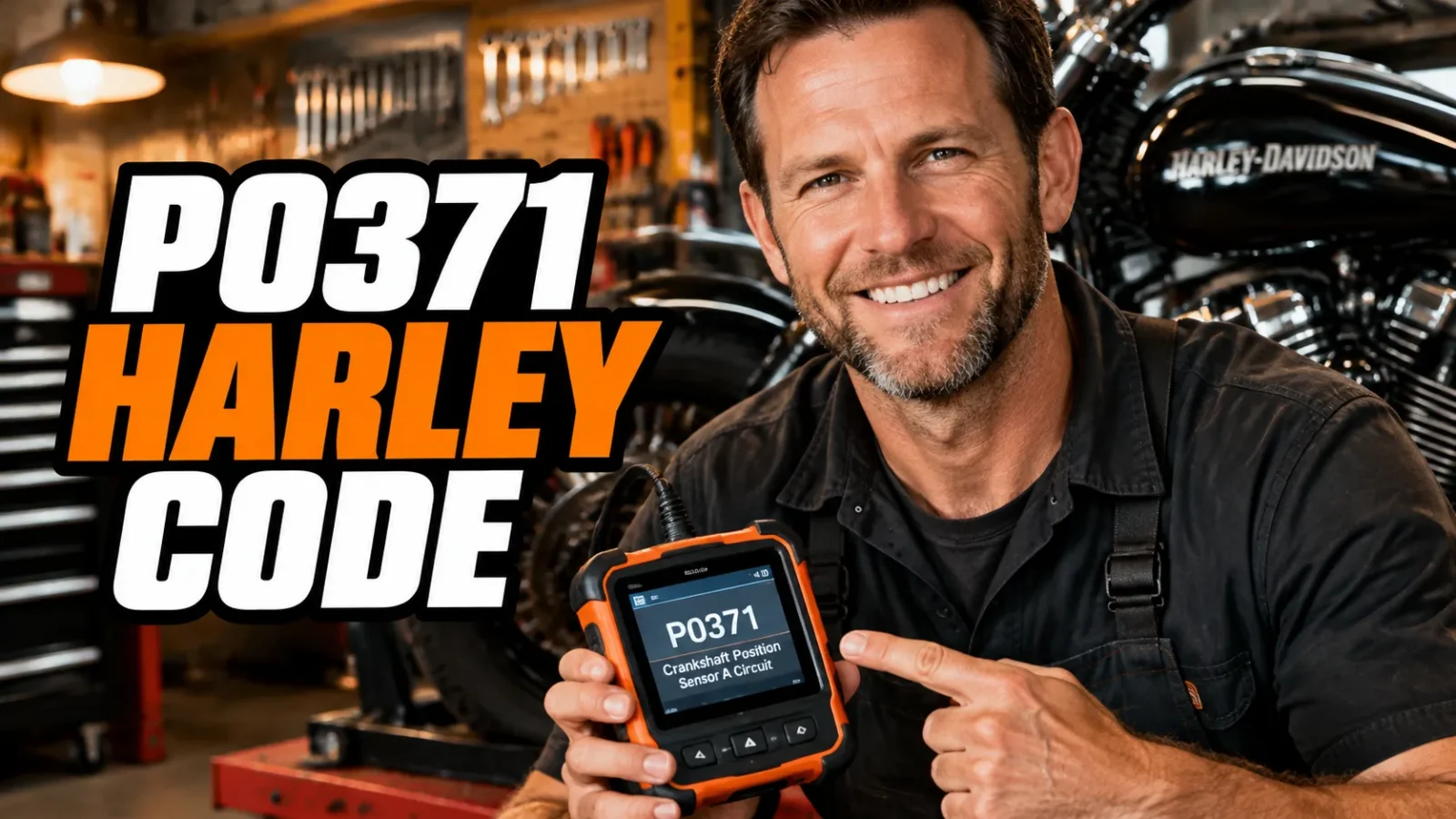
I’ll never forget the morning I turned the key on my Road King and saw that little orange engine light staring back at me. The bike still started fine, but I knew something was off. I pulled the diagnostic code from the speedometer and saw P0371. I had no idea what that meant, and honestly, the first thing I did was panic.
After a lot of reading, wrenching, and one very oily evening in my garage, I learned exactly what the p0371 Harley code tries to tell you. It’s a crankshaft position sensor issue, and it can be a real nuisance if you ignore it. In this article, I’ll walk you through what I found, how I fixed it, and what I wish I had known from the start.
- The P0371 Harley code points to a problem with the crankshaft position sensor (CKP) signal or circuit.
- Common symptoms include intermittent stalling, rough idle, hard starting, and the engine light staying on.
- The most frequent causes are a failing CKP sensor, damaged wiring, or debris on the trigger wheel.
- Do not ignore this code. A failing CKP signal can leave you stranded and cause a no-start condition.
What Does the P0371 Harley Code Actually Mean?
When your Harley’s ECM throws a P0371, it is telling you the crankshaft position signal has too many pulses for what the computer expects. In plain English, the sensor that tells your computer where the crank is in its rotation is sending a noisy or scrambled signal.
On most Harleys, that sensor is the crankshaft position sensor, often abbreviated CKP. It reads the trigger wheel teeth as the crank spins. If the ECM sees extra pulses or a signal that does not match the expected pattern, it sets this code.
I have seen riders confuse this with a cam position sensor code. Those are different. The P0371 is specifically about the high-resolution crank signal. Once you understand that, diagnosing it gets a lot less scary.
Why “Too Many Pulses” Matters
The ECM relies on the CKP signal to time fuel injection and ignition. If the signal is off, even for a split second, the bike can misfire or stall. It is not just an emissions code. It is a rideability issue waiting to happen.
In my case, the code came and went at first. That made me think it was a fluke. It was not. Intermittent codes are often the earliest warning sign of a sensor or wiring problem.
Symptoms I Noticed When My Harley Set the P0371 Code
Before I even pulled the code, I had already noticed a few things that felt wrong. At the time, I blamed bad gas or a loose battery cable. Looking back, the signs were all there.
- The engine light stayed on after startup.
- The bike stalled once at a stoplight after a long ride.
- Idle sometimes dropped low and recovered.
- One scary no-start after a hot soak in traffic.
- Throttle felt slightly sluggish under hard acceleration.
None of these symptoms happened every ride. That is what made the p0371 Harley code so frustrating. It was intermittent, so I kept second-guessing myself.
Common Causes of the P0371 Harley Code
After tearing into the bike, I learned there are only a handful of reasons a Harley will set this code. Most are easy to check at home if you have a service manual and some patience.
1. A Failing Crankshaft Position Sensor
The CKP sensor sits in a hot, oily area. Over time, the internal windings break down and the signal degrades. I have seen sensors test fine cold and then fail once the engine heats up.
This is the most common cause of the P0371 code. If your bike has higher mileage and the code is intermittent, the sensor should be your prime suspect.
2. Damaged or Chafed Wiring
The sensor wiring runs along the left side of the engine. It can rub against the crankcase or get pinched during oil filter changes. I found a small nick in the wire insulation on my bike that was not obvious until I moved the harness.
Even a tiny short or broken strand can create electrical noise. That noise gets interpreted by the ECM as extra pulses, which triggers the code.
3. Debris or Damage on the Trigger Wheel
The trigger wheel, or tone ring, is mounted on the crankshaft. If a piece of metal or clutch material gets stuck to it, the sensor will read extra teeth. I have also heard of cracked trigger wheels on high-mileage engines.
This is less common than a bad sensor, but it is worth checking before you throw parts at the bike.
4. ECM Harness or Ground Issues
A loose ground or corroded ECM connector can cause all sorts of false codes. Before I replaced anything, I cleaned every connector I could reach with contact cleaner. A little corrosion can cause a big headache.
How I Diagnosed the P0371 Code on My Harley
If you can change oil and use a multimeter, you can diagnose this code yourself. Here is the exact process I followed.
- Pull the code from the speedometer. Turn the ignition off, press and hold the trip reset button, then turn the ignition on until “diag” appears. Cycle through the codes and write down anything stored.
- Inspect the sensor connector and wiring. Look for green corrosion, melted insulation, or any place the wire rubs against metal.
- Test the sensor with a multimeter. Compare your reading against the service manual spec for your exact model. A sensor that reads open or way out of range is bad.
- Inspect the trigger wheel. Remove the CKP sensor and use a borescope or a bright light to look for cracked teeth or metal debris on the wheel.
- Clear the code and test ride. After you fix the issue, clear the code and ride the bike through a full heat cycle to see if it returns.
I also used a step-by-step guide on reading Harley trouble codes to make sure I was in the right diagnostic menu. It saved me from guessing.
The Fix: What Actually Worked for Me
On my bike, the problem turned out to be a combination of a slightly chafed wire and a CKP sensor that was on its way out. The sensor tested okay at rest, but after the bike warmed up, the signal would drop out intermittently.
I repaired the chafed section of wiring with heat-shrink tubing and replaced the sensor. The sensor itself was not terribly expensive, and the whole job took me about an hour.
After clearing the code, I took the bike on a long test ride. The engine light stayed off, the idle smoothed out, and the sluggish throttle response went away. I have put several thousand miles on it since, and the p0371 Harley code has not come back.
If you end up needing to replace your CKP sensor, I highly recommend following a good crankshaft position sensor replacement guide specific to your engine family. It will show you exact torque specs and wire routing.
Preventing the P0371 Code From Coming Back
After going through this, I made a few small changes to avoid a repeat. Most of them take less than ten minutes.
First, I started checking the sensor wiring every time I change the oil. The left side of the crankcase is a busy area, and it only takes a second to feel for chafing or exposed wire.
Second, I use dielectric grease on the sensor connector. It helps keep water and corrosion out of the pins. A little bit goes a long way.
Third, I do not ignore a check engine light anymore. Even if the bike runs fine, I pull the code as soon as I get home. Intermittent sensor problems are much cheaper to fix before they leave you stranded.
Final Thoughts on the P0371 Harley Code
If your Harley is showing a P0371, do not panic. It usually is not a catastrophic engine failure. It is a signal problem, and it can be fixed in your garage with basic tools.
Start with the simple stuff: wiring, connector, and sensor. In my experience, that solves the problem nine times out of ten. And if you are not comfortable doing the work yourself, bring these findings to a good independent Harley mechanic. It will save you time and money.
The key is not to ignore it. A failing CKP signal will eventually leave you on the side of the road. Fix it early, and your bike will thank you with years of reliable starts.
Frequently Asked Questions
What does the P0371 Harley code mean?
It indicates the ECM sees too many pulses from the crankshaft position sensor (CKP), usually due to a failing sensor, wiring damage, or a cracked trigger wheel.
Can I still ride my Harley with a P0371 code?
It is not recommended. The code can cause stalling, misfires, or a no-start condition, which could leave you stranded.
How do I fix a P0371 code on my Harley?
Start by inspecting the CKP sensor connector and wiring for damage. If those look good, test the sensor and inspect the tone ring for cracks or debris before replacing the sensor.
Where is the crankshaft position sensor located on a Twin Cam?
On most Twin Cam Harleys, the CKP sensor is on the left side of the crankcase, near the front of the engine, just above the oil filter area.

Related Articles

P0641 Harley Code: I Fixed My Bike’s Sensor Reference Voltage Fault – Here’s How
P0641 Harley code? I'll explain the 5V sensor reference circuit fault, common symptoms, and the step-by-step diagnosis and repair process…
 Jake Miller
12 min read
Jake Miller
12 min read
P1510 Harley Code: My Throttle-By-Wire Nightmare and the Fix That Worked
Struggling with the P1510 Harley code? I'll explain the throttle-by-wire fault, limp mode symptoms, common causes, and the exact fixes…
Jake Miller
10 min read
P0463 Harley Code: Why Your Fuel Gauge Is Lying (And How I Fixed It)
Struggling with the P0463 Harley code? I'll explain what it means, the symptoms, common causes, and the step-by-step diagnosis and…
Jake Miller
14 min read