
P0463 Harley Code: Why Your Fuel Gauge Is Lying (And How I Fixed It)
 Jake Miller
14 min read
Jake Miller
14 min read
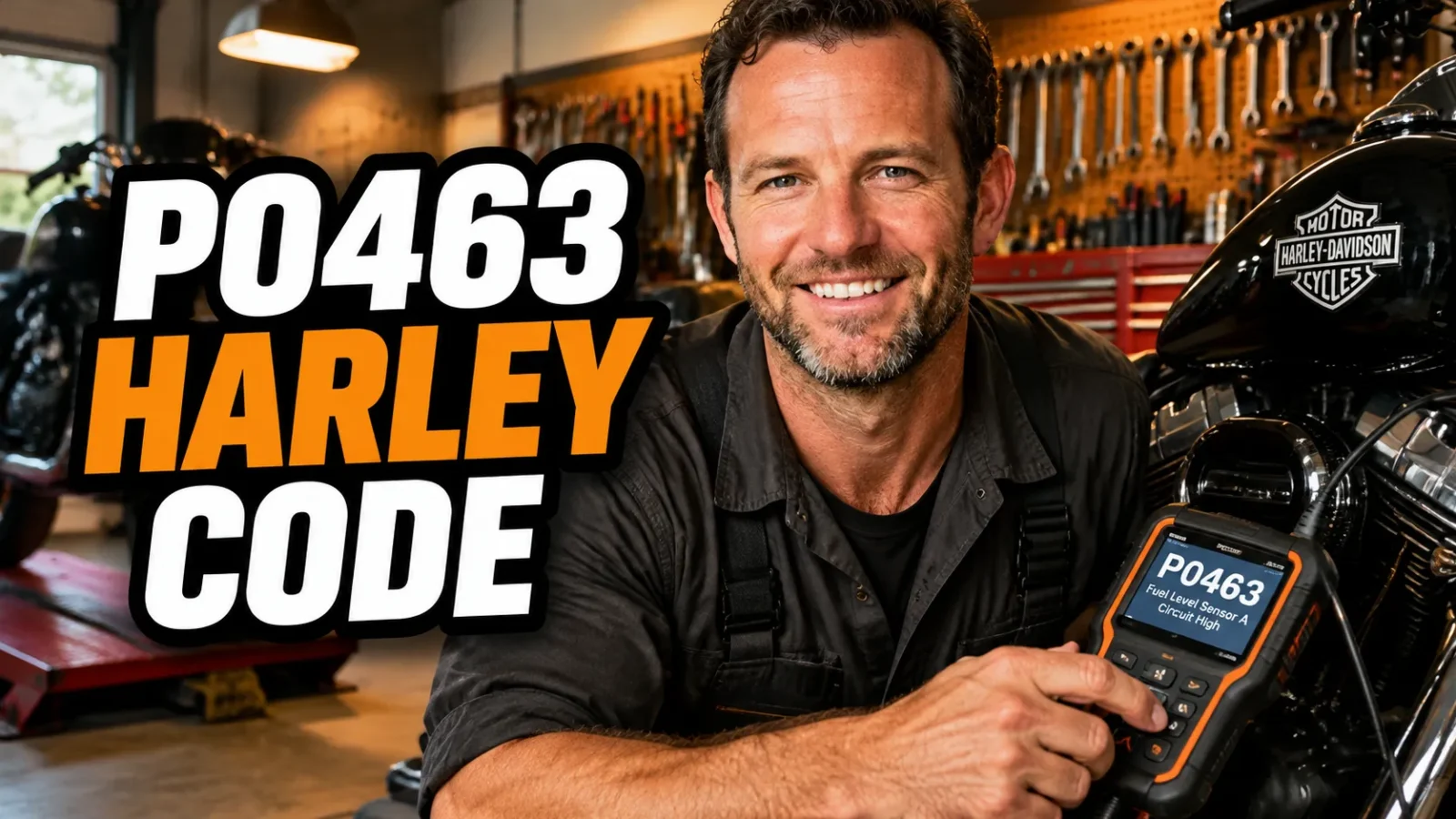
The first time my Harley threw the p0463 harley code, I glanced down at my fuel gauge and saw it pinned on empty. I knew I had half a tank. My gut told me it wasn’t a catastrophic engine problem, but I also knew I couldn’t just ignore it. After some late nights in the garage, I learned exactly what this code means and how to make it go away for good.
If you’ve ever had that sinking feeling when a check engine light comes on right before a ride, you’re not alone. The p0463 harley code is one of the more common electrical gremlins on Harley-Davidson touring and softail models. The good news is that it’s rarely something that will leave you stranded — if you deal with it the right way.
In this article, I’m sharing everything I’ve learned from my own bike and from helping other riders chase down the same issue. I’ll walk through the symptoms, the causes, and the exact tests I used to fix my fuel gauge. By the end, you’ll have a clear plan of attack.
- The p0463 harley code means the fuel level sensor circuit is reading high voltage or an open circuit.
- You’ll likely see a dead fuel gauge, a persistent check engine light, and possibly a low fuel warning even with a full tank.
- Most causes trace back to a disconnected connector, damaged wiring, or a failed fuel level sender inside the tank.
- Diagnosing it involves a visual inspection and a simple resistance test with a multimeter before you start throwing parts at it.
- In many cases, replacing the fuel level sender or the entire fuel pump assembly is the permanent fix I recommend.
What Does That Fuel Level Sensor Code Actually Mean?
When I first scanned my bike and saw the p0463 harley code, my immediate thought was, “Great, what’s a fuel level sensor circuit?” I’d never really thought about how the fuel gauge worked until it stopped working. Turns out, it’s pretty simple.
Your Harley’s fuel tank contains a float and sensor assembly. As the fuel level drops, the float moves and changes the electrical resistance through the sensor. Your bike’s ECU reads that resistance and converts it into the fuel level you see on the gauge.
P0463 specifically means the ECU is seeing a high voltage condition on that sensor circuit. In plain English, the circuit is open somewhere, so the ECU thinks the sensor is disconnected or broken. That’s why your gauge might read empty, full, or bounce around randomly.
What’s important to understand is that this code does not mean your engine is failing. It’s an electrical fault in a simple circuit. I’ve seen plenty of riders panic over this, but it’s usually a straightforward fix once you know where to look.
Symptoms I Noticed When My Harley Threw the Code
Every bike can behave a little differently, but on my Road King, the symptoms were pretty obvious. Here’s what I experienced and what I’ve seen on other Harleys with the same p0463 harley code.
Dead or Erratic Fuel Gauge
My fuel gauge would sometimes read completely empty even after I just filled up. Other times, it would swing from empty to half tank and back again while I was sitting at a red light. That kind of erratic reading is a huge red flag for a fuel level sensor issue.
On some bikes, the gauge might stay pegged at full. Either way, you can’t trust the gauge, and that’s a problem if you like to push the miles between fill-ups.
Persistent Check Engine Light
The check engine light came on and stayed on. It didn’t blink or flash — it just sat there glowing. That steady light usually indicates a non-critical fault, but it’s still annoying and can mask other problems if you ignore it.
I also had the low fuel warning light come on a few times even though I knew I had plenty of gas. That’s because the ECU uses the same sensor data for the warning light, so it gets confused too.
No Noticeable Performance Issues
Here’s the good part: my bike ran exactly the same as before the code appeared. No rough idle, no loss of power, no stalling. That’s a key clue that the problem is isolated to the fuel level sensing circuit, not the fuel delivery system itself.
If you’re feeling any engine performance issues along with a p0463 code, you might be dealing with a secondary problem. In my experience, this code by itself doesn’t affect how the bike runs, only how it reports fuel level.
Common Causes of P0463 on a Harley-Davidson
Understanding what causes the p0463 harley code can save you a lot of time and money. I tore into my fuel tank convinced I needed a new fuel pump. It turned out to be something much simpler, but I learned all the possible culprits along the way.
Disconnected or Loose Connector
The most common cause I’ve seen is a fuel level sensor connector that has worked itself loose. The connector sits on the bottom or side of the fuel tank, and vibration can slowly separate it over time. A quick visual check here is always step one.
On some touring models, the connector is accessible under the seat without pulling the tank. I’ve also seen pins that corrode or bend, preventing a solid connection even when the plug looks seated.
Damaged or Chafed Wiring
Harleys vibrate. A lot. Wiring harnesses that rub against the frame or the tank can wear through the insulation and create an open circuit. The fuel level sensor wires are thin and often run close to sharp edges.
I once found a wire that had been pinched between the tank and the frame rail. The insulation was cracked, and the wire inside was frayed. A quick soldering job and some heat shrink fixed it permanently.
Failed Fuel Level Sender
The fuel level sender is the part inside the tank that contains the float and resistor. Over time, the contacts can wear out, the float can stick, or the resistor can fail. When that happens, the circuit opens and you get the p0463 harley code.
On many Harley models, the sender is integrated with the fuel pump assembly. That means you can’t always replace just the sender — you might have to replace the whole fuel pump module. I’ll get into that in a minute.
Faulty Fuel Pump Assembly
Because the fuel level sensor is often part of the fuel pump assembly, a larger failure in that module can trigger the code. If the internal wiring inside the assembly breaks, you’ll see the same high voltage condition.
I’ve replaced an entire fuel pump assembly on a friend’s Ultra Classic for this exact reason. It’s more expensive, but it solved the problem when the sender alone wasn’t available separately.
How I Diagnosed the P0463 Harley Code Step by Step
Before you order any parts, you need to confirm exactly where the circuit is failing. I made the mistake of assuming it was the sensor, and I nearly bought a fuel pump I didn’t need. Here’s the diagnosis process I now follow every time.
Step 1: Read and Clear the Code
Use a quality OBD-II scanner or a Harley-specific diagnostic tool to confirm the p0463 harley code. Write down any other codes that appear. Clear the code, go for a short ride, and see if it comes back.
If the code returns immediately, you have an active fault. If it stays away for a while, it might be an intermittent connection issue. Intermittent faults can be trickier, but the same tests apply.
Step 2: Visual Inspection of the Connector and Wiring
Lift the seat and inspect the fuel pump connector. Look for loose pins, corrosion, or any signs of melting. Follow the wiring harness as far as you can without removing the tank. I use a bright flashlight and a small mirror to see the underside of the tank.
Pay special attention to areas where the harness touches the frame or engine. Any chafing or exposed wire is a likely culprit. If everything looks clean, move on to the resistance test.
Step 3: Test the Fuel Level Sender with a Multimeter
Disconnect the fuel pump connector. Set your multimeter to ohms. On most Harley models, the fuel level sender wires are the smaller pair in the connector. You’ll need a wiring diagram for your exact model to identify the right pins.
With the tank at a known fuel level, measure the resistance across the sender terminals. A typical reading might be around 90 ohms full and 0 ohms empty, but this varies by model. If you see “OL” or infinite resistance, the sender is likely failed or the circuit is open.
If the resistance reading is way out of spec but not infinite, the sender is probably worn and should be replaced. I always compare my readings to the factory service manual for my bike. It’s worth the small cost to have the right specs.
Step 4: Test the Wiring Harness Side
With the connector still unplugged, check for voltage on the signal wire with the key on. You should see a reference voltage, usually around 5 volts on the signal line. If there’s no voltage, the problem is on the ECU side or in the harness.
I also check continuity from the connector back to the ECU pin. A broken wire inside the harness can be hidden and frustrating. If the harness checks out, the issue is inside the tank.
The Fix: How I Got My Fuel Gauge Working Again
Once I confirmed my fuel level sender was dead, I had to decide between replacing just the sender or the whole fuel pump assembly. On my Road King, the sender was available separately, so I went that route. Here’s what I did.
Replacing the Fuel Level Sender
First, I drained the fuel tank and removed it from the bike. Then I pulled the fuel pump assembly out of the tank. Be careful with the O-ring — I reuse mine if it’s not cracked, but a new one is cheap insurance against leaks.
The sender is usually held on with small screws or clips. Disconnect the internal wiring, swap in the new sender, and reassemble everything. Make sure the float moves freely before you put the assembly back in the tank.
When to Replace the Whole Fuel Pump Assembly
If your bike’s sender isn’t available separately, or if the fuel pump itself is old and tired, replacing the entire assembly might make more sense. This is especially true if you’ve been chasing fuel delivery issues or your bike has high mileage.
I found an aftermarket assembly for a friend’s Street Glide that cost less than a dealer part and included a new sender. It’s a more involved job, but it solved his p0463 harley code and gave him a fresh fuel pump at the same time.
Repairing Wiring and Connectors
If your diagnosis pointed to a broken wire or a bad connector, fix that first. I’ve repaired several chafed wires with solder and marine-grade heat shrink. For a corroded connector, I clean the pins with electrical contact cleaner and a small brush.
Sometimes the connector itself is too far gone. In that case, I’ll replace the plug with a weatherproof connector. It takes a little time, but it prevents the same failure from happening again.
Clearing the Code and Test Riding
After any repair, clear the p0463 harley code with your scanner. Start the bike and let it idle for a few minutes. Check for leaks around the fuel tank and the connector. Then go for a short ride around town.
Watch the fuel gauge. It should now read accurately and stay steady. If the code comes back, you still have an issue somewhere in the circuit. Don’t ignore it — go back through the diagnosis steps.
Preventing the P0463 Code from Coming Back
I’m a big believer in preventive maintenance. After dealing with this code once, I made a few changes to keep it from happening again. None of these are hard, but they’ve saved me a lot of headaches.
Inspect the Connector Every Season
Every spring, I pull the seat and check the fuel pump connector. I look for corrosion, loose pins, and any signs of water intrusion. A little dielectric grease on the pins goes a long way toward preventing future problems.
This is a five-minute job that can stop the p0463 harley code before it ever appears. I do it as part of my routine spring inspection along with battery and tires.
Keep Wiring Harnesses Secure
After my chafed wire incident, I started checking all wiring harnesses for rub points. I use extra zip ties and split loom to keep wires away from sharp edges. Where the harness passes near the frame, I add a little rubber padding.
Harley-Davidson bikes vibrate more than most people realize. Anything that can rub will eventually wear through. A few minutes of securing wires now can save you hours of diagnosis later.
Use Quality Parts
If you do have to replace the fuel level sender or wiring components, don’t cheap out. I’ve seen too many aftermarket sensors fail within a year. Stick with OEM or a reputable aftermarket brand that other riders trust.
Same goes for electrical connectors. Weatherproof connectors cost a little more, but they hold up better against moisture and vibration. I’ve never regretted spending a few extra dollars on solid electrical parts.
When to Call a Mechanic Instead
I enjoy wrenching on my own bike, but I also know my limits. The p0463 harley code is usually a DIY-friendly fix, but there are times when a professional is the better call.
If you’re not comfortable draining the fuel tank or testing electrical circuits, don’t force it. Fuel is flammable, and a mistake can be dangerous. A good independent Harley mechanic can diagnose and fix this issue quickly.
Also, if you’ve gone through the tests and still can’t find the problem, it might be time to get a second set of eyes. Some electrical gremlins hide in places that require advanced tools like an oscilloscope to find. There’s no shame in getting help.
I’ve also recommended a mechanic to riders who have multiple codes or other engine symptoms along with the fuel level code. Sometimes what looks like a simple sensor issue is actually part of a larger electrical or ECU problem.
Final Thoughts: Don’t Let That Code Ruin Your Ride
The p0463 harley code isn’t the end of the world, and it certainly doesn’t mean your bike is junk. In my experience, it’s almost always a straightforward electrical issue with a clear path to repair. The key is to diagnose before you replace parts.
Start with the easy stuff: check the connector and wiring. Then test the sender with a multimeter. If you get an infinite resistance reading, you’ve found your problem. Replace the sensor or the fuel pump assembly, clear the code, and get back on the road.
I’ve now helped several riders fix this exact code on their own bikes. Every single time, it came down to either a loose connection, a chafed wire, or a dead fuel level sender. None of them needed a new ECU or a major engine repair.
So if you’re sitting in your garage staring at that check engine light, take a breath. Pull out your scanner, do the tests, and trust the process. Your Harley will be back to reporting fuel correctly in no time, and you’ll have the satisfaction of fixing it yourself.
Frequently Asked Questions
What does the P0463 code mean on a Harley Davidson?
P0463 indicates the fuel level sensor circuit is reporting high voltage, which usually points to an open circuit or a failed sensor inside the fuel tank.
Can I ride my Harley with a P0463 code?
Yes, in most cases, but you won’t have an accurate fuel gauge and you could run out of fuel unexpectedly. It’s best to diagnose and fix it soon.
What are the most common causes of P0463 on a Harley?
Common causes include a disconnected or corroded fuel level sensor connector, damaged wiring, a faulty fuel pump assembly, or a failed fuel level sender.
How do I fix a P0463 Harley code?
Inspect the fuel level sensor connector and wiring first, then test the sensor with a multimeter. Replace the fuel level sender or complete fuel pump assembly if the sensor is out of spec.

Related Articles

P0641 Harley Code: I Fixed My Bike’s Sensor Reference Voltage Fault – Here’s How
P0641 Harley code? I'll explain the 5V sensor reference circuit fault, common symptoms, and the step-by-step diagnosis and repair process…
Jake Miller
12 min read

P1510 Harley Code: My Throttle-By-Wire Nightmare and the Fix That Worked
Struggling with the P1510 Harley code? I'll explain the throttle-by-wire fault, limp mode symptoms, common causes, and the exact fixes…
Jake Miller
10 min read

P0371 Harley Code: What It Means and How I Fixed It for Good
Learn what the P0371 Harley code means, the symptoms to watch for, and how to diagnose and fix the crankshaft…
Jake Miller
8 min read