
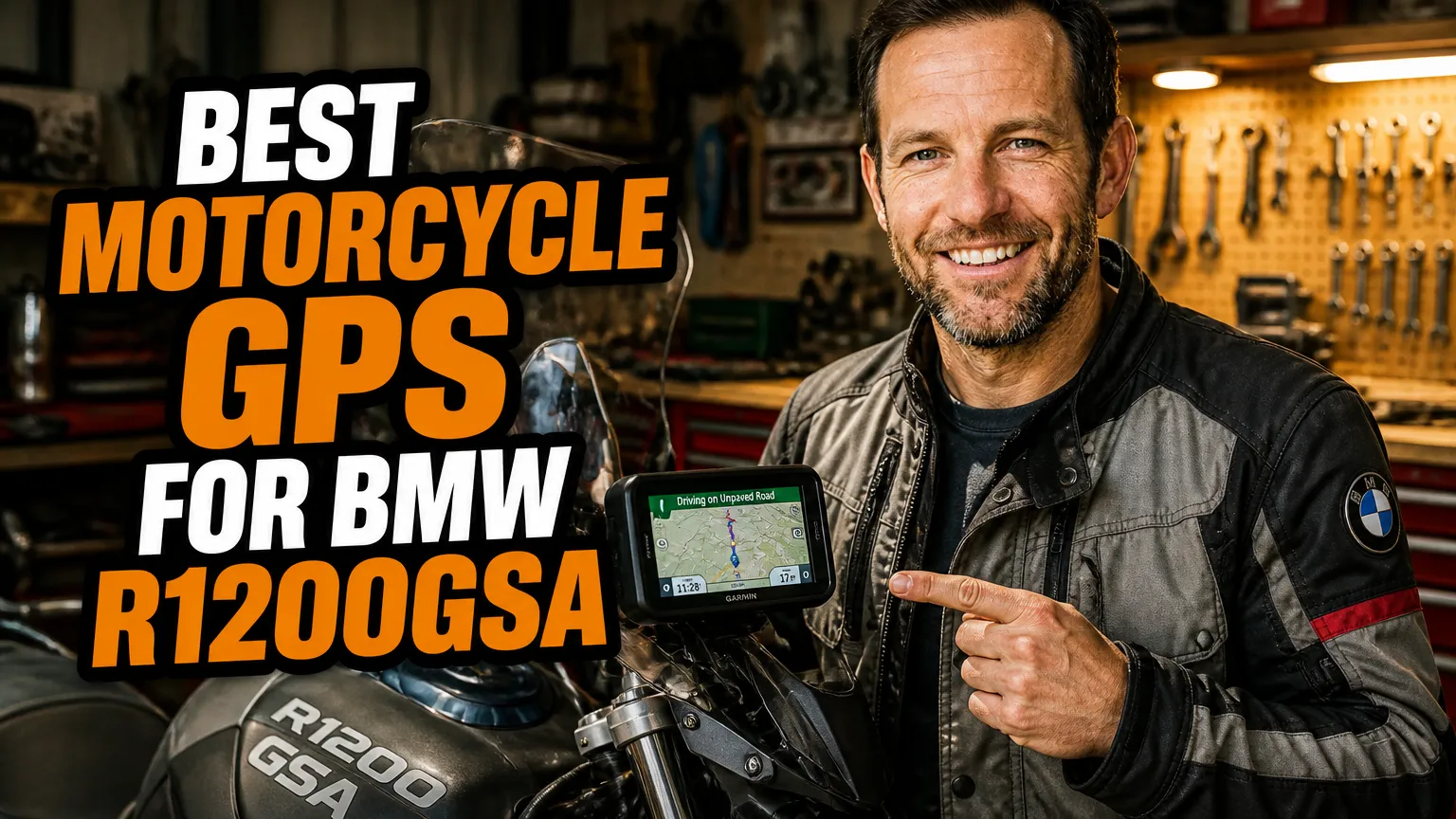
I have owned my BMW R1200GSA for six seasons now, and I have burned through more navigation setups than I care to admit. The big GS is a brilliant touring platform, but its factory nav cradle is a very specific piece of real estate, and not every unit plays nicely with it.
Over the last three years I have mounted, wired, cursed at, and eventually judged ten different navigation devices on that same bike. Some stayed for a single trip. A couple have never come off.
This is the honest list, sorted by what I actually think works on the GSA, not by what looks good in a press release.
- The BMW Motorrad Navigator VI is still the only unit that fully integrates with the GSA’s Multi-Controller wheel.
- The Garmin Zumo XT2 is my overall pick if you want the best screen, speed, and features without BMW pricing.
- CarPlay units like the Chigee AIO-5 Play and Carpuride W702 are the fastest-growing choice for GS riders, and the Chigee talks to the wonder wheel.
- Budget riders should look at the Garmin Zumo 396 LMT-S or the TomTom Rider 550.
- Whatever you buy, budget for a mounting adapter. The stock BMW cradle does not fit third-party units.
How I Judge a GPS on the R1200GSA
The GSA is a tall, vibey, weather-exposed bike, and it punishes weak hardware. Before I even look at features, I check four things.
Screen brightness and glare
The GSA’s nav position sits behind the tall Adventure windscreen, which is great for wind protection and terrible for glare. A 400-nit screen is useless at noon in Spain. I want 1,000 nits minimum, and I want matte, not glossy.
Glove-friendly input
I ride with Held Sambia gloves most of the year. If a touchscreen cannot register a gloved tap in the rain, it is a paperweight. Physical buttons still win here, and so does the wonder wheel.
Mounting and power on the GSA
The 2013 to 2019 GS Adventure has a powered navigation cradle above the dash, wired into the bike’s harness. BMW’s own units drop straight in. Everything else needs an adapter plate or a separate RAM mount on the bar clamp.
Real waterproofing
IPX7 is the baseline. I have drowned cheap units in a single Scottish afternoon and watched water pool behind the screen. If it is not IPX7 or IP67, I do not take it on tour.
1. BMW Motorrad Navigator VI: Best Factory Integration
The Navigator VI is the obvious answer, and for once the obvious answer is also a good one. It is built by Garmin for BMW, and it slots into the GSA’s powered cradle like it was born there, because it was.
The killer feature is the Multi-Controller wheel. I can zoom, scroll, and pan the map with my left thumb without ever lifting a hand off the bar. On a long day in the Alps, that alone is worth the price of entry.
Specs are solid rather than spectacular. You get a 5-inch WVGA touchscreen, IPX7 sealing, lifetime maps, Bluetooth for headset and phone, curvy-road routing, and full bike data on the screen when it is docked.
The downsides are real, though. It costs around $800 new, it is slower than a modern Zumo, and the touchscreen on early units had a well-documented delamination and ghosting problem. Mine developed a ghost touch at year four.
If you want seamless integration and you use the wonder wheel constantly, buy the BMW Motorrad Navigator VI. If you do not care about the wheel, keep reading.
2. Garmin Zumo XT2: Best Overall for Most Riders
The Zumo XT2 is what I recommend to nine out of ten GS owners, and it is the unit that lives on my bike today. It is simply the best all-round adventure GPS on the market.
The 6-inch display is genuinely bright and readable in direct sun, the touchscreen works with heavy gloves, and the whole thing is IPX7 and MIL-STD-810 rated. It has survived two off-road drops and a full day of torrential rain on my watch.
Battery life is around six hours of active navigation, which means I can plan routes at the camp table without draining the bike. USB-C charging is a welcome upgrade over the old micro-USB.
The standout feature is the built-in Group Ride Radio, which lets me track up to 20 other riders without buying an accessory. For GS club rides, that is enormous.
It costs around $600, and it does not talk to the wonder wheel. That is the trade. I have written more about the Garmin Zumo XT2 if you want the deep dive.
3. Garmin Zumo XT: Best Value Adventure Unit
The original Zumo XT is still on sale, and it is the smart buy if you want 90 percent of the XT2 experience for about $450, often less on sale.
You get a 5.5-inch display that is still brighter than most rivals, full IPX7 waterproofing, glove-friendly touch, and BirdsEye Satellite Imagery for planning off-piste sections in the Pyrenees.
It pairs with Garmin’s inReach satellite communicators, so you can send an SOS from a dead-end trail in Morocco. That matters on a GSA, because the bike takes you places where phone signal does not exist.
The main compromises are the older processor, the lack of built-in group radio, and the micro-USB port. None of them bothered me on a 4,000-mile trip.
If the XT2 is out of budget, this is the one I would buy without hesitation.
4. TomTom Rider 550: Best Route Planning
TomTom’s route planning is still, in my opinion, the most fun of any brand. The Rider 550 generates winding routes that genuinely find the good roads rather than the fastest ones.
The 4.3-inch screen is smaller than I would like, and it is not as bright as the Garmin XT2, but the mapping interface is cleaner and faster to use with gloves on.
You get IPX7 waterproofing, lifetime world maps, GPX import, Bluetooth headset support, and the MyDrive app for planning on your phone and pushing routes to the unit.
The 550 also supports tyre pressure monitoring with TomTom’s own sensors, which I found accurate and genuinely useful on a heavy GS.
At around $400 it is a fair deal, but the small screen is the reason it is not my number one. Full details live at TomTom’s Rider page.
5. Garmin Zumo 396 LMT-S: Best Budget Pick
The Zumo 396 LMT-S is the unit I hand to friends who are new to touring and do not want to spend $600 on navigation.
At roughly $250, you get a 4.3-inch glove-friendly touchscreen, IPX7 sealing, Bluetooth hands-free calling, rider alerts for sharp curves and speed cameras, and full GPX route import.
It is slower to calculate routes than the XT or XT2, and the screen is smaller than I would want on a big GSA dash. But it has never once failed me on a wet commute or a weekend run.
There is no BirdsEye imagery and no inReach pairing, so it is a road unit rather than an expedition one.
For 90 percent of GS riding, which is tarmac with the occasional gravel road, that is completely fine.
6. Garmin Montana 700i: Best for Off-Grid Touring
If your GSA actually goes where the GSA ads promise, the Montana 700i is the tool. It is a rugged handheld that happens to work beautifully on a motorcycle.
The 5-inch glove-friendly display is IPX7 and MIL-STD-810 rated, and the unit runs on a rechargeable pack with around 18 hours of battery life. I have run it for three days between charges on low-power settings.
The headline feature is built-in inReach satellite technology, so you can send messages and trigger an SOS with no phone signal at all. For solo riding in Iceland or the Moroccan Atlas, that is not a luxury.
It runs full topographic maps offline and handles track logs like a proper handheld.
You need a separate rugged mount and a power cable for the bike, and at around $700 it is not cheap. But it replaces two devices, so I count it as good value.
7. Chigee AIO-5 Play for BMW: Best CarPlay with Wonder Wheel Support
This is the unit that surprised me most. The Chigee AIO-5 Play for BMW is a CarPlay and Android Auto screen built specifically for BMW’s navigation cradle.
That means it plugs into the factory wiring and, crucially, it reads the Multi-Controller wheel. I can flick through CarPlay menus with my left thumb, which no Garmin can do.
The screen is bright, responsive, and IP67 rated. I rode through a two-hour downpour in the Picos de Europa and it never fogged or flickered.
It runs Google Maps, Waze, Calimoto, Scenic, or whatever app you prefer, so the mapping is as good as your phone. You also get front and rear camera options on the Lite version.
At roughly $350 to $450, it is cheaper than a Navigator VI and far more modern. The catch is that it depends on your phone, so a dead battery means no navigation.
8. Carpuride W702: Best Big Screen for the Money
The Carpuride W702 is the value alternative to the Chigee, and it is what I recommend to riders who want a huge screen without the BMW tax.
It gives you a 7-inch IPS touchscreen with wireless CarPlay and Android Auto, IP67 waterproofing, and a glove-friendly panel. That screen is enormous on a GSA dash, and I love it for glancing at maps at speed.
It does not read the wonder wheel, so you are tapping the screen or using voice control. That is the main compromise, and for some riders it is a dealbreaker.
Mounting requires an adapter to the BMW nav bracket or a RAM ball on the bar clamp. I used a CNC adapter and it was rock solid for 6,000 miles.
At around $250, it is the cheapest way to get a modern, phone-powered navigation screen on a GS. More at Carpuride.
9. Beeline Moto II: Best Minimalist Option
Not everyone wants a giant screen on their bars. The Beeline Moto II is a small circular unit that gives you a single arrow and a distance countdown, and nothing else.
I used one for a month and found it strangely liberating. You stop staring at a map and start reading the road, which is the whole point of riding a GSA through the Alps.
It is IP67 rated, the battery lasts around 30 hours, and it pairs with a genuinely good route-planning app. It costs around $250 at Beeline.
The limitation is obvious: no map, no speed camera alerts, no bike data, no satellite messaging. It is a navigation aid, not a navigation system.
For short blasts and riders who know where they are going, it is brilliant. For a two-week tour, I would want more.
10. Quad Lock Motorcycle Mount with Vibration Dampener: Best Phone Setup
I resisted this for years, and I was wrong. A properly mounted phone with the right apps is a legitimate navigation solution on a GSA.
The Quad Lock Motorcycle Mount with the Vibration Dampener is the setup I trust. The dampener protects your phone’s optical image stabilisation from the boxer’s vibes, which is the thing that kills phone cameras on bikes.
Add the Weatherproof Wireless Charging Head and you have charging, protection, and mounting in one unit. The whole setup runs about $200 if you already own the case.
Pair it with Calimoto, Scenic, or Rever and you get better routing than most dedicated units offer, for a fraction of the price.
The catch is heat and vibration. On a 38-degree day in Andalusia, my phone has overheated and shut down mid-route. A dedicated GPS has never done that to me.
What I Would Actually Buy
If I could only keep one unit on my R1200GSA, it would be the Garmin Zumo XT2. It is fast, bright, tough, and independent of my phone, and the Group Ride Radio is genuinely useful on club runs.
If I used the Multi-Controller wheel every single day, I would swallow the price and stay with the BMW Navigator VI, because nothing else integrates that cleanly.
And if I wanted the best value per dollar on a GS, I would buy the Chigee AIO-5 Play for BMW. It gives me CarPlay, wonder wheel control, and a modern screen for less than half the price of the BMW unit.
Whatever you choose, plan the mount before you buy the device. On the GSA, the bracket is half the battle.
Frequently Asked Questions
Does the BMW Navigator VI work with the R1200GSA Multi-Controller wheel?
Yes. The Navigator VI is the only unit that talks natively to BMW’s Multi-Controller wheel through the stock powered cradle, so you can zoom and scroll maps with your left thumb without lifting a hand off the bar.
Can I fit a Garmin Zumo XT2 on the BMW nav bracket?
Yes, but you need an adapter plate. The GSA’s factory cradle is BMW/Garmin Navigator specific, so I used a CNC adapter from a third party to bolt the Zumo’s powered mount to the same spot.
Is a CarPlay screen like the Chigee AIO-5 Play waterproof?
The Chigee AIO-5 Play is rated IP67, which survived everything I threw at it, from Scottish drizzle to a full day of Spanish downpour. It is built for motorcycle use, not car use.
What is the cheapest reliable option for the R1200GSA?
The Garmin Zumo 396 LMT-S at around $250 is the cheapest unit I would actually trust on a long tour, though it lacks the satellite messaging and huge screen of the premium models.

Related Articles

6 Best Motorcycle Phone Mounts That Keep Your Phone Charged on the Road
Compare six dependable motorcycle phone mounts with wireless or USB charging, including fit, power wiring, vibration protection, weather resistance, and…
 Jake Miller
10 min read
Jake Miller
10 min read

5 Best Motorcycle Phone Mounts for Naked Bikes and Open-Cockpit Riding
I compare secure, vibration-conscious phone mounts for naked and touring bikes, with fit notes, real trade-offs, and setup tips for…
Jake Miller
11 min read

7 Best Phone Mounts for Sport Bikes: Secure, Vibration-Smart Picks
Compare secure phone mounts for sport bikes, including clip-on fit, vibration control, case systems, prices, and my practical picks for…
Jake Miller
12 min read