
9 Best GPS Units for Adventure Motorcycle Riding: TomTom Rider 550 and Rivals Ranked
 Jake Miller
11 min read
Jake Miller
11 min read
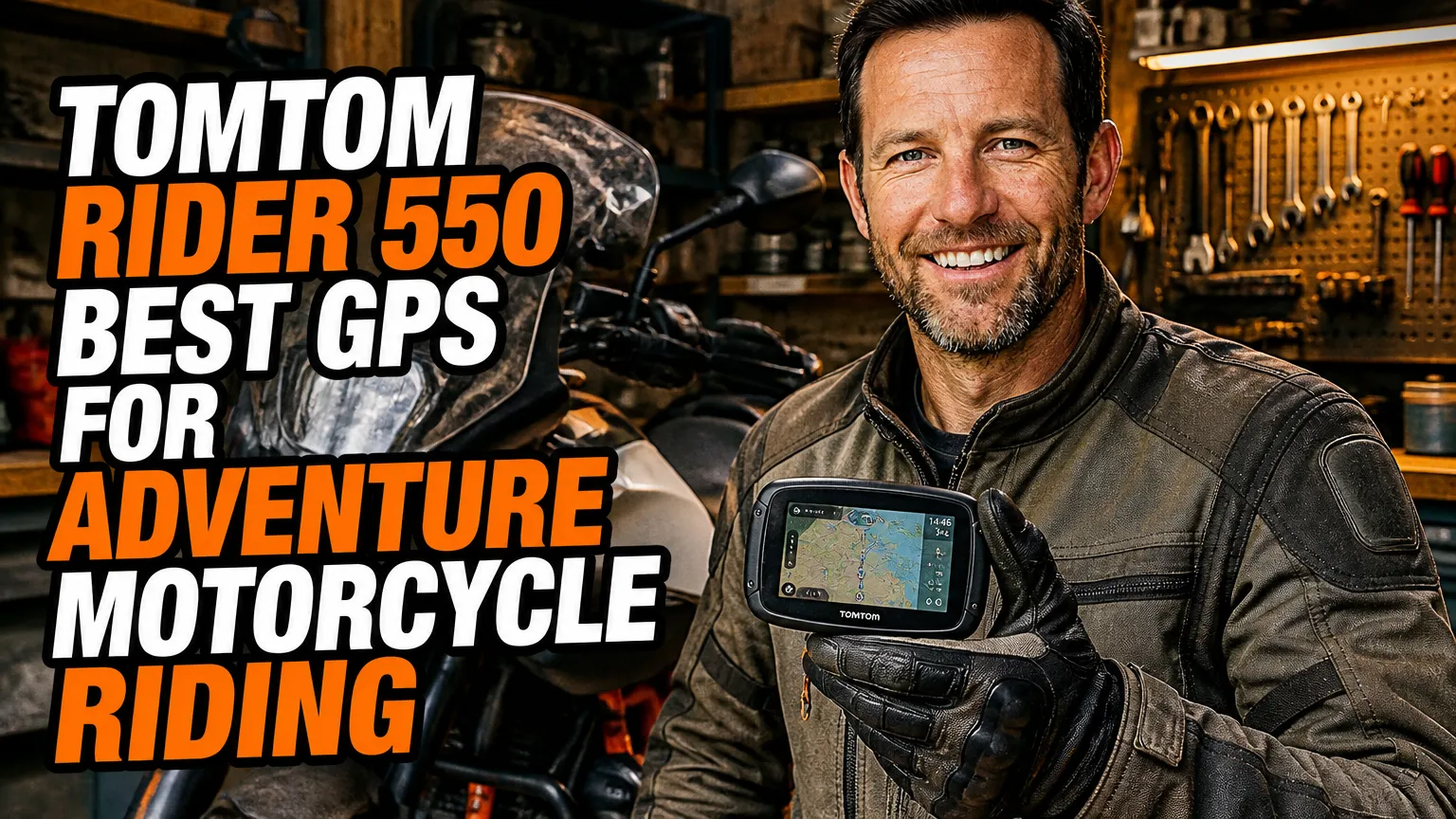
I have bolted more navigation units to more handlebars than is strictly reasonable, and I have the cracked RAM arms to prove it. Adventure riding punishes electronics in a way that road touring never does: washboard gravel, 40°C heat, sudden hail, and long days where the screen is the only thing telling me whether the next fuel is 40 km or 140 km away.
Over the past few seasons I have run the TomTom Rider 550 as my primary unit, and I have swapped in Garmin zumo, Montana, Tread and a couple of phone-based setups to see how they actually compare once the tarmac runs out. This list is what I would genuinely spend my own money on.
- The TomTom Rider 550 is my top pick for most adventure riders: IPX7, glove-friendly, brilliant Winding Roads routing and easy GPX import.
- If you want the biggest, brightest screen and group tracking, the Garmin zumo XT2 is worth the extra money.
- For truly remote solo trips, nothing beats a unit with built-in satellite messaging like the Garmin Montana 700i.
- Budget riders can still get a proper waterproof dedicated unit in the Garmin zumo 396 LMT-S.
- Whatever you buy, hardwire it. Vibration and cold kills battery-only setups.
1. TomTom Rider 550 — The GPS I Keep Coming Back To
The TomTom Rider 550 is the unit that lives on my bars for most of the year, and if someone asked me for the best GPS for adventure motorcycle riding without any further context, this is what I would hand them. It has a 4.3-inch capacitive touchscreen that responds through winter gloves, and it is IPX7-rated, which I have tested properly in a Scottish downpour.
What sold me was the routing brain. Winding Roads and Round Trip planning build loops I would never have found on my own, and Thrilling Rides comes with pre-loaded scenic routes in a lot of regions. I plan on the MyDrive web app at home, sync over Wi-Fi, and the route is on the device before I have pulled my boots on.
GPX import matters more to adventure riders than anything else, and the Rider 550 handles it without drama. I load tracks from route-planning sites and from rally organisers, and it follows them well enough for fire roads and gravel passes. Battery life is roughly six hours, which is fine because I hardwire mine.
Where the Rider 550 falls short
There is no satellite messaging, so if I am riding solo deep in the backcountry I still carry a separate communicator. Track following is also less precise than Garmin’s on tight, twisty off-road routes, and the 4.3-inch screen looks small next to a 6-inch zumo XT2.
Price sits around $399 to $449 with lifetime world maps, and the powered RAM mount is in the box. For the money, nothing else I have used balances simplicity and capability this well.
2. Garmin zumo XT2 — The Premium Big-Screen Choice
If screen size is your priority, the Garmin zumo XT2 is the one I would buy. Its 6-inch, 1280×720 ultrabright display is readable in direct sun, works through gloves, and is IPX7-rated. After a week of dusty trail riding, mine looked like it had been through a sandblaster and still worked perfectly.
The XT2 carries 64 GB of internal storage, a microSD slot, and a built-in Group Ride Radio that shows other riders on your map. Garmin rates it for up to 20 riders within roughly 8 miles line of sight, which is genuinely useful when a group spreads out on a dusty trail and nobody can see the rider behind them.
Adventurous Routing is Garmin’s answer to TomTom’s Winding Roads, and in my experience it leans harder into unpaved options. The track recorder lets me save where I have actually been, which is gold when I want to rebuild a route from a ride I stumbled into by accident.
What I do not love
It is expensive at around $599, and the menu system takes a while to learn. It also pairs with an inReach for satellite messaging rather than including one, so that is another purchase if you ride truly remote terrain.
3. Garmin zumo XT — The Value 5.5-Inch Option
The Garmin zumo XT is the XT2’s older sibling and still the sweet spot for a lot of riders I know. It has a 5.5-inch, 1280×720 glove-friendly display, IPX7 sealing, and 32 GB of internal storage plus a microSD slot. I ran one for two seasons before upgrading and never once had it fog up or glitch.
You still get Adventurous Routing, the track recorder, BirdsEye satellite imagery and Wi-Fi map updates. The main difference is the missing built-in Group Ride Radio, though you can add the accessory radio separately if your riding group uses it.
At around $499, it saves you about a hundred dollars over the XT2 and gives up very little for road-biased adventure touring. If most of your riding is tarmac with occasional gravel, I would pocket the difference.
4. Garmin Montana 700i — Best for Off-Grid Safety
When I ride solo into places with no phone signal, the Garmin Montana 700i is what I want on the bars. It is a 5-inch glove-friendly touchscreen handheld built to MIL-STD-810 for shock, thermal and water resistance, plus IPX7 sealing. It feels like a brick in the best possible way.
The headline feature is built-in inReach satellite messaging and SOS, which works without any cellular coverage. That single feature has changed how confidently I plan remote routes, because a mechanical failure 60 km from a road stops being a genuine emergency.
It runs on a removable lithium-ion pack with roughly 18 hours of standard GPS use, holds 16 GB internally, and accepts a microSD card. The camera-free 700i sits around $599, while the 750i adds an 8 MP camera for about a hundred more.
The trade-off
It is not as slick for turn-by-turn road navigation as the zumo or TomTom units, and the interface assumes you are comfortable with a handheld. I treat it as a safety device first and a navigator second.
5. Garmin Tread Base Edition — Built for Group Adventure Rides
The Garmin Tread Base Edition is Garmin’s powersport-specific navigator, and it is the one I would choose if I rode in a big group most weekends. It has a 5.5-inch ultrabright display, IPX7 sealing, preloaded TopoActive and street maps, and Group Ride Radio built in from the factory.
Because it ships with topo mapping out of the box, I did not have to buy extra map packages before a gravel trip. The screen brightness is genuinely excellent, and I found it easier to read at speed on loose surfaces than most road-biased units.
It sits around $599, the same ballpark as the zumo XT2, so the decision really comes down to whether you want topo-first mapping and group radio or the more polished touring interface of the zumo line.
6. Garmin zumo 396 LMT-S — The Budget Dedicated Unit
The Garmin zumo 396 LMT-S is the unit I recommend to riders who want a proper waterproof GPS but cannot justify four hundred dollars. It has a 4.3-inch dual-orientation screen, IPX7 sealing, Bluetooth hands-free calling, LiveTrack and rider alerts for sharp curves and speed changes.
Adventurous Routing is included, so you still get the curvy-road bias that makes Garmin units fun. At around $299, it is the cheapest way I know to get a real motorcycle GPS rather than a phone in a case.
What you give up
There is no Wi-Fi, so map updates go through Garmin Express on a computer. The processor is also noticeably slower than the XT family, and the screen is dimmer in harsh sun. For weekend gravel and backroad trips, though, it does everything I need.
7. Chigee AIO-5 Lite — Best CarPlay and Android Auto Setup
If you would rather run your phone’s apps on a proper weatherproof screen, the Chigee AIO-5 Lite is the one I have had the most success with. It brings wireless CarPlay and Android Auto to the bars, so I can use my normal navigation app with its offline maps and traffic layers.
What makes it more than a phone mirror is the hardware around it. It has front and rear cameras with blind-spot detection, TPMS support, and an IP67 rating that has survived everything I have thrown at it. The display is bright and glove-friendly.
Pricing lands somewhere in the $300 to $400 range depending on configuration. The catch is that it still needs your phone, so if your phone dies or overheats in a tank bag, your navigation dies with it.
8. Garmin GPSMAP 67i — The Handheld Hybrid for Deep Backcountry
For riders who treat navigation as a survival tool rather than a convenience, the Garmin GPSMAP 67i is my pick. It is a button-driven handheld with a 3-inch sunlight-readable colour screen, multi-band GNSS for accurate positioning under tree cover and in canyons, and IPX7 plus MIL-STD-810 toughness.
It includes inReach satellite messaging and SOS, and battery life is measured in days rather than hours, with up to 180 hours in expedition mode. I have used it as a backup navigator on a long off-road trip and never worried about charging it.
At around $599, it is not cheap, and the small screen makes it a poor primary road navigator. As a rugged backup that also saves your life, it is worth every cent to me.
9. Beeline Moto II — The Minimalist Backup
The Beeline Moto II is the odd one out on this list, and that is exactly why I like it. It is a tiny circular unit that shows a single arrow pointing where to go, paired with the Beeline app on your phone. No maps, no clutter, no distraction.
It is IP67-rated, runs for around 30 hours per charge, and mounts almost anywhere with a simple twist-lock. I use mine on short local rides and as a backup on trips where the main unit is doing the heavy lifting.
At roughly $230, it is not a replacement for a full adventure GPS, because it cannot follow a GPX track through a maze of fire roads. As a second device that keeps me off my phone screen, it has earned a permanent spot in my tank bag.
TomTom Rider 550 vs Garmin zumo XT2: My Honest Take
I get asked this comparison constantly, and my answer depends entirely on where you ride. The TomTom Rider 550 wins on simplicity, price and the quality of its scenic routing. I can hand it to a friend and they can use it within five minutes.
The Garmin zumo XT2 wins on screen size, group tracking, off-road track accuracy and ecosystem depth. If your trips involve lots of unpaved miles and riding in a pack, that extra capability justifies the higher price.
My own setup is both: the Rider 550 as the primary unit for touring, and a Garmin handheld in the bag for emergency communication when I go remote.
What I Look For in an Adventure Motorcycle GPS
Ruggedness and glove-friendly screens
IPX7 is my absolute minimum. Anything less and a single river crossing or a sustained downpour ends your navigation. Capacitive screens that work with wet, dusty gloves matter more than resolution.
Track handling and routing intelligence
GPX import is non-negotiable for me. I want to load a track, follow it precisely on gravel, and record where I actually went. Scenic routing modes like Winding Roads and Adventurous Routing are a bonus that keeps me off boring highways.
Power and mounting
Hardwire it. Every unit I have run on internal battery alone has eventually died mid-ride or vibrated loose. A powered mount plus a proper vibration-damped cradle is worth as much as the device itself.
Connectivity and safety
Wi-Fi map updates save real hassle, and Bluetooth headset prompts keep my eyes up. If you ride solo in remote areas, satellite messaging is the one feature I would pay almost anything for.
Final Verdict: What I Would Buy
If I had to pick one unit and ride away tomorrow, it would be the TomTom Rider 550. It is the most usable adventure GPS I have owned, it costs less than the flagship Garmin options, and its routing has taken me down roads I would never have found otherwise.
If budget is not a concern and your trips lean off-road, buy the Garmin zumo XT2 instead. And if you ride alone in genuinely remote country, add a satellite-capable device like the Montana 700i or GPSMAP 67i no matter which main unit you choose.
Whichever you pick, hardwire it, protect the mount, and carry a paper map as backup. Electronics fail. Good trips do not have to.
Frequently Asked Questions
Is the TomTom Rider 550 good for adventure riding?
Yes. In my experience the Rider 550 handles gravel and fire roads well, is IPX7 waterproof, works with gloves, and imports GPX tracks easily. It has no satellite messaging, so I still carry an inReach on remote solo trips.
TomTom Rider 550 or Garmin zumo XT2?
I pick the TomTom Rider 550 for simpler road-biased touring and the Garmin zumo XT2 for a bigger screen, group radio and tougher off-road track following. The XT2 costs roughly $150 more.
Do I need a dedicated GPS or is a phone enough?
For day rides a phone is fine, but on multi-day adventure trips a dedicated unit like the TomTom Rider 550 survives vibration, rain and heat far better, and it will not flatten your phone battery.
What is the best budget motorcycle GPS?
The Garmin zumo 396 LMT-S is still my value pick at around $299, though it has no Wi-Fi and map updates need a computer.

Related Articles

6 Best Motorcycle Phone Mounts That Keep Your Phone Charged on the Road
Compare six dependable motorcycle phone mounts with wireless or USB charging, including fit, power wiring, vibration protection, weather resistance, and…
Jake Miller
10 min read

5 Best Motorcycle Phone Mounts for Naked Bikes and Open-Cockpit Riding
I compare secure, vibration-conscious phone mounts for naked and touring bikes, with fit notes, real trade-offs, and setup tips for…
Jake Miller
11 min read

7 Best Phone Mounts for Sport Bikes: Secure, Vibration-Smart Picks
Compare secure phone mounts for sport bikes, including clip-on fit, vibration control, case systems, prices, and my practical picks for…
Jake Miller
12 min read