
10 Best Portable GPS for Motorcycle Touring, Off-Road and Daily Riding
 Jake Miller
12 min read
Jake Miller
12 min read
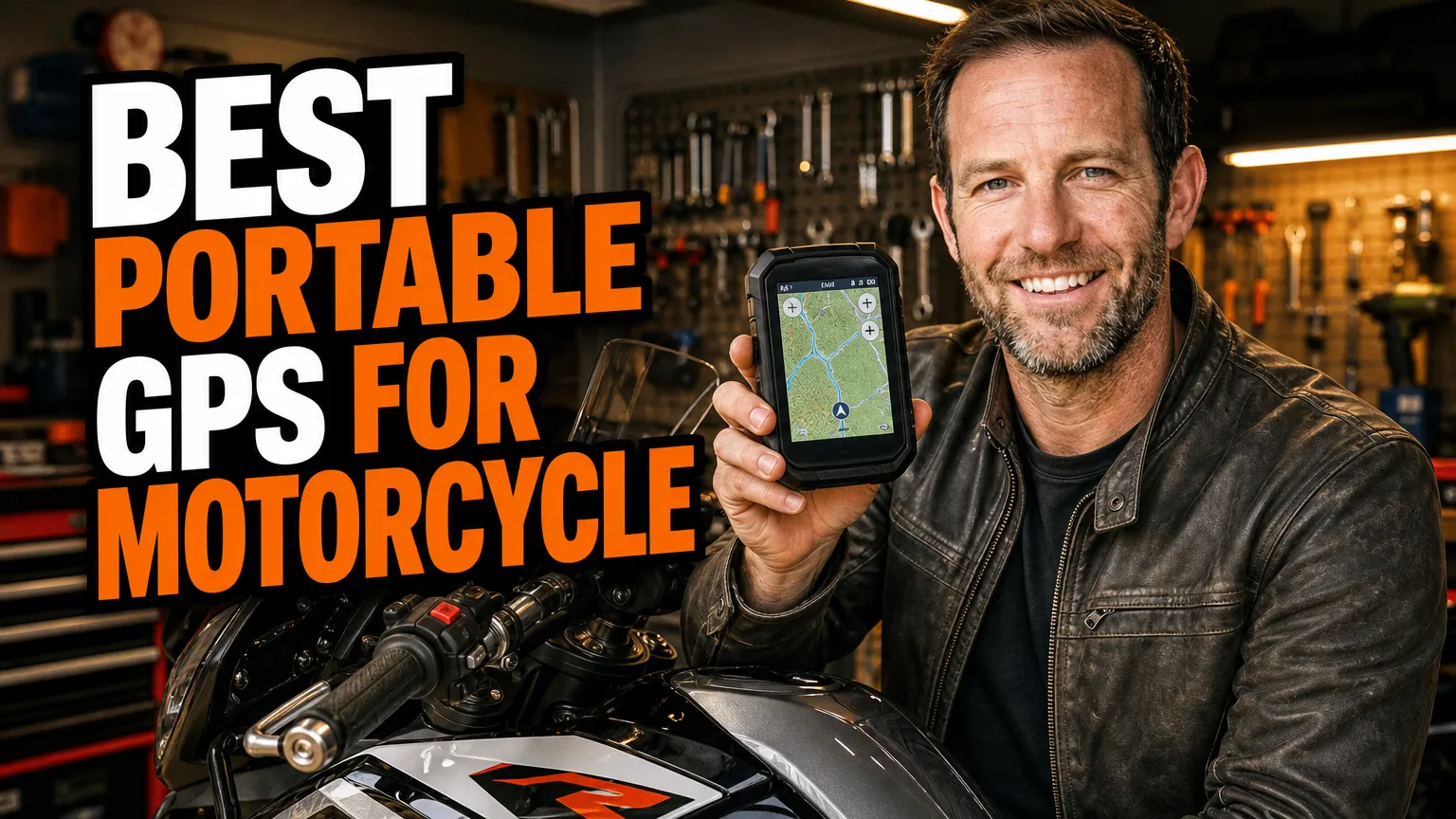
I have ruined two phones on motorcycles. One cooked itself behind a windscreen in 38°C heat on a run through Java, and another filled with water during a “light shower” that turned into two hours of monsoon. That is the exact moment I stopped pretending my phone was a navigation device and started buying proper hardware.
Since then I have run dedicated motorcycle GPS units on everything from a loaded touring bike to a 250cc dual sport, and I have loaned handhelds to friends who got lost on forest roads with no signal. This list is what I would actually spend my own money on today.
Every unit below is a real, currently available product. I have noted the screen size, the waterproof rating, the battery life and roughly what you will pay, because those are the four things that decide whether a GPS is usable on a bike or just expensive clutter.
- The Garmin Zumo XT2 is the best all round motorcycle GPS I have used, with a 6 inch screen, IPX7 sealing and built in Group Ride Radio.
- The Garmin Zumo 396 LMT-S is the cheapest unit I would still trust in heavy rain.
- For dirt and remote touring, the Garmin Montana 700i and GPSMAP 67i add inReach satellite SOS.
- If you want minimal clutter, the Beeline Moto II does turn by turn from your phone in a package the size of a watch.
- Budget $250 to $700 depending on screen size and whether you want satellite messaging.
1. Garmin Zumo XT2 — Best Overall Portable Motorcycle GPS
If you only read one section of this article, read this one. The Garmin Zumo XT2 is the unit I reach for on every long trip, and it is the closest thing to a no compromise motorcycle navigator that exists right now.
The headline is the 6 inch, 1280 x 720 touchscreen. It is bright, it responds to gloves, and it stays readable in direct tropical sunlight, which is more than I can say for most rivals. The whole unit is IPX7 rated, so rain, pressure washers and creek crossings are non issues.
What sold me was the built in Group Ride Radio. On the Zumo XT you had to buy a separate radio module and mount it somewhere; on the XT2 it is inside the housing. My riding group uses it constantly to see where everyone is and to send short voice messages when someone stops for fuel.
What I like in practice
Adventure Routing genuinely works. I planned a mixed asphalt and gravel route across West Java and the XT2 handled the transition between sealed and unsealed roads without trying to drag me back onto a highway. BirdsEye Satellite Imagery is a nice bonus when you want to see whether that “road” on the map is actually a road.
Battery life is around 6 hours, which is enough for a long day but not enough to skip the hardwire kit. Internal storage is 32GB with a microSD slot, and it pairs to my helmet headset and phone over Bluetooth without drama. Expect to pay roughly $600 to $650.
2. Garmin Zumo XT — Best Value Flagship
The Garmin Zumo XT is the previous generation flagship, and because the XT2 exists you can now find it for meaningfully less money. I ran one for two seasons and never once felt short changed.
You get a 5.5 inch, 1280 x 720 glove friendly display, the same IPX7 waterproofing, the same 32GB of internal storage, and the same Adventure Routing and BirdsEye Satellite Imagery features as its replacement. Battery life is also around 6 hours.
The main difference is the radio. The Zumo XT needs the separate Group Ride Radio accessory if you want to track your mates, which adds cost and wiring. If you mostly ride alone, that does not matter at all.
For roughly $400 to $500 the Zumo XT is the smartest buy on this list for a rider who wants a big, tough, fast screen without paying flagship money. I have recommended it to at least four friends and none of them have regretted it.
3. Garmin Zumo 396 LMT-S — Best Budget Dedicated Unit
Not everyone needs a six inch screen. The Garmin Zumo 396 LMT-S is the unit I suggest to riders who want a proper motorcycle GPS but flinch at the price of the Zumo XT line.
It has a 4.3 inch display, IPX7 sealing, Bluetooth for headset and phone, hands free calling, music control and rider alerts for sharp curves and speed cameras. It ships with preloaded street maps and includes lifetime map updates, which is a real long term saving.
Battery life is around 4 hours, so this one really does want to be wired to the bike. I also found the smaller screen slightly harder to glance at in heavy traffic compared with the XT, but at $250 to $300 that is a fair trade.
If you tour on sealed roads, want reliable navigation and do not care about satellite imagery, the Zumo 396 LMT-S is a genuinely sensible purchase.
4. TomTom Rider 550 — Best for Planning Twisty Routes
TomTom does one thing better than anyone, and that thing is finding you a fun road. The TomTom Rider 550 has a Winding Roads mode that deliberately routes you away from motorways and toward curves, and Round Trip planning that builds a loop from wherever you are standing.
The hardware is a 4.3 inch touchscreen with IPX7 waterproofing and roughly 6 hours of battery. It pairs with a headset for spoken directions and with your phone for traffic and hands free calls.
The MyDrive advantage
Where the Rider 550 really earns its place is MyDrive, TomTom’s cloud route planner. I build routes on my laptop, drop in GPX files from friends, sync them, and the route is waiting on the device when I switch it on. That workflow is cleaner than anything Garmin offers.
At around $400 it is priced against the Zumo XT, and honestly the XT has the better screen. But if your priority is discovering new roads rather than navigating to a known destination, the Rider 550 is the one I would take.
5. Garmin Montana 700i — Best Dual Sport Unit With Satellite SOS
When I ride alone into places with no cell coverage, the Garmin Montana 700i is what goes on the bars. It is a rugged handheld first and a motorcycle navigator second, and that combination is exactly what makes it brilliant for dual sport riding.
You get a 5 inch, 1280 x 720 screen, full IPX7 waterproofing, 16GB of internal storage plus a microSD slot, and up to 18 hours of battery life in normal GPS mode. That battery figure is the reason I trust it on multi day trips where charging is uncertain.
The headline feature is inReach satellite technology built in. That means two way satellite messaging and an interactive SOS button that contacts emergency services, independent of phone signal. I have never had to press it, and I am very glad it is there.
It mounts on the bike with a Garmin AMPS mount or a RAM cradle, and it also works as a hiking GPS when you park up. At roughly $700 it is the most expensive unit here, and for remote riding it is worth every cent.
6. Garmin GPSMAP 67i — Best Handheld Backcountry Navigator
The Garmin GPSMAP 67i is the button operated alternative to the Montana. If you have ever tried to use a touchscreen with wet winter gloves, you already understand why some riders insist on physical buttons.
It has a smaller 3 inch display, but it is IPX7 rated and built like a brick. Battery life is the standout: roughly 35 hours in normal GPS tracking and up to 180 hours in expedition mode, which means it can sit in a tank bag running for days.
Like the Montana 700i, the GPSMAP 67i includes inReach satellite messaging and SOS. It also supports multi band GNSS, which locks on faster and holds position better in steep valleys and dense canopy where older units struggle.
Storage is 16GB internally with microSD expansion. At around $600, it is a serious tool for adventure riders, bikepackers and anyone who spends time beyond the reach of a cell tower.
7. Garmin eTrex 32x — Best Cheap Backup Handheld
The Garmin eTrex 32x is the unit I keep in my pannier as a backup and lend to friends who show up without navigation. It is small, light, cheap and surprisingly capable.
It runs on two AA batteries for up to 25 hours, which is a genuinely useful trick on a motorcycle. No charging cable, no USB port to corrode, just fresh batteries from any convenience store. It has a 2.2 inch colour display and IPX7 waterproofing.
It includes TopoActive maps, a three axis compass and a barometric altimeter, plus support for GPS and GLONASS. Storage is 8GB with a microSD slot. At roughly $250 it is the cheapest thing here that I would still take into the mountains.
Is the screen tiny? Yes. Would I want to navigate a 500km day on it? No. But as a backup or a first GPS for a new rider, the eTrex 32x is excellent value.
8. Beeline Moto II — Best Minimalist Option
Sometimes I do not want a big screen on my bars at all. The Beeline Moto II is a tiny circular device that pairs with your phone and shows a simple compass style arrow with a distance countdown. No map, no clutter, no distraction.
It is IP67 rated, charges over USB C, and runs for around 20 hours per charge. The handlebar mount is included and it takes about two minutes to fit. Because your phone stays in your pocket, it is not baking in the sun or rattling itself to death.
The trade off is obvious: it needs your phone to work, and you lose the ability to see the road ahead as a map. For city commutes, cafe runs and riders who genuinely find map screens distracting, that is a feature rather than a flaw.
At roughly $230 it is the least expensive way to get proper turn by turn navigation onto a motorcycle without touching your phone mid ride.
9. Trail Tech Voyager Pro — Best for Dirt Bikes and Engine Data
The Trail Tech Voyager Pro is built for a different job entirely. It is a 4 inch colour touchscreen that combines GPS trail navigation with engine telemetry, and for dirt bikes and dual sports that combination is hard to beat.
Depending on the kit you buy, it can display engine temperature, RPM, speed and battery voltage, with TPMS support for tyre pressure monitoring. GPS wise it handles trail maps, track logging and waypoints, and it is IP67 sealed against mud and water crossings.
I fitted one to a friend’s enduro bike and the engine temperature readout alone changed how he rode in slow technical sections. Knowing your bike is about to overheat before it does is worth real money.
Pricing sits around $400 to $500 depending on the model and sensor kit, and you do need a bike specific harness. If you ride trails rather than highways, the Voyager Pro makes far more sense than a road biased GPS.
10. Chigee AIO-5 Play — Best CarPlay and Android Auto Alternative
Not everyone wants a standalone GPS. The Chigee AIO-5 Play is a 5 inch motorcycle display that runs wireless Apple CarPlay and Android Auto, mirroring your phone’s navigation apps onto a screen that is actually designed for a bike.
It is IP67 rated, hardwired to the bike, and it supports handlebar control integration on several BMW, Honda and Harley models, so you can scroll with the factory wheel or buttons. That integration is what separates it from a generic tablet strapped to the bars.
The catch is that it has no maps of its own. Everything comes from your phone, which means if you lose signal and your chosen app needs data, you are relying on downloaded offline maps. I always download the regions I plan to ride in before I leave.
At roughly $400 it is a strong choice if you already love Google Maps, Waze or Rever and just want a rugged, waterproof, sunlight readable window onto them.
How I Decide Which One to Buy
Waterproofing is not optional
Anything less than IPX7 or IP67 has no business on a motorcycle. Rain at 100km/h finds every seam, and a GPS that dies mid trip is worse than no GPS at all. Every unit on this list passes that bar.
Screen size versus handlebar space
A 6 inch screen is wonderful until it blocks your instruments or fouls the tank bag. I measure the space on the bars before I buy anything, and I would rather run a 4.3 inch unit that fits properly than a 6 inch unit wedged in at a bad angle.
Battery life tells you how to wire it
Under 5 hours means you should hardwire it. Over 15 hours means you can treat it like a handheld and take it hiking too. The Montana 700i and GPSMAP 67i sit firmly in the second camp, and that flexibility is why I like them so much.
Decide if you need satellite SOS
If you ride alone in remote areas, inReach on the Montana 700i or GPSMAP 67i is not a luxury. It is the difference between a broken leg being an inconvenience and being a genuine emergency. If you only ride populated roads, save the money.
Final Thoughts From My Own Bars
If I had to buy one unit tomorrow with my own money, it would be the Garmin Zumo XT2. It has the best screen, the best waterproofing and the built in Group Ride Radio that makes group touring genuinely easier.
If the budget is tighter, the Garmin Zumo XT delivers 90 percent of that experience for a lot less. And if your riding takes you far from tarmac and cell towers, the Garmin Montana 700i is the one I would trust with my safety.
Whichever you pick, mount it properly, hardwire it where you can, and download your maps before you leave the driveway. That last tip has saved me more than any feature on this list.
Frequently Asked Questions
Do I need a dedicated motorcycle GPS if I already have a phone?
Not strictly, but a dedicated unit like the Garmin Zumo XT2 survives rain, vibration and heat far better than a phone, and it keeps navigating where there is no cell signal. I still carry my phone, but the GPS does the navigating.
Are portable motorcycle GPS units waterproof?
The good ones are. Everything on this list carries at least an IPX7 or IP67 rating, meaning it can sit in a downpour or a creek crossing without dying. Cheap car GPS units usually cannot.
Can I use a handheld GPS like the Garmin GPSMAP 67i on a motorcycle?
Yes. With a RAM or Garmin AMPS mount it works fine, and the inReach satellite messaging is a genuine safety net when I ride alone. The trade off is a smaller screen that is harder to read at speed.
How much should I budget for a motorcycle GPS?
Expect $250 to $300 for a solid entry unit like the Garmin Zumo 396 LMT-S, $400 to $500 for a mid range screen, and $600 or more for a flagship or a satellite capable handheld.

Related Articles

6 Best Motorcycle Phone Mounts That Keep Your Phone Charged on the Road
Compare six dependable motorcycle phone mounts with wireless or USB charging, including fit, power wiring, vibration protection, weather resistance, and…
Jake Miller
10 min read

5 Best Motorcycle Phone Mounts for Naked Bikes and Open-Cockpit Riding
I compare secure, vibration-conscious phone mounts for naked and touring bikes, with fit notes, real trade-offs, and setup tips for…
Jake Miller
11 min read

7 Best Phone Mounts for Sport Bikes: Secure, Vibration-Smart Picks
Compare secure phone mounts for sport bikes, including clip-on fit, vibration control, case systems, prices, and my practical picks for…
Jake Miller
12 min read