
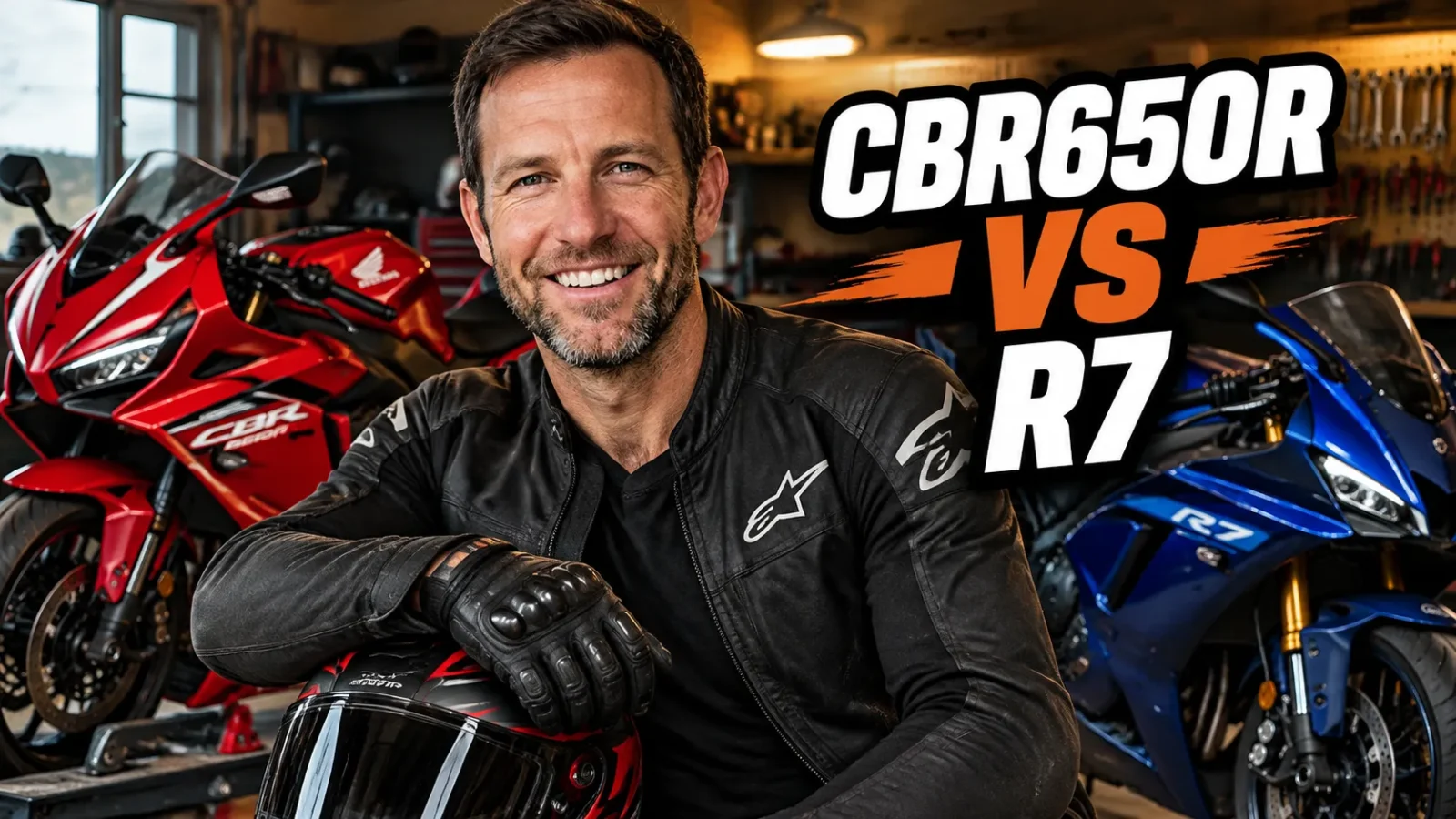
I still remember the first time I swapped keys between these two bikes on the same afternoon. I had a Honda CBR650R parked next to a Yamaha YZF-R7, a full tank in each, and a 90-minute loop of back roads plus a highway blast home. By the time I pulled into my driveway, I understood exactly why this comparison refuses to die.
Both bikes sit in the same showroom price bracket. Both look like proper sportbikes. Both are aimed at riders who want real performance without jumping straight onto a liter bike. But they get there in completely different ways, and that difference shows up in the first hundred metres.
I’ve now put thousands of kilometres on each, including two track days and a lot of miserable stop-start commuting. Here’s my honest breakdown, including the parts nobody mentions in the spec sheets.
- The CBR650R wins on top-end power, refinement, and highway comfort thanks to its 649cc inline-four.
- The R7 wins on weight, agility, and mid-range punch from its 689cc CP2 parallel twin.
- For track days and canyon carving, I’d take the R7. For commuting and long rides, I’d take the CBR650R.
- The R7 is cheaper and simpler; the CBR650R counters with traction control and the clever E-Clutch.
- Neither bike is “better” outright. It comes down to the riding you actually do most weekends.
Why These Two Keep Ending Up in the Same Conversation
On paper, the pairing looks odd. One is a 649cc inline-four with a fairing designed to slice through wind. The other is a 689cc parallel twin wrapped around Yamaha’s proven CP2 engine, the same heart that powers the MT-07 and Ténéré 700.
But the numbers line up almost perfectly. Both make somewhere between 70 and 95 horsepower. Both weigh in the 400 to 460 pound range. Both cost roughly the same as a decent used car. And crucially, both are the sensible middleweight sportbike choice for someone who doesn’t want to pay supersport insurance premiums.
That’s why I keep recommending them to the same people. If you’re stepping up from a 300 or 400, or coming back to riding after a decade away, these two bikes sit right at the sweet spot.
Engine and Power Delivery: Two Very Different Personalities
This is where the comparison gets genuinely interesting, because the character gap is enormous. You can feel it before you even leave your street.
The CBR650R’s Screaming Four
Honda’s inline-four is a beautiful thing when you let it breathe. Below 6,000 rpm it’s almost docile, smooth, and quiet enough to slip through a residential area without drawing a single glare. Then the cam profile wakes up.
Past 8,000 rpm the CBR650R transforms. The induction howl arrives, the tach needle sweeps toward 12,000, and you get that classic four-cylinder crescendo that no twin can replicate. I’ve genuinely caught myself short-shifting just to hear it again on the way up through the gears.
Peak output lands around 94 horsepower at 12,000 rpm, with roughly 47 lb-ft of torque at 8,500 rpm. That’s a rev-happy, reward-the-rider powerband. You have to work for it, and that’s the point.
The R7’s Torquey Twin
The R7 takes the opposite approach. Its 270-degree crank parallel twin makes about 73 horsepower, which sounds like a loss until you look at the torque figure: around 50 lb-ft, arriving at just 6,500 rpm.
Riding it is a completely different experience. You roll on the throttle at 4,000 rpm in third gear and the bike simply goes. No downshift required, no waiting for the revs to build. It pulls cleanly out of tight corners in a way the Honda just can’t match without a gear change or two.
The trade-off is the top end. Above 9,000 rpm the twin starts to feel breathless and buzzy, while the Honda is only getting started. If your riding involves a lot of highway miles at 130 km/h plus, you’ll notice the difference immediately.
So which feels faster in the real world?
Off the line and around town, the R7 feels quicker because the torque is right there. In a roll-on drag race from 80 km/h, the CBR650R claws it back and pulls away hard once it’s above 9,000 rpm. Two different kinds of fast.
Weight, Chassis, and Handling
This is where the Yamaha lands a serious punch. The R7 weighs in around 414 pounds wet, while the CBR650R is closer to 456 pounds. That 40-plus pound gap is not a rounding error.
You feel it the moment you tip into a corner. The R7 changes direction with a flick of the wrists, and its narrow inline twin engine means the bike feels almost 250cc-sized between your knees. On a tight, technical road, it’s genuinely hard to believe how much pace it carries.
Where the R7 Feels Untouchable
Yamaha also gave the R7 fully adjustable KYB suspension front and rear. That’s a big deal at this price point, and it means you can actually dial the bike in for your weight and your pace rather than just living with whatever the factory decided.
Set up properly, the R7 feels like a scalpel. The front end gives you huge confidence, the brakes are strong, and the whole package encourages you to brake later and lean further than you probably should.
Where the Honda Fights Back
The CBR650R’s Showa separate function big piston fork is excellent quality, but it offers far less adjustment. Out of the box it’s plush and composed, which is great for real roads, less ideal if you’re chasing lap times.
What the Honda does have is stability. That extra weight and longer wheelbase make it feel planted at speed in a way the R7 can’t quite match. On a fast, flowing road with long sweepers, I actually prefer the Honda. It feels like it’s on rails, and the extra mass stops it getting unsettled by mid-corner bumps.
Horses for courses, as they say. Tight and technical favours the Yamaha. Fast and flowing favours the Honda.
Comfort, Ergonomics, and Daily Life
I commute. A lot. And this is where my opinion gets less diplomatic, because the R7 is genuinely punishing in traffic.
The seat height is a claimed 32.9 inches and the clip-ons are low and far forward. After 45 minutes of stop-start city riding, my wrists and lower back were filing formal complaints. The narrow seat doesn’t help either.
The CBR650R is no Gold Wing, but it’s noticeably more liveable. The bars are a touch higher, the seat is broader, and the riding triangle is what I’d call “sporty but realistic.” I’ve done four-hour rides on the Honda without needing a chiropractor.
Then there’s the E-Clutch. Honda’s system lets you pull away and shift without touching the clutch lever at all. In heavy traffic it is, without exaggeration, one of the best features I’ve used on any motorcycle. If your riding is 80 percent urban, this alone might decide the comparison for you.
Electronics and Features
The R7 is refreshingly, almost stubbornly simple. No traction control, no ride modes, no quickshifter, no IMU. What you get is a slipper clutch and a decent LCD dash. Yamaha’s argument is that less electronics means less to go wrong and a purer connection, and there’s some truth to that.
The CBR650R plays a different game. You get Honda Selectable Torque Control, a five-inch TFT display, full LED lighting, and a USB-C socket. It’s a more modern motorcycle in almost every measurable way.
Personally? I like having traction control on a cold, damp morning. I don’t think it makes me a lesser rider to admit that.
Track Day Reality Check
I’ve had both on track, and the result surprised me slightly. On a tight, twisty circuit, the R7 is the clear winner. Its lighter weight and torquey twin let you get on the power earlier and carry more corner speed, and the fully adjustable suspension means you can actually set it up for the day.
On a longer circuit with big straights, the tables turn. The CBR650R’s top-end power lets it chase down and pass the R7 on the main straight, and its stability under hard braking is reassuring.
If you’re planning to do a lot of track days, the R7 has a huge aftermarket of race bodywork, rearsets, and suspension parts. It’s become a genuine club racing favourite for good reason.
Price, Insurance, and Running Costs
The R7 usually undercuts the CBR650R by a few hundred dollars at the dealership, and insurance quotes tend to come in slightly lower too. The twin is also a bit more frugal if you ride sensibly.
The catch is that “sensibly” is hard on the Honda. Ride the CBR650R the way it wants to be ridden, constantly in the upper rev range, and fuel economy drops noticeably. Four cylinders also mean four of everything at service time.
Neither bike is expensive to run in the grand scheme of motorcycling. But over five years, the Yamaha will likely cost you less.
Which One I’d Buy
If I could only keep one, I’d take the CBR650R, and it comes down to how I actually ride. Most of my miles are commuting, weekend highway runs, and the occasional track day. The Honda does all of those things comfortably, and that inline-four sound is something I’d miss every single day.
But if my riding looked different, if I lived near tight mountain roads, did monthly track days, and cared more about lap times than luggage hooks, I’d buy the R7 without hesitation. It’s the sharper, more exciting motorcycle when the road gets twisty.
My advice: ride both. Not around the block, but for an hour each. The spec sheet won’t tell you which one suits you. Your wrists, your commute, and your favourite road will.
Frequently Asked Questions
Is the CBR650R faster than the Yamaha R7?
In a straight line and at high speed, yes. The CBR650R’s inline-four makes around 94 hp and keeps pulling to 12,000 rpm, while the R7’s parallel twin makes roughly 73 hp. The R7 feels quicker off the line thanks to its extra torque, but the Honda walks away once speeds climb.
Which is better for a beginner, the CBR650R or the R7?
I’d point newer riders toward the CBR650R if they plan to commute, because the power is smoother and the riding position is friendlier. The R7 is not a monster, but its aggressive ergonomics and light, twitchy front end reward experience.
Does the Yamaha R7 have traction control or a quickshifter?
No. The R7 has no traction control, no ride modes, and no factory quickshifter. The CBR650R counters with Honda Selectable Torque Control and an optional E-Clutch, so it wins the electronics battle on paper.
Which one is cheaper to own?
The R7 usually costs a bit less up front and tends to be cheaper to insure. The CBR650R drinks more fuel when you use all those revs, and its four-cylinder service costs can add up over several years of ownership.

Related Articles

DRZ400E vs DRZ400S: I’ve Ridden Both, and Here’s the One I’d Actually Buy
DRZ400E vs DRZ400S: I break down carb, power, weight, street legality, and which of these two Suzuki dual sports I'd…
 Jake Miller
9 min read
Jake Miller
9 min read

Ironhead vs Shovelhead: An Honest Wrench Turner’s Guide to Picking Your Vintage Harley
I've ridden and wrenched on both Ironhead Sportsters and Shovelhead Big Twins. Here's the honest difference in power, reliability, parts,…
Jake Miller
9 min read

Ninja 400 vs Ninja 650: An Owner’s Honest Take on Which One You Should Buy
I've ridden both the Ninja 400 and Ninja 650 back to back. Here's how they compare on power, weight, comfort,…
Jake Miller
9 min read