
DRZ400E vs DRZ400S: I’ve Ridden Both, and Here’s the One I’d Actually Buy
 Jake Miller
9 min read
Jake Miller
9 min read
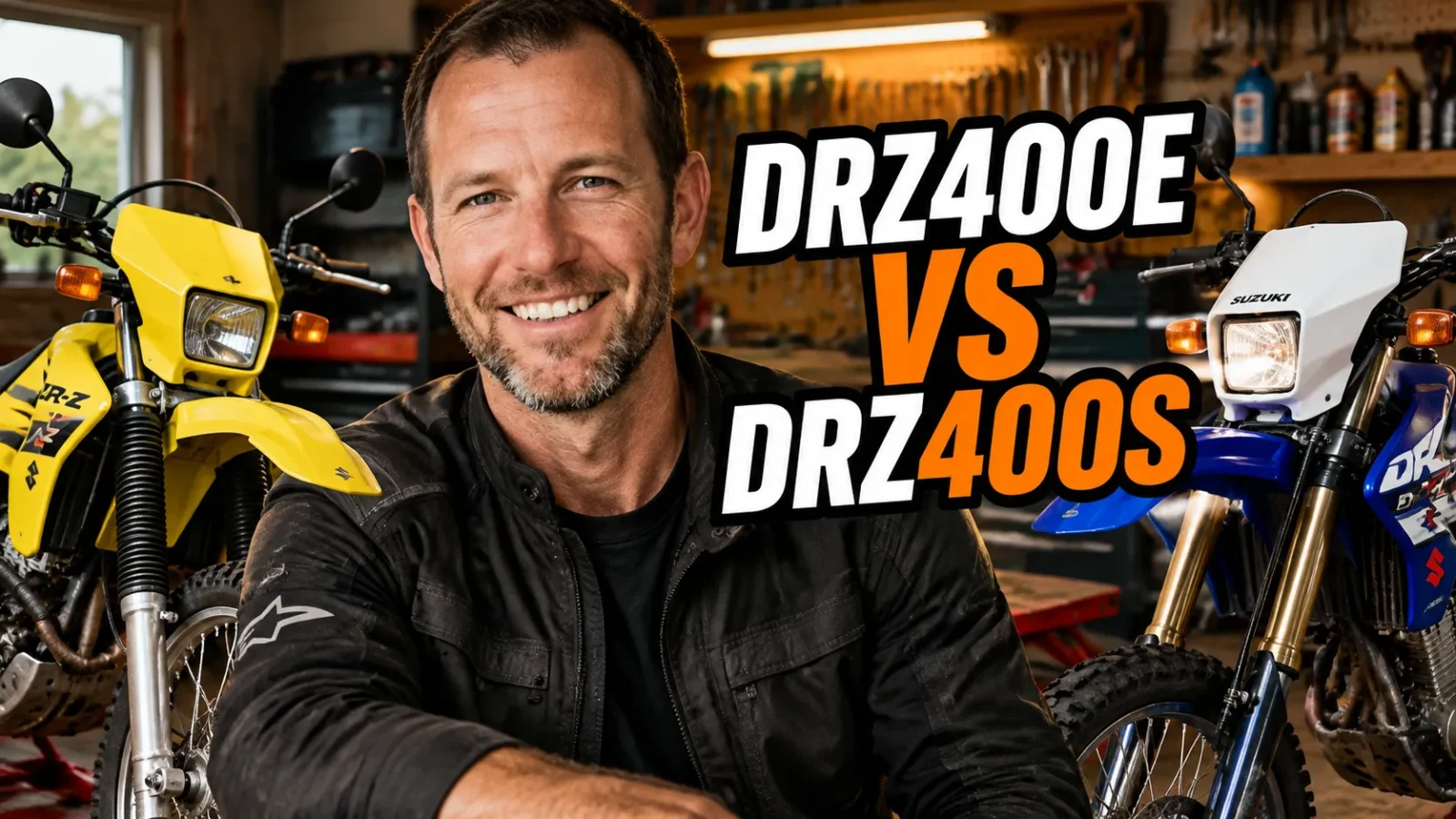
I’ve owned a DRZ400S for years, I’ve borrowed my buddy’s DRZ400E more times than he’d care to admit, and I’ve burned entire evenings reading jetting threads while my dinner went cold. If you’re stuck deciding between these two, I’ve been exactly where you are.
Here’s what surprised me most: underneath the plastics, they’re basically the same motorcycle. Same 398cc liquid-cooled single. Same frame. Same five-speed gearbox. Same reputation for refusing to die.
What separates them is a carburetor, a wiring harness, a title, and roughly 25 pounds. That’s it. And those four things change the bike completely.
- The DRZ400S is street legal from the factory; the DRZ400E is off-road only in the US.
- The E makes noticeably more power thanks to an FCR39 flat-slide carb, higher compression, hotter cams, and a freer exhaust.
- The E is roughly 25 pounds lighter with lower gearing and more aggressive suspension.
- For most riders the S is the smarter buy. The E is the better bike if you can legally register it and you ride mostly dirt.
- You can close most of the performance gap on an S, but you’ll spend real money doing it.
The Short Answer, Because You’re Probably Impatient
If you want one sentence: buy the S if you need a street-legal bike, buy the E if you don’t.
Everything else is detail. Important detail, but detail. The E is the sharper, lighter, faster machine. The S is the one you can actually live with every day.
Now let me explain why, because the reasoning matters more than the conclusion.
Same Engine, Two Very Different Personalities
The 398cc DOHC four-valve single in both bikes is the same basic lump, and it’s the reason these machines have such a cult following. It’s not fast. It’s not light. It’s just unkillable.
Suzuki built it to survive neglect, bad fuel, and owners who forget oil changes exist. Twenty-plus years later, that engine is still the reason people buy these bikes.
The Carburetor Is the Whole Story
The single biggest mechanical difference sits between the airbox and the cylinder head. The S runs a Mikuni BSR36, a vacuum-slide carburetor built for smooth throttle response and reasonable fuel economy.
The E runs a Keihin FCR39 flat-slide. It’s bigger, it’s more responsive, and it delivers fuel the way a race bike does. Crack the throttle on an E and it snaps forward in a way the S simply doesn’t.
I noticed this within about thirty seconds of my first ride on an E. The S always feels like it’s thinking about your request before answering. The E just goes.
Compression, Cams, and Exhaust
Beyond the carb, the E runs higher compression, roughly 12.2:1 against the S’s 11.3:1. It also gets more aggressive cam profiles and a larger exhaust header with none of the emissions plumbing.
Stack all of that together and you’re looking at a genuine gap. On most dyno charts I’ve seen, an S puts down somewhere in the mid-30s at the rear wheel while an E lands closer to 40 horsepower.
That doesn’t sound like much on paper. On a 300-pound motorcycle in the dirt, it’s the difference between a bike that pulls and a bike that yanks.
The Street Legal Question Nobody Warns You About
Here’s where a lot of people get burned, and I’ve watched it happen more than once. In the United States, the DRZ400E was never sold as a street-legal motorcycle.
No turn signals. No brake light switch. No horn. No mirrors. No passenger pegs. A single-filament headlight with no high beam. And an off-road title that many states will simply not convert, no matter how much you spend.
The S, by contrast, rolled off the showroom floor fully compliant. Blinkers, brake light, horn, mirrors, high beam, the works. You can insure it, plate it, and ride it to work tomorrow morning.
It Depends Where You Live
In markets like Australia and New Zealand, the E was registerable for road use, which is why you’ll see plated E models listed for sale there. If you live in one of those places, the whole calculus changes.
So before you fall in love with an E, check your local rules. That’s the least glamorous advice in this article and the most valuable.
Weight, Suspension, and Gearing
Strip the lights, blinkers, and street hardware off and the E drops roughly 25 pounds compared to the S. On a 300-pound motorcycle, that’s not a rounding error.
You feel it every time you pick the bike up off the ground, and you feel it in the air over a jump. Lighter is better off-road. That’s just physics.
The E also gets more suspension adjustment and slightly more travel. The S is valved softer and set up for street comfort, which is lovely on the highway and vague when you’re pushing hard through rocks.
Gearing Changes Everything
From the factory, the S runs taller gearing, around 15/44, while the E runs something closer to 14/47. That’s a big difference in character.
The E’s lower gearing makes it feel punchier everywhere. It lugs up technical climbs without stalling, and third-gear wheelies are almost effortless.
The S’s taller gearing keeps highway RPMs sane. Mine cruises at 65 mph without screaming, which matters a lot when your ride to the trails is thirty miles of pavement.
What It’s Actually Like to Live With Each One
Spec sheets are fine, but ownership is where the real differences show up. Here’s my honest take after spending serious time on both.
Living With the S
The S is the bike I’d hand to a friend who’s never ridden dirt. It’s forgiving, it’s plated, and it’s genuinely usable as a commuter.
Mine has done grocery runs, 200-mile backroad days, and tight single track. It isn’t great at any of them, but it does all of them without complaint.
The trade-off is that it always feels a little muted. The CV carb softens everything. You twist the throttle and the bike thinks about it first.
Living With the E
The E feels like the S after three espressos. Sharper, lighter, and noticeably quicker to rev.
On tight trails the difference is obvious. The E turns in with less effort, and the FCR gives you instant response when you need to loft the front wheel over a root.
On the road, though, it’s a different story. If yours isn’t plated, you’re trailering everywhere. Even if it is, the E isn’t built for highway miles.
Where Does the DRZ400SM Fit In?
I’d be doing you a disservice not to mention the SM. It’s the supermoto version that arrived in 2005 with 17-inch wheels and bigger brakes.
Mechanically it’s much closer to the S than the E. Same BSR36 carb, same engine tune, same street-legal package. It just wears sticky street rubber and stops harder.
If you’re a pavement rider who wants the DRZ look with better road manners, that’s your bike. It’s not really part of this comparison.
Can You Turn an S Into an E?
Sort of. This is the question I get more than any other, and the honest answer is yes, but it costs.
The classic path goes like this: 3×3 airbox mod, rejet, aftermarket exhaust, and eventually an FCR39 swap. Add E cams and you’re within spitting distance of E power.
What you can’t remove is the wiring harness, the lights, the passenger pegs, the heavier battery, and the extra street hardware. The S will always carry that weight.
Is the Swap Worth It?
For most riders, no. You’ll spend several hundred to well over a thousand dollars chasing a bike you could have simply bought.
A well-sorted S with a pipe and a jet kit is honestly plenty for 90 percent of trail riding. Ride it first before you start ordering parts.
Reliability, Maintenance, and the Parts Bin
Both bikes share the same well-documented weak points, and none of them are dealbreakers. The countershaft sprocket seal can weep. The regulator and rectifier can fail. Valve clearances need checking every few thousand miles.
The good news is that the aftermarket is enormous. You can buy virtually any part for a DRZ, often for less than you’d expect, and forums are full of people who already solved whatever problem you’re about to have.
Do the E’s Extras Cost You at Service Time?
Slightly. The FCR39 is fussier than the BSR36. It’s more sensitive to jetting, more sensitive to altitude, and more sensitive to a dirty air filter.
If you hate carburetor work, the S is the friendlier bike. If you enjoy tinkering, the FCR is genuinely rewarding once it’s dialed in.
Availability and Resale
In the US, the E was discontinued after 2007 while the S is still on dealer floors today. That means used E models are rarer, and clean plated ones command a serious premium.
The S is everywhere. You’ll find dozens within a few hours’ drive, and you’ll sell it just as easily. That liquidity is worth real money.
If you buy smart, a used S is one of the lowest-risk motorcycle purchases you can make. Parts are cheap, buyers are plentiful, and the bike doesn’t depreciate much further.
Which One Should You Buy?
I’ve laid out the differences, so here’s how I’d actually decide.
Buy the S If…
- You want to ride it home from the dealership legally
- You spend a lot of time on pavement between trails
- You value parts availability and painless resale
- You’re newer to dirt riding and want something forgiving
- You want one bike that does everything reasonably well
Buy the E If…
- You can legally register it where you live, or you don’t need to
- You ride mostly dirt and only occasionally touch pavement
- You want the lightest, sharpest version of the DRZ
- You’re comfortable doing your own jetting and maintenance
- You have a truck or trailer for transport
My Verdict After Living With Both
If I could only own one, I’d keep the S. Not because it’s the better motorcycle, because honestly it isn’t. The E is faster, lighter, and more fun.
I’d keep the S because I can plate it, insure it, commute on it, and sell it in a weekend. That flexibility is worth more to me than ten extra horsepower.
But if you live somewhere the E can be registered, or you’ve got a truck and ride exclusively off-road, buy the E and don’t look back. It’s the DRZ that Suzuki should have kept building.
Either way, you’re getting one of the most bulletproof dual sports ever made. That’s not a bad place to land.
Frequently Asked Questions
Is the DRZ400E street legal?
In the United States, no. The E was sold as an off-road machine with no turn signals, no brake light switch, and an off-road title that many states will not convert. In markets like Australia and New Zealand it could be registered for the road, so the answer depends entirely on where you live.
How much more power does the DRZ400E make than the DRZ400S?
On most dyno charts I have seen, the S puts down somewhere in the mid-30s at the rear wheel while the E lands closer to 40 horsepower, thanks to its Keihin FCR39 flat-slide carb, higher compression, hotter cams, and a freer exhaust.
Can I put DRZ400E parts on a DRZ400S?
Yes, and plenty of riders do. The FCR carb, E cams, and E exhaust header all bolt onto an S engine. Just budget for jetting work and accept that the S still carries its street hardware and extra weight.
Which is better for a beginner, the DRZ400E or the DRZ400S?
For most beginners I recommend the DRZ400S. It is street legal out of the box, far easier to find, and much easier to sell later. The E makes sense only if you are already comfortable in the dirt and can legally register it.

Related Articles

CBR650R vs R7: Which Middleweight Sportbike Actually Won Me Over
I've ridden both the Honda CBR650R and Yamaha YZF-R7 back to back. Here's how they really compare on power, weight,…
Jake Miller
9 min read

Ironhead vs Shovelhead: An Honest Wrench Turner’s Guide to Picking Your Vintage Harley
I've ridden and wrenched on both Ironhead Sportsters and Shovelhead Big Twins. Here's the honest difference in power, reliability, parts,…
Jake Miller
9 min read

Ninja 400 vs Ninja 650: An Owner’s Honest Take on Which One You Should Buy
I've ridden both the Ninja 400 and Ninja 650 back to back. Here's how they compare on power, weight, comfort,…
Jake Miller
9 min read