
Ironhead vs Shovelhead: An Honest Wrench Turner’s Guide to Picking Your Vintage Harley
 Jake Miller
9 min read
Jake Miller
9 min read
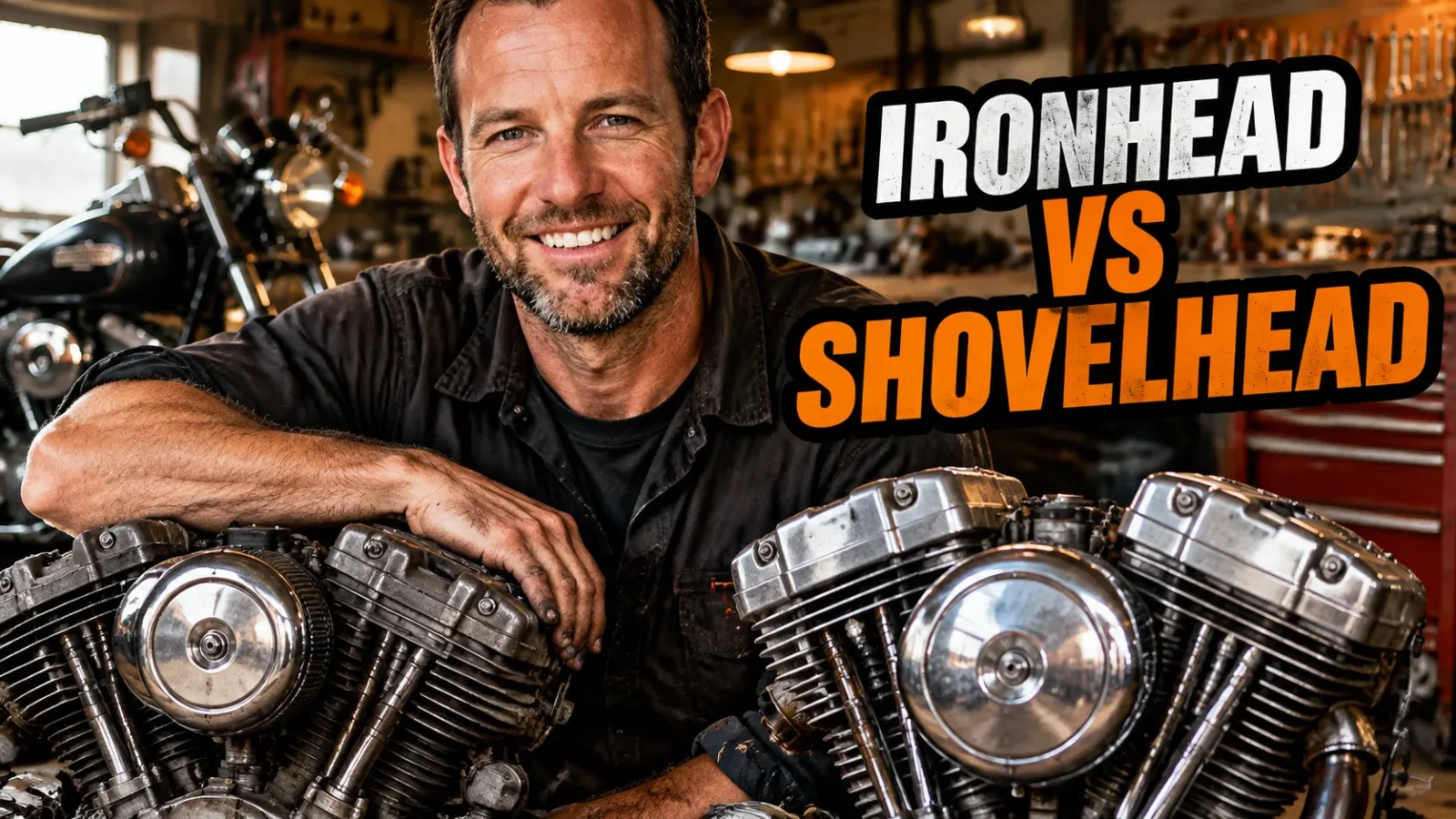
I still remember the first time I kicked over a 1974 Ironhead Sportster in a freezing garage in Ohio. Forty-something kicks later my leg was jelly, my hands smelled like gas, and the thing finally barked to life with a sound that was half chainsaw and half jackhammer. That moment hooked me on old Harleys for good.
Years later I bought a 1978 Shovelhead FLH with a weeping primary and a front end that wandered like a shopping cart at speed. Between those two bikes I’ve put tens of thousands of miles on America’s two most stubborn air-cooled V-twins, and I’ve rebuilt enough of both to have opinions.
So when riders ask me “Ironhead vs Shovelhead, which one should I buy?” I don’t hand them a spec sheet. I hand them the truth, warts, leaks, and all. Here’s my honest take after living with both.
- The Ironhead is a 1957 to 1985 Sportster engine: smaller, lighter, revvier, and relentlessly needy.
- The Shovelhead is a 1966 to 1984 Big Twin: torquey, heavier, and the better long distance companion.
- Both leak oil. Neither is a daily commuter unless you enjoy wrenching.
- Shovelhead parts and aftermarket support are noticeably better than Ironhead.
- My pick depends on the mission: around town and backroads, Ironhead. Highway miles and two-up, Shovelhead.
Two Very Different Bikes Wearing the Same Badge
The biggest mistake I see new buyers make is treating these as interchangeable “old Harleys.” They are not. They were built in different factories, for different riders, with completely different architecture under the paint.
The Ironhead is a Sportster engine. It’s a unit construction design, meaning the engine and transmission share a case. The Shovelhead is a Big Twin, with a separate transmission bolted behind it and a primary chain connecting the two.
That single structural difference shapes everything: weight, handling, maintenance routines, and how the bike feels when you crack the throttle. Once you understand it, the rest of the comparison falls into place.
What Actually Separates an Ironhead from a Shovelhead
Let me start with the mechanical reality, because it explains every riding impression that follows.
The Ironhead: Sportster DNA, 1957 to 1985
The Ironhead gets its nickname from its cast iron cylinder heads, which replaced the aluminum heads of the earlier K-model and flathead Sportsters. Harley built it from 1957 through 1985, when the Evolution Sportster finally took over.
Displacement started at 883cc, moved to 900cc, and settled at 1000cc from 1972 onward. It’s a 45-degree, air-cooled, overhead valve V-twin with a four-speed gearbox and, on most examples, a kickstarter you’ll get very familiar with.
What I love about the Ironhead is how compact and mechanical it feels. It’s a bike you sit in rather than on, and every input translates directly into noise and motion.
The Shovelhead: The Big Twin Workhorse, 1966 to 1984
The Shovelhead replaced the Panhead in 1966 and ran until about 1984. Early examples from 1966 to 1969 are the “Pan-Shovel” hybrids, using a generator lower end and Panhead-style cases. From 1970 on you get the alternator bottom end most people picture.
Standard displacement was 74 cubic inches, or 1207cc. In 1978 Harley added an 80 cubic inch, 1340cc version that gave the engine noticeably more grunt down low.
The Shovelhead is a big, lazy, torquey engine. It pulls from idle in a way an Ironhead simply can’t, and it does it while sounding like distant thunder rolling across a cornfield.
Power, Displacement, and Real World Speed
Here’s the part nobody tells you: neither of these engines is fast by modern standards. An Ironhead 1000 makes something in the neighborhood of 55 to 60 horsepower on a good day. A 74 cubic inch Shovelhead makes less than that, but with far more torque.
On my Ironhead, keeping up with highway traffic meant holding the thing near its vibration peak for hours. It would do it, but it wasn’t happy, and neither were my fillings.
The Shovelhead, by contrast, lopes along at 70 mph feeling barely awake. Roll on the throttle in top gear and it just pulls, no downshift required. If your riding involves distance, the Shovelhead wins that argument before it starts.
But around town, the Ironhead is the more entertaining machine. It’s lighter, it turns in quicker, and it encourages you to wring its neck in a way that a 700-pound touring bike never will.
Reliability: Which One Leaves You Stranded More Often?
I want to be careful here, because “reliable” is a loaded word for 40 to 60 year old motorcycles. Neither is reliable in the way a modern bike is. Both will need attention, and both will teach you to carry tools.
That said, my experience has been pretty consistent. A neglected Shovelhead will still start and run. A neglected Ironhead will make you walk.
Ironhead Weak Points I’ve Learned to Watch
Ignition is the Ironhead’s Achilles heel. Points, condensers, and magnetos need regular attention, and a marginal charging system will leave you with a dead battery and a very tired leg.
Cylinder heads are the other big one. Ironhead heads are prone to cracking between the valve seats, and finding good uncracked cores is getting harder every year. I’ve had one repaired by a machinist and it was never quite right afterward.
Vibration also loosens everything. I’ve lost exhaust bolts, carburetor hardware, and one memorable turn signal on a single afternoon ride. Blue Loctite is your friend.
Shovelhead Weak Points That Cost Me Money
The Shovelhead’s reputation for leaking is well earned. Rocker box gaskets, pushrod tube seals, and the primary cover all weep eventually, and some bikes seem to mark their territory no matter how many gaskets you throw at them.
Valve guides wear, especially on the exhaust side, and a worn top end shows up as oil smoke and hard starting. My 1978 needed a top end refresh around 35,000 miles, which is fairly typical.
The oil pump and the aluminum cases are the other weak spots. Case cracking around the tappet blocks and oil pump area is a known issue, so inspect carefully before you buy.
Vibration, Sound, and That Intangible Thing
Let’s be honest: most of us buy these bikes for how they make us feel, not for the spec sheet. And this is where the two diverge dramatically.
The Ironhead vibrates like a paint shaker. At certain rpm it blurs the mirrors, numbs your hands, and rattles the fillings in your teeth. It’s exhausting and I absolutely love it.
The Shovelhead has a slower, deeper, more rhythmic shake. It’s still a solid mounted engine, so it buzzes, but it’s a throb rather than a buzzsaw. Long rides are genuinely more tolerable.
Sound-wise, an Ironhead with open pipes is a sharp, angry crackle. A Shovelhead is a low, hollow rumble you feel in your chest. If you’ve ever stood behind a Shovelhead at a stoplight, you know exactly what I mean.
Parts, Aftermarket Support, and Keeping Them Alive
This is where the practical buyer needs to pay attention, because a motorcycle you can’t maintain is just garage art.
Shovelhead support is excellent. Because the Big Twin platform was the backbone of the chopper and custom scene for decades, there’s a huge aftermarket for cases, cylinders, ignition systems, carburetors, and complete top end kits. If you need something, someone makes it.
Ironhead support is good but not equal. Common wear items, gaskets, bearings, and clutch parts are easy to find. The trouble spots are cosmetic and structural: original tinware, correct air cleaners, and uncracked cylinder heads can take months of searching.
My rule of thumb after years of hunting parts: if you want a bike you can keep on the road indefinitely, the Shovelhead is the safer bet. If you want a bike with a tighter community of dedicated weirdos, the Ironhead is your tribe.
Which One Should You Buy?
Here’s how I’d break it down for someone standing in a seller’s driveway with cash in hand.
Buy an Ironhead If…
You ride mostly around town, backroads, and short day trips. You enjoy tinkering as much as riding, you have a garage and patience, and you want a bike that feels raw and small and alive.
You also need to be comfortable with a kickstarter and with the idea that your bike will occasionally embarrass you in front of your friends. That’s part of the deal.
Buy a Shovelhead If…
You want to actually cover ground. Two-up riding, highway miles, weekend trips with luggage, and a riding position that doesn’t fold you in half all point to the Big Twin.
It’s also the better choice if you want to customize. The aftermarket is deeper, the platform is more forgiving of changes, and resale on a well built Shovelhead is stronger than most people expect.
A Word on Prices and Budget
Neither of these is a cheap hobby anymore. Nice Ironheads have climbed steadily, and clean Shovelheads have gone up even faster as the Evo generation rediscovered them.
Whatever you budget for the purchase, set aside another third for the inevitable sorting. Every old Harley I’ve bought needed tires, brakes, a battery, and a carburetor rebuild within the first month.
My Final Take
After years of living with both, I don’t think there’s a universal winner. What I do think is that most people ask the wrong question.
The right question is what kind of riding do I actually do? If the answer is short hops and local mischief, buy the Ironhead and enjoy its frantic, rattling personality. If the answer is real miles and real distance, buy the Shovelhead and accept that it will leak on your driveway forever.
Me? I kept both for as long as I could, and I only sold the Ironhead because my knee finally surrendered to the kickstarter. The Shovelhead is still in my garage, still marking its territory, and still the bike I reach for when I want to disappear for a few hundred miles.
If you’re shopping for your first vintage Harley, ride both before you commit. Twenty minutes on an Ironhead and twenty minutes on a Shovelhead will tell you more than any spec sheet ever could. Trust your hands, trust your backside, and trust the grin factor. That’s the only comparison that really matters.
Frequently Asked Questions
Is an Ironhead or a Shovelhead more reliable?
Neither is a modern bike, but in my experience a well sorted Shovelhead tolerates neglect slightly better than an Ironhead. Ironheads demand constant ignition and carb attention, while Shovelheads mainly punish you with oil leaks and top end wear.
How many cubic inches is a Shovelhead?
Most Shovelheads were 74 cubic inches (1207cc), and Harley added an 80 cubic inch (1340cc) version starting in 1978. Ironheads, by comparison, were 883cc, 900cc, and finally 1000cc.
What years was the Ironhead Sportster made?
The Ironhead Sportster ran from 1957 through 1985, when the Evolution Sportster replaced it. The Shovelhead Big Twin ran from 1966 until roughly 1984.
Are parts still available for Ironheads and Shovelheads?
Yes. Shovelhead aftermarket support is excellent thanks to decades of custom demand, while Ironhead parts are plentiful for common wear items but harder to find for things like uncracked cylinder heads and correct tinware.

Related Articles

CBR650R vs R7: Which Middleweight Sportbike Actually Won Me Over
I've ridden both the Honda CBR650R and Yamaha YZF-R7 back to back. Here's how they really compare on power, weight,…
Jake Miller
9 min read

DRZ400E vs DRZ400S: I’ve Ridden Both, and Here’s the One I’d Actually Buy
DRZ400E vs DRZ400S: I break down carb, power, weight, street legality, and which of these two Suzuki dual sports I'd…
Jake Miller
9 min read

Ninja 400 vs Ninja 650: An Owner’s Honest Take on Which One You Should Buy
I've ridden both the Ninja 400 and Ninja 650 back to back. Here's how they compare on power, weight, comfort,…
Jake Miller
9 min read