
6 Best 360 Cameras for Motorcycle Riding I’ve Actually Mounted on My Helmet
 Jake Miller
11 min read
Jake Miller
11 min read
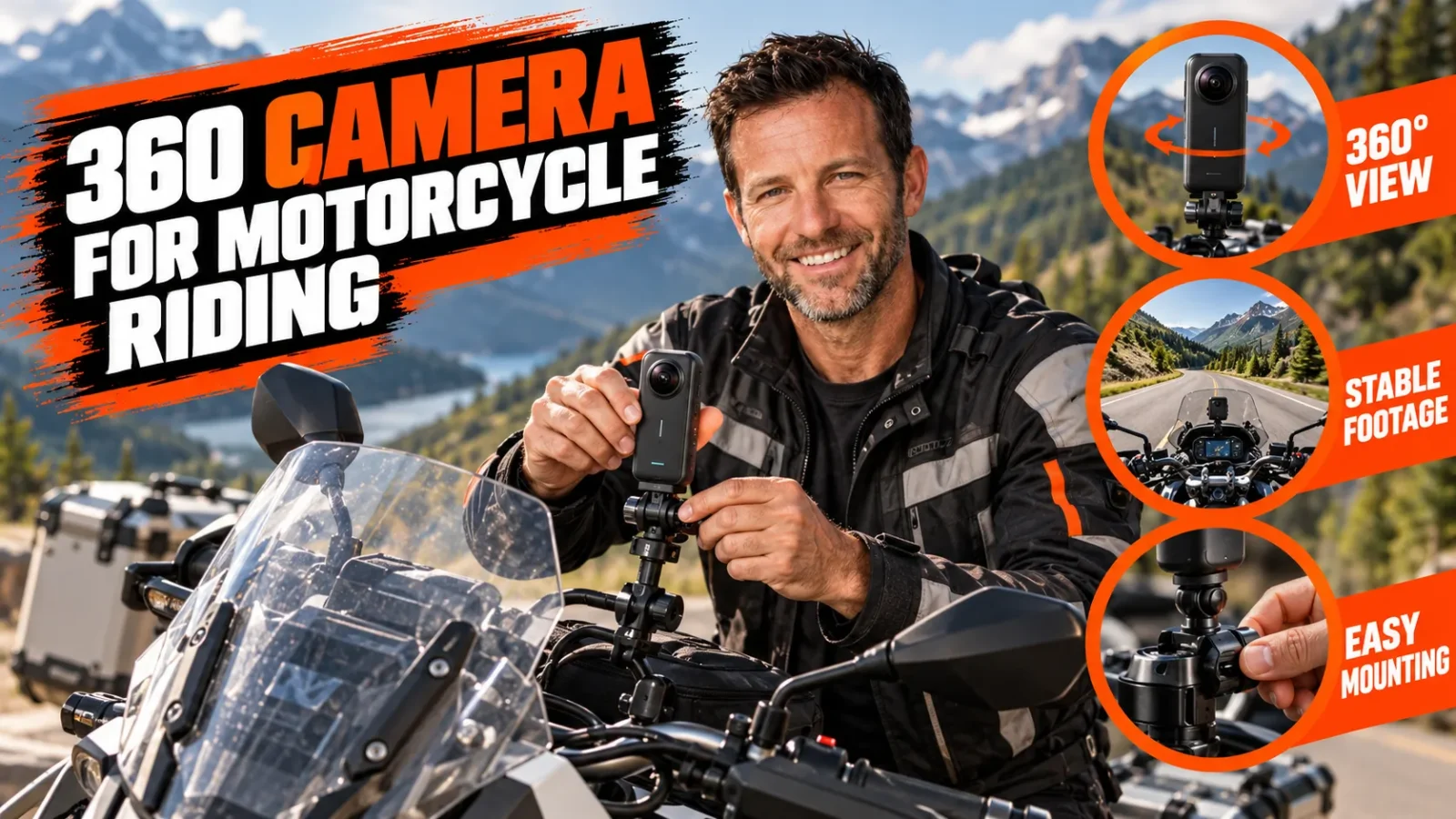
I’ve spent the last few years strapping cameras to every part of my motorcycle and my helmet, chasing that perfect shot of a canyon carve or a sunset ride. The problem with a fixed-lens camera is simple: you only get one angle, and you have to guess it correctly before the moment happens.
A 360 camera solves that headache entirely. You capture everything around you and reframe the shot later on your phone, which has saved more of my rides than I can count. After testing six of the best 360 cameras for motorcycle riding across highway miles, twisty backroads, and a few embarrassing low-speed drops, I’ve got some strong opinions to share.
- The Insta360 X4 is my top overall pick thanks to 8K resolution and rock-solid stabilization at highway speeds.
- The Insta360 X3 is the best value option if you don’t need 8K footage but still want flagship stabilization.
- The GoPro MAX makes sense if you’re already deep in the GoPro ecosystem and want familiar software.
- Mounting matters as much as the camera — a poor mount ruins even the best footage, so I always pair my camera with a proper adhesive or clamp mount.
- Battery life and heat management are the real dealbreakers on long rides, not just resolution numbers.
Why I Switched to a 360 Camera for My Rides
For years I ran a standard action camera bolted to my chin bar, and honestly, it worked fine. If you’re still on the fence, my breakdown of the best gopro camera for motorcycle helmet options is still a solid resource for that route.
But I kept missing moments. A deer darting from my left, a buddy pulling a wheelie behind me, a gorgeous view I only noticed after I’d already passed it. A 360 camera captures all of that simultaneously, and I just pick the angle afterward.
The tradeoff is file size and a slightly steeper editing curve. If you’re not ready to commit fully, it’s worth comparing against my general roundup of the best action camera for motorcycle helmets before deciding which style fits your riding better.
1. Insta360 X4 — Best Overall 360 Camera for Motorcycle Riding
The Insta360 X4 is what’s currently mounted on my own helmet, and it’s earned that spot fair and square. It shoots 8K30 360 video, which gives me enough resolution to reframe a flat, single-lens shot and still get crisp 4K output for YouTube.
On my last mountain pass ride, the Insta360 X4‘s FlowState stabilization made my footage look like it was shot on a gimbal, even over rough chip-seal pavement. It’s rated IPX8 waterproof up to 33 feet without a housing, so rain and splashes are a non-issue.
Specs That Matter on the Road
Battery life lands around 135 minutes of 8K recording, which covers most of my riding sessions before I need a swap. It supports a 1/1.28-inch sensor per lens, has a touchscreen for quick framing checks at gas stops, and starts around $499.
The invisible selfie stick effect works brilliantly for motorcycle footage too — mount it on a short pole and the stick disappears in post, giving you a drone-like flying camera look following your bike.
Where It Falls Short
8K footage eats storage fast, so I always ride with a 256GB or larger microSD card. It also runs warm on long summer rides, though I haven’t had it shut down from overheating like some early 360 cameras used to.
2. Insta360 X3 — Best Value for Everyday Riders
If the X4’s price tag or file sizes feel like overkill, the Insta360 X3 is genuinely the smarter buy for most riders. I used one for almost two years before upgrading, and honestly, the footage still looks great on Instagram and YouTube.
It caps out at 5.7K30 rather than 8K, which actually makes editing on my phone faster and the files far more manageable on longer multi-day trips. The stabilization is nearly identical to the X4’s for anything under highway speeds.
Real-World Durability
The Insta360 X3 is also IPX8 waterproof to 33 feet, has a 2.29-inch touchscreen, and runs about 81 minutes on a full charge. At roughly $399, it’s one of the best price-to-performance ratios in the 360 camera space right now.
I still recommend this one to friends starting out because the learning curve on the Insta360 app is identical to the X4, so you’re not sacrificing usability to save money.
3. Insta360 ONE RS 1-Inch 360 Edition — Best Image Quality
This is the camera I reach for when image quality genuinely matters more than convenience, like filming a feature video of a bike I’m reviewing. The Insta360 ONE RS 1-Inch 360 Edition uses dual 1-inch sensors co-engineered with Leica, and the difference in dynamic range is noticeable immediately.
Shadows under tree canopy on forest roads retain far more detail than on the X3 or X4, and highlights from direct sun don’t blow out nearly as badly. It’s a modular system too, so the lens module swaps onto the same base as other ONE RS mods.
Why It’s a Niche Pick for Riders
Resolution tops out at 6K, which is lower than the X4’s 8K, but the sensor size more than makes up for it in actual perceived quality. The catch is battery life — around 73 minutes per charge — and a higher price point near $549 for the bundle.
I’d recommend this one specifically to riders who create sponsored content or sell footage, where image quality justifies the extra hassle of swapping batteries mid-ride.
4. GoPro MAX — Best for GoPro Loyalists
I know a lot of riders who already own a GoPro Hero and a drawer full of GoPro mounts, and for them, the GoPro MAX is a natural fit. It shoots 360 video at 5.6K30 and also functions as a standard hero-style camera when you only want one lens active.
That dual-mode flexibility is genuinely useful. On days I don’t feel like editing 360 footage, I just switch the GoPro MAX to its “Hero mode” with in-camera horizon leveling and shoot normally.
Mount Compatibility
Since it uses the standard GoPro folding mount, it works with every mount I already own from my chin bar setup. If you’ve already dialed in your rig using my guide to the best go pro mounts for motorcycle helmets, the MAX drops right in without buying new hardware.
The downside is that it’s an older sensor at this point, first released back in 2019, so low-light performance and stabilization lag noticeably behind the newer Insta360 lineup. It typically sells for around $399, and I only recommend it if you’re staying inside the GoPro ecosystem on purpose.
5. Insta360 ONE X2 — Best Budget Pick
For riders on a tighter budget, the Insta360 ONE X2 is still a genuinely capable camera even though it’s a couple generations old now. I picked one up secondhand for under $200 and was surprised how usable the footage still is for casual ride vlogs.
It shoots 5.7K30 360 video, has IPX8 waterproofing to 33 feet, and includes the same FlowState stabilization core technology found in newer models, just an earlier version of it.
What You’re Giving Up
Low-light footage is noticeably grainier than the X3 or X4, and the touchscreen is smaller and less responsive. Battery life sits around 80 minutes, which is fine for shorter rides but tight for all-day touring.
Still, if you’re just testing whether 360 footage fits your riding style before committing serious money, the Insta360 ONE X2 is a smart, low-risk entry point.
6. Kandao QooCam 3 — Best Alternative for Low-Light Night Rides
Most riders overlook Kandao, but the QooCam 3 genuinely surprised me on a dusk ride through unlit backroads. Its larger 1/1.55-inch sensors handle low light noticeably better than the Insta360 X3, with less visible noise in shadow areas.
It records at up to 8K30 and includes a dedicated HDR mode that stacks exposures in real time, which is fantastic for riding into and out of tunnels where lighting changes instantly.
Software Is the Weak Link
The Kandao app isn’t as polished as Insta360’s, and reframing footage takes a few more steps to get right. Priced around $400 to $500 depending on the bundle, it’s competitive, but I’d only recommend it to riders comfortable with a slightly rougher editing workflow in exchange for better night footage.
How I Actually Mount My 360 Camera
Camera choice only gets you halfway there. A shaky, poorly positioned mount ruins footage from even the best 360 camera on this list, so I take mounting just as seriously as the gear itself.
Helmet Mounts vs. Bike Mounts
I run mine on a chin mount for POV riding footage, since it keeps the horizon steady and shows more of the road ahead than a top-of-helmet mount. For cinematic bike-following shots, I switch to a short pole mounted near the tail unit or tank.
My full thinking on mount placement and hardware choices lives in my guide to the best go pro mounts for motorcycle helmets, and the same logic applies directly to 360 cameras since most use the same mounting standard.
Adhesive Mounts for a Cleaner Look
When I want the camera locked in place with zero wobble and no visible mount arm ruining the shot, I go with a proper adhesive setup. I detailed my exact process, including cure time and surface prep, in my piece on the best go pro adhesive mount setup for motorcycle helmet.
That same 3M-backed adhesive approach works perfectly for 360 cameras too, since most share the same folding mount tab on the bottom.
What I Actually Look For When Buying a 360 Camera
Stabilization Quality
Motorcycle riding is uniquely brutal on cameras because of constant engine vibration and road chatter. I always check real-world stabilization footage before buying, not just marketing claims, since some cheaper 360 cameras still show visible jitter at highway speed.
Waterproofing Without a Case
Every camera on this list is waterproof without an external housing, which matters a lot to me. A housing distorts the 360 stitch line and creates visible seams in your footage, so native waterproofing is a must-have, not a nice-to-have.
Battery Life and Heat
I’ve had cameras shut down mid-ride from overheating on hot summer days, which is incredibly frustrating when you can’t just pull over safely. I now prioritize models with proven heat management, like the Insta360 X4, especially for longer touring days.
Storage and File Sizes
8K 360 footage is enormous. I ride with at least a 256GB microSD card rated V30 or higher, and I’ve learned the hard way to offload footage after every riding day rather than letting it pile up.
My Final Take
If you want my honest, no-nonsense recommendation, the Insta360 X4 is the best 360 camera for motorcycle riding right now. It balances resolution, stabilization, and battery life better than anything else I’ve tested.
If budget is tighter, the Insta360 X3 gets you 90% of the experience for less money and smaller files. And if you’re chasing the absolute best image quality for professional-feeling footage, the Insta360 ONE RS 1-Inch 360 Edition is worth the extra hassle.
Whichever one you pick, pair it with a solid mount and give your setup a proper shakedown ride before a big trip. Trust me, the worst time to discover a loose mount or a dead battery is halfway through the ride you most wanted to capture.
Frequently Asked Questions
Is a 360 camera better than a regular action camera for motorcycle riding?
It depends on your goals. A 360 camera like the Insta360 X4 lets you reframe your shot after the ride, which is huge if you can’t predict when something interesting will happen. If you want the absolute best low-light footage or simplest one-angle editing, a traditional setup like the best action camera for motorcycle helmets might still suit you better.
Where should I mount a 360 camera on my motorcycle or helmet?
I get the best results mounting it on a helmet chin mount or a short pole extension on the fuel tank, since 360 cameras need clearance on all sides to avoid capturing your mount in the shot. Check out my thoughts on the best go pro mounts for motorcycle helmets for mounting principles that carry over well to 360 cameras.
Do 360 cameras work well in the rain or at highway speeds?
The top models, including the Insta360 X4 and GoPro MAX, are waterproof without a housing and handle wind noise reasonably well with an included foam windscreen. I’ve ridden through light rain and 75 mph highway stretches with both and had no issues.
Is an adhesive mount safe for a 360 camera on my helmet?
Yes, as long as you use a genuine 3M-backed mount and let it cure for 24 hours before riding. I break down my exact process in my guide to the best go pro adhesive mount setup for motorcycle helmet, which applies directly to 360 camera mounts too.

Related Articles

6 Best Rear View Cameras for Motorcycle: Riders Who Want Eyes in the Back of Their Head
I've tested the top rear view cameras for motorcycles so you don't have to. Here are my real-world picks for…
Jake Miller
12 min read

8 Best Cameras for Riding Motorcycle in 2026 (Rider-Tested Picks)
I've mounted, crashed, and rain-soaked dozens of cameras on my helmet and bike. Here are the 8 best cameras for…
Jake Miller
9 min read

9 Best Cameras for Motorcycle Travel: My Tested Picks for Long-Haul Rides
I've tested action cams, 360 cameras, and mirrorless bodies on thousands of touring miles. Here are the 9 best cameras…
Jake Miller
12 min read