
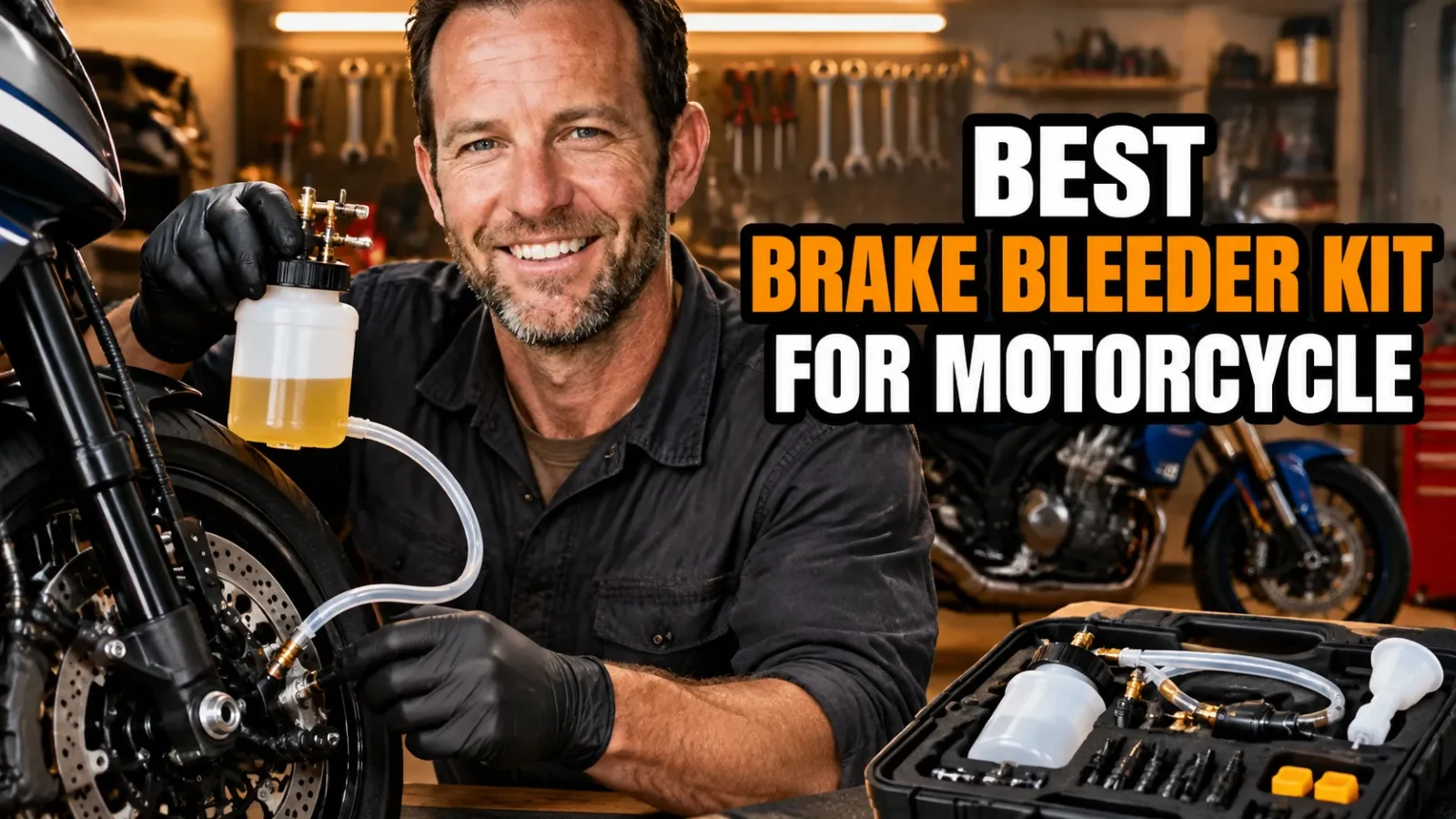
I still remember the first time I tried to bleed the front brakes on my old SV650 with nothing but a length of aquarium tubing and a Gatorade bottle. Brake fluid went everywhere, I introduced a bubble I didn’t have before, and I spent the next two hours chasing a spongy lever.
That day taught me something valuable: a proper brake bleeder kit is not a luxury. It’s the difference between a fifteen-minute job and an all-afternoon frustration fest.
Since then I’ve bled brakes on sportbikes, dual-sports, cruisers, and a couple of track bikes. I’ve used cheap one-way valves, mid-range vacuum pumps, and a friend’s professional pressure bleeder. Below are the kits I actually reach for, ranked by how well they work for the average rider in a home garage.
One quick note before we dive in. Brake fluid is nasty stuff. It strips paint, it absorbs moisture from the air, and it’s toxic. Whatever kit you buy, wear gloves, cover your tank and fairings with a towel, and dispose of old fluid properly. If you’re also doing a full service while the bike is up on stands, it’s worth reading up on the best motor oil for 4 stroke motorcycle so you knock out both jobs in one session.
- My overall pick is the Motion Pro Mini Bleeder — cheap, tiny, and genuinely one-person friendly.
- For a dry system or multiple bikes, the Mityvac MV8000 vacuum pump saves serious time.
- Budget riders can’t go wrong with the OEMTOOLS 25036 one-man bleeder wrench.
- Skip the gimmicks. A check valve, clean fluid, and patience beat any fancy gadget.
- Always match your fluid to the DOT spec on your reservoir cap (usually DOT 4 or DOT 5.1).
1. Motion Pro Mini Bleeder — My Overall Pick
If I could only own one brake bleeder for the rest of my riding life, it would be this little guy. The Motion Pro Mini Bleeder is a tiny one-way check valve that threads onto your caliper’s bleeder screw, and it does one job perfectly: it stops air and fluid from being sucked back into the system when you release the lever.
That single feature is why I recommend it to every rider who asks me how to bleed brakes solo. You crack the bleeder screw, pump the lever, and fluid flows out through the valve while the tubing runs down into a catch bottle. You never have to open and close the screw in rhythm with someone yelling “down… now!”
What I love most is the size. It lives in my tank bag’s tool roll alongside a small 8mm wrench. I’ve used it at a track day paddock, in a hotel parking lot, and on the side of a mountain road after a lever went soft. For around $15 to $20, nothing else comes close on convenience.
The catch bottle is small, so on a full flush you’ll empty it a couple of times. Minor annoyance. Still my number one pick.
2. Mityvac MV8000 Vacuum Brake Bleeder — Best for Dry Systems
When I rebuilt the front caliper on my V-Strom, I started with a completely empty system. That’s the scenario where a vacuum pump earns its keep. The Mityvac MV8000 is the handheld vacuum pump I’ve trusted for years, and it pulls fluid through a dry line in minutes instead of an hour of lever pumping.
You connect the included tubing to the bleeder screw, pump the vacuum handle to build negative pressure, then open the screw. Fluid gets drawn out of the reservoir, through the master cylinder, down the line, and into the collection jar. Air comes with it. It’s almost therapeutic once you get the hang of it.
The MV8000 comes with a decent selection of adapters and a fluid reservoir jar with a lid. Build quality on the metal pump body is solid — mine has survived a decade of garage abuse. It costs roughly $60 to $80 depending on where you buy, which is real money, but it pays for itself the first time you’d otherwise be stuck.
One tip from my own mistakes: don’t pull too much vacuum right at the start. I once cracked a bleeder screw loose so fast that I sucked a big gulp of air past the threads. Go gently.
3. OEMTOOLS 25036 One-Man Bleeder Wrench — Best Budget Kit
Sometimes you don’t want a whole system. You just want a wrench that lets you bleed brakes alone. The OEMTOOLS 25036 is exactly that — a combination wrench with a built-in one-way check valve and a short length of tubing.
You slide the box end over the bleeder screw, run the tubing into a bottle, and pump the lever. The valve releases fluid but blocks air from returning. It’s the cheapest way I know to get a genuinely functional one-person bleed setup, usually under $20.
The catch: the wrench only fits one bleeder screw size, so check your caliper before buying. Mine is an 8mm, which covers most Japanese bikes, but European calipers often use 11mm. Measure first, buy once.
Compared to the Motion Pro Mini Bleeder, this one is bulkier in a tool roll but feels more substantial in the hand. If you only bleed brakes at home in your own garage, this is the value pick.
4. Capri Tools Vacuum Brake Bleeder Kit — Best Mid-Range All-Rounder
If you want a vacuum pump with a proper fluid reservoir and a nicer set of adapters than the Mityvac’s base kit, the Capri Tools Vacuum Brake Bleeder Kit is a strong step up. I borrowed one from a friend for a weekend of servicing three bikes, and it handled all of them without a hiccup.
The 90-degree swivel on the vacuum port is a small detail I now miss on cheaper pumps — it makes routing the tubing around a caliper so much less awkward. The included master cylinder adapter kit also helped when I had to top up a reservoir that sits at an odd angle.
Price lands somewhere around $80 to $100. It’s more than most home mechanics need, but if you’re the guy friends call when their brakes feel mushy, it’s worth considering. Pair it with a proper torque wrench and you’ve got a serious home brake setup.
5. Park Tool BKM-1 Hydraulic Brake Bleed Kit — Best for Precise Work
Strictly speaking, the Park Tool BKM-1 is a bicycle kit. But I know several riders, myself included, who’ve adapted it for motorcycle hydraulic clutches and small master cylinders because the syringes and fittings are so precisely made. Park Tool’s tolerances are excellent, and the fluid stays clean.
If you ride a bike with a hydraulic clutch, this kit is genuinely useful. The two-syringe push-pull method gives you fine control over fluid movement, and the bleed blocks are handy for preventing piston movement during service.
Fair warning: the fittings are sized for bicycle calipers, so you’ll need adapters for most motorcycle bleeders. It’s a niche pick, and I’m including it mainly because riders with hydraulic clutches keep asking me what to use. If that’s you, this is my honest answer.
6. BikeMaster Brake Bleeder Kit — Great Value for DIY Riders
BikeMaster is one of those brands that quietly makes solid, inexpensive motorcycle-specific tools, and their brake bleeder kit is a good example. It bundles a one-way bleeder valve, tubing, and a catch bottle in a package designed with motorcycle calipers in mind.
I keep one of these as a backup in my trailer toolbox. The valve body is plastic rather than metal, so I wouldn’t expect it to survive years of daily shop use, but for a home garage it’s perfectly adequate. It runs around $20 to $30 and is available at most motorcycle dealers.
The included tubing is the right softness — flexible enough to loop over the caliper, stiff enough not to kink. Small things matter here, and BikeMaster got the tubing right.
7. Russell Speed Bleeders — The Permanent Upgrade
This one isn’t a kit in the traditional sense. Speed Bleeders are replacement bleeder screws with a built-in check valve, and once you install them, every future brake flush gets dramatically easier. I put a set on my track bike three seasons ago and I’ve never gone back.
You simply crack the screw, pump the lever, and close it. No tubing jungle, no second person, no drama. They’re available in most common metric thread sizes, so check your caliper’s thread pitch before ordering.
They cost around $15 to $20 per caliper, which adds up on a bike with three calipers. But they turn an annual chore into a five-minute task, and for me that’s money well spent. This is the upgrade I recommend to anyone who plans to keep their bike long-term.
How I Actually Choose a Bleeder Kit
After years of trial and error, my decision comes down to three questions. First, am I starting with a full system or a dry one? Dry systems demand a vacuum pump. Second, am I servicing one bike or several? One bike rarely justifies more than a one-way valve kit. Third, how much do I hate being interrupted mid-job to run to the garage for a missing adapter?
The answers point most riders to a one-way valve kit like the Motion Pro or OEMTOOLS model, with a vacuum pump added later if the need arises. That’s the path I’d take if I were starting over.
And while you’re in the garage with dirty hands, it’s a smart time to think about your other fluids. If your oil is due, check out my notes on the top engine oil for 4 stroke motorcycle before you button everything back up. Doing brake fluid and oil in the same session saves you a second round of cleanup.
Riders in hot climates often ask me which oils hold up best under heat cycling, and the short answer lives in my guide to the best engine oil for 4 stroke motorcycle in India — the heat degradation principles apply everywhere, not just there. If you want the broader comparison across brands and viscosities, my deep dive into what is the best engine oil for 4 stroke motorcycle covers the full picture.
Final Thoughts on Picking Your Kit
You don’t need a $300 professional bleeder to get a rock-solid lever. You need a kit that fits your bike, matches your budget, and removes the two-person headache. The Motion Pro Mini Bleeder does that for the price of a decent lunch, and it’s what I reach for first every single time.
Step up to a vacuum pump if your projects get bigger, or install Speed Bleeders if you want to make the job permanently easier. Either way, fresh fluid and a properly bled system are some of the best safety money you’ll ever spend on your bike. Your brakes will thank you the next time you really need them.
Frequently Asked Questions
What is the easiest brake bleeder kit for a motorcycle?
For most riders, the Motion Pro Mini Bleeder is the easiest option. It is a one-way check valve that lets you crack the bleeder screw and just pump the lever until the fluid runs clean.
Do I need a vacuum bleeder or will a manual kit work?
A manual kit works fine for routine fluid changes on a single bike. A vacuum bleeder like the Bleed-O-Matic style pump is faster when you service multiple bikes or are starting with a completely dry system.
How much should I spend on a motorcycle brake bleeder kit?
You can get a genuinely good one-way valve bleeder for under $20. Spend $40 to $80 if you want a vacuum pump, and $150 or more only if you are rebuilding calipers regularly and want a professional setup.
Can I bleed motorcycle brakes by myself?
Yes. That is exactly why one-way valve bleeders and vacuum pumps exist. They eliminate the need for a second person to pump and hold the lever while you open and close the bleeder screw.

Related Articles

7 Best Disc Brake Locks for Motorcycles: My Real-World Picks After Years of Testing
I've tested disc brake locks on my own bikes for years. Here are 7 real, ride-proven picks, from the ABUS…
 Jake Miller
10 min read
Jake Miller
10 min read

7 Best Incandescent Brake Light Bulbs for Motorcycles: My Real-World Picks
I tested and ranked the 7 best incandescent brake light bulbs for motorcycles, from the Philips 1157 to the Osram…
Jake Miller
11 min read

7 Best Brake Pads for Touring Motorcycles: My Real-World Picks After Thousands of Miles
I tested the top brake pads for touring motorcycles. From EBC to Brembo, here are my honest picks for stopping…
Jake Miller
9 min read