
7 Best Exhaust Flame Thrower Kit Options for Motorcycles (Rider-Tested Picks)
 Jake Miller
9 min read
Jake Miller
9 min read
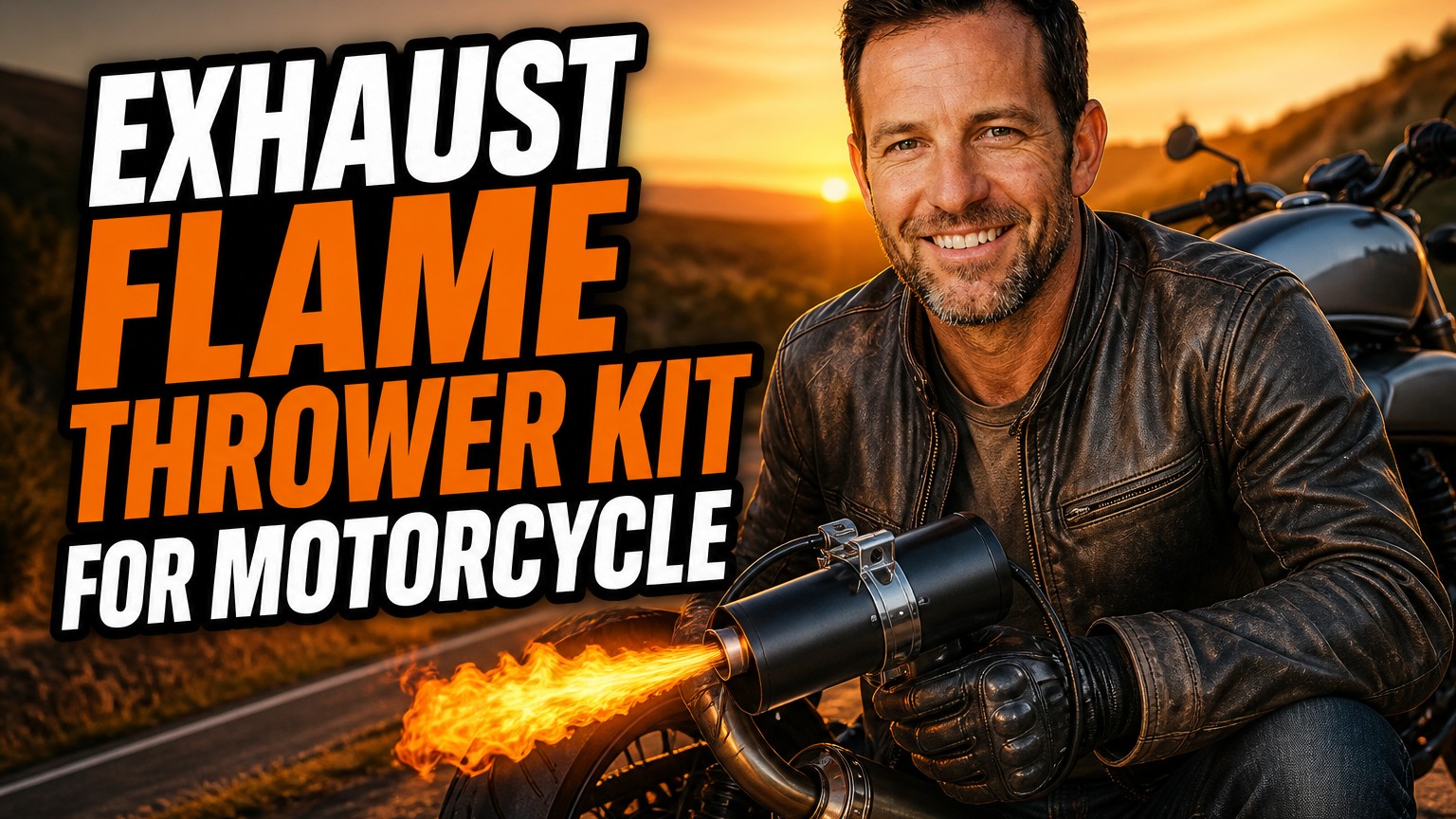
I’ll be honest: the first time I saw a bike spit a two-foot flame out of its tailpipe on a late-night downshift, I was hooked. I’ve spent a lot of time (and a few ruined heat shields) chasing that effect on my own bikes.
Here’s what most buyers don’t realize. The generic “flame thrower kits” on marketplace sites are mostly unbranded, with no real support, documentation or consistent quality. I wouldn’t bolt one of those near my fuel system.
So in this guide I focus on real, well-known products that produce flames the way modern bikes actually do: fuel and ignition tuning, ignition-cut quickshifters, and free-flowing pipes. Everything below is for off-road, track or show use only.
- Real flames come from a combo of tune, ignition cut and a free-flowing exhaust, not one magic bolt-on.
- My top pick is the Dynojet Power Commander 6 for adjustable, plug-and-play fuel control.
- Pair a quickshifter and a quality slip-on like the SC-Project CR-T for the best visual effect.
- Flame setups are illegal on public roads in most regions, so keep them for the track or private land.
How I Chose These Flame-Producing Setups
I judged each product on four things: how reliably it creates flames, how safe it is for the engine, how easy it is to install, and whether a real company stands behind it.
I also looked at how well each option plays with others. Flames rarely come from one part. They come from a system, so I’ve noted what each product pairs with best.
The Basic Science in 30 Seconds
Flames happen when unburnt fuel reaches the hot exhaust and ignites outside the combustion chamber. That fuel gets there when you cut the throttle, when ignition is cut for a clutchless upshift, or when timing is retarded.
The tune decides how much fuel arrives and when. The exhaust decides how loud and visible the result is.
1. Dynojet Power Commander 6 — Best Overall for Tunable Pops and Flames
The Dynojet Power Commander 6 is my first stop for anyone who wants flames without reflashing the factory ECU. It’s a plug-in fuel controller that sits between your harness and your injectors, so it’s reversible.
On supported models, I’ve used it to richen deceleration cells and play with ignition trim. Done carefully, that gives you a crisp crackle that turns into visible flames with an open slip-on.
Expect to pay roughly $400 to $480, depending on your bike. Dynojet publishes base maps, and the software lets you tweak them cell by cell.
Why I Like It
- Plug-and-play installation on most popular sport bikes and nakeds
- Fully reversible, so you can return to stock for inspection
- Huge library of base maps from a company with decades of dyno experience
What to Watch
The Power Commander 6 will not magically create flames on its own. You still need a free-flowing exhaust, and you need to be gentle with decel fueling. Overdo it and you’ll cook your O2 sensors and header paint.
2. Woolich Racing Tuned — Best for Deep ECU-Level Control
If you want flames to look factory-clean, Woolich Racing Tuned is the route I trust. It reflashes your stock ECU rather than adding a box on top.
On supported bikes, it lets you edit fuel, ignition and decel strategies directly, including the “pops and bangs” style maps the Euro sport bike crowd loves. There’s no extra wiring to hide.
The software and interface cost varies by bike and license, but you can generally expect a few hundred dollars in total. The learning curve is steeper than a plug-in box, so I’d recommend a tuner you trust for your first map.
Best For
Riders who value a clean look, are comfortable with data logging, and want precise control over when flames appear. Check bike compatibility before you buy, since support varies a lot by model and year.
3. Dynojet Quickshifter — Best for Upshift Flames
If you want flames on demand with every gear change, the Dynojet Quickshifter is my pick. It cuts ignition for a split second when you pull the shifter, so you can upshift without the clutch.
That brief ignition cut sends a charge of unburnt mixture into the pipe. With an aggressive exhaust, you get a satisfying burst of flame under hard acceleration.
Typical pricing runs about $250 to $400, plus a shift sensor for your bike. I’ve found it makes the bike faster and more fun, with the flames as a bonus.
My Take
This is the most useful item on my list because it improves riding, not just looks. Pair it with the Power Commander 6 and you have a very capable combo.
4. SC-Project CR-T — Best Slip-On for Looks and Sound
The SC-Project CR-T is one of the most recognizable slip-ons in the sport bike world. Its short, stubby canister with a carbon end cap looks fantastic, and it sounds even better.
On the right bike with a proper tune, it’s one of my favorites for showing off flames. The compact shape makes the flame appear to leap straight out of the bike’s rear end.
Prices usually land between $700 and $1,100, varying by model fitment and finish (titanium or carbon options). It’s not cheap, but the build quality is excellent.
Pros and Cons
- Pro: Lightweight construction and a head-turning design
- Pro: Free-flowing, ideal for decel pops with a tune
- Con: Loud, and often not road-legal without a baffle or db killer
5. Akrapovič Slip-On Line (Titanium) — Best Premium Build
When someone asks me for the highest-quality exhaust to pair with a flame tune, I point them to the Akrapovič Slip-On Line. The titanium construction handles heat cycling far better than cheap steel, so it won’t discolor or crack as quickly.
The sound is deeper and more refined than many competitors. Combined with a decel tune, you get crackle and the occasional flame without harshness.
Expect to spend roughly $800 to $1,600, depending on the bike. It’s an investment, but it holds its value well on the used market.
Who Should Buy It
Riders who want durability and a premium finish, and who care about sound quality as much as visuals. Check whether your version is street-legal in your region, because many Akrapovič lines come with homologated options.
6. Yoshimura Alpha T Slip-On — Best Value for Heat-Tolerant Flames
The Yoshimura Alpha T is a stainless slip-on with a titanium or carbon-fiber style end cap, depending on the model. It’s an American-built name with strong racing pedigree.
I like it for flame builds because it flows well and takes heat in stride. It’s also easier on the wallet than an Akrapovič or SC-Project.
Prices commonly sit around $450 to $800. For many riders, that’s the sweet spot of performance, build quality and cost.
My Experience
It produces a raspier, more aggressive note than some rivals. With a modest decel tune, I got steady crackle and the occasional short flame at night.
7. Arrow Pro-Race Slip-On — Best Italian Race-Style Option
The Arrow Pro-Race slip-on rounds out my list. Arrow is an Italian brand with deep racing roots, and the Pro-Race line uses lightweight titanium or stainless construction depending on the bike.
I find the Arrow Pro-Race has a sharp, crisp note that makes flames sound as dramatic as they look. It also tends to offer excellent fitment on European models.
Expect pricing around $600 to $1,200. If you ride a Ducati, Aprilia or BMW, it’s worth a close look.
Buying Guide: What I Look For Before I Spend a Dime
Compatibility First
Always confirm that a controller, quickshifter or tune supports your exact model and year. Flame setups are not universal, and the wrong map can wreck an engine.
Exhaust Materials
Titanium and quality stainless steel handle the thermal shock of repeated flames much better than cheap chrome-plated steel. Cheap pipes will discolor, crack or warp after a few sessions.
Tune Conservatively
More fuel is not always better. A lean-to-rich swing that’s too aggressive can overheat valves and ruin catalytic converters. I always start mild, then add a little at a time while watching temperatures.
Safety, Legality and Engine Health
Flame effects are illegal for road use in most places. They typically involve emissions tampering, noise violations or both. I only use mine on private property, at closed events or on the track.
Fire risk is real. Keep bags, fairings and plastics well clear of the tailpipe, and never trigger flames near dry grass, spectators or fuel.
Protect Your Engine with Good Oil
Extra fuel can wash past rings and thin your oil, so I shorten my change intervals on any bike that sees heavy decel fueling. If you’re shopping, my guide to the best motor oil for 4 stroke motorcycle engines is a good starting point.
You can also compare the top engine oil for 4 stroke motorcycle options if you want a deeper look at viscosity and additive packages.
Riders overseas may find the best engine oil for 4 stroke motorcycle in india breakdown more useful for local brands. And if you’re still unsure, this walkthrough on what is the best engine oil for 4 stroke motorcycle answers the basics.
For a broader overview, check out the best engine oil for motorcycle roundup too. Fresh, high-quality oil is cheap insurance for a bike that lives hard.
My Recommended Combos
Best Overall Combo
For the best mix of reliability and drama, I’d run the Dynojet Power Commander 6, a Dynojet Quickshifter and an SC-Project CR-T. It’s flexible, reversible and gives you flames on both decel and upshifts.
Best Budget Combo
Pair a Yoshimura Alpha T with a conservative decel map. You’ll spend less and still get plenty of crackle with occasional flames.
Best for Purists
Go with Woolich Racing Tuned and an Akrapovič Slip-On Line. It’s the cleanest, most “factory-looking” way to get a fire-breathing bike.
Final Thoughts
After a lot of trial and error, I’ve learned the best flame setups are built, not bought in a single box. A good tune, a quality exhaust and a quickshifter will beat any generic kit every time.
Take it slowly, tune conservatively and respect the law. Do that, and you’ll get all the fire and attitude without frying your engine or your wallet.
Frequently Asked Questions
Are exhaust flame thrower kits legal on motorcycles?
In most places, no, not for public roads. Flame effects usually require emissions or noise modifications that are illegal for street use in the US (EPA and CARB rules), the UK and much of the EU. I only run flame setups on a closed course, at private events or on show bikes.
Can an exhaust flame kit damage my motorcycle?
Yes, if it is installed or tuned badly. Unburnt fuel igniting in the exhaust can overheat catalysts, damage O2 sensors, discolor headers and wear out slip-on packing. A conservative tune and quality exhaust materials reduce the risk significantly.
What is the safest way to get flames from a motorcycle exhaust?
The safest route is a quickshifter with ignition cut or a decel tune on a quality aftermarket exhaust, rather than a crude secondary fuel injector. Keep flammable parts clear of the tailpipe and never run flames near spectators or dry grass.
Do I need a tune to get flames from my exhaust?
Almost always. A free-flowing exhaust alone may give you a few pops, but reliable flames need an ECU tune or fuel controller to deliver extra fuel or a retarded spark on deceleration and upshifts.

Related Articles
7 Best Batteries for Motorcycles I’ve Tested and Trust in 2026
I've tested dozens of motorcycle batteries to find the best performers. From AGM to lithium, here are my top picks…
Jake Miller
15 min read

The Perfect Battery for Your Harley Davidson Softail: A Rider’s Complete Guide
Discover the perfect battery for your Harley Davidson Softail. I've tested multiple options and share real-world performance data, maintenance tips,…
Jake Miller
14 min read

The Best Battery for Your Harley Davidson: My Complete Guide After Years of Testing
Discover which battery truly performs best for Harley Davidson motorcycles. Real rider experience with AGM, lithium, and OEM options to…
Jake Miller
12 min read