
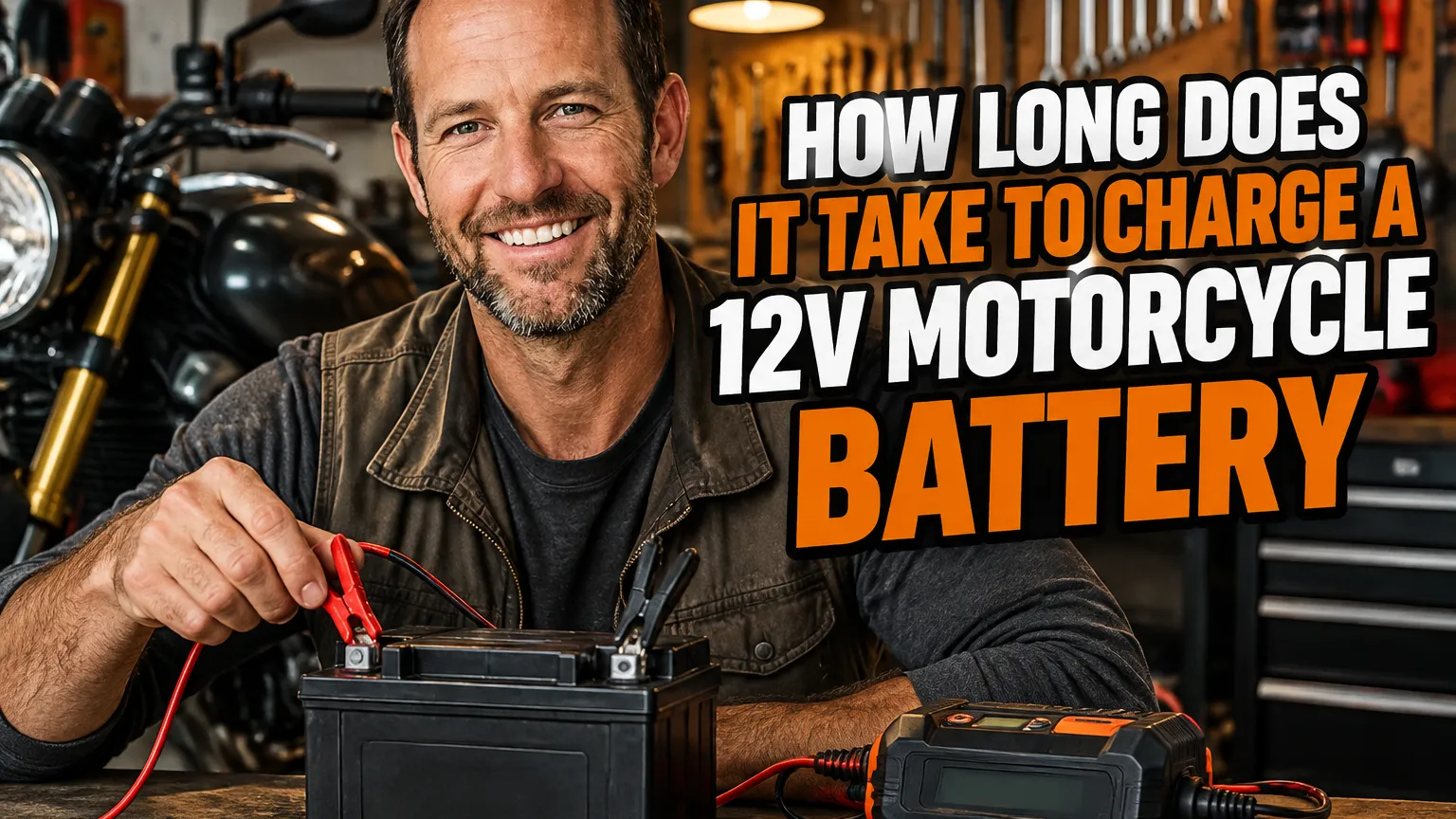
How Long Does It Take to Charge a 12V Motorcycle Battery? My Real-World Charging Times
 Jake Miller
9 min read
Jake Miller
9 min read
Why I Stopped Guessing and Started Measuring
For years I did what most riders do: I threw my dead motorcycle battery on a charger overnight, crossed my fingers, and hoped for the best. Sometimes it worked. Sometimes I came back to a hot, swollen brick that never held a charge again.
So I finally did the boring thing. I bought a proper smart charger, a cheap multimeter, and I started logging actual data across every 12V battery I owned. The results changed how I think about charging forever.
The short answer is that most 12V motorcycle batteries take 4 to 10 hours to charge properly. But that range is so wide that it’s almost useless without context. The real answer depends on three things: your battery’s capacity, your charger’s output, and how deeply you drained it.
Let me walk you through exactly how I work this out now, so you can stop destroying batteries and start getting years of reliable service out of them.
- Typical charge time: 4 to 10 hours on a proper trickle or smart charger for most 12V motorcycle batteries.
- The math that matters: Divide your battery’s amp-hour (Ah) rating by your charger’s amp output, then add about 40% for inefficiency and absorption.
- Never exceed the C/10 rate: If your battery is 12Ah, don’t push more than 1.2 amps into it or you’ll cook the plates.
- A full 12V battery rests at 12.6 to 12.8 volts. If it reads below 12.4V after charging, it isn’t done.
- Storage matters more than speed: The right maintainer prevents most of the deep discharges that force long charge times in the first place.
The Basic Math Nobody Tells You
Charging a battery isn’t magic, it’s arithmetic. Your battery has a capacity measured in amp-hours (Ah), and your charger pushes current measured in amps (A). Divide one by the other and you get a rough baseline.
A Real Example From My Garage
My daily rider runs a 12V 12Ah AGM battery. My go-to trickle charger outputs 1.2 amps. So:
12Ah ÷ 1.2A = 10 hours
That’s the theoretical minimum. In practice I add about 30 to 40 percent for charging inefficiency and the absorption phase, which means a dead-flat battery takes me around 13 to 14 hours to bring back to a true 100 percent.
If I use my bigger 2 amp charger instead, the math drops to roughly 6 hours of bulk charging plus absorption, so about 8 hours total. That’s a much nicer overnight window.
Why Faster Isn’t Better
Here’s the part riders get wrong. You cannot just grab a 10 amp charger and cut the time to an hour. Lead-acid and AGM motorcycle batteries have a maximum recommended charge rate called the C/10 rule.
That means your charge current should never exceed 10 percent of the battery’s Ah rating. For a 12Ah battery, that’s 1.2 amps. For an 8Ah battery, it’s 0.8 amps. Push harder and you generate internal heat, warp the plates, and boil off electrolyte.
I learned this the expensive way on a cheap battery I tried to “fast charge” before a weekend trip. It read fine for a week, then collapsed without warning. Never again.
Charging Times by Battery Size and Charger Output
Rather than make you do the math, here’s the cheat sheet I keep taped to my garage wall. These are realistic total times, not just the theoretical bulk phase.
Small Batteries (4Ah to 8Ah)
These are common in smaller bikes, scooters, and some dirt bikes. On a 0.8A maintainer, expect 6 to 9 hours. On a 1A charger, roughly 5 to 7 hours. They fill up fast, which is one reason I love them for quick top-ups.
Mid-Size Batteries (10Ah to 14Ah)
This is the sweet spot for most street bikes and cruisers. On a 1.2A charger, plan on 10 to 14 hours. On a 2A charger, 7 to 9 hours. This is the range I deal with most, and it explains why overnight charging is still the most practical approach.
Large Batteries (16Ah to 20Ah+)
Big touring bikes and adventure rigs run these. On a 1.5A charger you’re looking at 13 to 18 hours. A 2A to 3A charger gets you there in 9 to 12 hours. If you own one of these, a dedicated maintainer is not optional equipment, it’s essential.
What Actually Changes the Charging Time
The amp-hour math gives you a baseline, but several real-world factors stretch or shrink it considerably.
Depth of Discharge
A battery sitting at 80 percent charge tops up in an hour or two. A battery that’s been drained to 20 percent takes the full long haul. This is why a bike that sat all winter takes dramatically longer than one that just needs a weekend boost.
If your bike sits for months, you really should be looking at the best motorcycle battery for long storage so you’re not fighting a deeply sulfated cell every spring.
Battery Chemistry
Flooded lead-acid, AGM, and lithium all behave differently. Lithium (LiFePO4) batteries charge faster and hold voltage higher, but they need a charger with a lithium-specific profile. AGM sits in the middle. Flooded lead-acid is the slowest and most sensitive to overcharging.
Temperature
Cold slows the chemical reaction inside the battery. A battery that charges in 8 hours at 70°F might take 12 hours at 40°F. I’ve learned to bring batteries indoors the night before charging in winter.
Interestingly, heat is just as much of an enemy on the other end of the spectrum. The same way engines punish themselves with thermal stress, as I explained in my guide on how hot does a motorcycle engine get, batteries also degrade when heat climbs past their comfort zone.
Charger Quality
A dumb charger just pushes current until you unplug it. A smart charger runs bulk, absorption, and float stages automatically. The smart one takes slightly longer to hit float but produces a genuinely full battery that lasts.
How I Know My Battery Is Actually Full
Time alone is a terrible gauge. The charger light turns green, but that doesn’t always mean the battery is saturated. Here’s the check I do every time.
First, I disconnect the charger and let the battery rest for two hours. Then I check voltage with a multimeter. A healthy, fully charged 12V battery should read between 12.6 and 12.8 volts at rest.
If it reads 12.4V or lower, it’s not done. If it reads 13.2V or higher immediately after charging, it’s just surface charge and needs to settle before you trust the number.
The Voltage Chart I Use
Here’s what those resting numbers actually mean:
12.7V equals 100 percent. 12.4V equals roughly 75 percent. 12.2V equals about 50 percent. 12.0V equals 25 percent. And anything under 11.9V is effectively dead and may not recover without a desulfating charger.
Knowing where you sit on this scale tells you exactly how long to plan for.
Charging With the Bike Running: Does It Actually Work?
Riders ask me this constantly. The answer is complicated. Your motorcycle’s charging system (the stator plus regulator/rectifier) does produce power, but the amount depends heavily on engine RPM.
At idle, many bikes barely break even. Above 3,000 RPM, the system starts meaningfully charging. But a 20 minute commute with lights on and stoplights in between rarely refills a deeply drained battery.
My rule: ride-to-charge only works for maintenance, not recovery. If your battery is genuinely low, a proper charger is the only reliable path. This is also why I’m picky about which batteries I trust, and my breakdown of the best battery brand for motorcycle applications matters here.
Common Mistakes I’ve Made (So You Don’t Have To)
Charging looks simple, but I’ve ruined more than one battery through carelessness. Here are the traps.
Overcharging Overnight on a Dumb Charger
Dumb chargers keep pushing current. Leaving one connected for 24 hours on a small battery can boil it dry. It’s a slow, invisible death.
Charging a Frozen Battery
Never charge a frozen battery. If your garage dips below freezing and your battery is discharged, it can freeze solid. Charging it frozen can crack the case or, worse, cause a rupture.
Ignoring Sulfation
Batteries that sit discharged for weeks build sulfate crystals on their plates. Once sulfation sets in deeply, no charger can bring them back. The only fix is prevention through a maintainer.
This is the same principle of preventive maintenance that saves you from catastrophic failures elsewhere. Neglect a battery, a bearing, or a baffle, and eventually you pay for it. If you’ve ever wrestled with stubborn exhaust hardware, you know the drill, which is why I wrote up how to take baffles out of motorcycle exhaust for the same reason: fixing problems before they compound.
Choosing the Right Charger for the Job
I own three chargers, and each has a job. A 0.75A maintainer that lives permanently on my stored bike. A 1.5A smart charger for regular recovery work. And a 2A multistage unit for bigger batteries or faster turnarounds.
For most riders, a single 1.2A to 1.5A smart charger with automatic float mode covers 95 percent of needs. It’s slow, but slow is good. It’s also safe to leave connected for months, which is the whole point of a maintainer.
What to Look For
Multistage charging (bulk, absorption, float). Automatic voltage detection. Temperature compensation if you charge in a cold garage. Desulfation mode for reviving marginal batteries. And a SAE connector so you don’t fight alligator clips every time.
The Cost of Getting This Wrong
A quality 12V motorcycle battery costs anywhere from $40 to $150. Getting two seasons instead of five out of it because of bad charging habits is a real, recurring financial hit. I’ve done the math on my own mistakes, and it’s ugly.
It’s the same logic that makes any engine work painful when it shouldn’t be. Just as you’d think long and hard before facing how much does it cost to rebuild a motorcycle engine, you should think about battery care as cheap insurance against expensive replacements.
My Final Answer and My Routine
So, how long does it take to charge a 12V motorcycle battery? In my garage, the honest answer is 6 to 12 hours for most situations. Small batteries fill in half a day, big ones need an overnight stretch, and anything deeply drained needs closer to 20 hours with proper absorption time.
My routine is boring and it works. I run a smart 1.2A maintainer every two weeks during riding season, and it stays connected all winter. I check resting voltage monthly. I never fast charge. And I replace batteries the moment they fail to hold above 12.4V after a full charge.
Follow that pattern and you’ll rarely need to ask how long charging takes, because your battery will almost never be dead in the first place. That’s the real trick, and it took me years of wrecked batteries to figure out.
Frequently Asked Questions
How long does it take to charge a 12V motorcycle battery?
Most 12V motorcycle batteries charge in 4 to 10 hours with a proper trickle charger. A 12V 12Ah battery on a 1.2A charger takes about 10 hours, while a 2A charger cuts that to roughly 6 hours. Heavily discharged batteries need closer to 12 to 20 hours for a safe, full saturation.
Can I charge a motorcycle battery too fast?
Yes. Charging above 10% of the battery’s Ah rating (called the C/10 rate) generates heat, warps plates, and boils off electrolyte. Fast charging 12V bike batteries is one of the quickest ways to permanently reduce their capacity.
How do I know when my 12V motorcycle battery is fully charged?
Rest the battery for 2 hours after charging, then check with a multimeter. A healthy fully charged 12V battery reads 12.6 to 12.8 volts at rest. Anything below 12.4V means it still needs more time on the charger.
Is it better to trickle charge or ride to charge my battery?
Short rides rarely recharge a depleted battery because the stator and regulator only push out enough current above certain RPMs. For a deeply drained battery, a quality trickle charger is far more reliable than hoping a 20 minute commute does the job.

Related Articles

Scooters vs Motorcycles: My Honest, First-Hand Comparison After Riding Both for Years
After thousands of miles on both scooters and motorcycles, I break down cost, comfort, maintenance, and safety to help you…
Jake Miller
10 min read

7 Scooters That Look Like Motorcycles for Riders Who Want Style and Storage
Explore my top 7 scooters that look like motorcycles, from adventure crossovers like the Honda X-ADV to sporty maxis like…
Jake Miller
9 min read

How Long Do Honda Motorcycles Last? My 20-Year Owner’s Reality Check
Discover how long Honda motorcycles really last from an owner with 100k+ miles of experience. Learn maintenance secrets, high-mileage examples,…
Jake Miller
10 min read