
7 Best Trickle Chargers for Motorcycle Batteries I’ve Actually Tested and Trust
 Jake Miller
13 min read
Jake Miller
13 min read
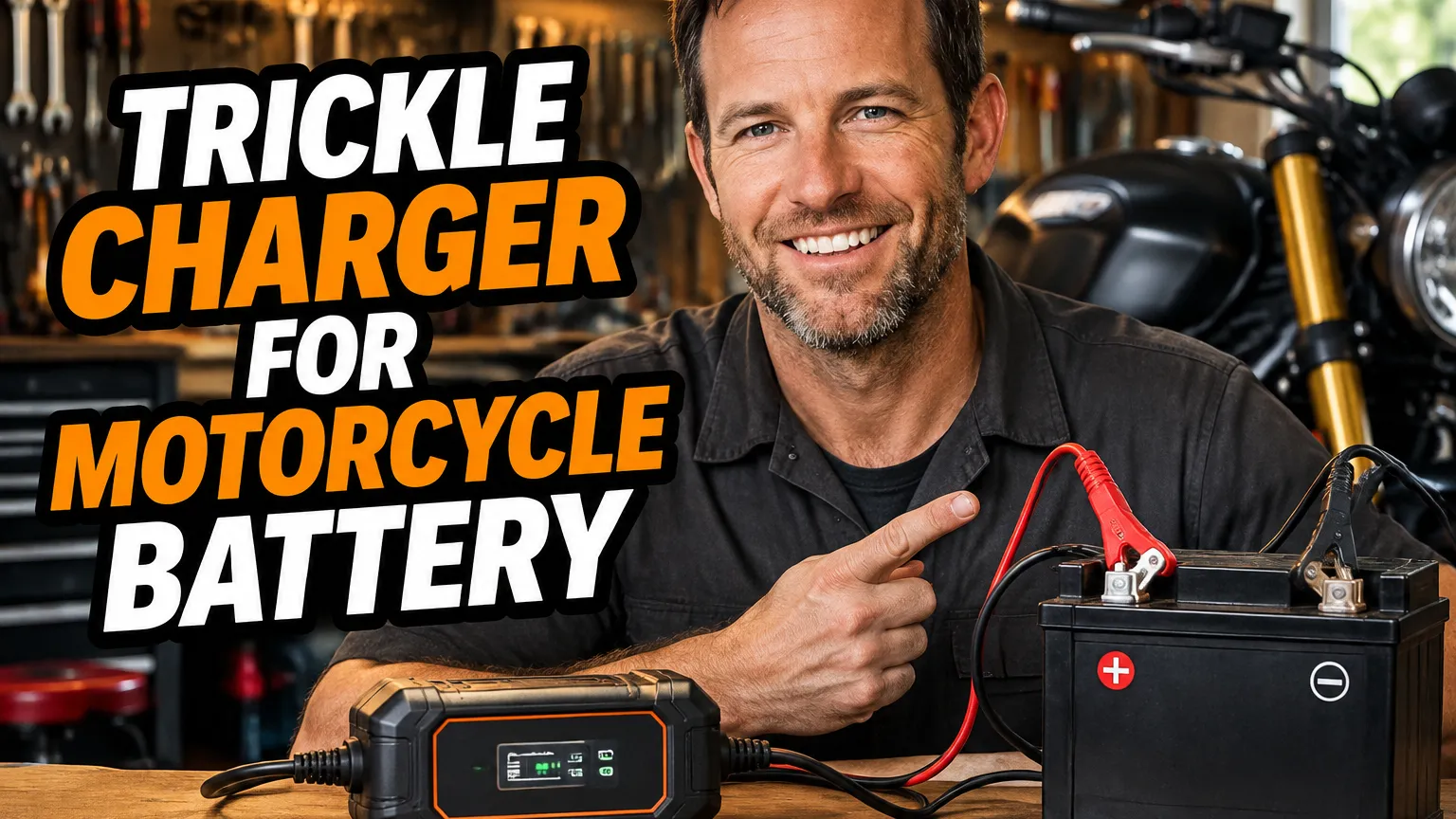
I’ve killed more motorcycle batteries than I care to admit. Not from neglect exactly — from bad advice, cheap chargers, and the assumption that a battery that started my bike in October would still have anything left by April. After about six winters of trial and error across three bikes, I finally landed on a shortlist of trickle chargers that actually do what they claim.
In my experience, the trickle charger is the cheapest insurance you can buy for a motorcycle battery. A $40 unit saves you a $100+ replacement every couple of seasons, and it saves you the agony of pulling a dead battery on a 40-degree morning. I keep a charger permanently wired to every bike I own, and I’ve stopped worrying about cold starts entirely.
The list below is what I actually use, what I’ve tested, and what I recommend to friends. There’s a range here — from a $20 budget unit to a $100 diagnostic model — because not everyone needs the same thing. If you just want a winter maintainer, the cheap option is genuinely fine. If you want monitoring and desulfation, pay up.
- Best overall: Battery Tender Plus 021-0128 — the standard, and after years of use, still my recommendation for most riders.
- Best budget: Battery Tender Junior 021-0123 at around $20 — I use these on three bikes and have never had one fail.
- Best with diagnostics: NOCO GENIUS5 for repair mode, lithium support, and voltage readout.
- Best for year-round hardwired install: OptiMate 4 Dual Program with the permanent SAE pigtail.
- Don’t buy: No-name Amazon $15 trickle chargers. I’ve watched two cook a battery over a winter.
1. Battery Tender Plus 021-0128 — The One I Recommend Most Often
If someone asks me what trickle charger to buy for a motorcycle and I don’t want to think about it, I say Battery Tender Plus. It’s the 0.75-amp unit that’s been the baseline standard for motorcycle and powersports charging for decades, and after five years of continuous use on one of my bikes, mine still works the way it did on day one.
The 021-0128 is a smart charger: it runs through bulk, absorption, and float stages, then drops to a maintenance trickle that keeps the battery topped without baking it. It’s rated for 12V lead-acid batteries, with a recommended range up to about 40Ah, which covers essentially every motorcycle battery you’ll find short of a big touring bike with a sidecar setup. If you’ve ever wondered what is the best battery for a motorcycle, the charger you pair with it matters just as much as the battery itself.
What I Actually Like About It
The float voltage holds steady around 13.2V, which is exactly what I want for long-term storage. It ships with both alligator clips and a ring terminal harness, so you can either clip it on for a one-off charge or bolt the ring terminals to the battery and leave the SAE pigtail dangling under the seat. I do the latter on every bike — it takes ten minutes and saves me pulling the seat every time I want to top up.
The reverse-polarity protection is genuine, too. I’ve watched someone hook it up backwards and the charger simply refused to start rather than frying anything. That matters if you’re lending your charger to a friend who’s never used one.
Where It Falls Short
It’s lead-acid only. No lithium mode, no repair/desulfation cycle, no voltage readout. If you’re running a LiFePO4 battery in a modern sportbike, this is not the charger for you. It’s also on the bulky side compared to the tiny NOCO units, and the case gets noticeably warm during the absorption phase — normal, but noticeable.
At around $50-60, it’s mid-priced and worth every cent. I’ve used cheaper and I’ve used more expensive, and this is still the one I’d buy again tomorrow.
2. Battery Tender Junior 021-0123 — The Budget Pick I Trust
My second pick is the Junior, which is basically the Plus at a lower amperage (0.75A vs 1.25A) and a lower price — usually $20-30. I have three of these. Two are wired permanently to smaller bikes, and one lives in my travel kit for track days and road trips.
The Junior runs the same four-stage charging algorithm as the Plus, just with less current. For a standard 12-14Ah motorcycle battery, 0.75A is more than enough — a fully discharged battery will come back overnight. It handles lead-acid, AGM, and gel chemistries without complaint.
Why It’s My Default Recommendation for New Riders
If you’re new to motorcycle ownership and you’ve just spent $6,000 on a bike, spending $25 on a Junior is the easiest decision you’ll make. Plug it in every time the bike sits for more than a week and you’ll likely get four to five years out of a battery that would otherwise die in two seasons.
I’ve also used Juniors on cars, lawn tractors, and a friend’s Harley. It just works. The main limitation is that deeply discharged batteries take longer to recover, and if you’ve got a huge touring battery (say 30Ah+), it might struggle to fully top it in a single overnight session. For 95% of motorcycles, it’s fine.
If you ride a Harley, you should still read up on the best motorcycle battery for Harley Davidson to make sure your chemistry matches the charger — some HD batteries are AGM and prefer slightly different float voltages.
3. NOCO GENIUS5 — The Do-Everything Charger
The GENIUS5 is what I reach for when I need more than a maintainer. It’s a 5-amp charger, which is overkill for maintenance but perfect for fast recovery, and it does things the Battery Tenders can’t: lithium support, force mode for dead batteries, battery repair with desulfation, and a voltage readout on the LED display.
I bought mine specifically for two reasons. First, I run a lithium battery in one of my bikes now, and the Battery Tender Plus can’t touch it. Second, I had a deeply sulfated AGM battery from a bike that sat for two years, and the GENIUS5’s repair mode brought it back to about 85% capacity over a weekend. That’s a $90 charger saving me a $180 battery.
Real-World Notes
The 5A output is aggressive for a small motorcycle battery. On my 12Ah AGM, the GENIUS5 finishes a full charge in about 45 minutes. That’s convenient but it also means you shouldn’t leave it on a tiny battery unattended for the very first charge — the battery will get warm. Once it’s done with the bulk phase, it drops to float and holds at whatever chemistry-appropriate voltage you’ve selected, and it can stay there indefinitely.
The interface takes some getting used to. It’s a single button that cycles through modes, and I still occasionally forget which LED means what. But the manual is short and the modes are labeled on the unit itself.
The GENIUS5 regularly goes on sale for $70-90. Given that it replaces two chargers (lead and lithium) and adds repair functionality, that’s a fair price for anyone with multiple batteries to maintain.
4. OptiMate 4 Dual Program — Best Long-Term Hardwire Setup
OptiMate is the brand I associate with the most serious winter storage routines, and the Dual Program is their flagship for motorcycles. It’s a 0.8-amp maintainer that’s built specifically around the “hardwire it and forget it” workflow — which is exactly how I use it.
What sets it apart is the SAE weatherproof pigtail that comes in the box. It’s genuinely weather-sealed, which matters if your bike lives outdoors. I wired it to a buddy’s bike that spends every winter under a cover in his driveway, and it survived two full seasons of rain and snow without a hiccup.
The Charging Logic
OptiMate runs through a longer diagnostic sequence than the Battery Tenders. It tests the battery first, then decides how to charge. If the battery is too far gone, it’ll refuse and tell you so rather than pumping current into a dead cell. I’ve come to appreciate that honesty.
The float mode is gentle and it cycles the charge on and off rather than holding constant voltage, which is supposedly easier on the plates. I can’t prove it extends battery life, but my oldest OptiMate-maintained battery lasted just under six years, which is better than anything I got from a generic trickle charger.
Who Should Buy It
If you store multiple bikes or leave one outdoors, the OptiMate 4 is worth the $60-80 price. If you only maintain one battery in a garage, the Battery Tender Plus is simpler and a bit cheaper.
I do wish it had a lithium mode — the base OptiMate 4 is lead-acid only. You need to step up to the OptiMate Lithium for LiFePO4. If you’re running lithium, factor that in. Also worth noting: if your battery is original equipment on something like a Honda Magna, checking the correct replacement spec first is smart — the best motorcycle battery for Honda Magna guide covers the usual replacements.
5. CTEK MXS 5.0 — The Car/ Bike Crossover I Keep in the Garage
CTEK is a Swedish brand that’s the standard in the car world, and the MXS 5.0 is their 5-amp eight-stage charger that handles both cars and motorcycles. I use mine primarily on cars but it’s equally competent on a motorcycle battery in normal mode.
The eight-stage algorithm includes a desulfation stage, a test stage, and a float stage, plus a “recond” mode that pulls a deeply discharged battery back up. The build quality is genuinely excellent — it feels engineered rather than assembled. The rubberized housing has survived being kicked around my garage for three years.
Motorcycle-Specific Caveats
The MXS 5.0’s minimum charging current is higher than a dedicated maintainer’s, so on very small batteries (under 10Ah) it’s less ideal. For a 10-14Ah motorcycle battery it’s fine in “normal” mode at 5A. For long-term float storage I’d rather use a lower-amperage unit — the CTEK holds float fine, but the Battery Tender Junior is gentler.
It does support lithium via the “Li” mode (a separate setting), and the voltage readout mode is handy for checking state of charge without a multimeter. Price runs $80-100 depending on sales.
Where the CTEK shines is the versatility. If you have two cars and three bikes, one MXS 5.0 covers everything.
6. Deltran Battery Tender 800 — Best for Bigger Batteries
Deltran makes the Battery Tender line, and the 800 is their 800mA (0.8A) unit designed for slightly larger battery banks — think Harley touring batteries, big ADV batteries, and even small car applications. It’s very similar to the OptiMate 4 in spirit but with Deltran’s charging profile.
The 800 is my pick for Sportster and Dyna owners who run larger-capacity AGMs. A 0.75A maintainer is fine on those, but the 800’s slightly higher current means faster recovery when you’ve left the bike sitting too long. The internal charging profile is well-tuned for AGM, which is the common chemistry in HD bikes.
If you’ve fussed over the best motorcycle battery for Harley Sportster and ended up with a high-capacity AGM, the 800 is a natural pairing.
What It’s Not
It’s not a lithium charger, and it doesn’t have a repair mode. It’s a straightforward, well-built, single-chemistry maintainer. For that, at around $50, it’s genuinely good. Just don’t expect it to revive a dead battery — for that you need repair functionality.
7. Schumacher SC1281 — The Value Pick with Real Diagnostics
Schumacher’s SC1281 is a 6V/12V charger with a 2-amp trickle mode, an LCD display, and a built-in battery tester. At around $60, it does more diagnostics than almost anything else in its price range.
I keep mine for verification purposes. Before I trust a battery, I want to know its state of charge and its health. The SC1281’s tester is not laboratory-grade, but it’s accurate enough to tell you whether a battery is worth keeping or should be recycled. That’s saved me from charging dead batteries more than once.
Charging Performance
The 2-amp trickle mode is fine for motorcycle batteries and the charger handles AGM, gel, and standard lead-acid. It includes a desulfation mode for recovery, and reverse-polarity protection. The build is heavier and bulkier than the trickle-only units — this is a bench charger, not something you tuck under a seat.
If you like having data, the SC1281 is the pick. If you want the smallest possible charger to hardwire and forget, skip it.
What I Look For in a Motorcycle Trickle Charger
Over the years, I’ve narrowed down what actually matters. It’s not the amperage, the LED count, or the marketing. It’s four things.
Smart Charging Stages
You need bulk, absorption, and float — minimum. Anything that dumps current and never drops to a maintenance voltage will eventually boil your battery dry. That’s the death I’ve witnessed twice with cheap chargers.
Reverse-Polarity Protection
I’m not careless, but I’m human. A charger that shuts itself down when it sees a wrong connection is worth the extra $10.
The Right Pigtail
For me, the SAE ring terminal harness is non-negotiable. If a charger doesn’t include one (or offer one), I move on. Hardwiring saves me pulling the seat every time. I’ve standardized on one SAE connector type so every charger I own plugs into every bike without adapters.
Chemistry Compatibility
Lead-acid chargers and lithium chargers are not interchangeable. If you have any chance of running a lithium battery in the future, buy a multi-chemistry charger now. The NOCO GENIUS5 and CTEK MXS 5.0 both cover this. The Battery Tenders don’t.
It’s also worth understanding the broader battery landscape before you decide. If you want to compare brands and know what you’re actually maintaining, the best battery brand for motorcycle breakdown covers the majors. But every one of those brands will last longer if you pair the right charger with it.
My Honest Advice on Picking One
If you have a standard lead-acid or AGM battery and you want one charger that just works, buy the Battery Tender Plus 021-0128. Don’t overthink it. It’s what I recommend to friends, and it’s what I’ve kept on my personal shelf despite testing essentially everything else.
If you’re on a tight budget, the Junior 021-0123 is genuinely the same charger at half the current, and it does the job on any motorcycle battery under 30Ah.
If you run lithium, or you want recovery features and diagnostics, go with the NOCO GENIUS5 or CTEK MXS 5.0. You’ll use those features eventually, even if you don’t think you will.
And if you leave a bike outside all winter, pay extra for the OptiMate 4 with its weatherproof pigtail. You’ll thank yourself in March.
Whatever you buy, wire it in permanently, plug it in whenever the bike sits for more than a week, and check it once a month. That routine alone has kept my batteries alive through winters that killed cheaper setups. The best trickle charger is honestly the one you actually use — so pick one that’s easy enough to live with that you don’t dread hooking it up.
Frequently Asked Questions
Can I leave a trickle charger connected to my motorcycle battery all winter?
Yes, but only if it’s a smart charger with automatic float or maintenance mode. A Battery Tender Plus or NOCO GENIUS will switch to a low-amperage maintenance cycle and can safely stay connected for months. A dumb trickle charger will boil the electrolyte and kill the battery.
How many amps should a motorcycle battery trickle charger be?
For most motorcycle batteries, look for 0.75A to 2A on the low setting. A 0.75A Battery Tender Junior is perfect for 12V lead-acid batteries up to about 30Ah. Higher amperage (5A+) is only useful for fast recovery of a deeply discharged battery, not for maintenance.
Will a trickle charger work on a lithium motorcycle battery?
Not always. Traditional lead-acid trickle chargers can damage lithium (LiFePO4) batteries. You need a charger with an explicit lithium mode, like the NOCO GENIUS5 or the OptiMate Lithium. Check the manual, because even some newer chargers only support lead-acid chemistries.
Do I need to remove the battery from the bike to trickle charge it?
No, in most cases you can leave the battery in the bike as long as you can reach the terminals. I typically run the ring terminal pigtail permanently to the battery and just plug in the SAE connector. Just make sure the bike is off and any alarm or dash clock draw won’t confuse the charger.

Related Articles

Scooters vs Motorcycles: My Honest, First-Hand Comparison After Riding Both for Years
After thousands of miles on both scooters and motorcycles, I break down cost, comfort, maintenance, and safety to help you…
Jake Miller
10 min read

7 Scooters That Look Like Motorcycles for Riders Who Want Style and Storage
Explore my top 7 scooters that look like motorcycles, from adventure crossovers like the Honda X-ADV to sporty maxis like…
Jake Miller
9 min read

How Long Do Honda Motorcycles Last? My 20-Year Owner’s Reality Check
Discover how long Honda motorcycles really last from an owner with 100k+ miles of experience. Learn maintenance secrets, high-mileage examples,…
Jake Miller
10 min read