
Motorcycle Battery Gets Hot When Charging? Here’s What’s Actually Happening (And When to Worry)
 Jake Miller
8 min read
Jake Miller
8 min read
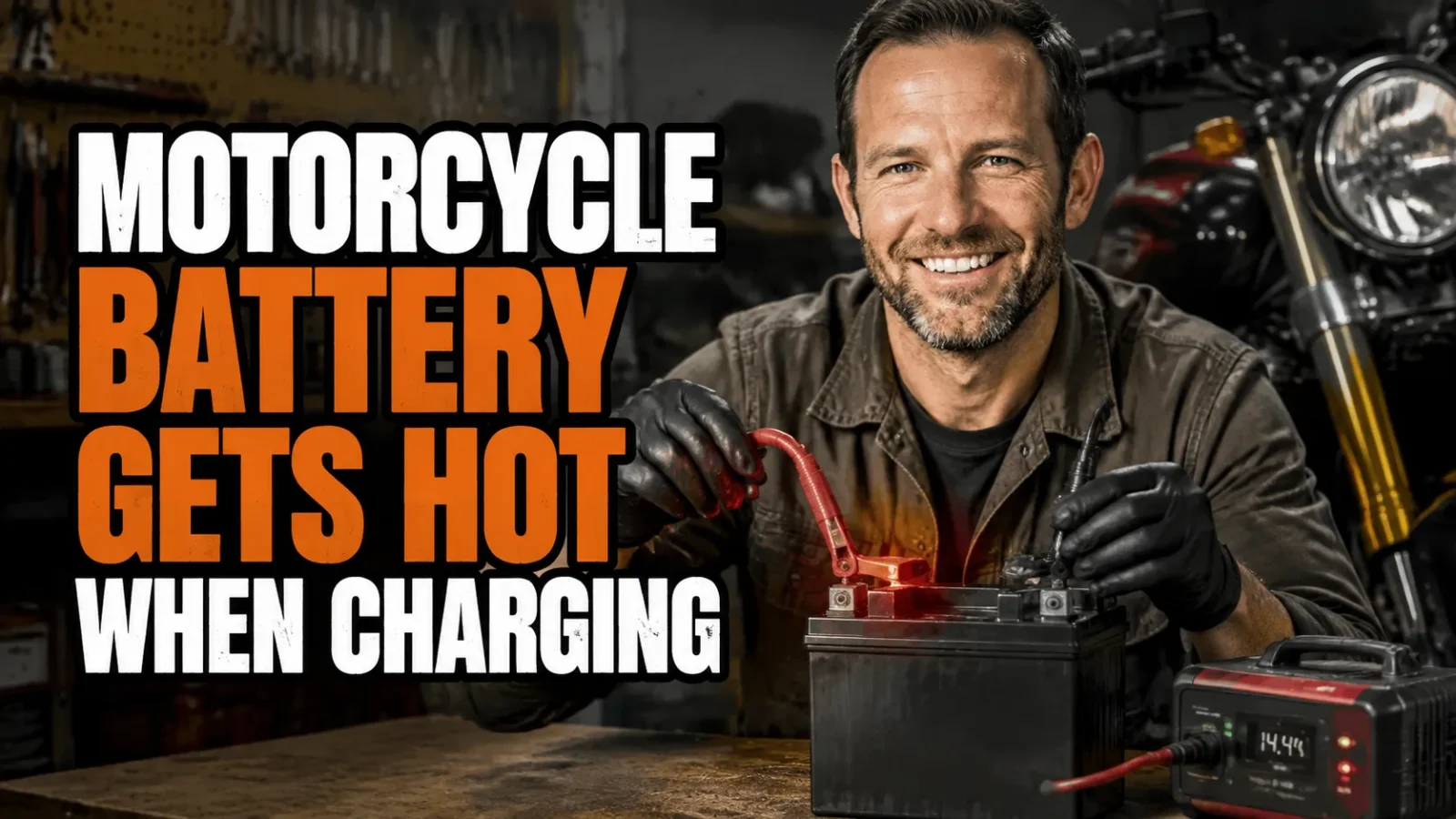
The Moment My Battery Started Feeling Like a Grilled Sandwich
I’d owned bikes for years before I ever got a charger that confused me. This one came with a weatherproof cover, a wall plug, and a reassuring little green LED. Ten minutes in, the LED was green. My battery was not.
It sat on my workbench and radiated heat like a mug of fresh coffee. Not dangerous, exactly. But notnormal either, and I learned quickly that heat is the battery’s version of a check-engine light. It’s telling you something.
Here’s the honest truth: some warmth during charging is chemistry doing its job. A lot of warmth, or heat that arrives too quickly, means the charge is being pushed, absorbed, or resisted more than it should be. Let me walk you through how to tell the difference.
- A little warmth during charging is normal, but heat above roughly 120°F (49°C) deserves attention.
- The most common causes are a mismatched charger voltage, an aged or sulfated battery, and loose or corroded terminals.
- Check the battery case for swelling, bulging, leaking electrolyte, or a burnt smell, and stop charging immediately if you see any.
- If heat shows up on every single charge, the battery is usually telling you it’s finished, not that it’s quirky.
- Match the replacement to your bike’s chemistry and your climate, then charge indoors in a cool, ventilated space.
First, What Counts As “Hot”?
I keep a cheap infrared thermometer in my garage now. Not because I’m obsessive, but because guessing with the back of your hand is unreliable. Touch alone can’t tell you 100°F from 130°F.
As a rough guide forlead-acid batteries, ambient temperature should stay under 120°F (49°C) throughout the charge. Above that, you’re accelerating water loss in the cells. For lithium-ion packs, the ceiling is lower and the consequences are worse, which is why I never charge a bike battery unattended indoors overnight.
Warmth that shows up late in the cycle, right when the charger moves into absorption and starts tapering the current down, is the most benign kind. Heat that appears within the first twenty minutes usually means something more serious, like a charger forcing too much voltage into a pack that can’t take it.
The Signs That Mean Stop Charging Now
- The case is swollen or bulging, especially on the sides or bottom.
- You see wetness, crusting, or a smell like rotten eggs around the terminals.
- The battery is too hot to keep your palm flat on it for more than a few seconds.
- You hear crackling, hissing, or popping during the charge.
- The charger’s indicator is flashing red or cycling on and off repeatedly.
Any one of those and I don’t finish the cycle. I disconnect, move the battery to a safe ventilated spot away from combustibles, and treat it as a battery that may need replacing today.
The Five Reasons Your Battery Runs Warm
1. Your Charger Speaks a Different Language Than Your Battery
This was my mistake, and it’s the most common one I see. I ran a lithium-friendly smart charger on an old flooded lead-acid battery because the case fit. The charger read the voltage, misjudged the chemistry, and pushed far too hard.
Lead-acid wants roughly 14.2 to 14.6 volts at the terminals during bulk charge. A lithium charge profile typically sits closer to 14.6 volts max but with a completely different absorption and termination logic. AGM and gel batteries have their own narrower windows. Using the wrong profile is like turbocharging an engine that was never built for boost.
If you’re shopping for a replacement, matching the chemistry properly matters more than capacity. My go-to battery brands for motorcycles all publish their recommended charge rates, which is the first thing I check.
2. The Battery Is Old, Sulfated, or Simply Worn Out
A healthy battery absorbs charge and cools down. A sulfated battery rejects charge, so the current sloshes around inside the cells as heat instead. That internal resistance is the whole problem.
Batteries usually give you a warning long before this point. Slow cranking, a weak horn, lights that dim at idle. But if the bike sat for months without riding, or you inherited it with an unknown history, sulfation is a real suspect.
3. Loose or Corroded Terminals Add Resistance
Corrosion is a poor conductor. Every bit of oxidation on the terminal or the cable clamp turns your charger’s energy into heat right at the connection point, which is why a hot battery often means a hot terminal too.
My routine is simple: a wire brush or a terminal scrubber, a clean rag, and a proper fastener tightened to spec. Then I coat the clamps with dielectric grease so water and salt stop the next corrosion cycle from starting.
4. Reverse Polarity or a Faulty Charger
Connecting positive to negative doesn’t just fail to charge. It forces current the wrong way through the cells, and the battery heats up as a result. If your charger has no polarity indicator, verify it manually before you plug in.
A charger with a failing transformer or a bad internal connection also dumps its problems into the battery as heat. If the pack gets warm on one charger and cool on another, the charger is the problem, not the battery.
5. Something on the Bike Is Draining It As It Charges
This one catches people out because they assume a bike on a charger is a closed system. It isn’t. If your headlight relay, horn relay, or accessory circuit is stuck on, current flows in from the charger and straight back out to ground.
The charger never sees a full battery, so it never stops pushing. The result is a battery that stays warm indefinitely. If you’ve got a bike that won’t restart once the engine is warm, parasitic drain is usually the thread worth pulling first.
My Safe Charging Routine
I charge in the garage with the door open and a battery-ratedbattery designed for hot weather conditions if I know a long hot spell is coming. Never in direct sun, never on a wooden surface, never overnight while I’m asleep.
Before I connect anything, I check the battery for swelling and clean the terminals. Then I confirm the chemistry setting on the charger matches the label on the case. I set a timer for two to three hours and check in.
When the charge completes, I disconnect and let the battery rest. A warm battery that’s been sitting in a hot garage can keep rising for a while after you pull the plug, so don’t panic the second minute after.
What To Look For In A Replacement
When I finally did replace mine, I stopped obsessing over amps and started paying attention to fit, chemistry, and build quality. Thebest 6V batteries for touring motorcycles are a different conversation from a lightweight sport bike, mostly because touring machines carry more electronics and run in hotter conditions.
Look for a strong warranty, a real terminal layout that matches your bike’s cable clearance, and a manufacturer that publishes discharge specs. If you ride through a hot season or park in a hot garage, choosing a battery rated for hot weather is the single best upgrade you can make.
Quick Answers Before You Panic
Should I be worried if my battery is warm right now? Mild warmth after a full charge is expected. Warmth with any swelling, smell, or crackling is not. Check the temperature, then check the case.
Can I leave the charger on overnight? A modern smart charger with a proper float stage is generally fine. A cheap dumb charger is not, because it will cook a battery flat and keep cooking. I use a timer anyway.
Will heat shorten battery life? Yes, significantly. Every degree above 77°F (25°C) meaningfully cuts service life. A battery that repeatedly runs hot during charging can lose years of usable capacity in a single summer.
The Bottom Line
My old battery got hot on every single charge, and I kept telling myself that was normal. It wasn’t. It was a sulfated cell slowly boiling off the water it needed for the rest of its life, and I’d replaced it about eight months later than I should have.
The lesson I carry now is simple.Some heat is chemistry. Lots of heat is a message. Learn what your battery’s normal warmth feels like, keep a thermometer nearby, and when the message becomes a shout, take it seriously.
Frequently Asked Questions
Is it normal for a motorcycle battery to get hot while charging?
A little warmth is normal. Most lead-acid and lithium-ion packs put off heat during absorption, and a battery rising to around120°F (49°C) is generally still within safe range. If it climbs higher, climbs fast, or feels too hot to hold your hand on, something is wrong.
Why is my motorcycle battery overheating while on the charger?
Common culprits include a charger set to a voltage too high for the battery chemistry, a sulfated or aged battery that cannot accept charge, a loose or corroded terminal, a reversed polarity connection, or a parasitic drain on the bike draining the pack while it sits on the charger.
Can a hot battery be damaged or explode?
Yes. Sustained heat above roughly 140°F (60°C) accelerates electrolyte loss, dries the cells, and shortens battery life dramatically. Sealed lithium-ion packs can go into thermal runaway, venting gas or in rare cases igniting. Never charge a swollen, leaking, or cracked battery.
Should I replace a battery that gets hot every time I charge it?
Usually, yes. Once a battery is old, sulfated, or damaged internally, heat on every charge is a symptom rather than a quirk. Test the voltage and specific gravity, and if it fails to hold a full charge, replacing it with a freshbattery matched to your bike’s chemistry is the safer fix.

Related Articles

Scooters vs Motorcycles: My Honest, First-Hand Comparison After Riding Both for Years
After thousands of miles on both scooters and motorcycles, I break down cost, comfort, maintenance, and safety to help you…
Jake Miller
10 min read

7 Scooters That Look Like Motorcycles for Riders Who Want Style and Storage
Explore my top 7 scooters that look like motorcycles, from adventure crossovers like the Honda X-ADV to sporty maxis like…
Jake Miller
9 min read

How Long Do Honda Motorcycles Last? My 20-Year Owner’s Reality Check
Discover how long Honda motorcycles really last from an owner with 100k+ miles of experience. Learn maintenance secrets, high-mileage examples,…
Jake Miller
10 min read