
Motorcycle Has No Power but Battery Is Good? 7 Causes I’ve Actually Diagnosed and Fixed
 Jake Miller
11 min read
Jake Miller
11 min read
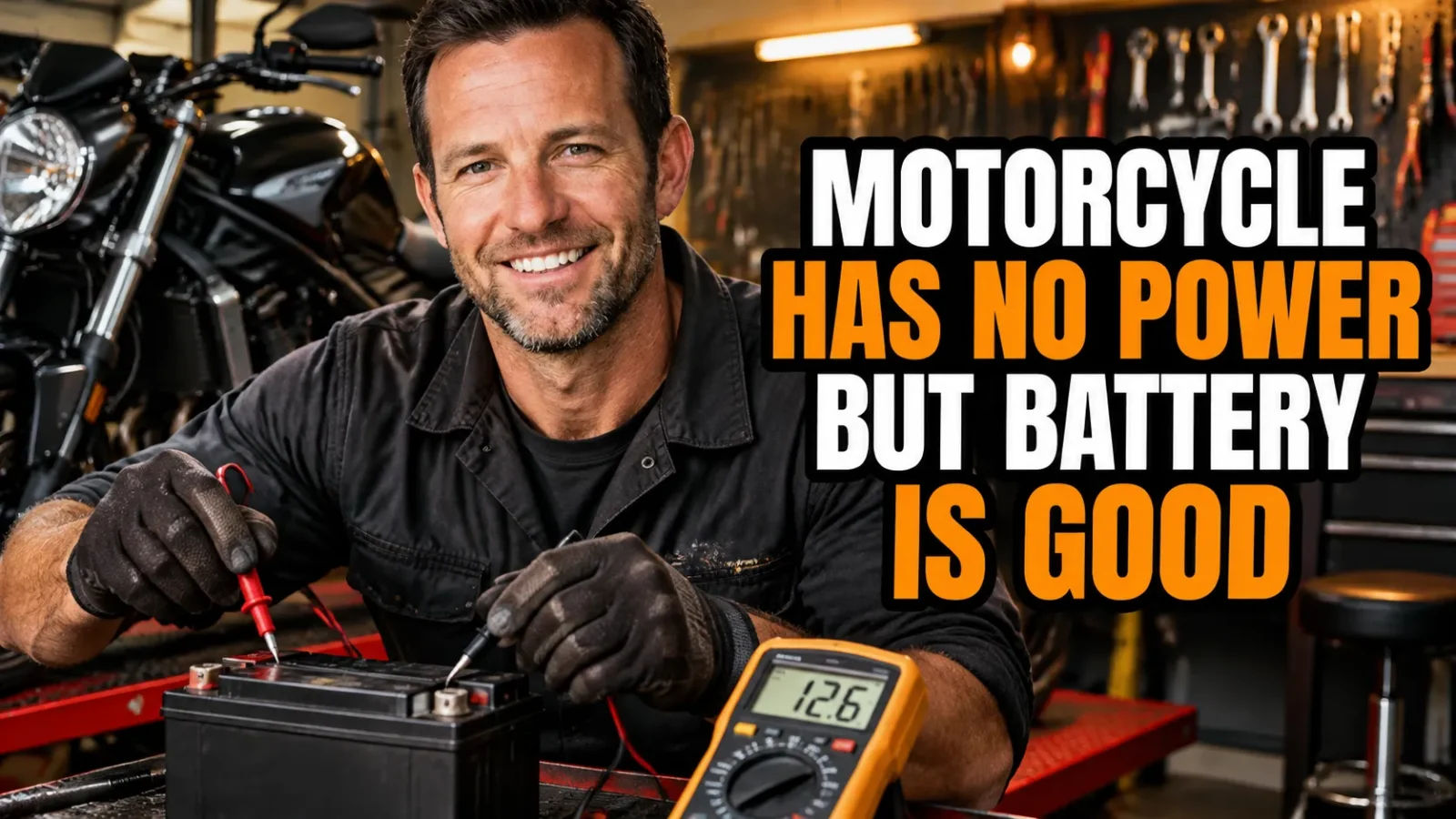
I’ve been riding for over a decade, and few things frustrate me more than swinging a leg over my bike, turning the key, and getting… nothing. No dash lights, no fuel pump hum, no starter click. Just silence. And the worst part? The battery tests fine. If you’re dealing with a motorcycle that has no power but the battery is good, I’ve been exactly where you’re standing, and I want to walk you through everything I’ve learned fixing this on my own bikes and my buddies’ bikes.
The good news: this problem is almost always something simple and cheap. The bad news: “no power” can mean five or six different things, and chasing the wrong one wastes an entire weekend. Let me save you that weekend.
- A “good” battery only rules out one suspect — the main fuse, starter relay, and bad grounds are the real usual culprits.
- Always load-test a battery, because voltage alone can lie to you.
- Most no-power gremlins are fixable in under an hour with basic tools and no mechanic bill.
- Regular maintenance — clean terminals, a quality charger, tight grounds — prevents the majority of these failures.
What “No Power” Actually Means
Before you start wrenching, get specific about your symptoms. “No power” is vague, and the exact failure mode points you toward completely different fixes. I break it into three categories based on what I’ve experienced in my own garage.
Category One: Total Silence
This is the scary one. You turn the key and the dash stays dark. No lights, no pump prime, nothing. In my experience, this almost always traces back to the main fuse, the ignition switch, or a ground cable that’s corroded loose. The starter motor isn’t even in the conversation yet, because the bike’s brain has no electricity at all.
Category Two: Lights On, No Crank
Here the dash lights up and the headlight works, but when you hit the starter button, you get silence or a single weak click. This is the classic starter relay or solenoid symptom, or a battery that reads fine at rest but collapses the second you ask it for 100 amps. I’ve personally had both happen on the same bike a year apart, which is why I always test in this order.
Category Three: It Cranks But Won’t Fire
The engine spins happily but never catches. Technically this isn’t “no power,” but riders describe it that way all the time. This points toward fuel delivery, spark, or a safety switch killing the ignition — a totally different diagnostic path than the first two categories.
The Seven Culprits I’ve Actually Found
Over the years, these are the failures I’ve personally pulled off bikes sitting dead in my garage. I’ll list them roughly in order of how often they’ve bitten me.
1. The Blown Main Fuse
This is my number one suspect, and it’s the first thing I check every single time now. The main fuse — usually a 20 or 30 amp blade fuse near the battery or starter relay — protects the entire electrical system. One dead short, one corroded wire touching frame, and it pops. The bike goes instantly, completely dark.
The fix costs about two dollars and two minutes. Pull the fuse, look at the metal strip inside, and if it’s broken, replace it with the exact same rating. But here’s the lesson I learned the hard way: find out why it blew, or the new one will pop the next ride. I once replaced a main fuse three times before I found a chafed wire in the headlight bucket.
2. The Starter Relay or Solenoid
If your dash has power but the starter won’t engage, the relay is my prime suspect. It’s the little box near the battery that clicks when you press the starter button. When its internal contacts burn out, power never reaches the starter motor. You’ll often hear a single click from the relay but no cranking.
I test mine with a simple trick: I bridge the two large terminals with an insulated screwdriver. If the starter spins, the relay is dead. It’s a five-dollar part on most bikes, and I keep a spare in my toolkit now. On my old cruiser, this failure happened twice in five years — it’s just a wear item.
3. A Battery That’s Lying to You
Here’s where I have to be honest with you: a battery can read 12.6 volts on a multimeter and still be useless. Voltage at rest tells you the battery is charged, not that it can deliver current. A battery with a dead cell or sulfated plates will show perfect voltage and then collapse to 6 volts the instant you hit the starter.
This is why I always insist on a load test. Most auto parts stores will do it for free, or you can buy a cheap load tester yourself. If the voltage drops below about 9.6 volts while cranking, the battery is the problem — even though it “tested good” with a simple voltage check. When I do need a replacement, I’ve spent the time figuring out what is the best battery for a motorcycle for my specific bike, because the right battery with proper cold cranking amps makes this whole failure mode much less likely.
4. Corroded or Loose Ground Cables
This one humbled me for years. Your bike’s electrical system completes its circuit through the frame, and the ground cable from battery negative to the engine or frame is critical. When that connection corrodes — and it always corrodes eventually — you get bizarre symptoms: dim lights, intermittent starting, or total no-power despite a perfect battery.
My rule now is simple: every time I change the oil, I pull both battery terminals and the ground bolt, clean them with a wire brush, and reassemble with a dab of dielectric grease. This ten-minute habit has prevented more problems than any other maintenance I do. I’ve also learned that when riders ask about the best battery brand for motorcycle use, the answer matters less than keeping those connections pristine — a premium battery can’t push power through a rusty ground strap.
5. The Ignition Switch
The ignition switch is a mechanical wear item, and on bikes more than a few years old, the contacts inside get pitted and oxidized. The result is exactly what you’d expect: turn the key, get nothing. Sometimes it works if you jiggle it, which is the telltale sign.
I test mine by checking for voltage at the switch’s output wire with the key on. No voltage in, no voltage out — switch is dead. Replacement switches run twenty to sixty dollars depending on the bike, and it’s a straightforward job on most models. Just make sure you get the right connector, because there are a few different styles out there.
6. Safety Switches and the Kill Switch
Modern bikes have a web of safety interlocks: side stand switch, clutch switch, neutral switch, and the handlebar kill switch. Any one of them can kill your start. The side stand switch is my personal nemesis — if the bike thinks the stand is down, it won’t crank, and those switches get gummed up with road grime.
My diagnostic habit: flip the kill switch off and on a few times, pull the clutch in firmly, confirm neutral, and try starting with the stand up. If it fires, you’ve found your gremlin. A shot of electrical contact cleaner into the switch usually fixes it. I’ve also seen kill switches fail internally on older bikes, which mimics a total no-power condition.
7. The Starter Motor Itself
If power reaches the starter but it won’t spin, the motor is the problem. Brushes wear out, armatures fail, and on high-mileage bikes, the starter is genuinely a maintenance item. You’ll usually get a click from the relay but no cranking, or a horrible grinding noise.
Before condemning mine, I always try the gentle tap test — a few light taps on the starter body with a rubber mallet while a helper presses the starter button. If it catches and spins, the brushes are worn and the starter’s days are numbered. It’s a temporary confirmation, not a fix, but it tells you exactly what to order.
How I Diagnose It, Step by Step
When my bike is dead in the driveway, I follow the same sequence every time. It takes about thirty minutes and has never once failed me.
Step one: confirm the battery voltage. Anything above 12.4 volts at rest means the battery is charged. Below that, charge it first — and if you ride infrequently, a quality best battery charger for a motorcycle with a maintenance mode is the single best investment you can make. I learned this after killing two batteries by letting them sit all winter.
Step two: check the main fuse. Visually, then with a multimeter on continuity. Thirty seconds, and it eliminates the most common cause.
Step three: listen for the fuel pump prime when you turn the key on. No hum means the bike’s ECU isn’t waking up, which points back to fuses, ignition switch, or grounds. A hum means power is flowing, and your problem is downstream — relay, starter, or safety switches.
Step four: inspect the ground cable and battery terminals. Clean, tighten, move on.
Step five: test the starter relay by bridging its terminals or swapping in a known-good one. If the starter spins, order a relay and ride on.
Step six: if everything checks out and the starter still won’t engage, pull the starter motor and have it tested at a shop. Most will bench-test it for free.
When the Battery Really Is the Problem
I want to be fair to the battery here, because sometimes it really is guilty despite your best testing. Batteries that sit discharged — especially over a cold winter — develop permanent sulfation that a load test might miss on a warm day. And batteries older than three or four years are living on borrowed time, even if they test fine.
My personal policy is to replace proactively at four years, and I choose replacements carefully. For my touring bike, which carries heated gear, a GPS, and a phone charger, I researched the best 6 battery for touring motorcycle options before buying, because the extra cold cranking amps and reserve capacity genuinely matter when you’re running accessories with the engine off. For my Indian, I went through the same process looking at the best battery for indian motorcycle picks, since those big twins have specific tray dimensions and power demands.
The pattern I’ve noticed: riders who maintain their batteries rarely get stranded, and riders who ignore them get surprised. It’s that predictable.
Prevention: My Four Habits
After years of this, my prevention routine is boring and effective. First, I keep the battery on a smart maintainer from October to April. Second, I clean terminals and the ground connection every oil change. Third, I carry a spare main fuse in the toolkit. Fourth, I replace the battery on a schedule, not a failure.
These four habits have taken me from “stranded twice a year” to “stranded never” in about five years of riding. The total cost is maybe forty dollars annually. The peace of mind is worth far more.
When to Call a Mechanic
I’m a confident home wrench, but I know my limits. If you’ve worked through the diagnostic sequence and everything tests good, the problem might be the ECU, a wiring harness chafe hidden under the tank, or an ignition coil failure — all of which need professional tools. Similarly, if the main fuse blows repeatedly, there’s a short somewhere that needs systematic tracing.
There’s no shame in the shop visit. I’d rather pay a diagnostic hour than spend my Saturday chasing a gremlin that needs a wiring diagram and a lift.
My Final Take
A motorcycle with no power but a good battery feels like a mystery, but it’s really just a checklist. Start with the main fuse, verify the battery under load, clean your grounds, and work through the relay and switches in order. Nine times out of ten, the fix is a two-dollar fuse or a ten-minute cleaning job.
I’ve fixed this problem on five different bikes now, and every single time, the cause was something simple I’d have found sooner with a methodical approach instead of random parts-swapping. Work the sequence, trust the process, and you’ll be back on the road before the weekend is gone. Ride safe, and keep a spare fuse in your pocket — future you will be grateful.
Frequently Asked Questions
My motorcycle has no power but the battery is good. What should I check first?
Start with the main fuse and the starter relay. A single blown fuse or a failed relay is the most common reason a bike with a healthy battery shows zero signs of life.
Can a battery test good but still cause a no-power problem?
Yes. A battery can show 12.6 volts at rest but collapse under load when you hit the starter. Always do a load test, not just a voltage check.
Why does my bike click but not start?
A single loud click usually means the starter relay or solenoid is working but the starter motor is seized, the battery is weak under load, or there’s a bad ground connection.
How do I prevent no-start electrical issues?
Keep terminals clean and tight, use a tender or smart charger during storage, and inspect your ground straps yearly. Most no-power gremlins start with corrosion.

Related Articles

Scooters vs Motorcycles: My Honest, First-Hand Comparison After Riding Both for Years
After thousands of miles on both scooters and motorcycles, I break down cost, comfort, maintenance, and safety to help you…
Jake Miller
10 min read

7 Scooters That Look Like Motorcycles for Riders Who Want Style and Storage
Explore my top 7 scooters that look like motorcycles, from adventure crossovers like the Honda X-ADV to sporty maxis like…
Jake Miller
9 min read

How Long Do Honda Motorcycles Last? My 20-Year Owner’s Reality Check
Discover how long Honda motorcycles really last from an owner with 100k+ miles of experience. Learn maintenance secrets, high-mileage examples,…
Jake Miller
10 min read