
Why Your New Motorcycle Battery Keeps Dying (And How I Fixed Mine for Good)
 Jake Miller
13 min read
Jake Miller
13 min read
I’ve Been There: The Frustration of a Dead “New” Battery
I still remember the gut-punch feeling when my brand-new battery died for the third time in two weeks. I’d just dropped $150 on what I thought was a premium replacement, and my bike still wouldn’t start on Monday morning. If you’re reading this, you’re probably in the same boat—furious, confused, and wondering if you got sold a lemon.
- A new battery dying repeatedly usually means a charging system fault, parasitic drain, or poor connections—not a defective battery
- Test your voltage output while running; you need 13.5-14.5V or your regulator/rectifier or stator is failing
- Check for parasitic draws with a multimeter—even 50mA can kill a battery in days when parked
- Clean and tighten all battery terminals and ground connections until metal shines through
- Invest in a quality battery tender if you don’t ride daily—it saved my battery life completely
Here’s what I learned the hard way: a new battery dying repeatedly is almost never the battery’s fault. After months of troubleshooting, multimeter testing, and more than a few roadside jumpstarts, I finally cracked the code on what was killing my batteries.
In this article, I’m sharing everything I discovered about why motorcycle batteries die prematurely, how to diagnose the real culprit, and the exact steps that fixed my charging nightmare for good. No fluff, no guesswork—just the solutions that actually worked.
The Real Culprits Behind Your Battery Deaths
When I first started diagnosing my dead battery problem, I made the classic mistake of assuming the battery itself was defective. I exchanged it twice before realizing I was chasing the wrong problem entirely.
The truth is that modern motorcycle batteries—even budget ones—are pretty reliable. When a new battery dies within days or weeks, something else in your electrical system is either draining it or failing to recharge it properly.
Your Charging System Isn’t Actually Charging
This was my problem, and it’s the most common reason new batteries die. Your motorcycle’s charging system has three main components: the stator (generates AC power), the regulator/rectifier (converts AC to DC and regulates voltage), and the wiring connecting everything.
When any of these components fail, your battery isn’t getting recharged while you ride. You’re essentially running on battery power alone, which drains it completely within a ride or two. In my case, my regulator/rectifier had failed internally—it looked fine from the outside, but it wasn’t converting power properly.
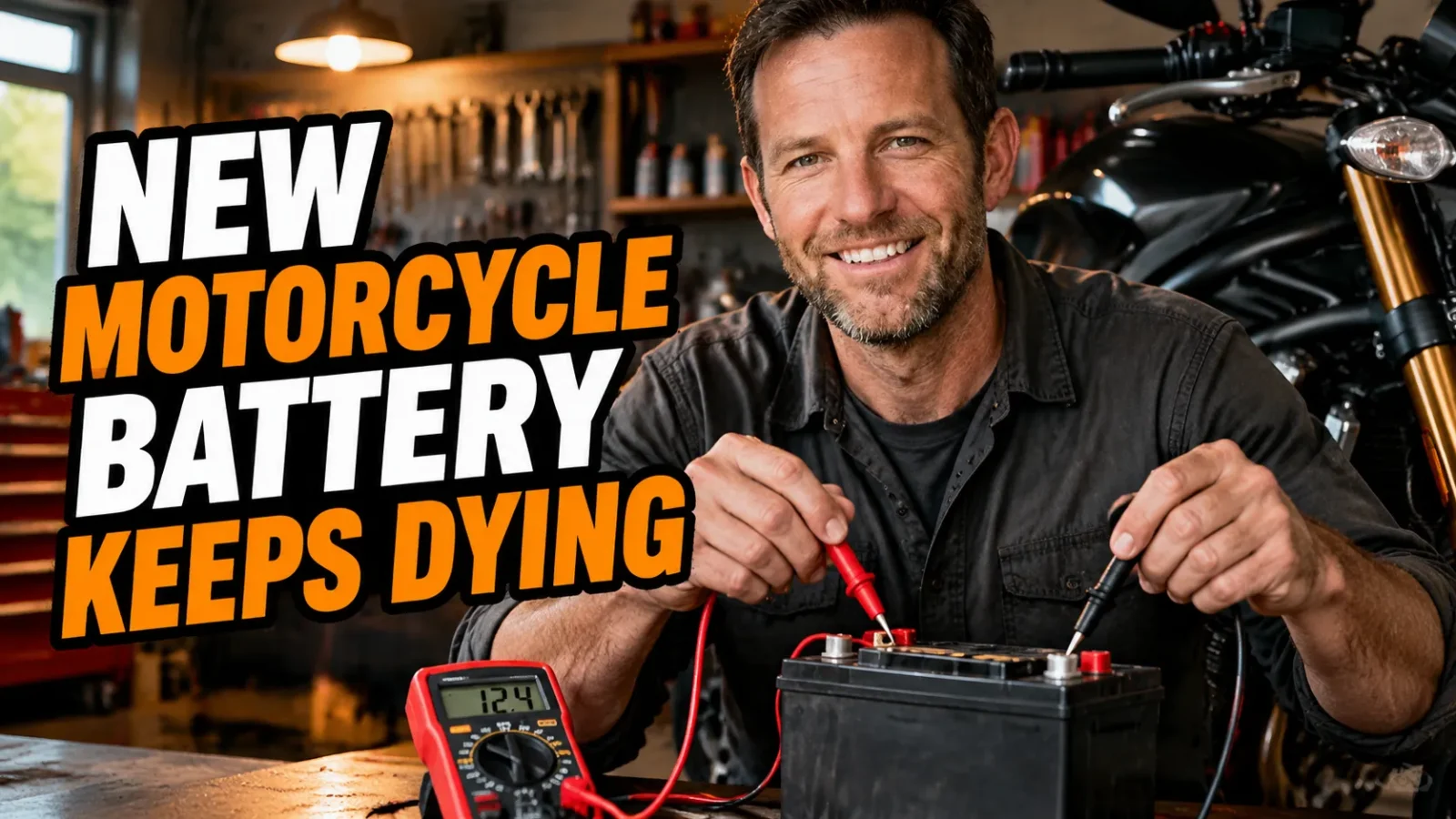
Here’s how I tested mine: With the engine running at idle, I measured voltage at the battery terminals. I got 12.4V—basically the same as when the engine was off. At 3,000 RPM, it only climbed to 12.8V. Those numbers told me immediately that my charging system was toast.
A healthy system should read 13.5-14.5 volts at any RPM above idle. Anything less means you’re not charging. Anything more (above 15V) means your regulator is failing and you’re overcharging, which will cook your battery from the inside.
Parasitic Drain: The Silent Battery Killer
Even when your bike is parked with the key off, small electrical draws can murder a battery surprisingly fast. I discovered this after fixing my charging system—my battery still died if I left the bike for a week.
Modern motorcycles have more electrical accessories than ever. That heated gear controller you installed? The USB charging port? The alarm system? The aftermarket LED strips? Each one potentially draws power even when everything seems “off.”
I found mine with a multimeter set to measure current. I disconnected the negative battery cable, connected the multimeter between the cable and the negative terminal, and watched the reading. A healthy bike should draw less than 20-30 milliamps when parked. Mine was pulling 85mA—enough to drain a battery in about five days of sitting.
Corroded or Loose Connections
This seems almost too simple to mention, but bad connections killed two of my batteries before I got serious about cleaning everything. Corrosion creates resistance, which prevents proper charging and can create voltage drops that confuse your bike’s electrical system.
I’m talking about both the obvious battery terminal connections and the ground connections you can’t see. My bike had a ground cable from the battery to the frame that looked fine on the outside but was green and crusty where it bolted to metal. That single bad ground was preventing my entire charging system from working efficiently.
How I Diagnosed My Specific Problem
Troubleshooting electrical problems requires a methodical approach, not random part swapping. I wasted money replacing parts that weren’t broken before I learned this lesson. Here’s the exact testing sequence I now follow, which has helped me diagnose issues on my own bikes and several friends’ machines.
Step 1: Test Battery Voltage at Rest
Before you start the bike, measure the battery voltage with a quality multimeter. A fully charged 12V battery should read 12.6-12.8 volts when at rest. If your “new” battery is reading 12.3V or less, it’s either not fully charged or it’s been sitting discharged so long that it’s sulfated.
I let my battery charge overnight with a smart charger, then tested again in the morning. This established a baseline and confirmed my battery could actually hold a charge. If it can’t reach 12.6V even after charging, the battery itself might actually be the problem (though this is rare with truly new batteries).
Step 2: Test Charging System Output
This is where I found my smoking gun. With the engine running, I measured voltage at the battery terminals at various RPMs. Start at idle, then rev to 2,000 RPM, 3,000 RPM, and 5,000 RPM. Record each reading.
You should see voltage climb to the 13.5-14.5V range by 2,000 RPM and stay stable there. If voltage doesn’t reach that range, your stator or regulator/rectifier is failing. If it climbs way above 15V, your regulator is definitely bad and will cook batteries.
When I did this test on my bike, voltage barely moved from the resting 12.6V. That told me power wasn’t making it from the stator to the battery—almost certainly a regulator/rectifier failure.
Step 3: Check for Parasitic Draw
With everything off and the key removed, I disconnected the negative battery cable and inserted my multimeter (set to measure DC current in series) between the cable and the negative terminal. This measures every milliamp of current leaving your battery.
I watched the reading stabilize (it takes 30-60 seconds for computers to go to sleep on modern bikes). Anything above 50mA is suspicious. Above 100mA and you’ve definitely got a problem.
I found my draw by pulling fuses one at a time while watching the multimeter. When I pulled the fuse for my accessory circuit, the draw dropped from 85mA to 18mA. Mystery solved—my heated grip controller was staying partially powered even when “off.”
Step 4: Inspect All Connections
I removed both battery cables and cleaned the terminals with a wire brush until I saw shiny metal. Then I traced every ground wire from the battery and cleaned those connection points too.
The difference was dramatic. My main frame ground had a thin layer of corrosion that was adding enough resistance to interfere with charging. After cleaning everything, my voltage readings improved even before I replaced any components.
The Fixes That Actually Worked for Me
Once I knew what was wrong, fixing it was straightforward. Your specific solution depends on what you found during testing, but here are the repairs that solved my issues permanently.
Replacing the Regulator/Rectifier
This was my primary fix. I ordered an OEM replacement regulator/rectifier for about $120 (aftermarket units were $60, but I wanted reliability). Installation took 20 minutes—just unplugging the old unit, bolting on the new one, and reconnecting the plug.
After replacement, my voltage test showed perfect numbers: 13.9V at idle, 14.2V at cruising RPM. My battery finally started staying charged between rides.
If your tests show overcharging (above 15V), this is definitely your fix. A failing regulator will destroy batteries fast by boiling off electrolyte and warping the internal plates. Choosing from the best battery brand for motorcycle won’t help if your voltage regulation is killing them.
Eliminating the Parasitic Drain
My heated grip controller was the culprit—its solid-state relay was leaking current even when switched off. I installed an inline switch on the power wire so I could physically disconnect it when not in use. The draw dropped to normal levels immediately.
For alarm systems or other accessories, sometimes you just have to live with a small draw and use a battery tender when parked. I installed a quick-connect pigtail on my battery terminals specifically for connecting a tender in my garage.
Upgrading to a Smart Battery Tender
This was a game-changer for my riding pattern. I don’t commute on my bike, so it often sits for a week or more between rides. Even with a healthy charging system, batteries self-discharge over time.
I invested in a quality smart charger—specifically, I researched best battery charger for a motorcycle options and picked one with desulfation modes and automatic maintenance charging. Now my bike is always ready to start, and my battery life has tripled.
The tender automatically switches to float mode once the battery is full, preventing overcharge damage. If you ride infrequently or live in a cold climate where you store your bike for months, this is absolutely essential.
When It Actually Might Be the Battery
I’ve focused on external causes because they’re responsible for 90% of “new battery dying” problems. But occasionally, you really do get a defective battery.
Here’s how to tell: If your battery won’t hold 12.6V after a full charge, or if it voltage-tests fine but dies under load (starter cranks weakly despite good voltage reading), you might have a bad cell. Internal short circuits or manufacturing defects can cause this.
Most quality batteries have warranties. I’ve had exactly one legitimately defective battery in 15 years of riding, and the manufacturer exchanged it immediately after I showed them my voltage test results. Make sure you know what is the best battery for a motorcycle for your specific needs before purchasing a replacement.
If you’re replacing batteries and you ride a touring bike with high electrical demands, consider upgrading to a higher-capacity battery. I researched options for my long-distance setup and found several best 6 battery for touring motorcycle choices that handled my heated gear and accessories without strain.
Prevention: Keeping Your Battery Healthy Long-Term
After solving my dying-battery nightmare, I implemented a maintenance routine that’s kept me trouble-free for three years. These habits take almost no time but make a massive difference.
Monthly Voltage Checks
Once a month, I spend two minutes checking battery voltage at rest and while running. This catches charging system problems before they kill a battery. If I see voltage trending downward over several months, I know something is starting to fail.
I keep a simple multimeter in my garage—nothing fancy, just a $20 digital unit that’s accurate enough for battery work. This small investment has saved me from multiple roadside failures.
Keep Connections Clean
Every oil change, I visually inspect battery terminals for corrosion. Twice a year, I disconnect the terminals and clean them with a wire brush. I also apply a thin coat of dielectric grease to prevent future corrosion.
This takes five minutes and has eliminated connection-related charging problems entirely. I’ve noticed that bikes stored outdoors or in humid climates need this more frequently—moisture accelerates corrosion dramatically.
Use a Tender for Storage
If my bike will sit for more than two weeks, it goes on the tender. This is especially critical during winter storage. Batteries self-discharge faster in cold temperatures, and letting them sit deeply discharged for months will sulfate the plates beyond recovery.
I’ve kept the same battery alive through four winters this way. Without a tender, I’d be replacing batteries annually at minimum.
Address Problems Immediately
The moment I notice slow cranking or dimming lights, I stop riding and start testing. Ignoring early warning signs just accelerates damage to both the battery and the charging system.
I learned this the expensive way—by running a bike with a failing regulator until it fried the stator too. What should have been a $120 repair became a $400 nightmare because I kept riding instead of diagnosing the problem.
Special Considerations for Different Motorcycle Types
Not all bikes have the same electrical demands or charging system designs. I’ve owned everything from simple dual-sports to electronics-laden touring rigs, and each has taught me something different about battery management.
High-Performance and Sport Bikes
These bikes typically have robust charging systems because of the power demands from fuel injection and ECUs. However, they also tend to have smaller batteries to save weight, which means less reserve capacity if something goes wrong.
I pay extra attention to connection quality on sport bikes because vibration is intense and can work terminals loose over time. I check battery hold-down bolts regularly and use thread locker on mounting hardware.
Touring Bikes with Heavy Accessory Loads
My touring bike runs heated gear, GPS, phone charger, auxiliary lights, and a sound system. The electrical demand is massive, and a marginal charging system will struggle to keep up.
For touring applications, I upgraded to a higher-capacity battery and verified that my charging system could handle the load by testing voltage under full accessory draw. If voltage drops below 13.5V with everything running, the system is overloaded. I also researched the best battery for indian motorcycle models specifically because those bikes have known high electrical demands.
Older Bikes with Simpler Systems
Classic and older motorcycles often have weaker charging systems that were never designed for modern accessory loads. Adding LED lights, phone chargers, or heated gear can overwhelm these systems.
I’ve learned to be conservative with electrical additions on vintage bikes. When I added a USB port to my older dual-sport, I wired it through a relay so it only had power with the ignition on, preventing parasitic draw.
My Final Recommendations
After three years of rock-solid reliability following my initial battery nightmares, here’s what I’d tell anyone dealing with a repeatedly dying “new” battery.
Start with systematic testing—don’t guess or randomly replace parts. A $20 multimeter and 30 minutes of testing will tell you exactly what’s wrong. Every time I’ve skipped this step, I’ve wasted money and time.
Fix the root cause, not just the symptom. Replacing the battery again won’t help if your charging system is bad or you have a parasitic drain. I learned this by going through three batteries before I fixed my actual problem.
Invest in a quality tender if you don’t ride daily. This single accessory has extended my battery life more than any other change. The $50 I spent on a good tender has saved me hundreds in replacement batteries.
Maintain your electrical system proactively. Clean connections, check voltages monthly, and address problems the moment they appear. Preventive maintenance is always cheaper and less frustrating than emergency repairs.
Most importantly, don’t accept a dying battery as normal. With a healthy charging system and basic maintenance, a motorcycle battery should last 3-5 years minimum. If yours isn’t, something is wrong—and now you know exactly how to find and fix it.
I went from replacing batteries every few months to riding worry-free for years. The knowledge I gained troubleshooting my own problem has saved me countless headaches and has made me a more confident rider. You can get there too.
Frequently Asked Questions
Why does my new motorcycle battery keep dying overnight?
A parasitic drain from accessories, faulty charging system components, or poor battery connections are the most common culprits. I’ve found that even a small draw of 50-100 milliamps can kill a battery in days.
How can I tell if my motorcycle’s charging system is bad?
Test your voltage at idle and at 3,000 RPM. You should see 13.5-14.5 volts while running. Anything outside this range means your regulator/rectifier or stator likely needs replacement.
Can a bad ground cause a new motorcycle battery to die?
Absolutely. I’ve seen corroded or loose ground connections prevent proper charging and create resistance that drains batteries quickly. Clean all ground points until they’re shiny metal.
Should I use a battery tender on my motorcycle when not riding?
Yes, especially if you ride infrequently. A quality tender maintains optimal charge without overcharging. I keep mine connected whenever my bike sits for more than a week.

Related Articles

Scooters vs Motorcycles: My Honest, First-Hand Comparison After Riding Both for Years
After thousands of miles on both scooters and motorcycles, I break down cost, comfort, maintenance, and safety to help you…
Jake Miller
10 min read

7 Scooters That Look Like Motorcycles for Riders Who Want Style and Storage
Explore my top 7 scooters that look like motorcycles, from adventure crossovers like the Honda X-ADV to sporty maxis like…
Jake Miller
9 min read

How Long Do Honda Motorcycles Last? My 20-Year Owner’s Reality Check
Discover how long Honda motorcycles really last from an owner with 100k+ miles of experience. Learn maintenance secrets, high-mileage examples,…
Jake Miller
10 min read