
7 Best Non-Petroleum Motorcycle Oils I Trust for Cooler, Smoother Rides
 Jake Miller
9 min read
Jake Miller
9 min read
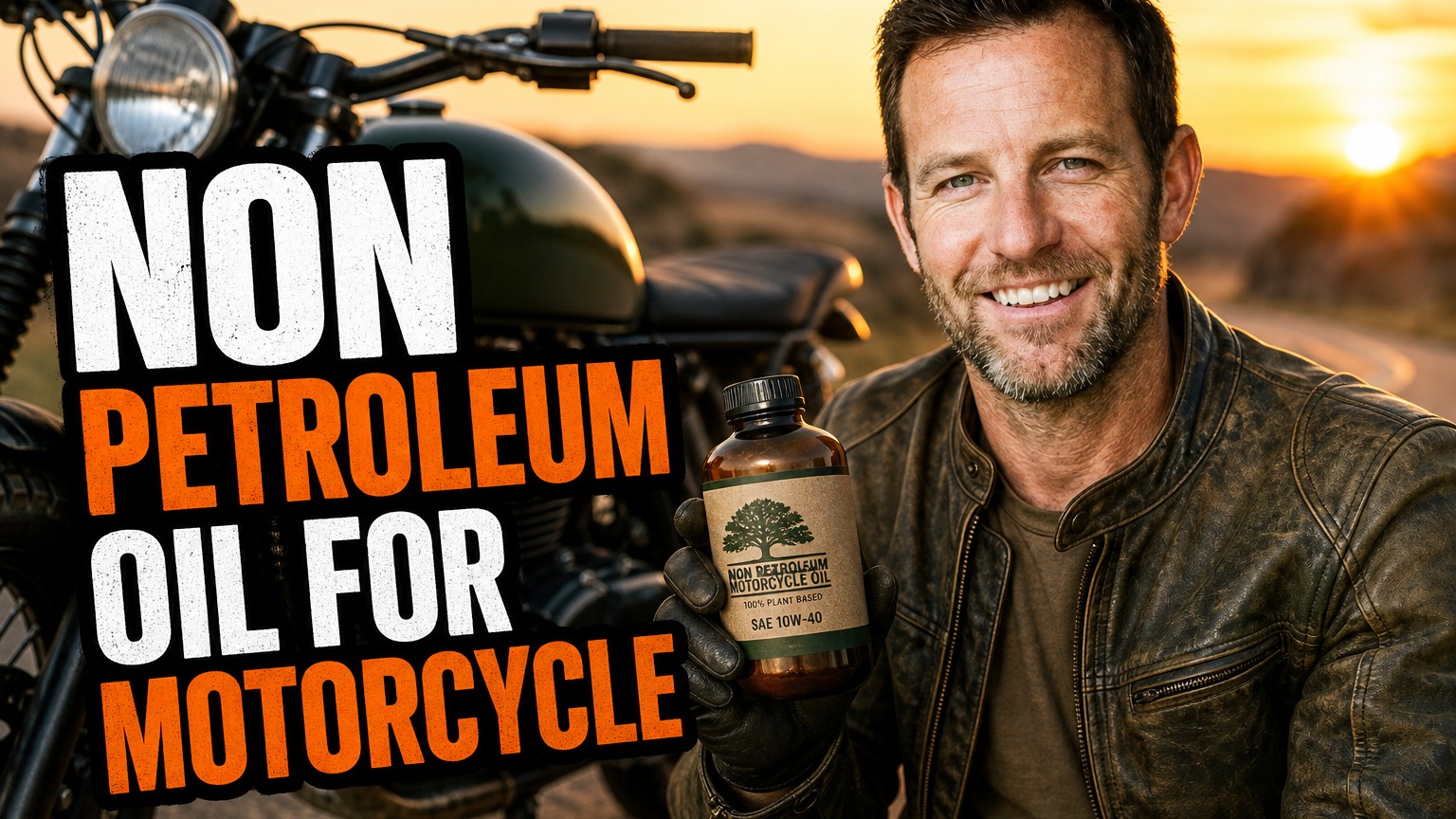
I’ve been riding and wrenching on my own bikes for years, and nothing sparks a debate in a garage faster than oil. Every rider has an opinion, and most of them are strong.
When I started looking for the best non petroleum oil for motorcycle engines, I wanted real answers. I wanted to know which synthetic oils handle heat, protect wet clutches, and hold up in hard riding. This list is what I landed on after plenty of oil changes and a lot of research.
- My top overall pick is Motul 300V Factory Line 15W-50, a double ester oil for spirited riding and track days.
- For most daily riders, Motul 7100 10W-40 and Shell Advance Ultra 4 10W-40 are the best value.
- Air-cooled V-twin owners should look at Amsoil Synthetic V-Twin 20W-50.
- Always check for a JASO MA/MA2 rating and match the viscosity in your owner’s manual.
What “Non-Petroleum” Actually Means for Motorcycle Oil
Conventional oil is refined straight from crude. Non-petroleum oils, in practice, are fully synthetic oils built on engineered base stocks like PAO (polyalphaolefin) or esters.
Esters are my favorite. They cling to hot metal surfaces, resist shearing, and handle the abuse a motorcycle gearbox dishes out.
Why Bikes Are Harder on Oil Than Cars
Most motorcycles share one oil supply between the engine, transmission, and wet clutch. That oil gets squeezed between gear teeth and cooked at high revs, which breaks down weaker oils quickly.
That’s why a car-grade synthetic isn’t automatically a good motorcycle oil. I always look for a JASO MA2 rating on the label.
How I Picked These Oils
I weighed five things: base stock quality, JASO rating, heat stability, real-world availability, and price per liter. I also leaned on my own riding experience and on feedback from fellow riders.
If you want to compare against more options, my guide to the best engine oil for motorcycle covers a broader range, including semi-synthetics.
1. Motul 300V Factory Line 15W-50 — Best Overall for Performance Riding
If I could only run one oil for the rest of my riding life, it would probably be the Motul 300V Factory Line 15W-50. It’s a fully synthetic oil built on Motul’s Ester Core technology, which blends double-ester base stocks for exceptional film strength.
What I Like
The 300V feels like it was made for high-revving engines. On my sportbike, the gearbox felt crisper and the engine ran noticeably smoother under hard acceleration.
It carries a JASO MA2 rating, so wet clutches are safe. It also comes in several grades, including 5W-30, 10W-40, and 15W-50, so you can match your manual’s spec.
What to Know
It’s pricey, usually around $20 to $30 per liter depending on the retailer and grade. That’s more than I’d spend on a commuter bike.
But for track days, spirited canyon runs, or an expensive engine, I consider it cheap insurance.
2. Motul 7100 4T 10W-40 — Best All-Rounder for Daily Riders
The Motul 7100 10W-40 is the oil I recommend most often to friends. It’s a 100% synthetic, ester-based oil with a JASO MA2 rating, and it costs less than the 300V.
In my experience, it’s a fantastic match for naked bikes, sport-tourers, and adventure machines. Shifting stays slick, and the clutch engages predictably, even in stop-and-go traffic.
Why It Earns Its Spot
- Ester-based formula for strong film strength and heat resistance
- JASO MA2 approval for wet clutch systems
- Widely available in 1-liter and 4-liter bottles
- Typically in the $15 to $20 per liter range
If you ride year-round and want a premium synthetic without going full racing grade, this is where I’d start. Riders comparing the best motor oil for 4 stroke motorcycle options will keep seeing this one near the top.
3. Amsoil Synthetic V-Twin Motorcycle Oil 20W-50 — Best for Air-Cooled V-Twins
Air-cooled V-twins run hot, and I learned that the hard way on a summer ride through desert heat. That’s where Amsoil Synthetic V-Twin Motorcycle Oil 20W-50 comes in.
It’s a fully synthetic oil designed for the demands of big, air-cooled cruisers. Amsoil formulates it to resist shear and thermal breakdown, and it’s JASO MA2 rated for wet clutch compatibility.
Real-World Impressions
On long, hot rides, the engine felt calmer, and I noticed less of that heat-soaked clatter at idle. Shifting also felt a bit smoother in the gearbox.
Pricing sits around $14 to $18 per quart, so it isn’t cheap. But for a Harley or similar cruiser, I think it’s worth it.
Who Should Skip It
If you ride a liquid-cooled sportbike that calls for 10W-40 or 10W-30, the 20W-50 isn’t right for you. Always follow the viscosity in your manual.
4. Red Line 10W-40 Motorcycle Oil — Best for Hard Use and Heat
I’ve got a soft spot for Red Line 10W-40 Motorcycle Oil. Red Line has a long reputation in racing, and this oil is built from synthetic base stocks with a strong additive package.
It’s formulated for motorcycle transmissions and wet clutches, and it’s JASO MA2 rated. It also has high film strength, which I appreciate when the engine is working hard.
My Take
The oil is slightly thicker in feel than some others, and I noticed reassuring oil pressure on hot days. It’s popular with riders on sportbikes, track bikes, and even older machines.
It usually costs about $13 to $17 per quart. For riders chasing the top engine oil for 4 stroke motorcycle use in hot climates, I think it’s a smart pick.
5. Shell Advance Ultra 4 10W-40 — Best Value Synthetic From a Major Brand
Not everyone wants to hunt down boutique oil, and I get that. The Shell Advance Ultra 4 10W-40 is easy to find and carries a fully synthetic formula.
Shell uses its PurePlus technology, which converts natural gas into a clear base oil rather than refining it from crude. That makes it a genuinely non-crude option.
Why It Works for Me
It’s JASO MA2 rated and meets API SN requirements, so it suits most modern four-stroke bikes with wet clutches. I’ve found it consistent and clean at changes.
Prices are typically $12 to $18 per liter, depending on region. If you live in Asia, it’s one of the easiest premium synthetics to find, which matters if you’re checking the best engine oil for 4 stroke motorcycle in India.
6. Liqui Moly Motorbike 4T Synth 10W-40 Street Race — Best European Option
The Liqui Moly Motorbike 4T Synth 10W-40 Street Race is a fully synthetic oil made in Germany. It uses an ester-based formulation and is marketed for sport and street bikes.
It has a JASO MA2 rating, so clutch slip isn’t a concern. I like how the gearbox felt during cold starts and highway cruising.
Strengths and Trade-Offs
- Strong cold-start flow for quick protection
- Ester content for film strength under load
- Fairly priced, usually $15 to $22 per liter
- Availability can vary depending on your country
If you ride a European bike, I think this oil makes a lot of sense. It’s a solid alternative when the Motul isn’t in stock.
7. Bel-Ray EXS Full Synthetic Ester 4T 10W-40 — Best for Spirited Street and Track Use
Bel-Ray has been in the motorcycle lubricant game for a long time. The Bel-Ray EXS Full Synthetic Ester 4T 10W-40 is their high-end four-stroke oil, built on ester base stocks.
The ester formulation is designed to give strong shear stability and film strength. It’s also JASO MA2 rated, so it’s suitable for wet clutch bikes.
How It Rides
I found it smooth and consistent through repeated heat cycles. Gear changes felt precise, even after a hard day of riding.
It typically costs about $15 to $20 per quart. If you want an alternative to the Motul lineup, this is the one I’d look at first. It’s also one of the strongest answers to what is the best engine oil for 4 stroke motorcycle when you want ester performance from a different brand.
How to Choose the Right Synthetic Oil for Your Bike
Check the Owner’s Manual First
The most important number is the viscosity your manufacturer recommends. If the manual says 10W-40, don’t jump to 15W-50 just because it sounds tougher.
Using the wrong viscosity can affect oil pressure, lubrication, and even warranty coverage.
Look for JASO MA or MA2
This rating tells you the oil is friction-tested for wet clutches. JASO MA2 is the higher friction standard and is what I look for on most bikes.
Avoid oils labeled “Energy Conserving” for wet clutch bikes, because they can contain friction modifiers that make the clutch slip.
Match the Oil to Your Riding Style
- Commuting: Motul 7100 or Shell Advance Ultra 4
- Track and spirited riding: Motul 300V, Red Line, or Bel-Ray EXS
- Cruisers: Amsoil Synthetic V-Twin
- European street bikes: Liqui Moly Street Race
Common Mistakes I See Riders Make
Ignoring the Filter
Great oil in a cheap, worn-out filter doesn’t do much good. I always swap in a quality filter with every oil change.
Stretching Intervals Too Far
Synthetics are tougher, but they aren’t magic. Heat, short trips, and hard riding all age oil faster than most people expect.
I stick to the manual’s interval, and I shorten it if the bike lives in harsh conditions.
Mixing Random Oils
Topping off with a different brand in an emergency isn’t a disaster. But for regular use, I stick to one oil so the additive packages work as intended.
Final Thoughts From My Garage
For me, the Motul 300V Factory Line 15W-50 is the standout if performance is your priority. For most everyday riders, the Motul 7100 or Shell Advance Ultra 4 offers a great balance of protection and price.
Whatever you choose, stay with the viscosity in your manual and look for that JASO MA2 rating. Your engine, your gearbox, and your clutch will all thank you.
If you’re deciding between a few of these, start with the one that matches how you actually ride. A good synthetic is one of the cheapest ways I know to keep a bike running well for years.
Frequently Asked Questions
Is synthetic motorcycle oil really non-petroleum?
Mostly, yes. Full synthetics built on PAO (Group IV) or ester (Group V) base stocks are engineered rather than refined directly from crude. Some ‘synthetic’ oils use heavily hydrocracked Group III petroleum, so check the base stock when it matters to you.
Can I use car synthetic oil in my motorcycle?
I don’t recommend it for bikes with a wet clutch. Many car oils contain friction modifiers that can cause clutch slip. Look for a JASO MA or MA2 rating on the bottle instead.
Do I need to flush my engine before switching to synthetic?
Usually not. On a healthy engine, I just drain the old oil, fit a fresh filter, and refill. If the engine is high-mileage or sludgy, talk to a mechanic before switching.
How often should I change non-petroleum motorcycle oil?
Follow your owner’s manual first. Many riders stay with the factory interval, while some stretch it slightly with high-quality synthetics. I would not exceed the manual’s recommendation on a bike that sees track days, heat, or heavy loads.

Related Articles
7 Best Batteries for Motorcycles I’ve Tested and Trust in 2026
I've tested dozens of motorcycle batteries to find the best performers. From AGM to lithium, here are my top picks…
Jake Miller
15 min read

The Perfect Battery for Your Harley Davidson Softail: A Rider’s Complete Guide
Discover the perfect battery for your Harley Davidson Softail. I've tested multiple options and share real-world performance data, maintenance tips,…
Jake Miller
14 min read

The Best Battery for Your Harley Davidson: My Complete Guide After Years of Testing
Discover which battery truly performs best for Harley Davidson motorcycles. Real rider experience with AGM, lithium, and OEM options to…
Jake Miller
12 min read