
7 Top Semi-Synthetic Motorcycle Oils I’d Trust in My Own Engine
 Jake Miller
9 min read
Jake Miller
9 min read
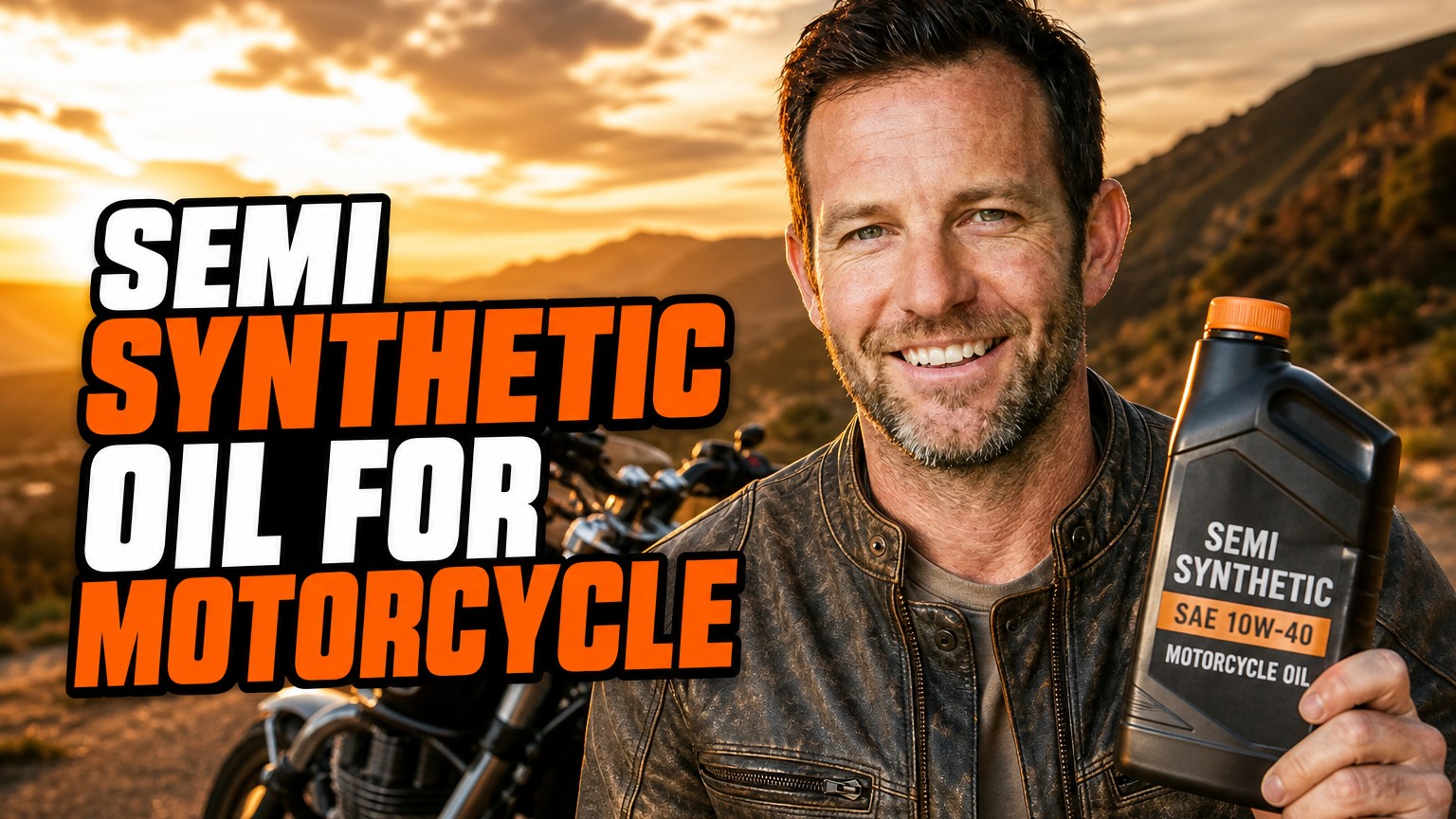
I’ve been wrenching on and riding my own bikes for years, and oil is the one maintenance topic I never get tired of talking about. It’s cheap, it’s easy to change, and it makes a real difference to how your engine, gearbox and clutch behave.
Semi-synthetic (also called synthetic blend) is the sweet spot for a lot of riders. You get much of the heat protection of a full synthetic without the full synthetic price tag.
Below are the seven semi-synthetic oils I’d happily pour into my own bikes. I’ve used several of them personally, and I’ve leaned on specs, rider feedback and my own experience for the rest.
- My overall favorite is the Motul 5100 4T 10W-40, thanks to its ester-based blend and excellent clutch feel.
- Budget riders should look at the Shell Advance 4T AX7 or Valvoline 4-Stroke Synthetic Blend.
- Always choose a JASO MA2 oil in the viscosity your manual specifies (usually 10W-40 or 20W-50).
- Semi-synthetic is ideal for commuters, tourers and cruisers that see regular, moderate use.
How I Picked These Oils
I didn’t want a list of random bottles with fancy labels. I judged each oil on the things that matter in a real motorcycle engine, where the oil lubricates the engine, the gearbox and the clutch all at once.
My Selection Criteria
- JASO MA/MA2 certification: non-negotiable for wet-clutch bikes.
- Viscosity stability: how well the oil resists shearing in a gearbox.
- Availability and price: I want oil you can actually buy at a sensible price.
- Real-world feel: smooth shifts, quiet valvetrain and a clutch that doesn’t slip or grab.
Why Semi-Synthetic at All?
Mineral oil is fine for older, low-stress engines, but it breaks down faster under heat. Full synthetic is superb, but it costs more and isn’t always necessary for a bike that mostly commutes or cruises.
Semi-synthetic sits in the middle. If you ever want to step up, I’ve covered the best fully synthetic oil for motorcycle options separately.
1. Motul 5100 4T 10W-40 — Best Overall Semi-Synthetic
If you only read one entry, make it this one. The Motul 5100 4T is a “Technosynthese” blend, meaning it combines synthetic base stocks with ester technology. Esters cling to hot metal surfaces, which helps with protection when things get toasty.
What I Like
The first thing I noticed with the Motul 5100 was how smooth the gearbox felt, especially on cold-start shifts into first. It’s certified JASO MA2 and API SM-rated, so it’s safe for wet clutches and modern engines.
It’s available in 10W-30, 10W-40, 10W-50 and 15W-50, so you can match almost any manual. Expect to pay roughly $13 to $18 per liter.
What to Watch
It’s not the cheapest bottle on the shelf. But for the clutch feel and the range of grades, the Motul 5100 is the one I come back to most often.
2. Castrol Power1 4T 10W-40 — Best for Daily Commuters
The Castrol Power1 4T 10W-40 is a partial synthetic that you’ll find almost everywhere. I’ve bought it at big-box stores and small dealerships alike, which is a big plus when you need oil in a hurry.
Real-World Performance
It carries a JASO MA2 rating and is formulated to resist viscosity breakdown in shared engine-gearbox-clutch setups. On my commuter, I noticed a consistent, predictable clutch engagement through a whole interval.
Price is typically $10 to $15 per liter. For stop-and-go riding, the Castrol Power1 4T is a dependable, no-drama choice.
Who It Suits
It suits riders of standards, nakeds and small sport bikes who want a reliable oil without overthinking it. It’s also a good match if you follow your manual’s schedule to the letter.
3. Shell Advance 4T AX7 10W-40 — Best Budget Pick
I’m always looking for oils that deliver more than their price suggests. The Shell Advance 4T AX7 10W-40 is exactly that. It’s a semi-synthetic that routinely costs less than most of its competitors.
Specs and Feel
The AX7 meets JASO MA2 and API SL standards and uses Shell’s active cleansing technology to help keep engine internals tidy. In my experience, it’s quiet, shifts cleanly and holds its viscosity well for the price.
You’ll usually find it around $8 to $12 per liter, depending on your region. Availability is strongest outside North America, so check local stock first.
Best For
I’d recommend the Shell Advance AX7 to riders on a tight budget who still want a certified motorcycle-specific oil. It’s also great for beginners who change oil frequently while learning to wrench.
4. Valvoline 4-Stroke Motorcycle Synthetic Blend 10W-40 — Best Value in the US
If I’m shopping at an American auto parts store, the Valvoline 4-Stroke Motorcycle Synthetic Blend is usually the first motorcycle-specific bottle I see. It’s easy to grab and fairly priced.
Why It Works
It’s designed for engines, transmissions and wet clutches, and meets JASO MA2 and API SN requirements. It also comes in 20W-50, which is handy for hot-climate riding and air-cooled twins.
A quart typically runs about $9 to $12. That makes the Valvoline synthetic blend a very approachable option for weekend riders.
The Catch
It’s a solid, no-frills oil. I wouldn’t use it for track days, but for normal street riding it does the job well.
5. Bel-Ray EXP Semi-Synthetic Ester Blend 4T 10W-40 — Best for Hot-Running Engines
Bel-Ray has a long history in off-road and racing, and the EXP Semi-Synthetic Ester Blend shows it. I like it for bikes that run hot, like air-cooled V-twins or any bike that spends a lot of time in traffic.
Specs That Matter
The Bel-Ray EXP uses ester-based synthetic technology and meets JASO MA2 and API SN. It’s formulated for shear stability, so the oil holds up in the gearbox over its interval.
It’s offered in several grades, including 10W-40 and 20W-50, and costs roughly $12 to $16 per liter. In my experience, it’s a very consistent oil.
Best Use Case
If you’re after a heat-resistant semi-synthetic for a hot climate or spirited rides, this is a strong pick. For serious track use, I’d move up to the guides on the best full synthetic oil for super sport motorcycle engines.
6. Motul 3100 Gold 4T 10W-40 — Best for Older and High-Mileage Bikes
Sitting just below the 5100 in Motul’s lineup, the Motul 3100 Gold 4T is also a Technosynthese blend. It’s a little simpler than the 5100, but it’s a lovely oil for bikes with a few miles on the clock.
What Impressed Me
It’s JASO MA2 certified and designed to protect against wear while keeping clutch performance consistent. On an older machine I own, it quieted some valvetrain chatter, and shifts felt a touch more positive.
It costs about $12 to $16 per liter. The Motul 3100 Gold is the one I’d choose for a well-loved bike that doesn’t need race-grade protection.
Choosing Between the 3100 and 5100
I pick the 5100 for performance-oriented bikes and the 3100 for relaxed, everyday ones. Both are excellent, so it comes down to riding style and budget.
7. Castrol Power1 Cruise 4T 20W-50 — Best for Cruisers
Cruisers and air-cooled V-twins often call for a thicker oil, and the Castrol Power1 Cruise 4T 20W-50 is built for them. It’s a partial synthetic made for big, torquey engines that run at lower rpm.
Why Cruiser Riders Like It
It carries a JASO MA2 rating, so it works with the wet clutches found on most cruisers. The 20W-50 grade gives a healthy film of oil in hot conditions, which suits long highway miles.
Expect to pay about $11 to $16 per quart or liter. For a relaxed tourer, the Power1 Cruise is a great fit.
A Quick Caution
Always check the manual before running a 20W-50 oil. Some modern cruisers actually call for 10W-40 or 10W-50, and using the wrong grade can hurt performance.
How to Choose the Right Oil for Your Bike
The right bottle depends on your engine, climate and riding style. Here are the main rules I follow.
Always Start With the Manual
Your owner’s manual lists the viscosity grade and the required API and JASO ratings. That’s the baseline, and I never deviate from it without a good reason.
If you’re still learning what to look for, my guide to the best motor oil for 4 stroke motorcycle engines explains the basics in more detail.
Don’t Skip the Wet Clutch Check
Most motorcycles share oil between the engine and the clutch. That means friction modifiers found in some car oils can cause slipping.
Look for JASO MA or MA2 on the label. I also have a dedicated rundown of the best synthetic motorcycle oil for wet clutch bikes if you want more options.
MA vs. MA2: Is There a Real Difference?
Both are safe for wet clutches. MA2 simply indicates a higher friction performance range, which is common on modern bikes. In practice, I’d happily use either, as long as the label is there.
Match the Oil to Your Riding
Commuting, touring and relaxed weekend rides suit semi-synthetic oils well. Aggressive riding, track days and extreme heat call for something stronger.
If you want to compare more options, here’s my roundup of the top engine oil for 4 stroke motorcycle models across all oil types.
Oil Change Tips From My Garage
Good oil only helps if you treat it right. A few habits have saved me headaches over the years.
- Change the filter every time. It’s cheap insurance and keeps the new oil clean.
- Warm the engine first. Warm oil drains faster and carries more contaminants out.
- Check the level on level ground. I let the bike sit a couple of minutes before reading the sight glass or dipstick.
- Don’t overfill. Too much oil can cause foaming and leaks.
- Keep a log. I write the date and mileage on a note in my garage.
As a rule, I change semi-synthetic oil every 3,000 to 5,000 miles, or once a year if I don’t ride much. Oil ages even when the bike sits.
Final Thoughts: Which Semi-Synthetic Should You Buy?
If I had to pick just one, it would be the Motul 5100 4T 10W-40. It has the best mix of protection, clutch feel and grade availability I’ve found in this category.
On a tight budget, the Shell Advance 4T AX7 and Valvoline Synthetic Blend are fantastic. And if you ride a cruiser, the Castrol Power1 Cruise 20W-50 is hard to beat.
Whichever you choose, stick to the viscosity and JASO rating in your manual, change it on schedule, and your engine will thank you for years to come.
Frequently Asked Questions
Is semi-synthetic oil good for motorcycles?
Yes. A quality semi-synthetic gives you better heat resistance and shear stability than mineral oil at a lower price than full synthetic. Just make sure it carries a JASO MA or MA2 rating so it’s safe for a wet clutch.
Can I use car semi-synthetic oil in my motorcycle?
I wouldn’t. Many car oils contain friction modifiers that can make a wet clutch slip. Stick with a motorcycle-specific oil that is JASO MA2 certified.
How often should I change semi-synthetic motorcycle oil?
Most riders change it every 3,000 to 5,000 miles (5,000 to 8,000 km) or once a year, whichever comes first. Always check your owner’s manual, since hard riding, track days and stop-and-go traffic can shorten the interval.
Can I switch between mineral, semi-synthetic and full synthetic oil?
Yes, as long as the viscosity grade and JASO and API ratings match your manual’s requirements. Different oil types are compatible and can be switched at an oil change.

Related Articles
7 Best Batteries for Motorcycles I’ve Tested and Trust in 2026
I've tested dozens of motorcycle batteries to find the best performers. From AGM to lithium, here are my top picks…
Jake Miller
15 min read

The Perfect Battery for Your Harley Davidson Softail: A Rider’s Complete Guide
Discover the perfect battery for your Harley Davidson Softail. I've tested multiple options and share real-world performance data, maintenance tips,…
Jake Miller
14 min read

The Best Battery for Your Harley Davidson: My Complete Guide After Years of Testing
Discover which battery truly performs best for Harley Davidson motorcycles. Real rider experience with AGM, lithium, and OEM options to…
Jake Miller
12 min read