
Why Your Carburetor Overflows (And How I Finally Stopped Mine From Dumping Fuel)
 Jake Miller
9 min read
Jake Miller
9 min read
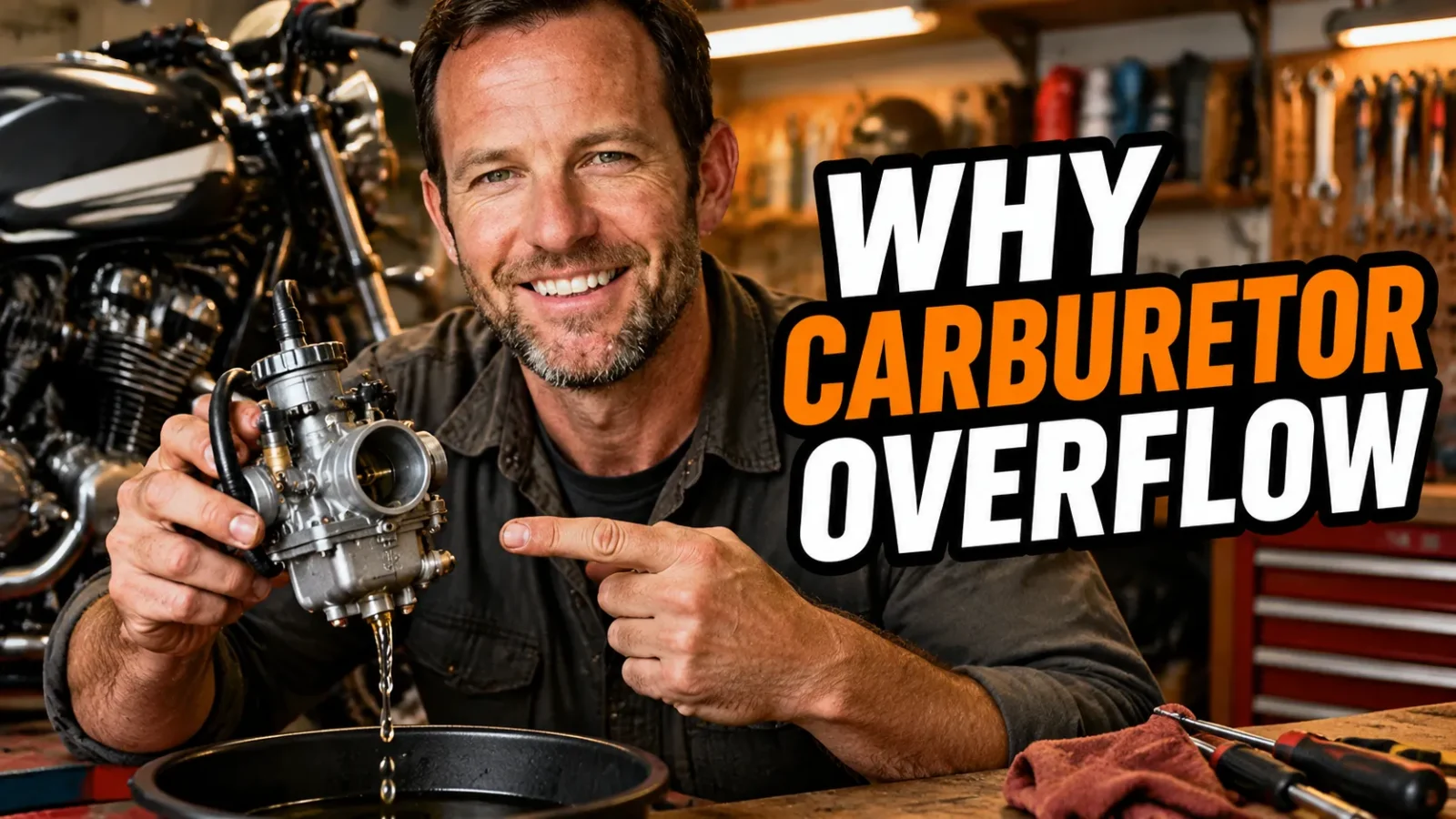
I still remember the smell. I walked into my garage one Saturday morning and the whole place reeked of gasoline, with a fresh puddle creeping out from under my bike’s air filter. Fuel was dribbling out of the carburetor overflow tube in a steady, mocking little stream.
If you’re reading this, you’ve probably got the same problem. Maybe it’s a slow drip, maybe it’s a full gusher the second you turn the petcock on. Either way, it’s frustrating, it’s messy, and honestly, it’s dangerous.
I’ve chased this exact gremlin across four different bikes over the years. Here’s everything I’ve learned about why carburetors overflow, and how I finally got mine to stop.
- The float and needle valve are the fuel level’s “off switch” — when they fail, fuel keeps coming and spills out the overflow.
- Stuck needles, varnish from ethanol fuel, wrong float height, and too much fuel pressure cause the vast majority of overflows.
- Tapping the bowl or shutting off the petcock might get you home, but it’s a band-aid, not a fix.
- Never ride it as-is — raw fuel near a hot engine is a fire hazard, and it can hydrolock your motor.
Why Carburetor Overflow Happens: The Short Version
A carburetor is really just a controlled leak. Fuel flows in from the tank, fills a small reservoir called the float bowl, and gets pulled into the engine as needed. A float and a needle valve work together to keep the fuel level in that bowl at a precise height.
Overflow happens when that control loop breaks. Fuel keeps flowing in, but nothing tells it to stop. The level rises past the overflow standpipe, and gravity does the rest.
That’s it. Every cause I’ve ever found is just a different way of breaking that same loop.
The Usual Suspect: A Stuck or Dirty Float Needle
Nine times out of ten, the culprit is the float needle and seat. The needle is a tiny cone-shaped plug that sits on the end of the float. As the bowl fills, the float rises and pushes the needle into its seat, sealing off the incoming fuel.
If that needle can’t seal, the bowl never stops filling. And if the bowl never stops filling, you get a puddle.
Think of it like a toilet tank
If you’ve ever replaced a flapper in a toilet, you already understand your carburetor. The float ball rises, the fill valve shuts off, and the water stops. When the flapper gets gummed up, water runs forever.
Your carburetor’s needle and seat work exactly the same way. And just like a toilet, the failure is almost always a sealing problem, not a mystery.
Debris and varnish are the real enemy
The single most common thing I find is a tiny speck of rust or grit wedged between the needle and its seat. It takes almost nothing. A grain of sand the size of a pinhead is enough to hold the needle open.
The second most common thing is varnish. Old fuel evaporates inside the bowl and leaves behind a sticky brown film that glues the needle in place. I’ve pulled needles out that were practically fossilized into their seats.
This is why ethanol-blended fuel gets so much blame. It absorbs moisture, breaks down faster, and leaves more gum behind than the old stuff ever did.
Float Height: The Adjustment Nobody Wants to Make
Even a perfectly clean needle won’t seal if the float height is wrong. Float height determines where the fuel level sits when the needle closes. Set it too high and the bowl overfills every single time.
I learned this the hard way after my first rebuild. I bent the float tang “close enough” and got a carb that overflowed worse than before I started. Close enough isn’t a thing here.
How I set float height now
I always look up the spec for my exact carburetor and measure with the carb tilted so the float tang just barely touches the needle. No compression, no guessing. I use a small ruler or a drill bit as a gauge.
If the float is brass and it’s sunk, that’s a different problem entirely. A brass float with a pinhole in it fills with fuel, sits low, and never shuts the needle off. I’ve shaken them next to my ear more times than I’d like to admit — if you hear fuel sloshing inside, it’s junk.
Fuel Pressure Problems: Petcocks, Pumps, and Gravity
Sometimes the needle and float are perfectly fine, but the fuel is arriving with too much force. Every float valve has a pressure limit, and once you exceed it, the needle gets pushed off its seat no matter how healthy it is.
Vacuum petcock failure
Most bikes use a vacuum-operated petcock that only flows when the engine is running or cranking. When the diaphragm inside fails, fuel can flow constantly, even with the bike off and parked.
I’ve come out to a flooded garage more than once because of a torn petcock diaphragm. If your carb overflows while the bike is just sitting there, test the petcock first. It takes five minutes and saves a lot of grief.
Electric fuel pumps and regulator drift
If your bike runs a fuel pump, check its output pressure against spec. A failing pump or a regulator that’s drifted high will overpressure the float valve and cause a constant overflow that no amount of cleaning will fix.
I always rule this out before I tear into the carb. It’s embarrassing to rebuild a carburetor twice and then discover the pump was the real problem.
Vents, Seals, and Other Sneaky Causes
Not every overflow comes through the needle. A few less obvious failures can leave you chasing your tail for weeks.
A blocked float bowl vent
The float bowl needs to breathe. If the vent is plugged, air pressure builds inside the bowl and pushes fuel out through the overflow. Mud daubers love vent tubes, and so does road grime.
A leaking float bowl gasket or O-ring
The O-ring under the needle seat is a part a lot of people forget to replace. When it fails, fuel sneaks past the seat threads and floods the bowl from a direction you’d never suspect.
A cracked overflow standpipe
Inside the bowl there’s usually a brass tube that sets the overflow height. If it’s cracked, fuel can seep through it and drip out even when the level is correct. I’ve seen this exactly once, and it drove the owner crazy for a month.
Ethanol Fuel Deserves Some Blame Too
I’m not going to pretend ethanol is the only problem, but it genuinely makes things worse. It attracts water, it degrades faster, and it leaves more deposits behind when it evaporates in a bowl that sits unused.
That’s why a bike that ran perfectly in October will overflow in April. The fuel in the bowl turned to gum, the needle glued itself open, and the first tank of fresh gas went straight onto the floor.
My routine now: always shut the petcock and run the bowl dry if the bike is going to sit more than a couple of weeks. It’s a thirty-second habit that has saved me hours of cleaning.
My Step-by-Step Diagnosis Routine
This is the order I work in now, and it’s cut my diagnosis time down to almost nothing.
- Shut off the fuel at the petcock. If the overflow stops immediately, you’ve confirmed the problem is upstream of the carb.
- Tap the float bowl lightly with a screwdriver handle. If the overflow stops, you’ve got a stuck needle, and now you know it’s mechanical instead of pressure-related.
- Drain the bowl through the drain screw and look at what comes out. Rust, grit, or cloudy fuel tells you the tank or filter is the source.
- Drop the bowl and inspect the needle and seat. Look for a wear ring on the needle tip and any varnish on the seat.
- Check the float for leaks and measure the float height against spec.
- Test fuel pressure if you have a pump, and test the petcock diaphragm if you have a vacuum unit.
- Verify the bowl vent is clear by blowing through it with your mouth.
I work in that exact order every time. Starting with the easiest checks saves me from pulling a carb off the bike when the real problem was a five-dollar petcock diaphragm.
Safety First: Why You Should Not Just Ride It Off
I want to be blunt here, because I’ve been tempted to ignore this myself. A carburetor that’s overflowing is not a minor annoyance you can ride around.
You’ve got raw fuel pooling on top of a hot engine, dripping onto exhaust pipes, and running down toward the ground where a stray spark could find it. I’ve seen a bike fire from exactly this. It happens fast.
There’s mechanical damage too. Fuel can wash past the piston rings into your oil, thinning it out and destroying bearings. On a multi-cylinder engine, it can fill a cylinder with liquid fuel and hydrolock the motor, which bends connecting rods.
So: shut the petcock, park it, and fix it properly before you ride again. No exceptions.
Should You Rebuild, Repair, or Replace?
Most of the time, a rebuild kit is all you need. A fresh needle, seat, O-rings, and gaskets cost very little and solve the overwhelming majority of overflow cases I’ve dealt with.
I also always add an inline fuel filter and clean the tank if I found rust. Installing new parts and feeding them the same grit is a recipe for doing the job twice.
Replacing the entire carburetor is usually unnecessary. I only consider it when the body itself is corroded, a passage is permanently blocked, or the throttle shaft bores are so worn that the carb can’t be tuned. Those are rare.
Final Thoughts From Someone Who’s Been There
Carburetor overflow feels mysterious, but it almost always comes down to one thing: fuel is getting in and nothing is stopping it. Find out which part of that control loop failed, and the mystery disappears.
Start with the simple checks. Shut off the petcock, tap the bowl, look at what’s in there, and test the needle and float. You’ll find your answer faster than you expect.
And if your bike is going to sit for a while, run that bowl dry. Trust me on that one. My garage floor and I have a much better relationship now.
Frequently Asked Questions
Why is my carburetor overflowing with fuel?
In most cases the float needle is not sealing against its seat, so fuel keeps filling the bowl until it spills out the overflow or vent tube. Debris, varnish, a worn needle tip, or float height set too high are the usual reasons.
Can I ride a bike with a carburetor that overflows?
Please don’t. Raw fuel near a hot engine is a fire risk, and fuel can also wash past the rings into your oil or fill the cylinder and hydrolock the engine.
Does a stuck float always mean I need a new carburetor?
No. Most overflow issues are solved with a carburetor rebuild kit, a fresh float needle and seat, and a proper float height adjustment. Replacing the whole carb is usually a last resort.
Why does my carburetor only overflow after sitting for a while?
That points to ethanol fuel leaving varnish and gum in the needle and seat, or a slow float leak that lets the float sink. Fresh fuel and a cleaned float valve often solve it.

Related Articles

Harley Fuel Pump Problems: What I’ve Learned Fixing My Own Bikes
From dead primes to hot-start stumbles, here's how I diagnose and fix Harley fuel pump problems, what repairs cost, and…
Jake Miller
8 min read

Does a Bigger Carburetor Really Mean More Power? What I Learned Losing (and Gaining) Horsepower
I've bolted on oversized carbs and lost horsepower. Here's the honest truth about carb sizing, airflow velocity, jetting, and when…
Jake Miller
9 min read

How to Clean a Dirt Bike Carburetor the Right Way: A Rider’s Step-by-Step Garage Guide
A rider's step-by-step guide to cleaning a dirt bike carburetor: tools, jet cleaning, float checks, and the mistakes that cost…
Jake Miller
11 min read