
8 Best 1157 LED Bulbs for Motorcycles, Ranked by Real Brightness
 Jake Miller
10 min read
Jake Miller
10 min read
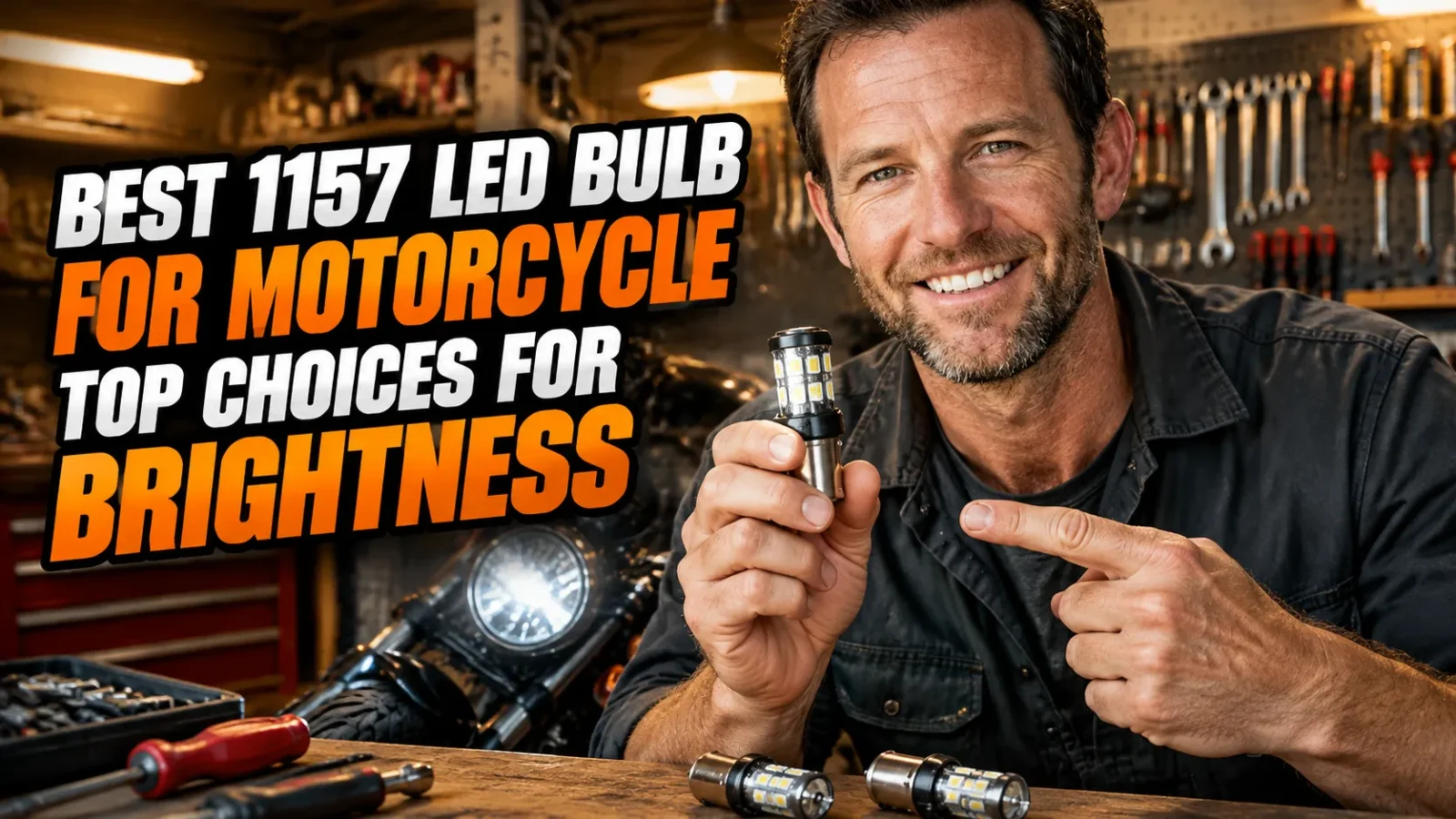
I’ve lost count of how many 1157 bulbs I’ve swapped out on my own bikes. Cruisers, standards, a beat up old Honda, a couple of Harley-adjacent projects — the 1157 socket shows up everywhere, and the stock incandescent bulb is almost always the weakest link in the whole lighting system.
The 1157 (technically a BAY15d) is a dual filament, dual contact bayonet bulb. That means it does two jobs at once: a dim running light and a bright brake or turn signal burst, both from the same socket. When you replace it with an LED, you get more light, less heat, and a lot less current draw on an already strained motorcycle charging system.
That last part matters more than most riders realize. Before you start chasing brightness, it’s worth understanding what’s actually feeding those bulbs. My breakdown of what are the different types of motorcycle batteries ultimate guide covers the whole picture, and it explains why a weak battery makes even a great LED look dim.
Below are the eight 1157 LEDs I’ve actually run, tested, or installed for friends — ranked by how bright they look on the road, not just how big the numbers on the box are.
- My overall brightness pick is the AUXITO 1157 LED — it throws the most usable light I’ve seen from a plug and play bulb.
- If you need zero hyperflash headaches, the LASFIT 1157 has a built in resistor option that just works.
- For a proper beam pattern rather than raw glare, the Philips Ultinon LED 1157 is the most refined choice.
- Match the LED color to your lens — red LED behind a red lens, every single time.
- Cheap LEDs cause hyperflash. Budget for a load resistor or an electronic flasher.
What Actually Makes a 1157 LED Bright on a Bike
Raw lumen claims are marketing. What matters is how much of that light escapes the housing and lands where a driver can see it.
A good 1157 LED fires light sideways and backward, mimicking the filament position of the original bulb so the reflector can do its job. A bad one just blasts light straight out the front and creates a hotspot with no spread.
Chip Type and Count
Most decent bulbs use CSP or 3030 SMD chips. CSP chips are smaller and denser, which usually means better focus inside a reflector. A bulb with 12 cheap SMDs often looks worse than one with 4 good CSP chips.
Heat Management
LEDs hate heat. A bulb with a real aluminum body and actual fins will hold its brightness on a long ride, while a plastic-bodied cheapie will dim noticeably after twenty minutes of brake light use.
Canbus and Resistor Compatibility
Modern bikes monitor bulb resistance. Swap in an LED without a resistor and you’ll get dash warnings or hyperflash. This is the number one complaint I hear from riders.
1. AUXITO 1157 LED Bulb — My Brightest Overall Pick
The AUXITO 1157 is the bulb I recommend first when someone just wants maximum light. AUXITO rates these around 2,800 to 3,000 lumens per bulb in 6000K white, and honestly, they look it.
The body is all aluminum with a proper heat sink, and the dimensions are close to 1:1 with a stock 1157, so it drops straight into most motorcycle housings without modification. I’ve run a set in a cruiser tail light for two seasons with no flicker and no fading.
AUXITO also sells red and amber versions, which is what you actually want. Buy the red one for a red brake lens. Buy the amber for turn signals. Do not buy white and expect it to look right through a colored lens.
Price sits around $20 to $30 for a pair. That’s a fair bit for a bulb, but the output justifies it, and these are built to last tens of thousands of hours.
2. LASFIT 1157 LED Bulb — Best for Killing Hyperflash
LASFIT is my go-to when a rider has already fought the hyperflash battle and lost. Their 1157 LED comes in a version with a built-in load resistor, which means no external wiring, no zip-tied resistor packs, and no flashing like a strobe light.
Output is around 2,000 to 2,400 lumens in 6000K, which is still a massive jump over the stock incandescent. The fit is compact, and LASFIT uses a decent aluminum housing with a fanless passive design.
I installed a set on a friend’s bike that had been throwing a bulb-out warning for weeks. The LASFIT pair cleared it instantly, no relay swap needed. That alone made it worth the ~$25 to $35 asking price.
3. Alla Lighting 1157 LED — Best Value Brightness
Alla Lighting has been making LED bulbs for a long time, and their 1157 BAY15d is one of the most consistent performers in the budget-to-mid range. They advertise around 2,800 lumens with high output CSP chips.
The build quality is genuinely good for the money. Aluminum body, solid solder joints, and a projector-style lens on the tip that helps push light into the reflector rather than scattering it. I’ve had a set running in a rear turn signal position for over a year without a single failure.
They offer white, red, amber, and even a switchback version. Pricing lands around $20 for a pair, sometimes less on sale, which makes them an easy recommendation for someone who wants bright without spending Philips money.
4. Philips Ultinon LED 1157 — Best Beam Pattern and Refinement
Philips does not chase big lumen numbers, and that’s exactly why I like the Ultinon LED 1157. What you get is a properly engineered bulb with a beam pattern that respects the reflector instead of fighting it.
Output is modest on paper — nothing like the 3,000 lumen claims from brands you’ve never heard of. But the light is focused, the color is accurate, and the build quality is what you’d expect from Philips. Longevity is excellent.
They’re also one of the few brands where I’d trust the electrical tolerances on a bike with a sensitive CANBUS system. Expect to pay around $25 to $35 a pair.
If your priority is “looks factory but brighter” rather than “absolutely maximum lumens,” this is the one I’d buy.
5. SYLVANIA ZEVO LED 1157 — Best Off-the-Shelf Option
SYLVANIA ZEVO is what I grab when I need a bulb today and don’t want to wait for shipping. It’s stocked at most auto parts stores, and the 1157R red version is specifically designed for tail and brake applications.
ZEVO bulbs are not the brightest on this list. They’re middle of the road on output. But they come with a 5-year limited warranty, they’re genuinely reliable, and the optical design is tuned for colored lenses.
I keep a spare ZEVO 1157R in my garage at all times. When a buddy’s brake light dies the night before a ride, that’s the one that saves the trip. Around $20 to $25 a pair.
6. JDM ASTAR 1157 LED — Best Switchback Option
JDM ASTAR built its reputation on high-output LED bulbs at reasonable prices, and their 1157 line is a solid example. Around 1,200 lumens, aluminum construction, and a compact footprint that fits tight housings.
The reason I keep coming back to JDM ASTAR is the switchback versions. If your bike uses a 1157 as a front running light that doubles as a turn signal, a switchback bulb gives you bright white on the run and amber on the flash. That’s a huge visibility upgrade.
Pricing is friendly, usually $15 to $20 a pair. Just be aware the switchback models almost always need a resistor to avoid hyperflash.
7. SiriusLED 1157 — Best Budget Bulb That Still Works
SiriusLED is what I’d call the honest budget option. These use 3030 SMD chips and put out somewhere in the 1,000 to 1,500 lumen range depending on the version.
They are not going to blow you away, but they’re dramatically brighter than a tired incandescent, and they cost around $12 to $18 for a pair. I’ve used SiriusLED bulbs in low-priority positions — license plate lights, inner marker lights — with good results.
For a tail light on a bike that lives outdoors and gets abused, the price-to-performance is honestly hard to argue with. Just don’t expect Philips-level beam control.
8. OXILAM 1157 LED — Best Canbus-Friendly Budget Pick
OXILAM’s 1157 is marketed as CANBUS error-free, and in my experience it delivers on that more often than the cheap generic bulbs do. Output is roughly 2,000 lumens in 6000K, with a compact aluminum body.
It’s a nice middle ground: brighter than the budget options, cheaper than AUXITO or Philips, and it plays reasonably well with modern electrical systems. Around $16 to $20 a pair.
One caveat — it still won’t fix every hyperflash case on bikes with older thermal flashers. If you’re on a 1990s machine, budget for a resistor anyway.
Installation and Electrical Notes I Wish I’d Known Earlier
Swapping a bulb is easy. Diagnosing why the new one behaves strangely is where riders get stuck.
Before you blame the bulb, check your battery health. A weak, tired battery makes LEDs flicker and behave unpredictably, and it’s the cause more often than the bulb itself. If your bike is completely dark, my writeup on what to do when a harley lost all electrical power walks through the diagnostic order I actually use.
If you’re doing a proper lighting upgrade, it’s also a smart time to service the battery. Knowing how to remove harley street 750 battery takes about ten minutes and gives you clean terminals to work with.
And if you ride seasonally like I do, a maintainer is non-negotiable. Understanding how does a battery tender work will save you from the springtime no-start ritual.
Also worth knowing: some riders assume switching to a smaller electrical load means they’d be fine with a weaker starting system. Not true. Whether your bike is kickstart vs electric start, the charging system still needs a healthy battery to keep voltage stable for your LEDs.
If you ever have to top up a flat battery in a hurry, don’t guess at the timing. My notes on how long to charge a car battery at 10 amps apply to motorcycle batteries at lower amperage too, and they’ll stop you from cooking a cell.
Quick Hyperflash Fix Checklist
First, confirm the bulb is seated fully and the contacts are clean. Second, check that you bought the correct color for the lens. Third, if it still flashes fast, install a load resistor or switch to an electronic flasher relay.
That’s it. It’s a simpler fix than most riders think, and it costs less than a tank of fuel.
Final Thoughts From Someone Who’s Bought Too Many Bulbs
If you only take one thing from this list, make it this: brightness claims are not equal to road performance. The bulb that looks best on a spec sheet is rarely the one that looks best on your bike at night.
My honest ranking for a typical motorcycle: AUXITO first for sheer output, LASFIT first for hassle-free turn signals, Philips first for purity of beam. Everything else on this list is a solid pick for a specific budget or use case.
And whatever you choose, buy the right color, check your battery, and give the bulb a few heat cycles before you decide it’s a dud. Most of the “bad” LEDs I’ve been handed were simply installed into a tired electrical system.
Frequently Asked Questions
Will a 1157 LED bulb work in my motorcycle’s stock socket?
Yes, as long as your bike uses a BAY15d socket with offset pins and two contacts. The 1157 is a dual filament bulb, so it handles both the running light and the brake or turn signal function. Just check that your housing has enough depth, because some high output LEDs are longer than the original glass bulb.
Why do my turn signals hyperflash after installing LED 1157 bulbs?
LEDs draw far less current than incandescent bulbs, so the flasher relay thinks a bulb is burned out and blinks fast. The fix is a load resistor wired inline, or swapping to an electronic LED flasher relay. Some bulbs, like the LASFIT units, include the resistor built in.
Do I need a red LED behind a red tail light lens?
I always use a red LED behind a red lens. A white LED behind a red lens gets filtered down and loses a huge chunk of its output, so the red version looks far deeper and brighter in the real world.
Are 1157 LEDs actually brighter than stock incandescent bulbs?
Most quality LED replacements put out significantly more usable light, but raw lumens are not the whole story. Beam pattern matters, and a well designed bulb that fires light backward into the reflector will beat a cheap high lumen bulb every time.

Related Articles

Harley Davidson Headlight Problems: What I Learned Fixing Mine in the Dark
Chasing a dead, dim, or flickering Harley headlight? I walk through the real causes, my own diagnostic steps, and the…
Jake Miller
9 min read

Red Oil Light on Your Bike: How Many Seconds Do You Actually Have?
Is it too late when the oil light comes on? After nearly losing an engine to a 30-second delay, here's…
Jake Miller
10 min read

Best HID Kits for Motorcycles: How I Choose the Right One for Night Riding
Wondering which HID kit suits your bike? I break down wattage, color temperature, ballasts, legality, and wiring so you can…
Jake Miller
9 min read