
8 Best H7 Motorcycle Bulbs for Corners: Picks That Light Up Dark Apexes
 Jake Miller
10 min read
Jake Miller
10 min read
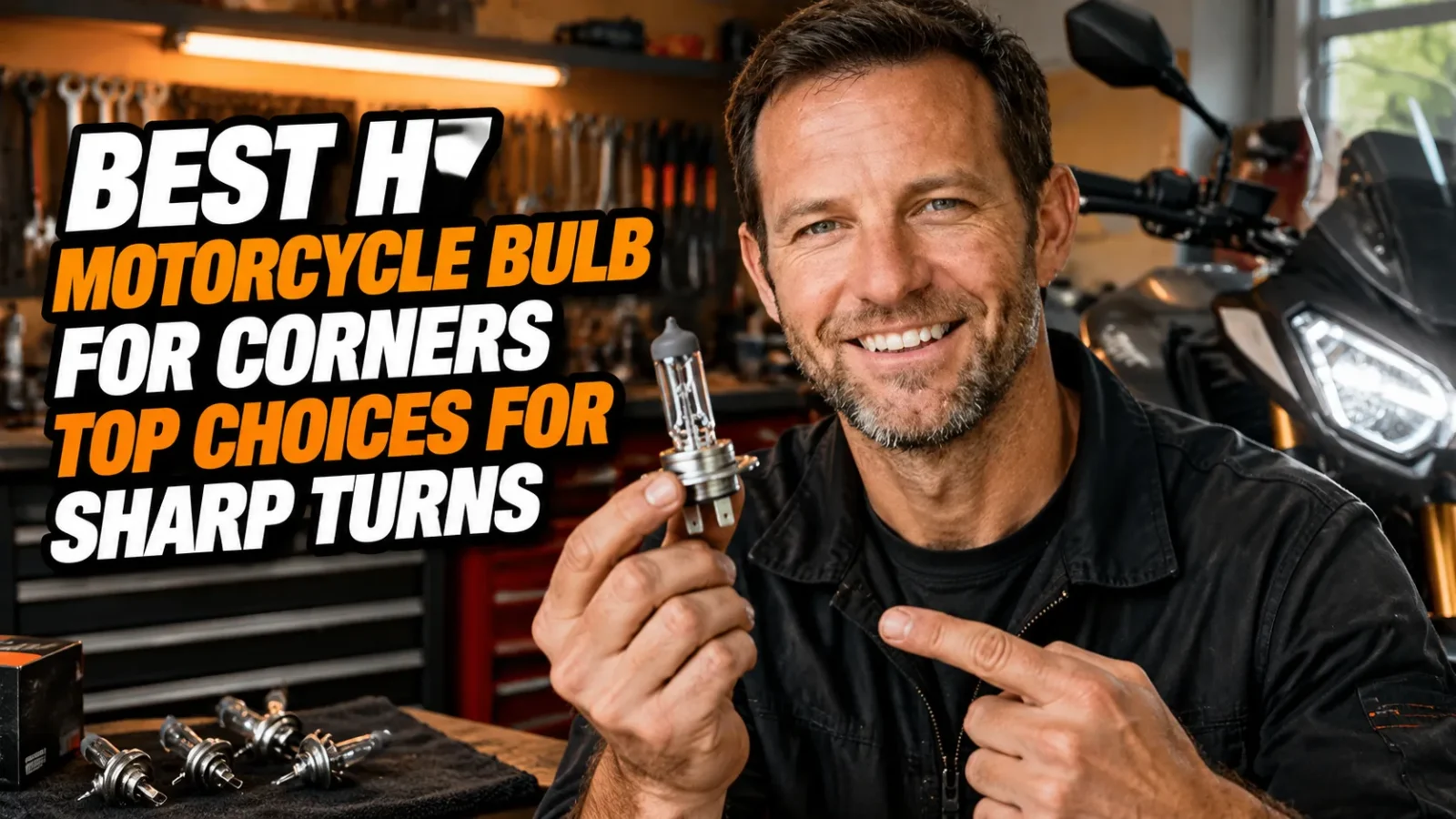
I have replaced the H7 in my own bike more times than I care to count, and every single swap started with the same complaint: the stock bulb lights the road ahead fine, but it lights up nothing inside the corner I am actually turning into.
H7 is one of the most common low beam fittings on motorcycles, from BMW GS twins to KTM singles to a long list of sport tourers and nakeds. It is a small bulb with a big job, and on a dark back road the gap between a cheap replacement and a good one is measured in how much of the turn you can see before you commit.
Below I am sharing the bulbs I have run myself, plus a few I have ridden behind on friends’ bikes, ranked by how they behave specifically on sharp turns. One thing before you buy anything: if your lights are dim because your battery is tired, no bulb will fix it. Start with this guide to what are the different types of motorcycle batteries ultimate guide, then come back.
- My overall halogen pick is the Osram Night Breaker 200 H7, with the Philips RacingVision GT200 a very close second.
- For LED, the only retrofits I genuinely trust are the Osram Night Breaker LED H7 and Philips Ultinon Pro6000, and only where they are road legal.
- Morimoto 2Stroke 3.0 and Diode Dynamics SL1 win on beam pattern where legality is not your priority.
- Beam pattern beats brightness every time. A scattered beam is worse in a corner than a good halogen.
- Aim the headlight before you spend a cent on bulbs.
1. Osram Night Breaker 200 H7 — My Overall Pick for Dark Corners
If you are staying with halogen, this is the bulb I recommend first. Osram rates the Night Breaker 200 H7 at up to 200% more brightness than a standard halogen, with a beam that reaches noticeably further down the road.
That extra throw is exactly what matters in a corner. On my own bike the difference showed up at corner entry, not on the straights, because I could pick up the apex and the exit earlier instead of riding into a black hole for half a second.
The color is a crisp white rather than the yellow of a stock bulb, which makes road markings, gravel and standing water pop out at night. It is a genuine upgrade you can feel on the first ride.
What It Costs You in Maintenance
Expect to pay roughly $35 to $45 for a pair. The catch is lifespan, and it is a real one: Osram quotes around 250 hours, so if you commute daily you will be buying these more often than a $6 long-life bulb.
I still think it is worth it. A bulb that shows me the corner is cheaper than a lowside, and I would rather change a bulb once a year than guess at apexes every night.
2. Philips RacingVision GT200 H7 — Brightest Road-Legal Halogen I Have Used
Philips claims up to 200% more brightness than a standard bulb for the RacingVision GT200, and it is ECE homologated, so it is road legal in a halogen housing. In my experience it is right there with the Osram for sheer output.
What I like on twisty roads is how even the spread is. It is not just a bright hotspot in the middle; there is usable light spilling toward the edges of the lane, which is what saves you when a corner tightens unexpectedly.
Price is around $40 to $50 per pair. Like every high-output halogen, life expectancy is on the short side, and vibration from a stiffly sprung bike will shorten it further.
If your bike runs a projector low beam, this bulb pairs beautifully with it. The sharp cutoff means you get the brightness without cooking oncoming drivers.
3. Osram Night Breaker LED H7 — Best Road-Legal LED Retrofit
This is the LED I recommend to anyone who wants modern light output without going fully illegal. The Night Breaker LED H7 runs around 6000K, produces roughly double the light of a halogen, and comes with a small external driver box.
It is road legal in markets where the approval exists, which in practice means Germany and a handful of other countries, and only for the specific vehicle models Osram lists. Everywhere else it is off-road use only, so check before you fit it.
Once fitted, the difference on a dark road is dramatic. Full brightness is instant, there is no filament to shake apart on rough tarmac, and the white light makes the far side of a bend much easier to read.
The Electrical Bonus Nobody Talks About
An LED like this draws a fraction of the current a 55W halogen pulls. That matters on older machines with weak charging systems, and it is the same reason machines that still rely on a lever instead of a button have their own quirks (there is a good breakdown of kickstart vs electric start if you ride something old).
Expect to pay roughly $110 to $140 per pair. I have run mine for two seasons without a single flicker.
4. Philips Ultinon Pro6000 LED H7 — Best Legal LED Alternative
Philips takes the same approach as Osram here: a proper retrofit with a real approval list rather than a generic eBay special. The Ultinon Pro6000 runs around 5800K, claims up to 200% more brightness, and uses active cooling to keep the emitter stable.
In corners, the extra reach is the selling point. I rode a friend’s bike with these fitted and the beam carved a clean, wide arc through a set of tight switchbacks, with no dark gap on the inside of the turn.
Pricing sits around $130 to $170 per pair, and you often need a specific adapter or a deeper dust cap on a motorcycle housing. Measure your clearance before ordering, because the fan housing is taller than a halogen base.
Legality works the same way as the Osram: check the approved vehicle list for your country before you fit them and ride on the road.
5. Morimoto 2Stroke 3.0 H7 — Best Beam Pattern for Projector Housings
Morimoto does not chase big lumen numbers, it chases beam accuracy, and it shows. The 2Stroke 3.0 uses a compact base and a carefully positioned emitter to mimic where a halogen filament actually sits inside the reflector.
That is exactly why it works in corners. Instead of a shotgun blast of light, you get a defined cutoff and a beam that lands where the housing was designed to throw it, so the inside of the turn stays lit instead of glowing with glare.
Price is roughly $130 to $160 per pair, which is not cheap, and it is not road legal in most markets. If you have already converted to a projector or run a housing that tolerates LEDs well, this is the one I would fit.
The compact driver also fits behind tight motorcycle fairings, which is more than I can say for a lot of LED kits.
6. Diode Dynamics SL1 H7 — Best Premium LED With Honest Specs
Diode Dynamics builds the SL1 in the United States, rates it around 1,600 lumens, and backs it with a multi-year warranty. That figure is far below the five-figure claims on budget bulbs, and that honesty is part of why I trust it.
The design goal is a focused beam with a clean cutoff. On a twisty road that translates into light exactly where you want it, with side spread that picks up the lane edge instead of flooding the trees.
Expect to pay around $160 to $200 per pair, making it the most expensive pick on this list. It is also the one I would hand to a rider who wants to fit a bulb once and forget about it.
The base is compact, so it fits in housings where bigger LED kits simply will not go. Colors are around 6000K, which reads white without tipping into blue.
7. Auxito H7 LED — Best Budget LED if You Accept the Trade-Offs
If you want to try LED for the price of a decent halogen pair, Auxito is the name I see most often, usually around $25 to $40 for a set. They are bright, cool white, and they draw less current than the bulbs they replace.
Here is my honest take after fitting a set to a friend’s commuter: the light output is real, but the beam is not as tightly controlled as the premium options. In a plain reflector housing it scatters, which sends light into the trees and into oncoming eyes.
Several Auxito models have a rotating collar so you can clock the emitter to match the housing. Take the time to do that, because it is the difference between a usable beam and a mess.
Lumen claims on the box are fantasy, so ignore them. Judge the bulb by how it lights the road on a dark night, not by what the packaging promises.
8. PIAA Xtreme White Plus H7 — Best Crisp White Halogen
PIAA has been making the Xtreme White Plus in Japan for years, and it remains my pick for riders who want a whiter light without going LED. It runs around 4000K and PIAA markets it as producing 110W of equivalent output from a 55W draw.
On the road it looks noticeably cleaner than a stock bulb, and the whiter tone helps contrast on broken tarmac and gravel-strewn corners. It will not out-throw the Osram or Philips, but it is close enough to matter.
Price sits around $70 to $90 per pair, which is steep for a halogen. Lifespan is shorter than a standard bulb as well, so treat it as a consumable rather than a lifetime purchase.
For a rider who hates the blue tint of cheap LEDs but wants something brighter than stock, this is the middle ground I recommend.
Before You Swap: Cornering Notes From My Own Mistakes
I have wasted money on bulbs that turned out to be fine, and I have also blamed bulbs for problems that had nothing to do with them. Here is what I check now before buying anything.
Aim First, Then Buy
A correctly aimed stock bulb beats a badly aimed premium one every time. Load the bike the way you actually ride it, set the cut off properly, and only then decide whether you need more output.
Your Charging System Matters More Than You Think
Dim lights are often a voltage problem, not a bulb problem. I once chased a weak headlight for a week before realizing the real culprit was the bike’s charging circuit, and if you have ever had a harley lost all electrical power moment at night, you know how quickly that goes from annoying to dangerous.
Before a long night ride I top the battery up, because the same math behind how long to charge a car battery at 10 amps applies to a motorcycle battery: charge rate and time matter, and a rushed top up leaves you short.
If you need to get at the battery to test it, some models hide it well. There is a step-by-step on how to remove harley street 750 battery that shows the kind of access you are dealing with on a lot of modern bikes.
Winter Storage Will Kill a Bulb’s Reputation
Half the riders who tell me their new bulb “went dim” actually left the bike sitting for three months. If you store your bike seasonally, learn how a maintainer works with this explainer on how does a battery tender work, and your lighting will be consistent every spring.
Fit a good bulb, aim it properly, and keep the battery healthy. Do those three things and sharp turns at night stop being a guessing game, which is really all any of us want.
Frequently Asked Questions
Can I put an LED H7 bulb in my motorcycle’s halogen housing?
Physically, yes, but legally and optically it depends. Some LED retrofits like the Osram Night Breaker LED H7 are approved for road use in specific markets and only for the vehicle models on the manufacturer’s list. In a plain reflector housing, most LED bulbs scatter light and blind oncoming traffic, so check your local rules and your housing type first.
Are brighter H7 halogen bulbs actually worth it for night cornering?
In my experience, yes. A premium halogen like the Osram Night Breaker 200 or Philips RacingVision GT200 throws noticeably more usable light down the road than a standard bulb, which means you see deeper into the corner. The trade off is a shorter lifespan of roughly a few hundred hours.
Do LED H7 bulbs drain a motorcycle battery faster than halogens?
No, usually the opposite. A typical H7 halogen draws about 55 watts, while most LED replacements draw 20 to 30 watts, so your charging system works less. If your lights are dim because the battery is weak, read this motorcycle battery guide before blaming the bulb.
Why does my headlight look bright but not light up corners?
That is almost always a beam pattern problem, not a brightness problem. Scattered light looks impressive against a garage wall but goes everywhere except the road. Aim the headlight properly, and choose a bulb with a sharp cutoff and good side spread for cornering.

Related Articles

Harley Davidson Headlight Problems: What I Learned Fixing Mine in the Dark
Chasing a dead, dim, or flickering Harley headlight? I walk through the real causes, my own diagnostic steps, and the…
Jake Miller
9 min read

Red Oil Light on Your Bike: How Many Seconds Do You Actually Have?
Is it too late when the oil light comes on? After nearly losing an engine to a 30-second delay, here's…
Jake Miller
10 min read

Best HID Kits for Motorcycles: How I Choose the Right One for Night Riding
Wondering which HID kit suits your bike? I break down wattage, color temperature, ballasts, legality, and wiring so you can…
Jake Miller
9 min read