
8 Best Halogen Bulbs for Motorcycle Headlights I’ve Actually Run at Night
 Jake Miller
11 min read
Jake Miller
11 min read
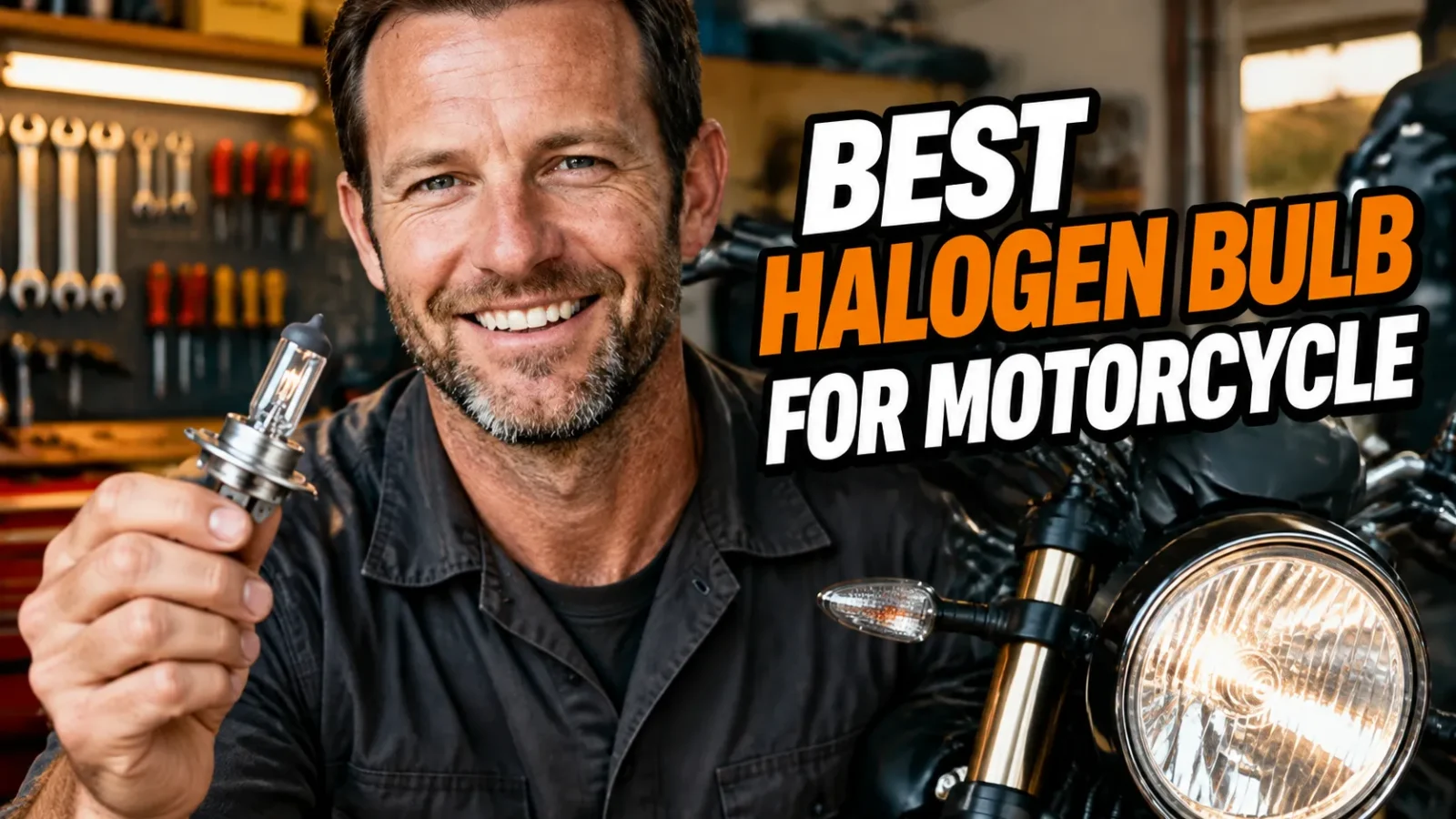
I’ve melted a reflector, cooked a stator, and spent more evenings than I care to admit crouched over a front wheel with a torch in my teeth, swapping a headlight bulb on the side of a road. Motorcycle halogen bulbs are one of those “five minute” upgrades that turn out to be anything but, mostly because there’s a lot of marketing noise around brightness claims and not much honest talk about what actually works on a bike.
Here’s the thing most riders miss: on a motorcycle, a bulb isn’t just a bulb. It’s bolted to something that vibrates constantly, gets rained on, and draws from a charging system that’s often barely keeping up at idle. A bulb that’s brilliant in a car can die in three weeks on a thumper.
If your charging system is already on the edge — and honestly, most of these bulbs are pulling from the same tired battery — it’s worth brushing up on what are the different types of motorcycle batteries ultimate guide before you start chasing watts. A weak battery makes even the best bulb look dim.
So this is my real-world list. Eight bulbs, all of them actual products I’ve either run personally or fitted for friends, ranked by what I’d actually put in my own bike.
- Best overall: Osram Night Breaker Laser H4 — the brightest drop-in I’ve used without touching the wiring.
- Best motorcycle-specific: Philips X-tremeVision Moto — built to survive vibration, not just look bright on a spec sheet.
- Best budget: Philips Vision Moto — cheap, tough, and a genuine upgrade over a bargain-bin bulb.
- Best long-life pick: PIAA Night Tech — less eye-searing, but it keeps working season after season.
- Skip: 100W “off road” bulbs unless you’ve upgraded relays and your reflector can take the heat.
1. Osram Night Breaker Laser H4 — Best Overall
If you only take one recommendation from this whole article, make it this one. The Osram Night Breaker Laser is the bulb I keep coming back to, and it’s the one I’ve fitted to three of my own bikes over the last few years.
Osram claims up to 150% more brightness than the minimum legal standard, plus a beam that reaches up to 150 metres further down the road. On my naked bike, the difference between this and a generic parts-store bulb was immediately obvious — road signs lit up a good 30 or 40 metres earlier, and the light had a slightly whiter, cleaner tone.
What I like about it
The brightness is genuine, not just a colour temperature trick. It’s a standard 60/55W H4, so it’s a true drop-in — no relay kit, no ballast, no CANBUS nonsense. It’s also road legal across Europe and widely available in the US.
Osram also makes it in H7, H11, and a few other bases, so if your bike doesn’t take an H4 you’re probably still covered.
What I don’t like
Lifespan. You’re trading filament life for output, and that’s just physics. I’ve had one last nearly two years and another go in about eight months. Buy two pairs and keep a spare under the seat — I do.
Expect to pay roughly $25 to $35 for a pair. Worth every cent.
2. Philips X-tremeVision Moto H4 — Best Motorcycle-Specific Bulb
This is the one I recommend to anyone whose bike does a lot of miles in bad weather. Philips builds the X-tremeVision Moto specifically for motorcycles, which means a reinforced filament designed to shrug off the constant vibration that kills ordinary car bulbs.
Philips rates it at up to 100% more light than a standard bulb, with a beam that’s noticeably wider at the edges than the Osram. I ran a pair through a full winter of commuting on a single-cylinder bike — the worst possible vibration environment — and neither failed.
It’s a 60/55W H4, road legal, and sits in the $20 to $30 range for a pair. The light colour is a warm white, not a fake-blue, which I actually prefer in fog and rain because it doesn’t wash out in wet tarmac.
If you ride a bike with a buzzy engine, this is my pick over the Osram for one simple reason: it survives.
3. Osram Night Racer 110 — Best for High-Vibration Singles
The Night Racer 110 is Osram’s motorcycle-focused line, and it sits in a slightly different spot than the Night Breaker. The claim is up to 110% more light and a beam roughly 40 metres longer than standard, but the headline for me is the vibration resistance.
It’s available in H4, H7, and HS1 — that last one matters, because HS1 is what a lot of smaller-displacement and older bikes use, and premium options are thin on the ground for that base.
I fitted a Night Racer 110 to a friend’s 250 single after she’d gone through two cheap bulbs in a season. It’s been in there over a year now. Not the absolute brightest bulb on this list, but the balance of output and durability is excellent.
Around $25 to $35 a pair, which is fair for something purpose-built for two wheels.
4. PIAA Night Tech H4 — Best for Longevity and Hard Use
PIAA is the brand I reach for when someone tells me they’re sick of replacing bulbs. The Night Tech H4 runs at a standard 60/55W but PIAA rates the output at roughly 110/100W equivalent, which sounds like marketing until you actually ride behind it.
The colour temperature is around 4000K — noticeably whiter than stock without tipping into that blue, glare-heavy look that’s useless in rain. Beam pattern is clean and well controlled.
The real selling point is durability. PIAA uses a heavier filament and better internal support, and it shows. I’ve had a set in a bike that lives outside, uncovered, through two winters, and both bulbs are still going.
The catch is price. Expect $50 to $70 for a pair, which is double most of this list. If you’d rather fit once and forget, that math works out.
5. Philips Vision Moto H4 — Best Budget Pick
Not everyone needs the brightest bulb on the shelf. The Philips Vision Moto is the one I put in bikes I’m flipping, loaning out, or just want a solid, honest bulb in without spending real money.
Philips rates it at up to 30% more light than a basic bulb, with the same motorcycle-specific vibration resistance as the X-tremeVision Moto. That’s the important part — it’s built for a bike, not borrowed from a car catalogue.
You’re looking at roughly $12 to $18 for a pair. It’s a genuinely meaningful upgrade over the no-name bulb that came in your bike, and it lasts far longer than the high-output options.
If your budget is tight, this is the bulb I’d buy over any mystery-brand “super white” bulb on a marketplace site. Those are a lottery, and I’ve seen the filaments fail spectacularly.
6. Sylvania SilverStar Ultra H4 — Best If You’re in the US
Availability matters, and if you’re in the States, Sylvania is on the shelf at every auto parts store. The SilverStar Ultra is the top of that line — up to 100% brighter than a standard bulb, with a whiter output than the base SilverStar.
Being DOT-compliant and easy to find is genuinely valuable when a bulb blows on a Sunday afternoon before a trip.
It’s not my favourite on this list, and I’ll be honest about why: lifespan is short, noticeably shorter than the PIAA or the Philips Moto options in my experience. And the light is white enough that it can feel glary in heavy rain.
That said, it’s around $30 to $40 a pair and you can have it in your hand in twenty minutes.
7. Osram Silverstar 2.0 H4 — Best Value Long-Life Bulb
If the Night Breaker Laser sounds appealing but you can’t stomach replacing it twice a year, the Silverstar 2.0 is the sensible middle ground. Osram quotes up to 60% more light than standard, which is a real, usable gain without pushing the filament to its limit.
I ran a pair of these for well over two years on a commuter bike, and they were still working when I sold it. The light colour is a clean white, close to the Night Breaker, just with less punch at the far end of the beam.
Price sits around $18 to $25 for a pair. For a rider who does big miles and doesn’t want to think about bulbs, this is the one I’d hand them.
8. PIAA Xtreme White Plus H4 — Best Whitest Halogen Look
Some riders just want the look, and I get that. The PIAA Xtreme White Plus runs at a standard 60/55W but produces a 4000K white output that looks dramatically cleaner than a warm stock bulb, with PIAA claiming roughly 110/100W equivalent light.
It’s the most expensive bulb on this list at $60 to $80 a pair, and honestly, the performance gain over the Night Tech isn’t huge. What you’re paying for is the colour and the PIAA build quality.
I’ll be straight with you: if you’re buying purely for usable light, skip this and buy the Night Breaker Laser or the X-tremeVision Moto. If you want the whitest halogen beam you can get without going LED, this delivers.
What I Actually Check Before Buying a Halogen Bulb
Fitment and base type
H4 is by far the most common motorcycle headlight base, but it’s not universal. Older and smaller bikes often use HS1 or BA20d, and many modern sportbikes use H7. Pull your bulb and look at the base before ordering anything, because a “best” bulb in the wrong base is useless.
Wattage, heat, and your charging system
Stick to the stock wattage. A 100W off-road bulb sounds tempting, but it pulls nearly double the current, generates serious heat, and will happily melt a plastic reflector or cook your stator. Standard 60/55W premium halogens give you most of the benefit with none of that risk.
Before you upgrade anything, make sure your battery is actually healthy. A halogen bulb’s output drops directly with voltage, so a tired battery means dim light no matter what you fit. If you’re doing the work yourself, knowing how to remove harley street 750 battery gives you a good sense of what’s involved on a typical bike, and it’s worth understanding how does a battery tender work if your bike sits for weeks at a time.
The same principle applies to other vehicles in your garage. If you’ve ever wondered how long to charge a car battery at 10 amps, the short answer is that a deeply discharged battery needs hours, and motorcycle batteries are just smaller versions of the same chemistry.
And if you ever switch the key and get nothing at all — no lights, no crank — that’s a separate problem. Here’s what to check when your harley lost all electrical power, because a blown main fuse looks exactly like a dead bulb from the saddle.
Riders on older bikes
If you’re on a vintage machine with a kick lever, your charging system is likely the limiting factor, not the bulb. The trade-offs between kickstart vs electric start setups are worth understanding, because bikes with minimal charging output often can’t keep up with a headlight plus anything else running at once.
Colour temperature vs usable light
Higher Kelvin numbers do not mean more light. A 6000K bulb looks blue and modern but throws less usable light on wet tarmac than a 4000K one. Every bulb on this list is between roughly 3500K and 4000K, which is deliberate — that’s the sweet spot for actually seeing at night.
Lifespan expectations
Accept that brightness and longevity trade off. If you want a bulb that lasts, buy the Silverstar 2.0 or the PIAA Night Tech. If you want maximum light, buy the Night Breaker Laser and keep a spare.
My Final Take
After all the swapping, melting, and roadside frustration, my pick is still the Osram Night Breaker Laser H4. It’s the best balance of usable light, cost, and drop-in simplicity I’ve found, and it’s the bulb I recommend to friends without hesitation.
But if your bike buzzes like a paint shaker, buy the Philips X-tremeVision Moto instead. And if you just want light that keeps working, the PIAA Night Tech is worth the extra money.
Whatever you choose, check your battery first. A great bulb behind a weak battery is just an expensive dim light.
Frequently Asked Questions
Are halogen bulbs still worth upgrading on a motorcycle?
Yes. A good halogen like the Osram Night Breaker Laser or Philips X-tremeVision Moto is a true drop-in swap that works with your stock wiring, draws the same wattage, and adds real usable light for well under $40 a pair. LED conversions are brighter on paper but often need a driver box, can flicker on older charging systems, and are not street legal in every jurisdiction.
What is the brightest halogen bulb I can put in a motorcycle?
For a standard 60/55W H4 socket, the Osram Night Breaker Laser and Philips X-tremeVision Moto are the brightest options I have run. Both claim roughly 100 to 150 percent more light than a basic bulb. Avoid 100W off road bulbs unless you have upgraded relays and a headlight that can handle the heat.
Will an upgraded halogen bulb melt my motorcycle headlight?
Not if you stay at the stock 60/55W rating. Melting happens when riders fit 100W bulbs into plastic reflectors, or when a bigger bulb is combined with a weak charging system. Check your stator output and keep your battery healthy, and a standard wattage premium halogen is safe.
How long do premium halogen bulbs last?
Expect six months to two years of regular riding from the brightest options. Bulbs that chase maximum output run their filaments hotter, so they trade lifespan for light. If you want long life, the Osram Silverstar 2.0 and PIAA Night Tech are better bets than the outright brightest picks.

Related Articles

Harley Davidson Headlight Problems: What I Learned Fixing Mine in the Dark
Chasing a dead, dim, or flickering Harley headlight? I walk through the real causes, my own diagnostic steps, and the…
Jake Miller
9 min read

Red Oil Light on Your Bike: How Many Seconds Do You Actually Have?
Is it too late when the oil light comes on? After nearly losing an engine to a 30-second delay, here's…
Jake Miller
10 min read

Best HID Kits for Motorcycles: How I Choose the Right One for Night Riding
Wondering which HID kit suits your bike? I break down wattage, color temperature, ballasts, legality, and wiring so you can…
Jake Miller
9 min read